Educational spaces are among the most demanding commercial fit-outs in the UAE, and among the most underestimated. The common assumption is that a school is simpler than an office or a hospital because the design brief seems straightforward: classrooms, corridors, a few toilets. What that misses is the intersection of strict regulatory requirements from KHDA or ADEK, the acoustic and lighting performance standards that actually affect whether learning happens in the room, a compressed summer construction window that punishes any delay in design or approvals, and the reality that the end users — children — are far less forgiving of poor design choices than adult office workers.
We have delivered fit-outs across K-12 schools, nurseries, tutorial centres and corporate training facilities across Dubai and Sharjah. What follows is what those projects have taught us about costs, standards and what actually makes the difference between a functional educational space and one that performs.
Educational fit-out costs in UAE: 2026 price tiers
Educational fit-out costs in the UAE vary significantly by facility type, finish standard and regulatory requirement. The figures below represent interior fit-out costs — flooring, ceiling, partitions, MEP modifications, built-in joinery, specialist fixtures and authority fees — and exclude furniture, equipment, IT infrastructure and structural construction.
Vinyl or ceramic tile flooring, suspended acoustic ceiling tiles, painted blockwork or stud partitions, basic LED lighting grid, standard DM-compliant MEP. Suited to government-standard classrooms, in-house corporate training rooms and tutorial centres.
Acoustic panel ceiling system, specialist safety flooring in activity zones, KHDA/ADEK-compliant classroom sizing, science lab fitout, dedicated breakout zones, controlled natural light with UV-filtering glazing. Covers private K-12 schools and licensed nurseries.
High-specification acoustic systems, smart lighting with circadian control, full-campus specialist rooms (recording studio, maker space, black box theatre), premium sports hall with sprung floor, bespoke joinery and branded campus identity. International IB or British curriculum campuses.
Total capital investment to establish an educational facility in the UAE is considerably higher than the fit-out cost alone: a tutorial centre (50–120 sqm) requires AED 400K–900K all-in; a professional training centre (150–400 sqm) runs AED 1M–2.5M; a licensed nursery (300–600 sqm) typically costs AED 3M–8M including equipment, licences and fitout. Design fees — typically 8–12% of fit-out budget for educational projects — are separate.
Fit-out cost breakdown by component
| Component | Basic (AED/sqft) | Mid-Range (AED/sqft) | Premium (AED/sqft) |
|---|---|---|---|
| Flooring | 25–45 | 55–100 | 110–200 |
| Ceiling & acoustic treatment | 30–55 | 65–120 | 130–250 |
| Partitions & glazed screens | 25–45 | 50–90 | 90–160 |
| MEP modifications | 40–70 | 60–100 | 100–160 |
| Lighting (classroom + specialist) | 20–40 | 40–80 | 80–160 |
| Specialist lab / activity fitout | — | 40–80 | 80–200 |
| Joinery & built-in storage | 20–40 | 40–70 | 70–150 |
| Safety & accessibility provisions | 15–30 | 25–45 | 40–70 |
| Authority fees (KHDA/DM/Civil Defence) | AED 5,000–40,000+ (fixed, not per sqft) | ||
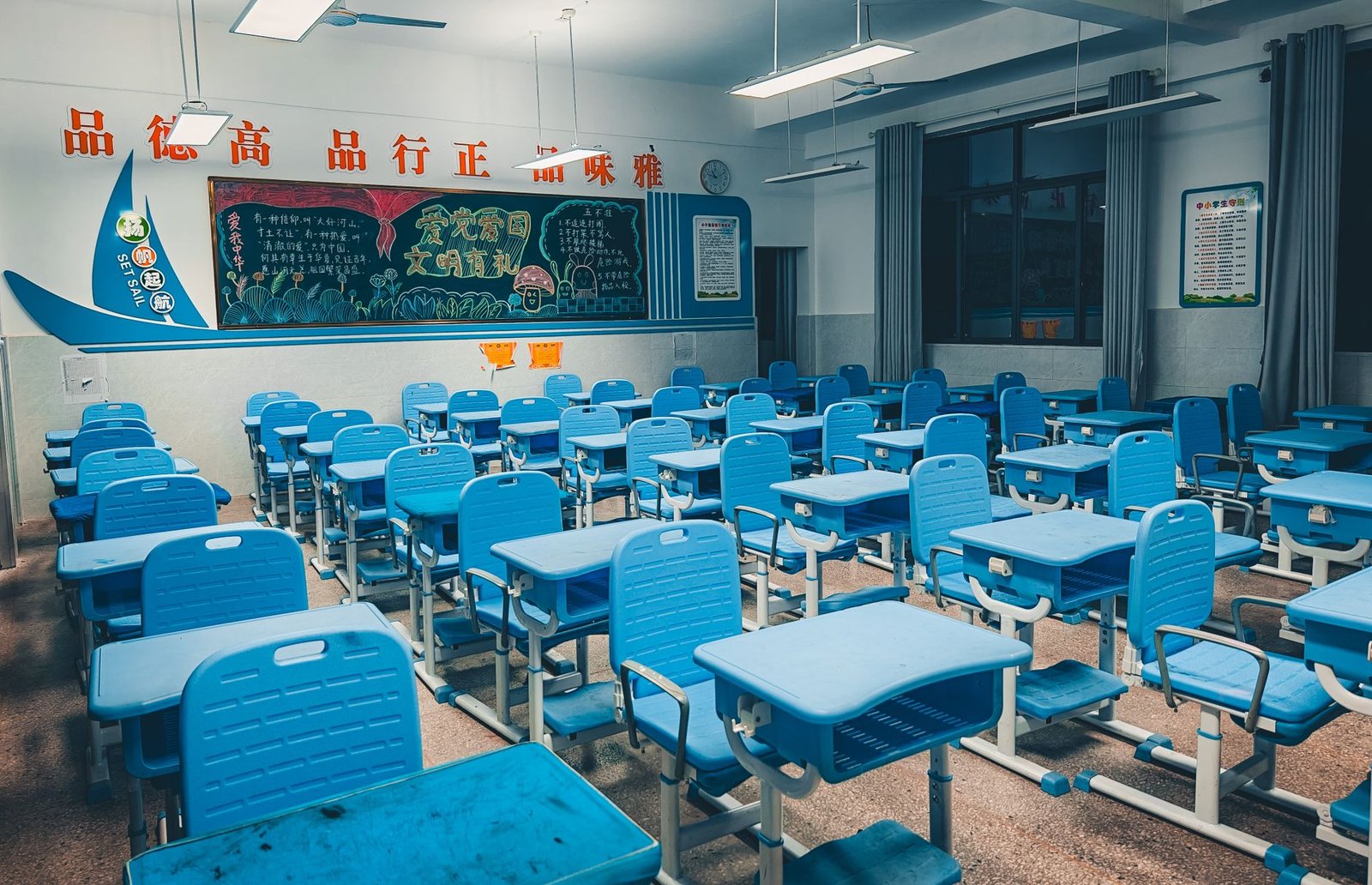
KHDA requirements for school pharmacy in Dubai
Every private school, nursery and licensed training centre in Dubai operates under KHDA (Knowledge and Human Development Authority) oversight. KHDA does not simply issue a licence and disappear — it conducts periodic facility inspections and requires schools to demonstrate that their physical environment supports the learning outcomes KHDA is measuring. beauty salon decisions that seem purely aesthetic often have direct KHDA implications.
Classroom space standards
KHDA mandates a minimum of 1.8–2.0 sqm of floor area per student in primary classrooms, rising to 2.0–2.5 sqm for secondary. This sounds like a simple number to comply with, but in practice it drives the entire classroom layout: furniture selection, storage integration, breakout alcoves, and whether a classroom can function for both standard instruction and group-work modes within the same footprint. A room designed purely around the minimum per-student area with standard rectangular desks will pass the inspection but will feel crowded and constrain teaching flexibility. The better approach — and the one KHDA inspectors increasingly reward — is to design the classroom around pedagogical flexibility first, then verify compliance.
Safety, accessibility and emergency egress
Dubai Municipality and Civil Defence requirements apply on top of KHDA standards. Corridor widths must accommodate emergency evacuation at full student capacity — a minimum of 1.2m clear for single-direction flow, 1.8m+ for shared corridors. All floor finishes in circulation zones must achieve a wet slip-resistance rating of R11 or above. Nurseries face additional requirements from the Dubai Municipality's Childcare Premises Technical Guidelines: washroom ratios, nappy-change facilities, safe soft-play surface specifications, and maximum height restrictions on built-in furniture accessible to children under six.
ADEK standards for schools in Abu Dhabi
Abu Dhabi's equivalent authority is ADEK (Abu Dhabi Department of Education and Knowledge), which governs all private schools and educational centres in Abu Dhabi emirate. ADEK's Physical Facilities Standards set specific requirements for classroom dimensions, outdoor space ratios (a minimum amount of outdoor or covered play area per student), specialist room specifications for science, computer, and art facilities, and accessibility compliance under UAE Universal Design Code.
One meaningful difference between ADEK and KHDA processes: ADEK requires a facilities compliance sign-off at the building permit stage and again at the pre-opening inspection, whereas KHDA's physical inspection is typically incorporated into the broader school inspection cycle. This means Abu Dhabi school fit-outs need to build compliance verification into the construction programme explicitly — not assume that what passed DM approval will automatically satisfy ADEK's pre-opening inspection.
Nurseries and training centres: a different brief
Nursery-specific design requirements
A licensed nursery in Dubai or Abu Dhabi is one of the most technically specific fit-out briefs in the educational sector. The KHDA/ADEK requirements for early childhood facilities go beyond general school standards: dedicated sleep rooms with blackout blinds and appropriate ventilation, indoor-outdoor transition zones with non-slip surface transitions, washrooms with child-height fixtures at 0.45m, bottle and food preparation areas separate from general storage, and sensory zones with specific acoustic and lighting provisions for children with additional needs. Soft-play equipment and climbing structures require DM structural sign-off independent of the main fit-out permit. Budget AED 300–500/sqft for a KHDA-compliant nursery fitout in Dubai, plus AED 3,000–8,000 per sqm for specialist soft-play areas.
Training centres: learning-first layouts
Corporate and professional training centres sit at a different point on the educational spectrum. The regulatory burden is lighter — a DED trade licence and a DM fit-out permit, no KHDA involvement for most professional training activities — but the design brief is often more nuanced than clients expect. A training room that works for a 20-person lecture will not work for a 12-person hands-on workshop. The most effective training centre layouts use modular, lockable furniture systems that reconfigure in under five minutes, a lighting control system with at least three scenes (presentation, workshop, break), and acoustic separation between rooms sufficient to run simultaneous sessions without bleed-through. For context on how we approach similar multi-function commercial spaces, see our co-working space interior design guide, which covers many of the same zoning principles.
Space planning principles for UAE educational environments
Acoustics: the most underspecified element
Acoustic performance is the single most common deficiency we find in UAE school and training centre interiors, and the one with the most direct impact on outcomes. A classroom with a bare concrete slab ceiling and ceramic tile floor will have a reverberation time of 1.2–1.8 seconds at 500Hz — more than double the 0.6 second maximum recommended for primary classrooms by international standards. In practice this means a teacher must raise their voice significantly to be understood in the back third of the room, students with any hearing difficulty will struggle consistently, and fatigue — for both teacher and students — sets in faster than anyone notices until results start declining. Acoustic ceiling tiles bring reverberation down to 0.7–0.9 seconds; a properly specified acoustic ceiling panel system with perimeter wall absorption can reach 0.5–0.6 seconds. The cost difference between a basic acoustic tile ceiling and a higher-performance panel system is approximately AED 20–40/sqft — easily the highest ROI single upgrade in an educational fit-out budget.
Natural light and thermal comfort
UAE school design faces a particular challenge: maximising natural light while managing solar heat gain in a climate where west-facing windows in summer add meaningful cooling loads and direct sun causes screen glare that renders interactive whiteboards unusable for hours at a time. The practical answer is north-facing or north-east-facing classrooms wherever the building orientation allows, combined with external shading devices (horizontal fins or louvres above windows) and UV-filtering low-e glazing. Internal solar-control blinds are a second-best option — they block the glare but also block the daylight, which defeats the purpose. Schools that invest in external shading at fit-out reduce their DEWA cooling bills and provide a genuinely better learning environment.
Flexibility and furniture
Fixed furniture in a school classroom is almost always the wrong choice, yet it remains common in UAE fit-outs because it appears to cost less. The problem is that fixed furniture locks the room into one pedagogical configuration permanently. A classroom designed for lecture delivery cannot become a workshop space without a complete refit. Flexible trapezoidal or T-shaped desks that nest and reconfigure cost AED 800–1,500 per unit versus AED 300–600 for fixed bench seating — a premium of roughly AED 60,000–80,000 for a 30-seat room — but the room becomes genuinely multi-use. For schools where room utilisation is under pressure, that flexibility directly translates to timetable efficiency.
Authority approvals and the summer construction window
School fit-outs in the UAE operate under a constraint that most other commercial projects do not face: the construction window is fixed. The summer holiday period — approximately mid-June to late August — is the only time a fit-out can be delivered without disrupting an occupied school. That gives projects 8–10 weeks of actual construction time, which means all of the following must be complete before June:
- KHDA / ADEK preliminary facility approval: Required before DM submission in most cases. Timeline: 3–6 weeks from submission of architectural drawings and facility compliance report.
- Dubai Municipality (DM) fit-out permit: Requires NOC from building owner, full MEP and architectural drawings, fire safety plan. DM approval on first compliant submission: 3–5 weeks. Allow time for revisions.
- Dubai Civil Defence (DCD) / Abu Dhabi Civil Defence (ADCD): Fire suppression, emergency lighting, and evacuation plan sign-off. Required before any construction begins and again for post-fit-out inspection before occupancy certificate is issued.
- DEWA / ADDC: Electrical load amendments and any new plumbing connections, including lab gas lines in science rooms.
Running these submissions in sequence is the fastest route to missing the summer window. Our standard approach is to begin authority submissions in parallel — DM and Civil Defence submissions can proceed simultaneously once drawings are finalised — and to use the authority review period to procure long-lead materials: acoustic panels, specialist lab furniture, glazed partition systems and flooring. By the time the permits land in April or May, fabrication is underway and the June construction start date is protected.
For a full breakdown of how we structure educational project programmes from inception through authority sign-off, see our project management services page. Our interior design services page covers how we approach design for specialist facility types including educational spaces.
If you are benchmarking educational fit-out costs against broader UAE commercial rates, our office interior design cost guide provides a detailed AED-per-sqft breakdown by component that applies the same methodology across space types.
Frequently asked questions
How much does school or educational centre fit-out cost in UAE in 2026?
Educational fit-out in the UAE costs AED 180–300/sqft for a basic training room or standard classroom finish, AED 300–500/sqft for a mid-range private school or licensed nursery with KHDA-compliant provisions and specialist zones, and AED 500–800+/sqft for premium international school campuses with specialist labs, maker spaces and high-specification sports facilities. These are fit-out costs only — furniture, IT infrastructure, equipment and professional design fees (typically 8–12% of the fit-out budget) are additional.
What KHDA requirements apply to school interior design in Dubai?
KHDA sets minimum space standards for Dubai educational facilities: classrooms require 1.8–2.0 sqm per student minimum (primary), corridors must meet emergency evacuation width requirements, and all facilities must comply with UAE Universal Design Code for accessibility. Schools also require a Dubai Municipality fit-out permit, Dubai Civil Defence approval for fire and life safety, and a DEWA NOC for electrical modifications. KHDA conducts a physical facilities inspection as part of its school review cycle.
What is the difference between KHDA approval and ADEK approval for schools?
KHDA governs private schools, nurseries and training centres in Dubai. ADEK (Abu Dhabi Department of Education and Knowledge) is the equivalent authority in Abu Dhabi emirate. Both set facility standards for classroom sizing, safety and specialist rooms, but with different submission processes and inspection timelines. ADEK requires a facilities sign-off at building permit stage and again at pre-opening inspection, which must be factored into the Abu Dhabi school project programme explicitly.
When is the best time to carry out a school fit-out in the UAE?
The UAE school summer holiday window — approximately mid-June to late August — is the only practical construction period for occupied campuses. This allows 8–10 weeks of uninterrupted fit-out work. Detailed design and authority submissions (KHDA/ADEK, DM, Civil Defence) must therefore begin by January–February at the latest to secure all approvals before the June construction start. Larger projects spanning multiple summer cycles require phased scope planning from the outset.
What design features matter most in UAE school and training centre interiors?
The highest-return investments in UAE educational interiors are: acoustic ceiling treatment (the most underspecified element, with direct impact on learning outcomes); natural light maximised through north-facing orientation and UV-filtering glazing with external shading; flexible furniture systems that allow the same room to operate in lecture, group and workshop modes; and for training centres, a three-scene lighting control system that supports presentation, workshop and break configurations. Acoustic panels that bring reverberation time below 0.7 seconds in classrooms are consistently the highest ROI single specification upgrade.
Planning a school or training centre fit-out in the UAE?
V Square manages educational fit-out projects from concept design through KHDA and ADEK approvals to on-time summer delivery — across Dubai, Abu Dhabi and Sharjah.
Get a free consultation