Why the Majlis Matters More Than Any Other Room in a UAE Home
In the UAE, the majlis is not simply a living room. It is a statement of identity, hospitality and social standing. The word translates roughly as "a place of sitting" — but in practice a majlis is the room where you receive guests, host family gatherings, observe Ramadan iftars, and represent your household to the world outside. Getting it right carries a weight that no bedroom or kitchen renovation does.
That cultural weight has a practical implication for interior designers and contractors working across Dubai, Sharjah and Abu Dhabi: a majlis fit-out carries higher client expectations per square foot than almost any other residential space. The materials need to read as genuine and considered — not just expensive — and the design must balance grandeur with the ease of a room that will be used constantly. We have delivered over 500 projects from our SRTIP base across the UAE, and majlis renovations consistently generate the most detailed client briefs of anything on the residential side.
This guide covers costs, design approaches, material choices, the permit landscape and realistic timelines so you can plan your own majlis project with accurate expectations. For context on how a majlis fits within a broader villa interior design project, that guide covers full-property costs and phasing.
Traditional vs Modern Majlis: Choosing Your Direction
The two dominant design languages for UAE majlis spaces are not actually opposites — they occupy a spectrum, and most successful projects land somewhere in between.
Traditional Majlis
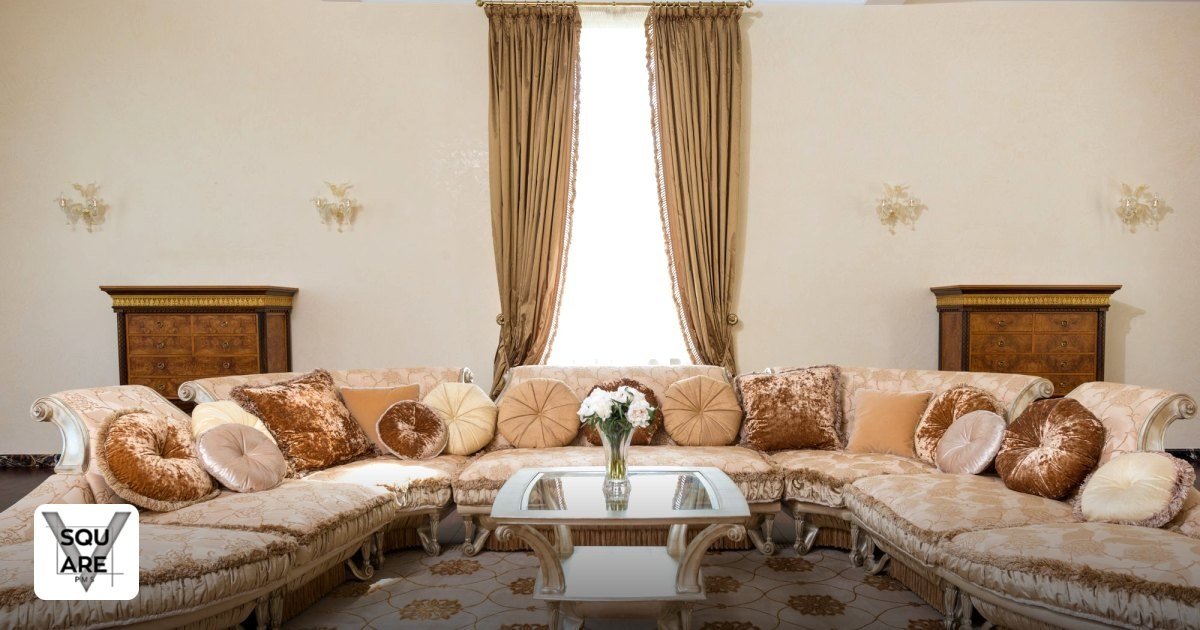
A traditional majlis is defined by its richness. Low upholstered seating platforms (maqaad) run along three or four walls, piled with embroidered cushions in gold, crimson and midnight blue. The ceiling is the showpiece: deep coffered plasterwork with Islamic geometric reliefs, gilded recesses and a central chandelier of substantial scale. Walls carry carved wooden screens — mashrabiya latticework — or are panelled in dark wood with arabesque router-cut patterns. Flooring is typically marble laid in a geometric pattern, anchored by a hand-knotted Persian or Turkish rug. Heavy floor-to-ceiling drapes in velvet or jacquard complete the room.
This style suits larger villas with high ceilings (4m+), owners who entertain frequently and formally, and properties in older or classically designed developments. It requires skilled craftsmen — particularly for plaster ceiling work and custom joinery — and its material lead times tend to be longer.
Modern Arabic Majlis
The modern majlis keeps the spatial generosity and cultural function but strips back the ornamentation. Plush, deep-seated contemporary sofas replace the maqaad platforms. Marble appears in large, clean slabs rather than patterned mosaic. The chandelier is replaced by a sculptural pendant or a recessed LED cove that still reads as generous but does not dominate the room. A single mashrabiya screen used as a room divider or feature panel provides the Arabic design reference without overwhelming the space.
This direction works well in newer developments with open-plan layouts, owners who prefer a more informal entertaining style, and any project where the budget needs to be carefully managed — modern Arabic is generally less expensive to execute than full traditional because it uses less custom craftsmanship per square metre.
Majlis Fit-Out Costs in UAE 2026
The figures below are all-in project costs covering design fees, materials, labour and loose furniture. They exclude VAT (5%) and any authority permit fees. These are real market rates — not the aspirational figures that often appear in design publications.
Quality flooring (porcelain or entry-level marble), custom upholstered sofas, off-the-shelf chandelier, standard drapes, painted walls with decorative stencil border. Suits apartments and smaller villas.
Premium marble flooring, bespoke joinery (seating platforms, display niches), imported chandelier, mashrabiya screen panel, fabric-lined walls or decorative plaster, Oriental rug, custom drapes. Most villa projects land here.
Hand-carved woodwork, Italian Calacatta marble, master craftsman plaster ceiling with gilded finish, statement chandelier (AED 50,000–150,000+), silk fabrics, fully bespoke loose furniture. Landmark Jumeirah villas and penthouse projects.
For a 50 sqm majlis — which is typical in a 4–5 bedroom Dubai villa — that translates to a total project cost of approximately AED 150,000–225,000 at standard tier, AED 225,000–325,000 at mid-range, and AED 325,000–500,000+ for a luxury finish.
| Element | Typical Cost Range (AED) | Notes |
|---|---|---|
| Marble flooring (supply + lay) | 40–120/sqft | Calacatta and Statuario at higher end; Crema Marfil more affordable |
| Oriental / Persian rug | 5,000–60,000+ | Machine-made vs hand-knotted; size 3×4m to 4×6m typical for majlis |
| Custom chandelier | 8,000–150,000+ | Murano glass and Middle Eastern crystal at higher end |
| Plaster ceiling with geometric motif | 80–250/sqft | Hand-applied relief vs CNC-routed mouldings |
| Mashrabiya screen (per panel) | 3,500–15,000 | MDF router-cut vs solid hardwood hand-carved |
| Custom seating / sofas | 15,000–90,000 | Full majlis set including chaise sections |
| Floor-to-ceiling drapes (per window) | 2,500–12,000 | Blackout lining + sheer layer; motorised optional |
| Wall panelling (joinery) | 60–180/sqft | Veneered MDF to solid wood with decorative routing |
| Design fees | 10–15% of project value | Concept + execution drawings + FF&E specification |
These figures apply to residential projects. Commercial majlis spaces — hotel lobbies, government reception halls, corporate VIP lounges — carry higher specifications and consequently higher budgets. Our interior design service covers both residential and commercial majlis projects across the UAE.
The Six Design Elements That Define a UAE Majlis
1. Flooring
Marble is the default choice for a UAE majlis, and for good reason — it is cool underfoot, ages well, and reads as quality to any visitor. The most common specification in mid-range Dubai villa projects is a large-format white Carrara or Crema Marfil marble laid in a straight pattern, with a contrasting border inlay. For a more traditional look, geometric waterjet-cut medallion inlays (AED 800–3,000 per sqm for the medallion element alone) create a focal centrepiece. An Oriental or Persian rug — preferably wool-pile hand-knotted — is placed over the marble to define the seating area and add warmth.
2. Ceiling
If one element separates a forgettable majlis from a memorable one, it is the ceiling. In traditional designs, a deeply coffered plaster ceiling with Islamic geometric star patterns — hand-applied by skilled plasterers — transforms the entire atmosphere of the room. In modern designs, a simple recessed perimeter cove with warm-white LED strip creates the illusion of floating architecture without the cost of ornate plasterwork. Either approach benefits from a ceiling height of at least 3.5m; below that, detailed ceilings can feel oppressive rather than grand.
3. Lighting
The chandelier is the heart of a majlis. It should be sized for the room — a 50 sqm majlis typically needs a chandelier of at least 1.2m diameter to read correctly — and hung at a height that allows it to be seen from the seating without obstructing movement. Beyond the chandelier, layer in wall sconces and recessed downlights on a dimmer system. The ability to move from bright overhead light (for formal gatherings) to warm ambient glow (for relaxed evenings) is what separates a well-designed majlis from one that feels flat at all hours. Arabic-style lanterns — copper-finished or coloured glass — work well as supplementary lighting in corners or beside the entrance.
4. Seating and Furniture
The choice between traditional maqaad floor seating and elevated contemporary sofas is mostly a lifestyle decision. Traditional floor seating is culturally authentic and works beautifully in formal reception contexts; it is less practical for older guests and for households that want the majlis to function as an everyday family room as well. Many clients opt for a hybrid: elevated sofas in a contemporary Arabic style, finished in a fabric that references traditional patterns, placed around a coffee table at the standard height. The dallah — a traditional Arabic coffee pot — and incense burner are almost always present as decorative and functional elements regardless of which seating style is chosen.
5. Wall Treatment
Walls in a UAE majlis carry more visual weight than in most other room types because the seating is usually pushed against them. Options range from simple high-quality paint with a decorative cornice (the lowest-cost approach) through to custom joinery panelling with arabesque router-cut patterns, hand-painted geometric borders, or fabric-lined wall panels for acoustic softness. One approach we find particularly effective at mid-range budget is a combination of painted plaster on the upper wall and a lower-wall joinery panel that integrates built-in display niches for decorative objects — it looks custom without requiring the full cost of floor-to-ceiling woodwork.
6. Textiles and Soft Furnishings
In a traditional majlis, textiles are everything — the cushions, drapes, upholstery and rug can represent 30–40% of the total fit-out budget. Floor-to-ceiling curtains in velvet or heavy jacquard, paired with a sheer voile for daytime light filtering, are standard. Cushions in Arabic embroidery or geometric prints add colour and pattern. For the rug, a hand-knotted wool piece from Iran, Turkey or Afghanistan will outlast three generations of machine-made alternatives — factor it as an investment rather than a furnishing expense.
Indoor vs Outdoor Majlis
Many UAE villas include a dedicated outdoor majlis — an open-sided or semi-enclosed space that functions as an extension of the indoor reception area, particularly used during the cooler months from October through April. An outdoor majlis typically includes a pergola or timber roof structure, weather-resistant upholstered seating, Arabic lanterns, and often an outdoor fireplace or gas fire pit as a centrepiece.
Outdoor majlis fit-out costs run from AED 35,000–80,000 for a standard pergola with furniture to AED 150,000–400,000 for a fully landscaped, mist-cooled, stone-paved outdoor reception space. Unlike indoor renovation, outdoor works almost always require a DM permit in Dubai and may require Trakhees approval in free zone residential developments such as Palm Jumeirah.
For homeowners planning a full residential overhaul that includes both indoor and outdoor majlis, our project management service coordinates both scopes simultaneously to avoid the timeline delay of treating them as sequential projects. We also cover the full apartment interior design cost landscape if you are working with a more compact residential space.
Authority Approvals: What You Actually Need
This is an area where a lot of incorrect information circulates, so let me be precise about what the Dubai Municipality and other UAE authorities actually require for majlis renovation works.
No permit required for: repainting walls, replacing flooring (no structural changes), changing drapes and furniture, replacing lighting fixtures on existing circuits, installing new AV or entertainment systems, and cosmetic ceiling works (adding mouldings or coves to an existing flat ceiling).
DM permit required for: removing or adding any load-bearing or non-load-bearing wall, changing the size or position of windows or door openings, adding new AC units that require structural penetrations, and any change to the structural ceiling level. Permit applications in Dubai typically take 2–3 weeks for a standard residential alteration.
Developer NOC required for any works — including cosmetic — in gated Emaar, Nakheel, Aldar, Sobha and most master developer communities. The NOC process takes 1–3 weeks and requires a scope-of-works document and sometimes drawings. We submit NOC applications on behalf of clients as a standard part of project mobilisation.
In Abu Dhabi, similar requirements apply through the Department of Municipalities and Transport (DMT). Sharjah requires a Sharjah City Municipality (SCM) permit for structural alterations. Our fit-out service includes authority submission management for all UAE jurisdictions we operate in.
Project Timeline: What to Plan For
A realistic timeline for a mid-range villa majlis renovation — say a 50 sqm room with new marble flooring, custom joinery seating, a feature plaster ceiling panel, bespoke chandelier and full soft furnishings — breaks down roughly as follows:
| Phase | Duration | Key Activities |
|---|---|---|
| Design & documentation | 2–3 weeks | Concept, 3D renders, finish schedules, FF&E specification |
| Approvals (if needed) | 1–3 weeks | Developer NOC and/or DM permit submission and approval |
| Material procurement | 3–6 weeks | Marble, chandelier, custom joinery, fabrics — local and imported |
| Site works | 3–5 weeks | Demolition, MEP adjustments, marble lay, joinery installation, ceiling works, painting |
| Soft furnishings & styling | 1 week | Rug, drapes, cushions, decorative items, final lighting commissioning |
| Total (cosmetic, no permit) | 8–11 weeks | From design sign-off to styled handover |
| Total (with structural permit) | 11–15 weeks | Adds permit processing to above |
The most common source of delay on majlis projects is not the site work itself — it is procurement. A bespoke chandelier ordered from a manufacturer in Cairo or Istanbul can take 6–8 weeks. A hand-knotted rug from Iran can take similar time. The way to avoid this compressing your timeline is to finalise the design and specify key items early, ordering before site work begins rather than after it finishes. Our AED-per-sqft cost breakdown guide gives broader context on how procurement management affects commercial fit-out timelines — the same principles apply to residential projects.
For homeowners living in the property during the renovation, phased delivery is worth discussing with your contractor. A well-organised team can typically pre-stage all materials and complete active installation in 2–3 weeks, minimising disruption to daily household life.
Common Majlis Design Mistakes to Avoid
After delivering projects across Dubai, Sharjah and Abu Dhabi, a few patterns of avoidable error appear repeatedly. The most expensive is over-buying chandelier before confirming ceiling height — a 1.5m diameter chandelier that looked perfect in a showroom can overwhelm a 3.2m ceiling and become impossible to reposition once the marble is down. Always specify chandelier size relative to confirmed ceiling height and the size of the seating area underneath.
The second common error is specifying drapes too light for the space. Many homeowners opt for sheer or semi-sheer curtains to keep the room feeling airy — and then find that the majlis feels exposed and lacks the enveloping quality that makes the room work for entertaining. Floor-to-ceiling blackout-lined drapes, even in a light fabric colour, give you the flexibility to open fully for daytime brightness and close completely for evening atmosphere. Install motorised tracks from the outset; retrofitting them after curtains are hung costs more and disrupts the ceiling finishes.
The third error is leaving acoustics as an afterthought. Marble floors, plaster walls and high ceilings create a reverberant room that makes conversation difficult when the space is full of guests. Rugs, cushions, heavy drapes and fabric wall panels all contribute to acoustic control — treat them as functional elements, not decorative ones, and the room will feel more comfortable to spend time in.
Frequently Asked Questions
How much does majlis interior design cost in UAE in 2026?
Majlis interior design in the UAE costs AED 300–450 per sqft for a well-finished standard fit-out, AED 450–650 per sqft for a premium build with bespoke joinery and imported stone, and AED 650–1,000+ per sqft for a fully bespoke luxury majlis. For a typical 50 sqm villa majlis, budget AED 150,000–325,000 at mid-range. VAT at 5% applies on top of all fit-out contract values.
What is the difference between a traditional and a modern majlis?
A traditional majlis uses low maqaad seating platforms, rich embroidered textiles, ornate coffered plasterwork ceilings with Islamic geometric patterns, carved mashrabiya wooden screens and baroque chandeliers in warm gold tones. A modern Arabic majlis keeps the spatial generosity and cultural function but uses contemporary sofas, clean-lined marble, sculptural lighting and subtle Arabic design references (a single mashrabiya panel, a geometric rug) rather than all-over ornamentation. Both are appropriate in UAE villas; the right choice depends on ceiling height, architectural style and owner lifestyle.
Do I need a permit to renovate my majlis in Dubai?
Cosmetic renovation — new flooring, paint, furniture, lighting on existing circuits, curtains — does not require a Dubai Municipality permit. Structural changes (removing or adding walls, altering window openings, new AC penetrations) require a DM building alteration permit (2–3 weeks). Works in Emaar, Nakheel, Aldar, Sobha or other gated communities require a developer NOC regardless of scope, adding 1–3 weeks. V Square manages permit and NOC submissions as part of our project management service.
What materials are typically used in UAE majlis design?
Flooring: polished marble (Carrara, Crema Marfil or Calacatta) at AED 40–120/sqft, layered with an Oriental or Persian wool-pile rug. Ceiling: coffered plasterwork with geometric reliefs (traditional) or recessed LED cove with statement chandelier (modern). Walls: decorative plaster with arabesque stencil, custom wood panelling, or fabric-lined panels. Seating: custom-upholstered sofas or maqaad platforms in velvet, silk-blend or high-quality jacquard fabric. Screens: mashrabiya panels in MDF router-cut or solid hardwood hand-carved.
How long does a majlis interior design project take in the UAE?
A complete majlis renovation takes 8–11 weeks from design sign-off to styled handover for a cosmetic project with no permits, or 11–15 weeks if structural changes and DM permits are involved. The longest phase is typically material procurement — bespoke chandeliers and rugs ordered from Turkey, Iran or Italy can take 6–8 weeks. Pre-ordering key items before site works begin is the most effective way to compress the overall project timeline.
Planning a Majlis Renovation?
V Square delivers end-to-end majlis interior design and fit-out across Dubai, Sharjah and Abu Dhabi — from design concept and material sourcing to permit submission and styled handover.
Get a Free Consultation