The home office has become a permanent feature of how professionals work in Dubai. What started as a pandemic workaround has settled into something more considered: a proper workspace designed into the home rather than improvised from a kitchen table or a corner of the bedroom. The difference in output between a well-designed home office and a makeshift one is not subtle — it is the difference between a workday that feels controlled and one that feels like an interruption of domestic life.
Dubai and Abu Dhabi present a specific set of design problems that most generic home office advice ignores. The climate drives choices that have no equivalent in cooler markets: direct sun hitting a west-facing window at 43°C in July is not a design preference problem, it is a productivity emergency. The density of Dubai apartment living means acoustic separation matters more here than in a suburban house. And the UAE's culture of co-working across time zones — London in the morning, Singapore in the afternoon — means many home offices here run longer hours than those built to standard assumptions. This guide addresses the real design problems, not the aspirational ones.
Home office fit-out costs in Dubai: 2026 price tiers
Home office costs in Dubai vary enormously based on whether you are converting an existing room with minimal intervention, or commissioning a purpose-designed space from scratch. The figures below assume a single-person workspace and exclude structural changes such as wall removal, which require separate permits and push costs significantly higher.
Desk, ergonomic chair, lighting upgrade, solar blinds, basic cable management, paint, and a floating shelf unit. Uses mostly off-the-shelf furniture. Suitable for a guest bedroom conversion or a study alcove in a villa.
Custom built-in joinery (desk + shelving + storage wall), acoustic panels or soft treatment, motorised blinds, task and ambient lighting upgrade, dedicated AC adjustment, and coordinated finishes. Transforms a room into a proper workspace.
Premium joinery in walnut, lacquer or stone-clad panels, custom standing desk mechanism, integrated AV for broadcast-quality calls, smart lighting, bespoke furniture, full acoustic treatment, mini-split AC. Built to host clients or record content.
Design fees for home offices are typically 12–18% of the fit-out budget for bespoke projects, or a fixed AED 3,500–8,000 for straightforward conversions handled by a single designer. If you are engaging V Square for a broader villa or apartment project, the home office is usually scoped as one room within the total, which brings the design cost per room down considerably.
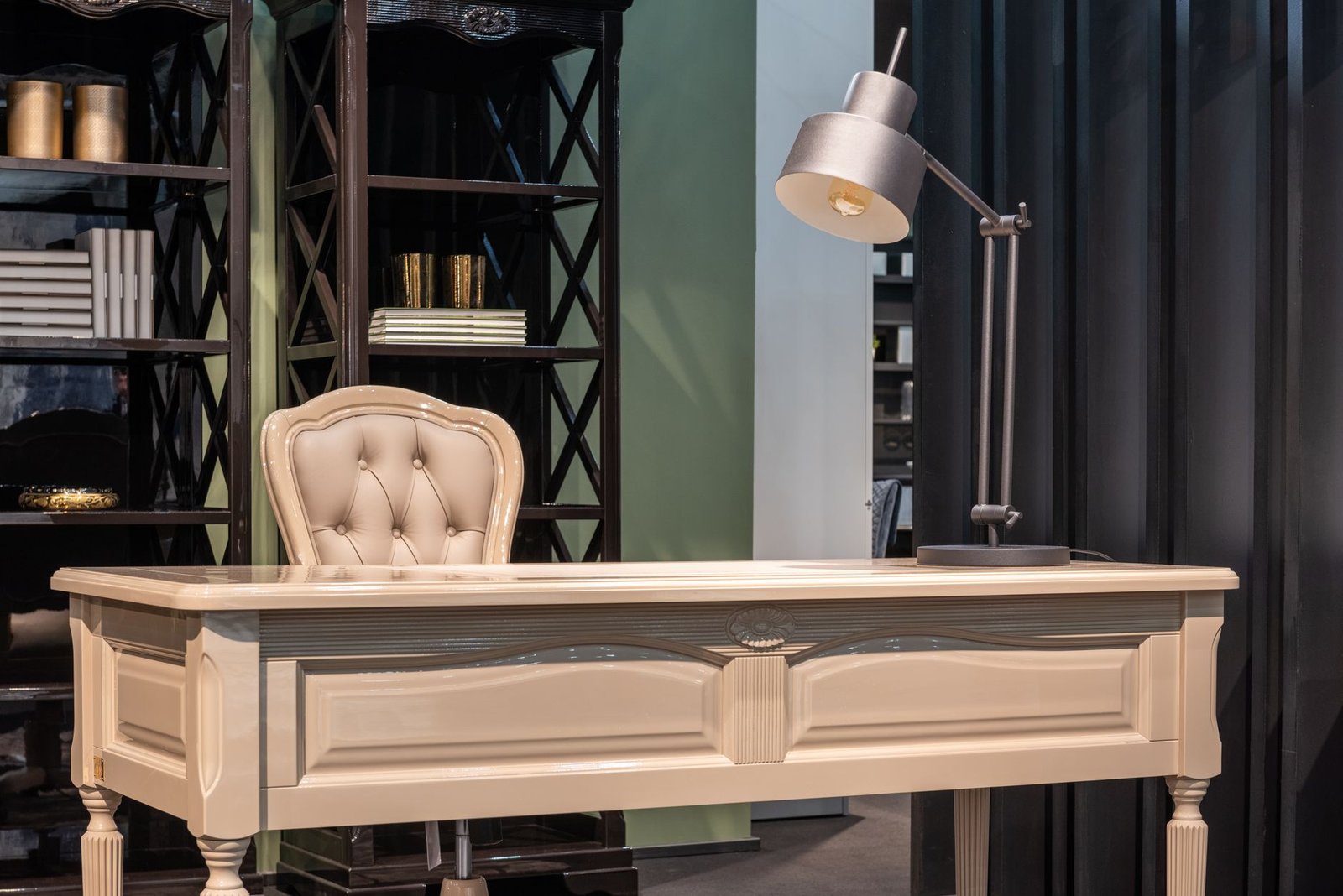
Cost breakdown by component
| Component | Budget (AED) | Mid-Range (AED) | Executive (AED) |
|---|---|---|---|
| Desk & work surface | 1,500–4,000 | 8,000–22,000 (custom) | 20,000–60,000 (bespoke/motorised) |
| Chair | 1,200–3,500 | 3,500–8,000 | 8,000–20,000+ |
| Storage joinery / shelving | 3,000–10,000 | 15,000–45,000 | 45,000–120,000 |
| Window treatment (solar blinds) | 1,500–5,000 | 5,000–14,000 (motorised) | 14,000–30,000 (smart + blackout) |
| Lighting upgrade | 1,000–3,500 | 4,000–12,000 | 12,000–35,000 |
| AC adjustment / mini-split | — | 3,500–9,000 | 9,000–22,000 |
| Acoustic treatment | 800–2,500 | 3,000–10,000 | 10,000–30,000 |
| Flooring (if changed) | 1,500–5,000 | 5,000–18,000 | 18,000–50,000+ |
| AV / smart home integration | — | 2,000–8,000 | 12,000–50,000 |
The UAE-specific design problems most guides miss
Managing sunlight in a Dubai home office
Dubai's solar intensity is roughly double that of London and 40% higher than Miami at peak summer hours. A west-facing window in a Dubai apartment between 14:00 and 18:00 in July is not a natural light feature — it is a glare and heat source that raises the perceived room temperature by several degrees even with AC running, causes screen fatigue within 20 minutes, and makes video calls look washed out. Getting this wrong is the single most common home office design mistake I see in Dubai residences.
The effective solution is a two-layer window treatment. The first layer is a solar roller blind with 10–20% openness factor — this cuts direct glare and solar heat gain while maintaining daylight diffusion and an outdoor view. The second layer is a heavier backing for occasions when you need to eliminate light entirely: video calls requiring a controlled backdrop, or early morning deep-work sessions where external light is too low to balance with your monitor. Motorised systems with a smart home timer — set to auto-close the solar blind at 13:30 on west-facing windows between June and September — cost roughly AED 5,000–14,000 for a single room and eliminate the need to think about it every day.
Dedicated cooling: why the home office AC matters more than you think
Most Dubai apartments and villas are cooled by a single central system that was designed to serve the whole unit. A home office generates significantly more heat per square metre than a living room does — computers, monitors, printers and docking stations in an 12 sqm room can add 600–900W of continuous heat load. Running the central system colder to compensate overcools the rest of the home and raises the electricity bill. The practical answer for serious home offices is a supplementary mini-split unit sized for the room — a 9,000 BTU unit (0.75 ton) handles up to 15 sqm comfortably and can be controlled independently of the central system. Budget AED 3,500–9,000 for supply and installation, including the DEWA-approved electrical connection.
Air quality matters too. UAE residents with tightly sealed apartments often find CO₂ accumulation in a small home office becomes noticeable within 2–3 hours — this shows up as reduced focus and mild headaches, not dramatic symptoms. Adding a small air purifier with a HEPA filter (AED 800–2,500) and leaving the door slightly open during work sessions typically resolves it without the cost of a mechanical ventilation solution.
Space planning: what size do you actually need?
The minimum viable home office in Dubai requires 8–10 sqm: enough for a desk, a chair that rolls freely, a small storage unit and space to stand and stretch. Below 8 sqm, the room starts to feel more like a storage cupboard with a desk than a place to spend eight focused hours.
For most professional uses — focused solo work, regular video calls, occasional paper-based tasks — 12–15 sqm is the right target. At this size you can fit a proper L-shaped desk or a wide single desk, a full storage wall, a secondary seating area (a reading chair is disproportionately useful for two-hour focus blocks), and acoustic treatment on at least two walls without the room feeling full. The most common conversion in Dubai villa projects we work on is a 14 sqm guest bedroom that becomes a full-time home office, which lands neatly in this range.
Executives who use their home office to meet clients, record content, or manage larger teams need 18–25 sqm. At this scale you are designing two distinct zones: a primary work desk area and a secondary meeting or content zone. These benefit from a physical or visual separation — a half-height joinery wall, a change in flooring material, or a lighting scene that you switch between for different activities. For a deeper look at how we handle space planning across larger residential projects, our villa interior design cost guide covers room-by-room planning across larger UAE properties.
Joinery: the element that separates a real home office from a nice desk
Built-in joinery is the most transformative single investment in a home office, and the one most commonly underestimated in a budget conversion. An off-the-shelf desk from a furniture retailer and a few floating shelves create a workspace. A custom-built joinery wall — desk integrated into the base, shelving above, cabinets for equipment at eye level, cable channels routed into the structure — creates an environment. The functional difference is significant: a joinery wall eliminates visible cable clutter, provides purpose-made storage so nothing piles up on the desk surface, and gives you a backdrop that looks professional on video calls without requiring a virtual background.
In Dubai, joinery for a 12 sqm home office runs AED 15,000–45,000 in mid-range materials (MDF with lacquer finish, open shelves in veneer, concealed cable management). Premium joinery in solid walnut or lacquered glass at the same scale runs AED 45,000–90,000. The quality difference shows in the drawer mechanism, the finish durability under Dubai's AC-drying effect, and the material's resistance to warping — cheap MDF panels in rooms that drop to 18°C in summer and rise to 30°C when the AC is off will delaminate at the edges within two to three years.
Lighting: the difference between feeling alert and feeling tired
Lighting for a home office in Dubai needs to solve two distinct problems: task lighting for focused screen work, and a broader ambient lighting scheme that supports the full working day without making the room feel like a fluorescent-lit cubicle or, conversely, an atmospheric restaurant. These are not the same problem and they do not have the same solution.
For task lighting, the target is 400–500 lux at the desk surface at a colour temperature of 4,000–4,500K — daylight-balanced white light that promotes alertness without the harshness of 6,500K cool white. A good desk lamp with adjustable arm and temperature control covers this. For ambient lighting, recessed LED spots on a separate dimmer circuit at 3,000–3,500K warm white — turned low in the background while the desk lamp carries the task load — creates a layered effect that prevents the room from feeling either too bright or too dim. Add a third circuit for a backlight behind the monitor (a LED strip at 6,500K bias lighting behind the screen reduces eye strain on long sessions) and the total lighting upgrade for a mid-range home office runs AED 4,000–12,000 depending on whether you are fitting new circuits or working within existing ones.
Acoustics: the overlooked dimension
Dubai apartments are predominantly concrete-frame construction, which means hard surfaces everywhere: tile or marble floors, plaster walls, glass windows. The acoustic result in a small home office is a reverberant room where your own voice sounds hollow on calls, and external noise — neighbours, traffic, construction — transmits clearly through walls and the building structure. For anyone spending more than two hours per day on video or voice calls, this is not a comfort issue; it directly affects how professional you sound and how quickly you fatigue.
The practical acoustic fix for a home office does not require a full soundproofing project. A combination of a large area rug (minimum 2×2.5m under the desk area), acoustic panel tiles on the wall behind the monitor (six to eight 60×60cm panels cover the reflection point), and fabric curtains instead of hard roller blinds on the opposite wall absorbs enough mid-frequency energy to transform the call quality. Total cost: AED 3,000–8,000. For a broader apartment renovation context, these acoustic decisions often get made alongside flooring and wall finish choices rather than as a separate category.
Permits: what you need and what you do not
A home office fit-out — joinery, lighting, flooring, painting, window treatment, furniture — does not require a construction permit in the UAE. These are interior cosmetic and furnishing changes within an existing residential space. If you are adding a new electrical circuit for a mini-split AC unit or increasing the electrical load of the room, that requires a DEWA-registered electrician to file a load addition request — this is handled as part of the installation, not a separate permit process you need to initiate independently.
If you are operating a business from your home in Dubai, the legal requirement is a home trade licence from DED or a freelance permit from a free zone — not a building permit. These licences restrict certain business activities (client visits at the home address are often excluded) and are issued by the licensing authority, not Dubai Municipality. For home offices that handle remote work for a single employer, no additional licence is needed beyond your existing employment visa arrangement.
The one scenario that does require a DM permit is removing or altering a structural wall to create a larger office space from two smaller rooms — for instance, combining a small bedroom and an adjacent study. Any structural change in a Dubai residential unit requires written approval from your building management company and a DM permit. Our project management team handles the authority submission process as part of the overall project scope.
Frequently asked questions
How much does a home office fit-out cost in Dubai in 2026?
A home office fit-out in Dubai costs AED 15,000–45,000 for a budget conversion of an existing room, AED 45,000–120,000 for a purpose-built study with custom joinery, built-in shelving and acoustic treatment, and AED 120,000–250,000+ for an executive home studio with premium finishes, integrated AV, smart lighting and bespoke furniture. These figures include design, joinery, MEP adjustments and finishes but exclude structural changes such as wall removal.
What size should a home office be in Dubai?
A functional single-person home office requires a minimum of 8–10 sqm. For comfortable dual-use — focused work plus a professional video call setup — 12–15 sqm allows a proper desk zone, storage wall and a secondary seating area. Executives hosting in-person meetings or recording content typically need 18–25 sqm. The most common conversion in Dubai is a guest bedroom (usually 12–16 sqm), which offers adequate size for most professional uses.
Do I need a permit for a home office in Dubai?
A fit-out or renovation within an existing room — joinery, painting, flooring, lighting — does not require a construction permit in Dubai. If you are conducting business activities from your home, you need a freelance permit or home trade licence from DED or the relevant free zone, not a building permit. Any structural change (removing a wall, relocating MEP services) requires Dubai Municipality approval and written consent from your building management company.
How do you manage natural light in a Dubai home office?
The most effective approach for Dubai is a two-layer window treatment: solar roller blinds (10–20% openness) as the primary layer to cut direct glare and heat gain while maintaining a view, plus blackout curtains or a heavy secondary layer for screen work and video calls. East-facing rooms are best for morning-heavy work schedules. West-facing rooms need the most intervention — motorised solar blinds with a smart home timer to auto-close from 13:30 onward are worth the AED 5,000–14,000 investment to avoid the afternoon sun problem from June to September.
What are the most important home office design features for Dubai apartments?
The highest-impact features are: (1) motorised solar blinds for afternoon sun control, (2) a supplementary mini-split AC unit so the room stays at 21–23°C without overcooling the rest of the home, (3) a custom built-in joinery wall for storage and a professional video call backdrop, (4) task lighting at 4,000–4,500K colour temperature, (5) an area rug and acoustic panels to reduce call reverberation, and (6) a dedicated electrical circuit for office equipment. These six elements define whether a home office is functional or merely furnished.
Designing a home office in your Dubai apartment or villa?
V Square designs and builds home offices across Dubai and the UAE — from single-room study conversions to full executive suites integrated into wider villa renovations. We handle joinery, MEP adjustments, AC coordination and authority submissions under one team.
Get a consultation →