Opening a nursery or childcare centre in the UAE is one of the most regulated commercial fit-out projects an operator will undertake. Unlike a retail shop or restaurant, the physical space must satisfy two regulatory bodies simultaneously: Dubai Municipality (DM) — or the relevant emirate authority — for the building fit-out permit, and KHDA (Knowledge and Human Development Authority) in Dubai or ADEK (Abu Dhabi Department of Education and Knowledge) in Abu Dhabi for the operating licence. The premises will be physically inspected before any children are admitted, and a shortfall in ceiling height, toilet ratios or play zone dimensions will result in a failed inspection.
This guide covers every element a UAE nursery operator needs to brief their interior design and fit-out team: KHDA and ADEK space standards, the zones a compliant nursery must contain, per-sqft cost tiers by finish level, the DM approval process, and a realistic project timeline from design to opening day.
Why Nursery Interior Design Is Different from Standard Commercial Fit-Out
Most commercial interiors are designed around adult ergonomics, brand aesthetics and operational efficiency. Nursery design starts from a different premise entirely: the space must be safe, stimulating and legible for children aged 45 days to six years, while remaining cleanable, durable and supervisable by staff.
The practical implications run through every design decision:
- No sharp edges anywhere — all joinery, shelving, partitions and furniture must have rounded profiles. Standard commercial contractor-grade details do not meet this requirement and must be specified explicitly.
- Non-toxic finishes — paints, adhesives, sealants and laminates must carry child-safe certifications. Standard commercial paints may not comply.
- Anti-slip, easy-clean flooring — rubber, cork and sealed luxury vinyl tile (LVT) are the standard choices. Hard ceramic tiles or polished concrete are not appropriate for infant and toddler zones.
- Acoustic control — nurseries contain multiple age groups in adjacent rooms. Without adequate acoustic separation, noise from an active preschool room will disturb sleeping infants. Acoustic ceiling tiles, soft wall panels and carpet underlays are standard tools.
- Sightlines — KHDA inspection teams check that staff can supervise all areas from natural standing positions. Opaque partitions that create blind spots are a failure point.
- Electrical and plumbing at correct heights — sockets at adult height only (or tamper-resistant at child height), child-height hand-wash basins and child-sized toilets at the correct bowl height.
These requirements add cost and complexity versus a standard commercial fit-out of equivalent area. A nursery cannot simply be furnished with off-the-shelf commercial contractor finishes.
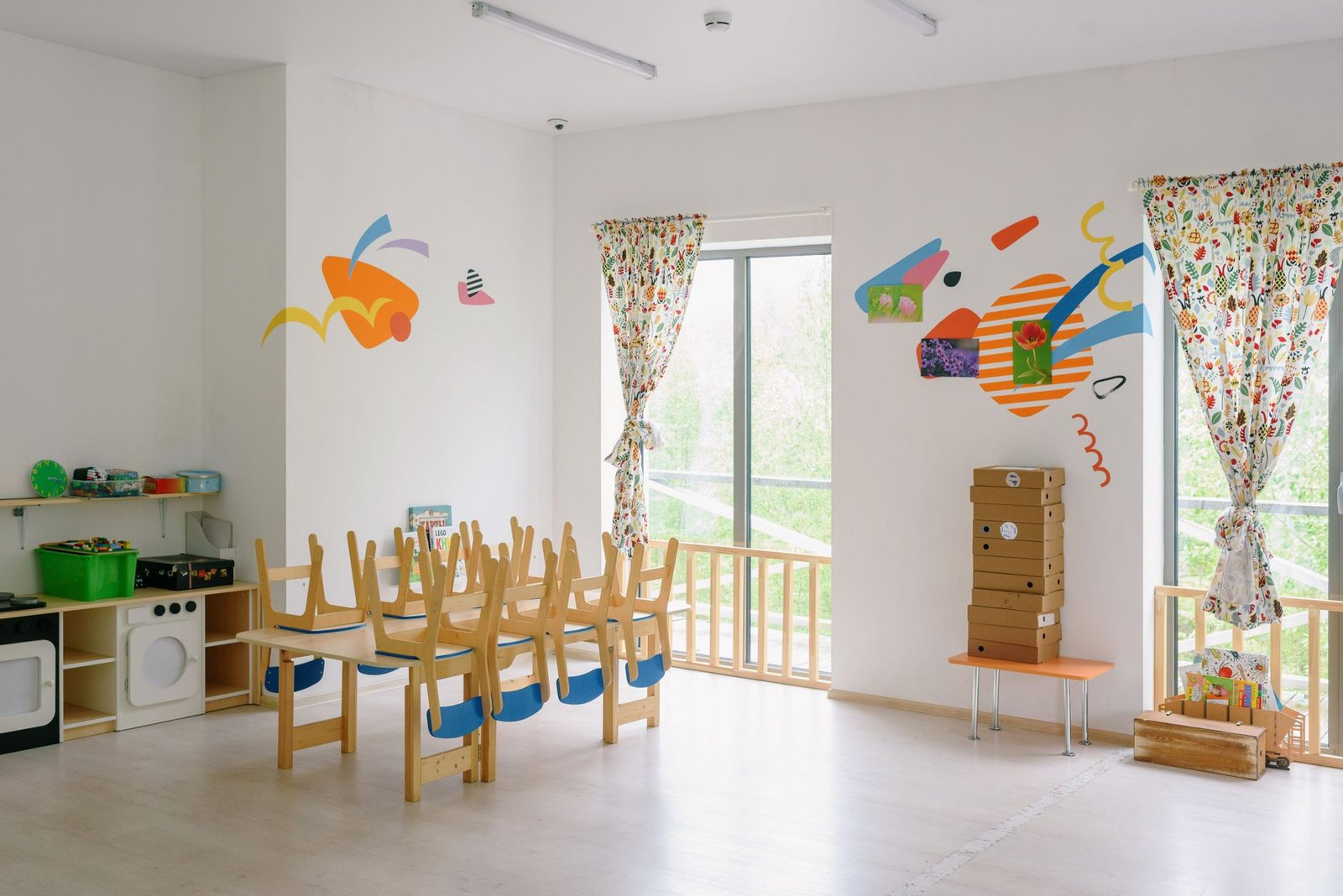
KHDA Space & Design Standards (Dubai)
KHDA's Early Childhood Centre (ECC) standards set the physical minimums that a Dubai nursery premises must meet before an operating permit is issued. The key spatial requirements are:
| Requirement | KHDA Minimum Standard | Design Note |
|---|---|---|
| Indoor floor area per child | 2.3 sqm | Net usable area; excludes toilets, kitchen, storage and corridors |
| Outdoor play area per child | 4 sqm | Must be dedicated, fenced and accessible directly from the nursery |
| Floor level | Ground floor only | KHDA does not approve upper-floor nursery premises |
| Child-sized toilets | 1 per 15 children | Child-height bowls (250–280 mm), hand-wash basin at 600 mm height |
| Nappy change area | Required for under-2 rooms | Raised change station with adjacent hand-wash basin; wipeable surfaces |
| Sleep / rest area | Required for infants and toddlers | Acoustically separated; dimmable lighting; cot-safe floor finish |
| Food preparation area | Required if meals served on-site | Separate DM food safety approval; stainless steel surfaces; extract ventilation |
| Staff room | Required | Separate from child areas; lockable storage for staff belongings |
For a 40-child nursery — a typical small-to-mid scale operation in Dubai — the minimum indoor net usable area is 92 sqm, plus toilets, kitchen, corridors and staff room. In practice, a 40-child nursery occupies a gross floor area of 200–300 sqm to meet all requirements comfortably. Outdoor play of 160 sqm minimum is also required, which significantly constrains suitable premises in dense urban areas.
ADEK Standards for Nurseries in Abu Dhabi
Abu Dhabi nurseries are licensed by ADEK and must comply with the Abu Dhabi Community Facility Planning Standards. While ADEK's published standards share many principles with KHDA, there are operational differences operators must note:
- ADEK nurseries serve children from birth to age 4 (versus KHDA's 45 days to 6 years). Children aged 4+ in Abu Dhabi transition to KG1 in school.
- A municipality certificate confirming the building is suitable for nursery use is mandatory before ADEK will issue a licence — equivalent to DM's fit-out permit sign-off in Dubai.
- The premises must be in a quiet area with safe vehicular access for drop-off and collection.
- CCTV coverage of all child-accessible areas is mandatory in Abu Dhabi, with footage accessible to parents on request.
- Health and safety documentation — including evacuation plans, fire drill records, pest control certificates and first aid training certificates for all staff — must be maintained on-site and available for ADEK inspection.
For operators planning to open nurseries in both emirates, the physical design standards are broadly compatible — build to KHDA spatial standards and the Abu Dhabi municipality certificate will typically follow, subject to local building code compliance.
Key Design Zones Every UAE Nursery Must Include
Infant Room (0–18 months)
The infant room requires the highest specification. Flooring must be fully padded or thick rubber matting to cushion falls. Cot storage and a secure sleep area with dimmable lighting are mandatory. The nappy-change station with an adjacent hand-wash basin is non-negotiable. Sightlines from all positions in the room to every sleeping cot are a KHDA inspection checkpoint. Acoustic separation from adjacent toddler or preschool rooms is essential — a sleeping infant room adjacent to a music activity area without adequate acoustic treatment is a recurring design error in UAE nurseries.
Toddler Room (18 months–3 years)
Toddler rooms need robust, easy-clean surfaces — these children are mobile, curious and significantly harder on finishes than older age groups. Child-height open shelving for self-serve toy and book access is a KHDA quality indicator. Low activity tables with child-height chairs, a designated messy play zone with washable wall finish (epoxy paint or tile up to 1.2 m height is standard), and a small outdoor-access point for age-appropriate play are typical requirements.
Preschool Classrooms (3–6 years)
Preschool rooms accommodate more structured learning activity. Fit-out includes designated reading corners with soft seating, arts-and-crafts stations with durable worktop surfaces, interactive whiteboard or display wall, and natural light maximisation. Acoustic ceiling tiles reduce background noise during group activities. KHDA's quality framework looks for an environment that supports child-led exploration — static rows of chairs facing a whiteboard do not meet the spirit of the standard even if they satisfy the letter of the space requirement.
Outdoor Play Area
The outdoor area must be fully enclosed with a secure fence or wall of minimum 1.8 m height. Shade structures are mandatory in UAE climatic conditions — either fixed canopy structures or sail shades covering at least 60% of the outdoor area. Rubber safety matting under any climbing or play equipment is required. The surface must drain adequately to avoid ponding after irrigation or rain. A drinking water point within or immediately adjacent to the outdoor area is standard practice.
Reception and Entry
The entry sequence — parent drop-off, security check, sign-in — must be designed to manage simultaneous arrivals safely. A lobby with a secure entry point (electronic access control or monitored gate) separating the public street from child areas is the standard layout. CCTV coverage from entry to all child-accessible areas, with a monitor visible at the reception desk, meets both KHDA and ADEK supervision standards.
Nursery Fit-Out Cost Tiers — UAE 2026
Nursery fit-out costs per sqft in the UAE 2026 vary significantly by finish level, joinery specification and play equipment procurement strategy. The figures below are per sqft of gross floor area and cover all internal fit-out works — partitions, flooring, ceiling, MEP, joinery, painting and fixed play features — but exclude loose furniture, outdoor play equipment, and authority fee deposits.
KHDA-compliant finishes; rubber or vinyl flooring; painted walls; contractor-grade child-height joinery; basic themed murals; standard MEP; meets minimum inspection requirements.
Themed classroom fit-out; acoustic ceiling tiles; soft play zone with foam padding; sensory wall features; upgraded hand-wash stations; commercial rubber flooring in infant room; enhanced outdoor shade structure.
Bespoke Montessori or Reggio Emilia environments; natural wood and cork finishes; imported play equipment; biophilic design elements; full CCTV integration; custom joinery throughout; premium acoustic treatment.
Indicative Budget for a 200 sqm Nursery (40 Children)
| Cost Item | Standard | Mid-Range | Premium |
|---|---|---|---|
| Interior fit-out (200 sqm) | AED 40,000–70,000 | AED 70,000–90,000 | AED 90,000–110,000+ |
| Loose furniture & fittings | AED 25,000–40,000 | AED 40,000–65,000 | AED 65,000–100,000+ |
| Outdoor area & play equipment | AED 15,000–25,000 | AED 25,000–45,000 | AED 45,000–80,000+ |
| Authority fees (DM + KHDA) | AED 10,000–25,000 (varies by emirate and category) | ||
Note: These figures illustrate relative cost tiers. Exact pricing depends on specific material selections, contractor rates, and the condition of the leased shell. V Square provides fixed-fee fit-out packages with KHDA pre-inspection support — contact our team for a site-specific estimate.
DM Fit-Out Approval Process (Dubai)
Before any physical works begin, a Dubai Municipality fit-out permit must be obtained. The process runs through the BPS (Building Permit System) portal and involves:
- Architectural drawings submission — floor plans, reflected ceiling plan, sections and elevations showing compliance with KHDA space standards and DM building code.
- MEP drawings — mechanical (ventilation and AC), electrical and plumbing layouts, including child-height plumbing points and extract ventilation for kitchen and nappy-change areas.
- DM review — typically 10–14 working days for a straightforward nursery fit-out in an existing shell.
- Civil Defence NOC — fire safety review covering sprinkler or heat detector coverage, emergency lighting, evacuation signage and exit routes. Nurseries require a minimum of two exit routes that do not pass through kitchen or storage areas.
- DEWA approval — electrical load approval if the fit-out adds significant load above the existing shell rating (typically triggered by kitchen equipment or additional AC units).
For nurseries planned in Dubai free zones — DIFC, TECOM or similar — the relevant free zone authority replaces DM as the approving body, but the documentation requirements are broadly similar.
Project Timeline: Design to KHDA Inspection-Ready
| Phase | Duration | Key Deliverable |
|---|---|---|
| Concept design & space planning | 2–3 weeks | KHDA-compliant zone layout; space allocation sign-off |
| Detailed design & DM documentation | 2–3 weeks | Architectural, MEP and Civil Defence drawings |
| DM fit-out permit & approvals | 2–3 weeks | Permit issued; works can commence |
| On-site fit-out works | 4–8 weeks | All finishes, joinery, MEP, outdoor area complete |
| Snagging & KHDA pre-inspection | 1–2 weeks | All KHDA standards verified; punch list cleared |
| KHDA ECC inspection & licence | 2–4 weeks | Operating permit issued; nursery ready to enrol |
Total: 13–23 weeks from design kick-off to first day of operation. Operators targeting a September intake — the start of the UAE academic year — need to begin the design and approval process no later than May. For a January intake, the equivalent start date is September or October.
Premium fit-outs with imported play equipment (typical lead times of 8–12 weeks from European or North American suppliers) should begin procurement during the design phase, not after fit-out completion.
Key Design Principles That Pass KHDA Inspection
Colour and Sensory Environment
KHDA quality inspectors look for environments that are stimulating but not overwhelming. Overly saturated, high-contrast colour schemes across every surface create visual noise that is detrimental to very young children. The design approach that tends to perform well in KHDA inspections uses neutral base tones — whites, soft greys, natural wood — with deliberate colour accents in activity zones. This approach also photographs well for marketing materials, which matters commercially.
Storage and Independence
Open, child-height storage throughout — for books, toys and art materials — signals a child-led learning environment in KHDA inspections. Storage at adult height for hazardous items (cleaning products, medication) with child-proof locks is a safety requirement, not a design option.
Transition Zones
The space between different age rooms — infant to toddler, toddler to preschool — should be designed as a soft boundary rather than a hard wall. Half-height dividers with glazed panels maintain sightlines while reducing noise transfer. This approach also gives the space visual depth and an open feel that photographs well for enrolment marketing.
Nursery Interior Design vs School Interior Design in the UAE
It is worth noting how nursery fit-out differs from the school fit-out projects described in our school and educational centre interior design guide. School fit-out (KG1 through Grade 12) operates under different KHDA standards focused on classroom density, science lab ventilation, sports facilities and taller ceiling clearances. Nursery fit-out is a distinct category with tighter safety specifications, mandatory outdoor play and the ground-floor-only rule that does not apply to schools. An interior designer experienced in school fit-out may not have the specialist knowledge to navigate a nursery inspection without additional briefing.
Similarly, medical facility design — such as the clinic and medical centre fit-out standards we cover in our DHA compliance guide — shares some principles (child-safe finishes, infection control surfaces) but follows DHA rather than KHDA as the approving authority. A nursery with a nurse's room or first aid bay must meet DM standards for that specific room, but the nursery as a whole is a KHDA-regulated premises.
For operators planning a multi-use education and care facility, understanding which regulatory authority governs each space — and designing accordingly — is essential to avoid a failed inspection on the day.
Frequently Asked Questions
How much does nursery fit-out cost in the UAE in 2026?
Nursery fit-out in the UAE costs AED 200–350 per sqft for a standard fit-out covering KHDA-compliant flooring, child-height joinery, basic play zones, toilets and MEP works. A mid-range fit-out with themed classrooms, sensory play areas and commercial-grade soft furnishings runs AED 350–450 per sqft. Premium nurseries with bespoke learning environments, imported play equipment and natural material finishes reach AED 450–550+ per sqft. These figures cover internal fit-out works; premises lease, loose furniture procurement and outdoor play equipment are separate line items.
What are the KHDA space requirements for a nursery in Dubai?
KHDA requires a minimum of 2.3 sqm of indoor space per child and a minimum of 4 sqm of dedicated outdoor play area per child. The nursery must be located on the ground floor only — KHDA does not approve upper-floor nursery premises. Separate child-sized toilet facilities must be provided at a ratio of at least one toilet per 15 children. Rounded furniture edges, non-slip flooring and secured electrical fittings are mandatory throughout.
What authority approvals are required to open a nursery in Dubai?
Opening a nursery in Dubai requires a Dubai Municipality (DM) fit-out permit, a KHDA Early Childhood Centre (ECC) operating permit, and a Civil Defence fire safety clearance. DM fit-out approval typically takes 2 weeks. KHDA conducts a physical inspection of the premises before issuing the operating permit. A food preparation area requires a separate DM food safety approval. The full pre-opening process from fit-out permit to KHDA ECC licence takes 3–5 months.
How is nursery interior design different from a standard commercial fit-out?
Nursery interior design requires child-safe finishes throughout: no sharp corners, child-height joinery, anti-slip and easy-clean flooring, non-toxic paints and sealants, and tamper-resistant electrical sockets. Acoustic control is essential to manage noise between age groups. Sightlines must allow staff to supervise all areas without blind spots. Storage must be at child level for learning materials and at secure adult height for hazardous items. These requirements add material cost and design complexity beyond a standard commercial fit-out of equivalent area.
What is the typical timeline for a nursery fit-out project in the UAE?
A complete nursery fit-out project in the UAE typically takes 13–23 weeks from design kick-off to KHDA inspection-ready handover. Design and documentation takes 4–6 weeks, DM approval 2–3 weeks, on-site works 4–8 weeks, and KHDA pre-inspection snagging 1–2 weeks. Premium fit-outs with imported play equipment may extend the timeline by 3–4 weeks for procurement lead times. Operators targeting the September intake should begin the process no later than May.
Planning a Nursery or Childcare Centre in the UAE?
V Square manages nursery fit-out projects from KHDA-compliant space planning through to authority approvals and inspection-ready handover — across Dubai, Abu Dhabi and Sharjah.
Get a Free Consultation