Why Clinic Fit-Outs Cost More Than Any Other Interior Project in the UAE
Clients who come to us after pricing a retail fit-out or office fit-out are consistently surprised by clinic numbers. The gap is not arbitrary — it reflects a completely different technical specification. A standard office needs a comfortable HVAC system. A clinic needs a dedicated, validated ventilation system with controlled pressure differentials between treatment zones and waiting areas, minimum air-change rates per specialty, and the capacity to isolate zones in the event of an infection-control incident. That alone adds AED 80–150 per sqft to the M&E budget before you've bought a single piece of furniture.
Add to that: antimicrobial wall and floor finishes, coved skirting (the curved wall-floor junction that prevents bacteria from accumulating in corners — DHA mandates it in clinical zones), medical-gas infrastructure, DCD-compliant fire suppression, and the fees for four separate regulatory submissions, and the cost basis becomes clear. Healthcare hotel is not more expensive because designers charge more — it costs more because it does more.
Clinic Fit-Out Cost in UAE 2026 — AED Breakdown by Tier
The table below covers Dubai (DHA jurisdiction). Abu Dhabi (DOH) costs are broadly similar; budget an additional 5–10% for DOH submission fees and longer review cycles on complex specialties.
| Tier | AED per sqft | Typical clinic type | What's included |
|---|---|---|---|
| Basic / Single Specialty | AED 600–800 | GP clinic, single-specialty (dermatology, dental) | DHA-compliant finishes, standard HVAC, basic medical gas, aluminium joinery |
| Mid-Range / Polyclinic | AED 850–1,100 | Multi-specialty polyclinic, diagnostic centre | Full MEP upgrade, custom joinery, enhanced infection-control surfaces, dedicated sterilisation room |
| Premium / Day Surgery or Imaging | AED 1,100–1,500+ | Day-surgery centre, radiology, IVF clinic | Radiation shielding, N+1 HVAC, laminar-flow ceilings (OT), medical-grade flooring systems, full BMS |
VAT at 5% applies to all fit-out services. DHA facility licence fees, medical equipment, and IT infrastructure are separate line items. For reference, the office fit-out cost guide for UAE 2026 covers the AED 200–700/sqft commercial range — the contrast with clinic costs illustrates how much regulatory compliance adds to the budget.
DHA Fit-Out Layout Requirements (2026 Updated Standards)
DHA updated its minimum space standards for clinics and pharmacies in March 2026. The core requirements that govern every floor plan we produce for a Dubai clinic:
- Consultation rooms: Minimum 12–15 sqm depending on specialty. Each must have a dedicated handwashing station with elbow-operated or sensor taps.
- Reception and waiting area: Must be clearly demarcated from clinical zones. Seating must allow adequate personal space; minimum 1.2m circulation widths for accessibility compliance.
- Sterilisation / clean utility room: Mandatory in any clinic performing procedures. Separate dirty and clean workflows — these cannot share a single zone or circulation path.
- Accessible design: Full People of Determination compliance: wheelchair-accessible entrance, consulting rooms, and accessible toilet. Ramp gradients, door widths (minimum 900mm clear), and tactile indicators are all checked at DHA inspection.
- Surface finishes in clinical zones: Flooring must be sealed, smooth, and wipeable (vinyl sheet or resin preferred; no joins in high-risk areas). Coved skirting — not angle bead — at all wall-floor junctions in treatment and sterilisation areas. Wall finishes must be compatible with hospital-grade cleaning agents.
- Acoustic separation: Consultation rooms must provide patient privacy; DHA inspectors check that conversations cannot be heard clearly from the waiting area. Acoustic wall panels or double-glazed internal windows are standard solutions.
Zone-by-Zone Design Guide
Reception and Waiting Area
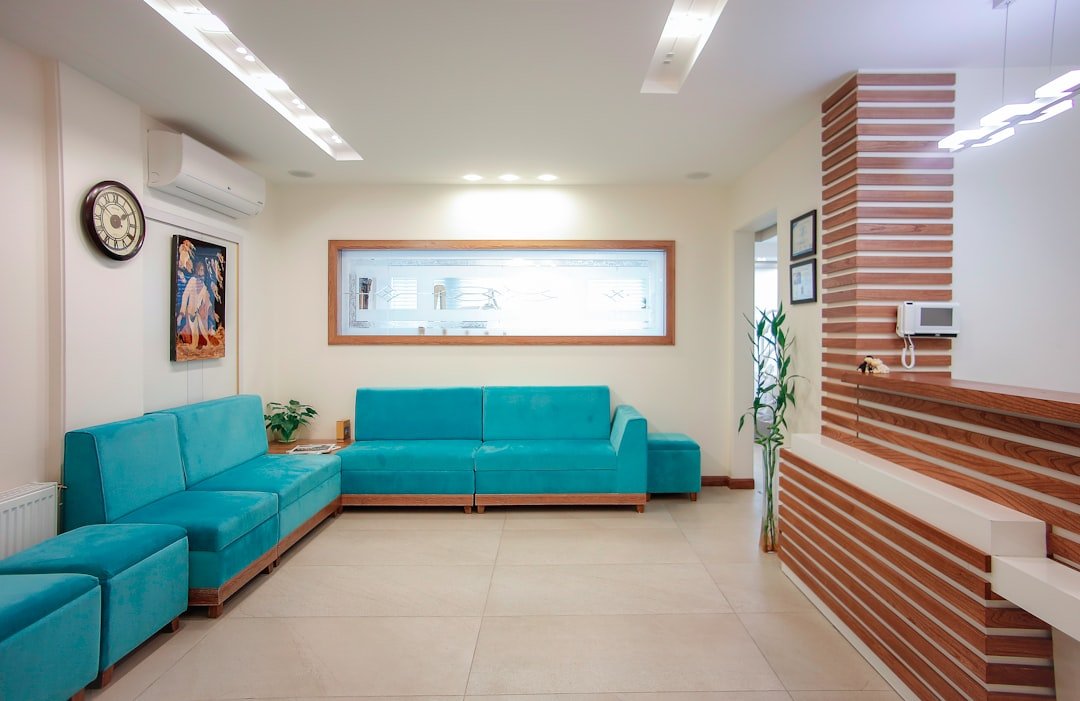
The first impression a patient forms about a clinic's quality of care is the reception. That's not a marketing cliché — it is supported by patient-satisfaction research out of NHS and JCI-accredited facilities. In practical terms: the reception counter should use antimicrobial laminate or solid surface (not natural stone, which is porous), lighting should be warm white (3,000–3,500K) to avoid the clinical harshness that raises anxiety, and seating should be spaced to allow personal space while remaining within a sight line of the reception desk. For a 10-seat waiting area, budget AED 40,000–80,000 for furniture, flooring, and feature joinery.
Consultation Rooms
The most common mistake we correct in clinic design briefs is undersized consultation rooms. Doctors need room to move between the desk, examination couch, and handwashing station without the patient feeling crowded. DHA's 12 sqm floor is a minimum — for a family medicine or OB/GYN consultation room, 14–16 sqm produces a significantly better clinical workflow. Design the handwashing station on the wall adjacent to the examination couch, not behind the doctor's desk, so it's accessible mid-examination without turning away from the patient.
Examination and Treatment Rooms
Treatment rooms require task lighting above the couch (minimum 1,000 lux at the procedure surface), a mobile or ceiling-mounted examination light on an arm, adequate storage for consumables (locked where medications are stored), and clear ergonomic sight lines between the clinician and the door. Every treatment room must have a clinical waste bin with a foot-operated lid, a sharps container holder at the correct height, and the handwashing station within one arm's reach of the procedure area.
Sterilisation and Clean Utility
This zone is where most budget surprises happen. A compliant sterilisation room needs a separate autoclave alcove with adequate ventilation to dissipate steam, a one-way workflow from dirty (instruments in) to clean (packaged instruments out), seamless vinyl or resin flooring, and a wash-hand basin on the dirty side. If the clinic performs surgical procedures, a separate scrub area adjacent to the procedure room is required. Budget AED 60,000–120,000 for a standalone sterilisation room fit-out.
The 4-Authority Approval Process for Dubai Clinics
Every clinic fit-out in Dubai requires sign-off from four separate government bodies — and all four approvals must be obtained before construction legally begins. Our project management team handles these concurrently where possible, but understanding the dependencies matters for realistic scheduling.
- 1. Dubai Health Authority (DHA): Layout review via the Sheryan portal. DHA checks floor plans against healthcare facility guidelines — room adjacencies, minimum dimensions, infection-control zones, accessibility. Submission requires DHA-approved engineering drawings. Review time: 4–6 weeks for standard submissions.
- 2. Dubai Municipality (DM): Building permit for structural modifications and MEP changes. If the fit-out involves no structural work (non-load-bearing partitions only), a DM NOC may suffice. Full structural changes require a DM permit, which takes 2–4 weeks.
- 3. Dubai Civil Defence (DCD): Fire safety approval is a legal prerequisite before construction begins. MEP drawings must show sprinkler layout, alarm device positions, emergency lighting, exit signage, fire door locations, and compartmentation. CDD review typically takes 2–3 weeks.
- 4. Department of Economic Development (DED): Trade licence for the clinic. DED requires the DHA facility licence (which comes after fit-out completion and DHA final inspection) as a precondition. The DED step is the final gate before opening.
Running DHA and DCD submissions in parallel (where drawings are sufficiently advanced) shaves 3–4 weeks off the overall timeline. This is where having a project management partner who has done this before makes a measurable difference.
Timeline: From Design to DHA Licence
Our honest benchmark for a 100–200 sqm single-specialty clinic in Dubai, assuming no major structural changes:
| Phase | Duration | Key milestone |
|---|---|---|
| Concept & space planning | 1–2 weeks | DHA-compliant floor plan agreed |
| DHA + DCD submission & review | 4–6 weeks (parallel) | Approval notices received |
| DM permit (if required) | 2–4 weeks (overlap) | Building permit issued |
| Fit-out construction | 6–10 weeks | Practical completion |
| DHA final inspection | 2–4 weeks | Facility licence issued |
| DED trade licence | 1–2 weeks | Clinic can open |
Total: approximately 16–28 weeks (4–7 months). Specialties requiring radiation shielding (dental X-ray rooms, fluoroscopy suites), medical gas systems beyond standard piped oxygen, or day-surgery licences add 4–8 weeks to the DHA review phase. If you are targeting an opening date, work backwards from it and start the design process at least eight months out.
For perspective on how construction timelines build, the office fit-out timeline guide covers the non-clinical equivalent — a useful baseline before factoring in the healthcare regulatory layers.
Choosing the Right Fit-Out Partner for a Medical Clinic in UAE
Not every beauty salon or fit-out firm in the UAE has handled a healthcare project. The difference matters at the drawing stage, not the construction stage — by the time DHA returns a non-compliant layout, you've already lost four to six weeks and paid for drawings that need to be redone. When evaluating a fit-out partner for a clinic, ask these questions directly:
- Can you show us completed clinic projects where DHA approval was obtained at first submission?
- Do you have in-house MEP engineers who have produced DCD-approved fire drawings for healthcare facilities?
- How do you handle the DHA Sheryan portal submission — do you manage it, or does the client?
- What is your process for DHA Part D infection-control compliance in finish selection?
- How have you handled post-inspection snagging on past clinic projects?
At V Square, healthcare and commercial fit-out projects run through the same interior design process as our corporate and residential projects — with an additional healthcare compliance layer our team manages in-house. We coordinate DHA, DCD, and DM submissions concurrently and have produced DHA-compliant layouts across GP clinics, dental practices, diagnostic centres, and specialist outpatient facilities across Dubai and Sharjah. If you are planning a clinic fit-out and want a realistic cost and timeline assessment before committing, a consultation call costs nothing.
Frequently Asked Questions
How much does it cost to fit out a clinic in Dubai in 2026?
Clinic fit-out in Dubai typically costs AED 600–800 per sqft for a basic GP or single-specialty clinic, AED 850–1,100 for a mid-range polyclinic, and AED 1,100–1,500+ per sqft for premium finishes or specialties requiring radiation shielding or laminar-flow ventilation. A 150 sqm basic GP clinic therefore runs AED 900,000–1,200,000 all-in before equipment and DHA licence fees.
What approvals are required to fit out a medical clinic in Dubai?
Four authorities must approve a Dubai clinic fit-out: the Dubai Health Authority (DHA) for facility layout and infection-control compliance; Dubai Municipality (DM) for building permits and structural changes; Dubai Civil Defence (DCD) for fire suppression, alarms, and emergency egress; and the Department of Economic Development (DED) for the trade licence. All four approvals must be in place before construction begins.
What is the minimum size for a consultation room in a UAE clinic?
DHA guidelines (updated March 2026) require consultation rooms to be a minimum of 12–15 sqm depending on specialty. Each consultation and examination room must include a dedicated handwashing station. Specialist procedures may require larger rooms — a physiotherapy treatment bay typically needs 15–20 sqm to accommodate a plinth and equipment safely.
How long does a clinic fit-out take in the UAE?
From initial Sheryan submission to a fully operational clinic typically takes 4–7 months for a standard single-specialty clinic. The breakdown: 4–6 weeks for DHA layout review, 2–3 weeks for DCD fire drawings (run in parallel), 6–10 weeks for physical fit-out, and 2–4 weeks for the DHA final inspection and facility licence. Complex specialties involving medical gas or radiation shielding add 4–8 weeks to the DHA review phase.
Does Abu Dhabi have different clinic fit-out rules?
Yes. In Abu Dhabi, the Department of Health (DOH) — formerly HAAD — is the healthcare regulator in place of DHA. DOH shares many principles with DHA (minimum room dimensions, infection-control finishes, handwashing provisions) but has its own submission portals, fee structures, and inspection protocols. Clinics in ADGM or other free zones within Abu Dhabi may also need zone-authority sign-off in addition to DOH approval.
Planning a Clinic Fit-Out in the UAE?
V Square handles DHA layout compliance, authority submissions, and end-to-end project management — so your clinic opens on schedule, not six months late.
WhatsApp Us Get a Quote