Why Sustainability Is No Longer Optional in Dubai Office Design
Dubai Municipality made its Green Building Regulations and Specifications (GBRS) mandatory for all new commercial construction in 2014. What most tenants miss is that those regulations also apply to fit-out works requiring a DM permit — which covers virtually every office fit-out of any meaningful scope. That means LED lighting to minimum lux standards, low-VOC interior finishes, water-efficient fixtures, and mechanical ventilation meeting ASHRAE 62.1 fresh-air rates are all required at the permit stage, not optional.
Beyond the regulatory floor, the business case for going further has hardened considerably. In conversations with building managers and HR directors across Dubai's commercial districts, three things come up consistently: cooling costs, staff turnover, and ESG reporting. UAE Net Zero 2050 has pushed sustainability metrics onto corporate reporting agendas at a speed that caught many fit-out teams off guard. Companies that designed their offices in 2020–2022 without green credentials are now retrofitting — an exercise that, as I have seen on more than one project, costs more than doing it right the first time.
For a new office fit-out in Dubai in 2026, the question is not whether to build sustainably. It is how far up the certification ladder to go, and how to sequence the design and approvals to avoid the token choices that look green on paper but deliver nothing measurable.
The Regulatory Landscape: DM Green Building, Estidama, LEED and WELL
Dubai Municipality Green Building Regulations (GBRS)
GBRS is the mandatory baseline. For commercial fit-outs it requires: LED lighting achieving minimum maintained illuminance levels; water fixtures meeting defined flow-rate maxima; thermal performance compliance for any new glazing installed during the fit-out; low-VOC paints and adhesives; and minimum outdoor air supply rates to ASHRAE 62.1. DM inspectors check GBRS documentation at the permit submission stage — non-compliant drawings are returned without approval. A compliance energy calculation and materials schedule are typically required as part of the permit package.
Abu Dhabi Estidama / Pearl Building Rating System
If your office is in Abu Dhabi, the governing green building framework is Estidama's Pearl Building Rating System (PBRS) or Pearl Community Rating System, administered by the Abu Dhabi Urban Planning Council. Pearl 1 is mandatory for all new commercial buildings in Abu Dhabi; Pearl 2 is required for government buildings. For fit-outs within existing Pearl-rated buildings, the tenant fit-out must maintain the building's Pearl rating — which means the interior design and MEP strategy needs to be coordinated with the base-build engineer from day one.
LEED CI (Commercial Interiors)
LEED CI is the most widely pursued voluntary certification for office fit-outs in the UAE. It awards points across Location & Transportation, Sustainable Sites, Water Efficiency, Energy & Atmosphere, Materials & Resources, Indoor Environmental Quality, and Innovation. A LEED Certified project needs 40 points; Silver 50; Gold 60; Platinum 80+. Most corporate fit-outs in Dubai that pursue LEED target Gold (60–79 points), which typically requires a committed design strategy from the concept stage, an energy model, a commissioning agent, and documentation that spans the entire construction phase. LEED registration with USGBC is straightforward; the documentation burden is real but manageable if it is built into the project management programme from week one rather than bolted on at the end.
WELL Building Standard
WELL is the counterpart to LEED — where LEED focuses on the building's environmental performance, WELL focuses on the occupants' health outcomes. WELL v2 awards Concepts including Air, Water, Nourishment, Light, Movement, Thermal Comfort, Sound, Materials, Mind, and Community. For UAE office fit-outs, the most impactful WELL investments are typically in air quality monitoring, circadian lighting, acoustic design, and biophilic features. WELL requires a post-occupancy performance verification — air quality sampling, lux measurement, noise measurement — conducted by a WELL Performance Testing Agent, which adds 2–3 months to the certification timeline after practical completion.
Biophilic Design for UAE Offices: What Actually Works
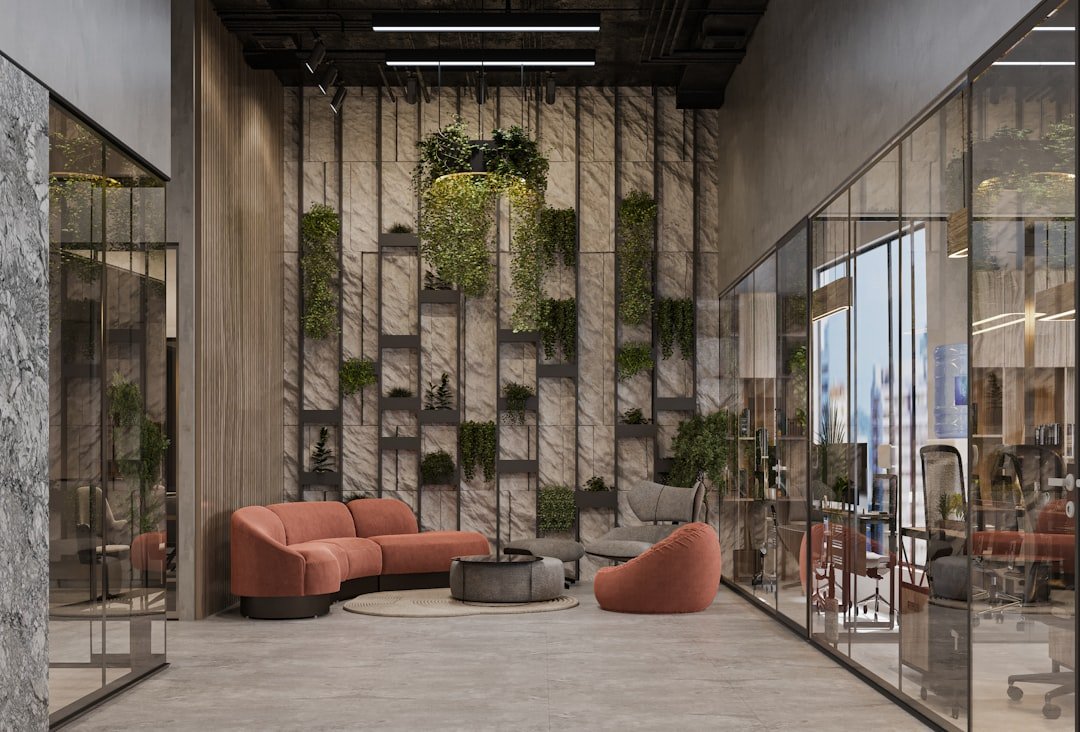
Biophilic design is arguably the most visible element of a sustainable office in 2026 — and also the most frequently misapplied. I have reviewed design proposals where "biophilic" meant a fern in a pot near reception and a nature-themed wall mural. That is not biophilic design; it is decoration. True biophilic design is a deliberate strategy to connect occupants with natural systems — light cycles, organic forms, living ecosystems, natural materials — in ways that measurably reduce stress cortisol levels and improve cognitive performance.
In the UAE context, the most effective biophilic elements are:
- Living plant walls: Internal-facing (not external — UAE summer heat stresses irrigation systems on external walls). A 3–5 sqm living wall in a reception or breakout area has high visibility impact and manageable maintenance cost. Hydroponic systems with automated irrigation are significantly easier to maintain than soil-based systems in air-conditioned UAE interiors.
- Maximised borrowed daylight: UAE offices are often deep-plan. Using glazed internal partitions, open-plan arrangements adjacent to the building perimeter, and high-reflectance ceiling finishes to push daylight 10–12 metres into the floor plate is one of the highest-ROI biophilic moves — it costs almost nothing compared to installation of a living wall and directly reduces lighting energy loads.
- Natural material accents: Solid timber joinery, stone or terrazzo reception counters, linen or woven acoustic panels on feature walls. These deliver biophilic warmth and texture without irrigation complexity. Sustainably sourced timber (FSC-certified) also contributes to LEED Materials & Resources points.
- Circadian-tuned LED lighting: Lighting that shifts from cool (5,000–6,500K) in morning hours to warm (2,700–3,500K) in late afternoon. This is a WELL Light Concept requirement and a meaningful health intervention — the UAE indoor environment is particularly biophilic-light-deprived because staff rarely experience natural light transitions inside fully air-conditioned offices.
- Nature-view artwork and framed views: Where floor-plate configuration does not allow direct daylight access, high-resolution nature photography in dedicated focus zones has been shown in peer-reviewed studies to measurably reduce stress responses. It is also the lowest-cost biophilic intervention per sqft.
Energy-Efficient MEP: The Largest Lever on Operating Cost
In a Dubai office, 60–70% of total energy consumption is typically attributable to HVAC — not lighting, not plug loads, not lifts. This means that the most impactful sustainable MEP decision is almost always in the air conditioning strategy, not in the LED specification. An office that installs LED lighting but does nothing to improve the HVAC zoning will achieve 5–8% energy reduction. An office that works with the building's chilled water system to improve zone controls, installs a demand-controlled ventilation strategy, and commissions a BMS to optimise setpoints can achieve 25–40% energy reduction on an equivalent floor plate.
Key MEP elements for a sustainable office fit-out in UAE
- Demand-controlled ventilation (DCV): CO₂ sensors in each zone control fresh-air delivery relative to occupancy. In a 50-person office where 30 people are regularly absent, DCV reduces fresh-air HVAC load by 25–35% versus a fixed-rate system.
- Variable air volume (VAV) terminal units: Where the base build allows modification of the HVAC distribution, replacing constant-volume boxes with VAV terminals gives granular zone control and significantly reduces overcooling (one of the biggest energy wastes in UAE offices).
- Building Management System (BMS) integration: A BMS that ties together HVAC setpoints, occupancy scheduling, and lighting scenes is the single highest-ROI sustainable investment per AED spent on a fit-out — typically an additional AED 15–35 per sqft above a standard electrical installation, recovering that in energy savings within 18–30 months.
- LED lighting with daylight and occupancy sensors: LED luminaires (DM GBRS mandatory) supplemented with daylight-linked dimming adjacent to windows and occupancy sensors in ancillary spaces (meeting rooms, breakout areas, toilets) can reduce lighting energy by 50–65% versus a standard LED installation without controls.
- High-performance solar film on external glazing: Where the fit-out lease terms allow glazing modification, solar-control film with a low solar heat gain coefficient (SHGC <0.25) dramatically reduces cooling load on perimeter zones — particularly south- and west-facing exposures in UAE buildings where solar gain can overwhelm the chilled air supply in summer.
Sustainable Materials Selection for UAE Offices
Materials selection under LEED CI is scored on recycled content, regionally extracted/manufactured content (within 800 km — most Middle East products qualify), rapidly renewable content, and FSC-certified wood products. Under WELL, the focus is on avoiding Red List chemicals — formaldehyde in composite wood, phthalates in PVC flooring, flame retardants in upholstery.
| Element | Sustainable Specification | LEED / WELL Benefit | Cost vs Standard |
|---|---|---|---|
| Floor — carpet tiles | Recycled-content carpet tile, low-VOC adhesive, Cradle to Cradle certified | MR recycled content + IEQ low-emitting materials | +5–12% |
| Floor — hard | FSC-certified engineered timber or recycled-content LVT (no PVC if targeting WELL) | MR wood, WELL Materials Red List avoidance | +8–18% |
| Paint | Low-VOC <50g/L (walls), <150g/L (trim) — DM GBRS mandatory | IEQ low-emitting materials; WELL Air Concept | +3–6% |
| Joinery / casework | FSC-certified plywood substrate; formaldehyde-free (E0 or CARB Phase 2) MDF | MR certified wood; WELL Materials | +10–20% |
| Acoustic panels | Recycled PET felt or natural wool; low-VOC binder | IEQ acoustic performance; WELL Sound | +5–15% |
| Raised access flooring | High recycled-steel-content panels | MR recycled content | Neutral to +5% |
One materials decision worth highlighting: avoid standard PVC vinyl flooring if pursuing WELL certification. PVC contains phthalate plasticisers that are on the WELL Red List, and while low-phthalate alternatives exist, they carry a premium. If the budget does not support timber or WELL-compliant LVT across the whole floor plate, a practical approach is to use compliant hard flooring in focus-work and private office zones (where occupants spend most of their time) and standard carpet tiles in open-plan areas where dwell time per sqft is lower.
Sustainable Office Fit-Out Cost Tiers
Meets DM Green Building Regulations mandatory baseline. LED with basic controls, low-VOC paints, water-efficient fixtures, ASHRAE-compliant ventilation. No third-party certification. Typical for SME offices in Sharjah, Dubai suburban districts. Green premium ~18% over a conventional fit-out.
Full LEED CI documentation, energy model, commissioning agent, living plant feature, high-performance glazing film, BMS integration, recycled-content/FSC materials, daylight sensors. Typical for regional HQs, professional services firms. Green premium ~24% over conventional.
LEED CI Gold or Platinum + WELL Gold or Platinum co-pursuit. Full biophilic design strategy, circadian lighting, acoustic engineering, air quality monitoring stations, premium sustainably sourced joinery, post-occupancy performance verification. Flagship offices, multinational HQs. Green premium ~28%.
These figures cover the interior fit-out works and sustainable-specific MEP enhancements. They exclude LEED/WELL registration and certification fees (typically USD 4,000–20,000+ for a mid-size office depending on area and rating level), commissioning agent fees (AED 35,000–120,000), and any base-build modifications to the building's central HVAC plant — which are a landlord negotiation, not a tenant fit-out cost.
Project Timeline: From Sustainable Brief to Certified Completion
| Phase | Duration | Green-Specific Deliverables |
|---|---|---|
| Concept Design + Green Strategy | 3–5 weeks | Sustainability brief, target credits/concepts, LEED/WELL registration, energy model basis of design |
| Detailed Design + DM Permit | 5–7 weeks | GBRS compliance schedule, energy model, materials cut-sheet register, DM permit submission with green documentation |
| Procurement | 4–6 weeks (parallel) | Green material sourcing, recycled-content verification, VOC test certificates, FSC chain-of-custody confirmation |
| Construction + Fit-Out | 10–18 weeks | Indoor air quality management plan, construction waste diversion tracking, BMS commissioning |
| Commissioning + Snagging | 2–3 weeks | BMS functional testing, lighting controls commissioning, HVAC balancing and TAB report |
| LEED CI Submission + Review | 6–12 weeks (post-completion) | USGBC online submission, design-phase and construction-phase credit documentation, reviewer Q&A resolution |
| WELL Performance Verification (if pursued) | 8–14 weeks (post-occupancy) | Air quality sampling, lux measurement, thermal comfort survey, WELL Performance Testing Agent report |
The critical project management insight here is that LEED and WELL documentation must be live throughout the construction phase — not assembled retrospectively at the end. Material submittals need to be checked against the cut-sheet register before installation, not after. Waste diversion logs need to be maintained weekly by the contractor's site team. When the documentation programme runs in parallel with construction rather than being deferred to completion, the certification timeline compresses significantly and the risk of credit failures drops to near zero.
On V Square-managed green projects, we embed a sustainability documentation coordinator into the project management team from the design stage. It adds a small overhead to the PM fee but consistently saves more in remediation and credit-failure costs than it costs.
Common Mistakes in UAE Green Office Fit-Outs
Treating green as a design add-on, not a brief requirement. The single most expensive mistake is commissioning a standard office design and then asking the designer to "make it green" in the third revision. Sustainability fundamentally affects space planning (maximising daylight penetration), MEP strategy (BMS integration from day one, not retrofitted), and materials selection (long-lead procurement for FSC joinery). A green brief must be established before concept design begins.
Underestimating the documentation burden of LEED CI. LEED CI certification is achievable and worth pursuing — but it requires disciplined documentation management from permit stage to completion. Contractors in UAE often have limited LEED site management experience. Assigning a dedicated LEED documentation coordinator (either in-house or via the project management team) is not optional on a Gold-targeted project; it is the difference between achieving 62 points and achieving 58 and losing Silver.
Specifying living walls without a maintenance plan. Living walls are the element most frequently installed and most frequently allowed to deteriorate. A wall of dead plants is worse for biophilic perception than no plants at all. Before specifying a living wall, establish who maintains it, at what frequency, at what annual cost, and what the plant-replacement protocol is. If that answer is uncertain, a curated cluster of high-quality potted plants on a regular maintenance contract delivers comparable biophilic benefit with far lower failure risk.
Choosing the wrong glazing film specification. Solar-control film is one of the most effective sustainable interventions in a UAE office, but the specification matters. A low-SHGC film that also significantly reduces visible light transmission will require more artificial lighting — negating part of the energy saving. The right specification depends on orientation, floor depth, and the lighting design strategy. This is a calculation, not a product choice.
Related Guides
Frequently Asked Questions
How much does a sustainable office fit-out cost in Dubai in 2026?
A sustainable office fit-out in Dubai costs AED 250–320 per sqft at DM GBRS compliance level, AED 320–400 per sqft for LEED CI Silver or Gold, and AED 400–480+ per sqft for LEED Gold or WELL co-certified premium workplaces. The green premium over a conventional fit-out of the same scope is typically 18–28%, recovering in 4–7 years through energy savings of 20–35%.
Is Dubai Municipality's Green Building Regulation mandatory for office fit-outs?
Yes. Dubai Municipality's GBRS applies to all fit-out works requiring a DM permit, which covers virtually every office fit-out of commercial scope. Mandatory elements include LED lighting, low-VOC finishes, water-efficient fixtures, thermal-compliant glazing, and ASHRAE 62.1 ventilation rates. DM checks GBRS documentation at the permit stage — non-compliant submissions are returned without approval.
What is the difference between LEED CI and the WELL Building Standard?
LEED CI focuses on the building's environmental performance: energy efficiency, water use, sustainable materials, and indoor environmental quality. WELL focuses on occupant health: air quality, water purity, circadian lighting, thermal comfort, acoustics, and toxin-free materials. They overlap by roughly 35–40% and many organisations in Dubai pursue both simultaneously. LEED CI is slightly less expensive to certify; WELL requires post-occupancy performance testing, which adds 8–14 weeks after practical completion.
What biophilic design features work best in UAE office environments?
The most effective biophilic features in UAE offices are: internal living plant walls (hydroponic, automated irrigation, away from external walls); borrowed daylight maximised through glazed internal partitions; natural material accents — solid timber joinery, terrazzo, woven acoustic panels; circadian-tuned LED lighting shifting from cool morning to warm afternoon tones; and nature-view photography or artwork in deep-plan focus zones. Full indoor gardens are architecturally striking but carry high maintenance cost; curated living walls plus material accents deliver 80% of the biophilic benefit at significantly lower overhead.
Does a green office fit-out take longer than a standard fit-out in Dubai?
DM GBRS compliance adds minimal programme time — perhaps 1–2 weeks for documentation at permit stage. LEED CI certification adds 4–8 weeks for documentation and USGBC review after practical completion. WELL certification adds a further 4–10 weeks for post-occupancy performance verification. The construction phase is comparable in duration to a conventional fit-out; the additional time is in design documentation, commissioning, and third-party verification — not in physical build activity.
Planning a Sustainable Office Fit-Out in UAE?
V Square manages green office fit-outs end-to-end — from LEED CI documentation and DM permit to BMS commissioning and certified handover. We have delivered sustainable workplaces across Dubai, Sharjah and Abu Dhabi.
Get a Free Consultation