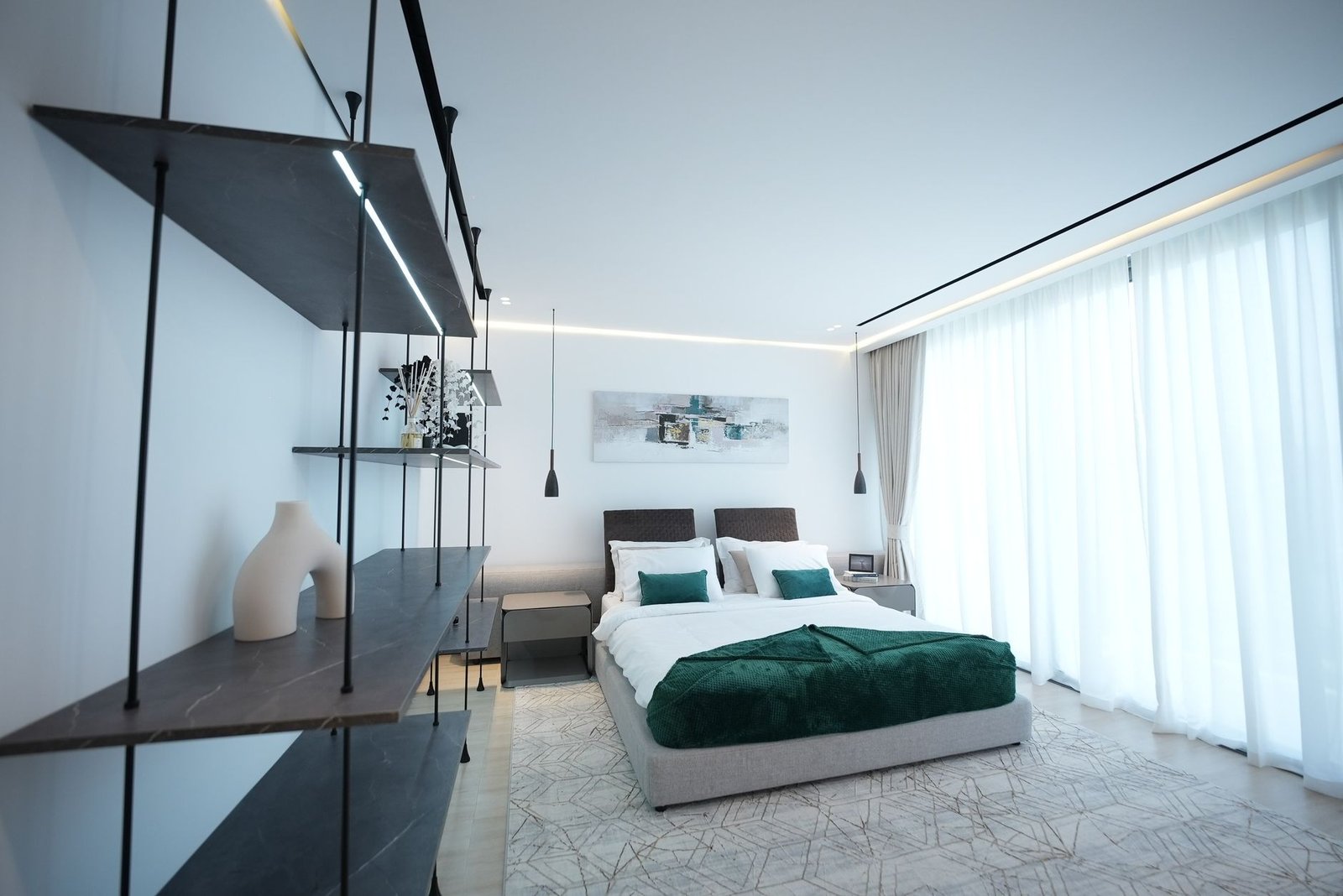
Of all the spaces we design at V Square, bedrooms tend to carry the highest emotional weight. The living room is for guests; the kitchen is for function. The bedroom is where a client actually lives — wakes up, unwinds, starts and ends the day. And yet it is routinely the room where budget pressure gets applied first, usually with a directive to "keep it simple." In fifteen years of delivering residential projects across Dubai, I have learned that the bedroom is also the room where under-investment shows most — and where a considered approach to three or four elements (wardrobe, lighting, flooring and one statement wall) delivers disproportionate impact relative to its cost.
This guide covers the real cost numbers for 2026, what separates a mid-range bedroom from a premium one, which design styles are working well in the UAE market right now, and the permit question that comes up on almost every residential project.
Bedroom interior design costs per sqft in Dubai (2026)
The figures below cover the fitout scope — design fees, civil works (if needed), custom joinery, flooring, wall finishes, ceiling work, lighting, and window treatments. They exclude loose furniture, bed linen, artwork, and decorative accessories, which are treated separately further down.
| Finish Level | AED / sqft | What it includes | Example: 450 sqft master bedroom |
|---|---|---|---|
| Standard refresh | AED 60–120 | Painting, basic flooring replacement, wardrobe reface or basic unit, no MEP changes | AED 27,000–54,000 |
| Mid-range | AED 180–350 | Custom built-in wardrobes, feature wall (upholstered or panelled), quality flooring, cove ceiling lighting, motorised blinds | AED 81,000–157,500 |
| Premium | AED 400–650 | Bespoke walk-in wardrobe with island unit, upholstered headboard wall, engineered timber or marble flooring, smart lighting system, full layered lighting design | AED 180,000–292,500 |
| Ultra-luxury master suite | AED 700–1,500+ | Italian or bespoke joinery, natural stone features, Crestron/Lutron smart systems, dressing room with integrated lighting, art niche | AED 315,000–675,000+ |
One observation worth making early: the gap between a AED 80/sqft refresh and a AED 300/sqft mid-range bedroom is not primarily about quality of materials — it is about what the design scope actually covers. Wardrobes alone can account for AED 40,000–100,000 of a bedroom budget. If the quote you receive is unusually low, ask specifically what it includes for joinery and lighting — those two line items are where shortcuts typically hide.
What does a full master suite fitout cover?
In a Dubai context, a master suite tends to be designed as three connected zones rather than a single room. Understanding each zone helps you build a more accurate budget from the start.
Zone 1 — The bedroom itself
This zone covers everything from the floor to the ceiling of the sleeping area: feature wall or headboard, flooring, cove or coffered ceiling treatment, curtains and blinds, lighting (ambient, reading, accent), and wall paint or panelling. In a well-designed mid-range project, this zone costs AED 45,000–100,000 for a 400–500 sqft room. Premium projects typically see AED 120,000–200,000+ for the same area.
Zone 2 — Walk-in wardrobe or dressing area
The walk-in wardrobe is almost always the single most expensive line item in a bedroom project. A bespoke fitted wardrobe across 8–12 linear metres of hanging, shelving and drawer storage costs AED 35,000–70,000 at mid-range. A proper walk-in dressing room (12–20 sqm, with island unit, full-height joinery, integrated LED lighting and mirror panels) runs AED 60,000–150,000+ depending on material and finishes specified. If you are on a tighter budget, a high-quality reach-in system with sliding or hinged doors in a dedicated alcove can deliver most of the function at AED 20,000–45,000.
Zone 3 — En-suite bathroom
For a full master suite, the en-suite is usually designed and executed alongside the bedroom fitout. A mid-range en-suite (15–20 sqm, tiled walls and floor, frameless glass shower, freestanding or built-in bath, decent sanitary ware) costs AED 35,000–65,000. A premium bathroom with book-matched porcelain or marble, bespoke vanity, heated floor and high-specification fixtures typically lands at AED 70,000–150,000. For a full treatment of bathroom costs and scope, our bathroom renovation cost guide for Dubai 2026 covers this in detail.
Wardrobe joinery — where the budget lives
No single element defines a Dubai bedroom fitout more than the wardrobe. It determines whether a space feels complete or unfinished, and it is the item most under-costed in initial estimates. Here is a realistic breakdown for 2026:
- Imported Italian or German systems (Poliform, Pax+custom, Molteni): AED 6,000–12,000 per linear metre installed. A 14m walk-in runs AED 84,000–168,000 before the island unit.
- Bespoke UAE-fabricated joinery (good-quality local or regional): AED 2,800–5,500 per linear metre. A 14m run with full-height doors, integrated LED strips and soft-close hardware runs AED 39,000–77,000.
- Island dressing unit (drawers, velvet-lined trays, mirror top): AED 12,000–35,000 depending on size and material.
- Mirror panels (full-height, back-lit or framed): AED 4,000–12,000 for a standard wardrobe wall, more for custom framed options.
The material of the wardrobe carcass (the box itself) matters more than most clients realise. E1-grade MDF or moisture-resistant panels hold their finish and structural integrity in Dubai's temperature cycling; lower-grade options can swell or delaminate within 2–3 years. Specify the board grade in writing before you sign the joinery contract.
Feature wall and headboard design
The headboard wall is the focal point of every bedroom and the element that most differentiates a mid-range space from a premium one. The three most common approaches in Dubai 2026 projects are:
Upholstered fabric or leather panel
Custom-fabricated in the UAE, this remains the most popular option for mid-to-premium residential projects. A full-width upholstered headboard panel (wall-to-wall, floor-to-ceiling or to a decorative pelmet) with foam backing and channel-tufted or flat-panel fabric typically costs AED 8,000–22,000 depending on fabric grade and dimensions. Genuine leather panels cost AED 18,000–45,000 for the same area.
Architectural joinery feature wall
Fluted timber panelling, slatted MDF with painted or veneer finish, or geometric 3D panel systems installed across the headboard wall cost AED 6,000–18,000 for the panel work itself, plus another AED 3,000–8,000 for the concealed LED strip lighting behind or around the panels that gives the piece its depth.
Stone or large-format tile feature wall
Porcelain stone-effect panels (600×1200mm or 800×1600mm format) are increasingly used on headboard walls in 2026 as the material quality has improved significantly. A full feature wall in a premium porcelain slab behind the bed runs AED 12,000–28,000 installed. Natural marble costs AED 25,000–65,000 for the same wall depending on stone selection.
Flooring choices for Dubai bedrooms
Dubai's climate — extreme heat externally, air-conditioned interiors — means flooring in bedrooms typically sits at 19–24°C year-round with low humidity. This makes engineered timber a reliable option (unlike solid wood, which can gap in drier months). The main choices in 2026 and their realistic installed costs:
- Engineered timber (oak, walnut, herringbone): AED 40–75/sqft installed. One of the most popular choices for premium Dubai bedrooms — warm underfoot, durable, easier to repair than solid wood.
- Large-format porcelain (stone-effect 800×800mm+): AED 30–65/sqft installed. Practical choice, wide range of stone looks, very low maintenance.
- Natural marble (Carrara, Calacatta, Crema Marfil): AED 90–200/sqft installed depending on stone, slab size and bookmatching. Most common in ultra-luxury master bedrooms.
- Carpet (wool blend or quality nylon): AED 25–55/sqft installed. Still popular in guest bedrooms and children's rooms, and in some master bedrooms for clients who prefer a warm, quiet surface underfoot.
For larger apartments or villas being done comprehensively, it often makes sense to align bedroom flooring with the main living areas for visual continuity. Our apartment interior design cost guide and villa interior design cost guide both cover how this decision plays out across an entire property.
Lighting design — the most commonly under-budgeted element
In residential projects across the UAE, lighting is frequently the last line item added and the first to get value-engineered. This is the wrong order. In a bedroom, lighting is what determines whether the space feels restful or clinical — and unlike joinery or flooring, a poor lighting design is expensive to fix once the ceiling is closed and plastered.
A proper layered lighting scheme for a master bedroom includes four types: ambient (downlights or a central fixture for general illumination), task (bedside reading lights, sufficient lux at the wardrobe interior), accent (cove lighting, back-lit panels, under-bed strip lights for night mode), and decorative (a pendant or chandelier that reads as a design element). To wire this properly with separate switch circuits — so the ambient and accent zones are independently controlled — typically adds AED 8,000–20,000 to the electrical scope compared to a single-circuit solution. With a Lutron or similar smart switching system, add another AED 12,000–35,000.
The return on this investment: a bedroom that transitions from day mode (bright, functional) to evening mode (warm, low, atmospheric) with a single scene-setter is dramatically more liveable than one lit by a single overhead circuit. This is worth building into the budget early rather than retrofitting later.
Interior design styles popular in Dubai bedrooms (2026)
Modern Luxe
Clean architectural lines, rich contrasting materials (dark joinery against light stone), statement pendants, brass or brushed-gold hardware, and a restrained colour palette anchored by one bold accent. This is the most common brief we receive for master bedrooms in premium Dubai developments — it photographs well, ages well, and suits the scale of larger master suites.
Japandi
The Japanese-Scandinavian fusion that has dominated premium residential design globally for the past three years remains popular in Dubai in 2026, particularly in newer master bedrooms. Characteristics: warm oak or ash joinery with no visible handles (push-to-open or recessed grip), linen and organic cotton textiles, low platform bed frames, muted terracotta and greige palette, wabi-sabi-influenced pottery and natural objects. Notably easier to execute on a mid-range budget than Modern Luxe — the aesthetic is about restraint rather than expensive materials.
Biophilic
Natural materials — jute, rattan, linen, aged timber, textured stone — with deliberate greenery (potted plants, a live moss panel behind the bed, a small indoor tree at the window). In Dubai, this style requires some consideration for plant care in a highly air-conditioned environment: some species handle it better than others. Fiddle-leaf figs, snake plants and ZZ plants are reliable; tropical varieties tend to suffer in the dry cool air.
Contemporary Arabic
Mashrabiya-pattern joinery used as a decorative panel behind the bed or as a room divider, geometric tile accents, warm ochre and terracotta tones against cream or off-white, hand-crafted lanterns reinterpreted in modern finishes. This style sits well in villas with large master suites in Sharjah, Abu Dhabi and some Dubai communities where there is cultural context to draw on.
Do I need a permit to renovate my bedroom in Dubai?
For most bedroom fitouts — painting, new flooring, wardrobes, a feature wall, new lighting points — no Dubai Municipality (DM) building permit is required. The scope is classified as cosmetic or maintenance work. However, there are situations where you do need approval:
- Structural changes (removing or adding a wall): DM building permit required.
- Adding a new en-suite bathroom where none existed: involves plumbing and drainage — requires DM approval and, in a strata building, a developer NOC.
- Relocating AC ducting or modifying the HVAC system: requires a mechanical permit.
- Adding electrical sub-panels or significantly increasing the electrical load: requires DEWA coordination.
In any strata building (an apartment block or villa community with a developers' committee), check with building management before starting work. Most communities require a fit-out NOC — a no-objection certificate from the developer or master developer — and specify working hours and site protection requirements. Getting this step wrong can result in work being stopped on-site, which costs more to resolve than getting it right at the start.
Timeline for a bedroom interior design project
A typical mid-range master bedroom fitout in Dubai runs on this sequence:
- Week 1–3: Brief, site measure, concept presentation, material mood board, design sign-off
- Week 3–6: Working drawings, joinery shop drawings, material procurement, contractor tendering (if not already appointed)
- Week 6–10: Joinery fabrication off-site (usually 3–5 weeks lead time for bespoke work)
- Week 8–12: On-site works: civil preparation, MEP modifications, painting, flooring installation
- Week 10–14: Joinery installation, lighting commissioning, window treatments, snagging and handover
This places a typical master bedroom project at 10–14 weeks from brief to handover if run in parallel where possible. An en-suite bathroom done concurrently adds 2–3 weeks to the critical path. The timeline compresses to 6–8 weeks for a standard refresh where custom joinery is not involved.
Planning a bedroom transformation in Dubai?
We handle the brief, drawings, joinery coordination, contractor management and site supervision so you don't have to. Tell us about your space and we'll set up a no-obligation consultation.
Book a free consultationFrequently asked questions
How much does bedroom interior design cost in Dubai in 2026?
Bedroom interior design in Dubai costs AED 60–120/sqft for a standard refresh, AED 180–350/sqft for a mid-range fitout with custom joinery and feature wall, and AED 400–650/sqft for a premium master bedroom with bespoke wardrobe, upholstered headboard wall and smart layered lighting. A full master suite (bedroom + walk-in + en-suite) at mid-to-premium specification typically lands at AED 150,000–500,000 in a Dubai villa or large apartment.
What is included in a master suite fitout in Dubai?
A complete master suite fitout covers three zones: the bedroom itself (feature wall, flooring, ceiling, lighting, curtains), the walk-in wardrobe or dressing area (bespoke joinery, island unit, integrated lighting), and the en-suite bathroom (tiling, sanitary ware, shower, vanity). Each zone has its own cost and timeline — getting all three designed together from the start avoids the material conflicts and rework that come from doing them separately.
How long does a bedroom interior design project take in Dubai?
A mid-range master bedroom fitout in Dubai takes 10–14 weeks from brief to handover when custom joinery is involved. The design phase (concept to sign-off) runs 2–3 weeks; joinery fabrication adds another 3–5 weeks; on-site installation takes 2–4 weeks. A cosmetic refresh with no bespoke elements can complete in 3–5 weeks. Adding a concurrent en-suite bathroom extends the timeline by 2–3 weeks.
Which interior design style is most popular for Dubai bedrooms in 2026?
Modern Luxe remains the most requested style for master bedrooms in premium Dubai developments — clean lines, contrasting materials, brass accents, statement lighting. Japandi (warm neutrals, natural materials, minimal joinery) is a close second and often easier to deliver on a mid-range budget. Biophilic design (earthy tones, natural materials, plants) and Contemporary Arabic (geometric patterns, warm ochres, mashrabiya accents) are both growing, particularly in Sharjah and Abu Dhabi projects.
Do I need a DM permit to renovate my bedroom in Dubai?
For cosmetic renovation — painting, new flooring, wardrobes, a feature wall, new lighting points — no Dubai Municipality permit is required. You need approval for structural changes (wall removal or addition), adding a new en-suite bathroom, relocating AC ducting, or modifying electrical sub-panels. In any strata building, always get a fit-out NOC from the developer or building management before starting work, regardless of scope — it is a required step, not optional.
See also: Kids' room interior design in dubai 2026.