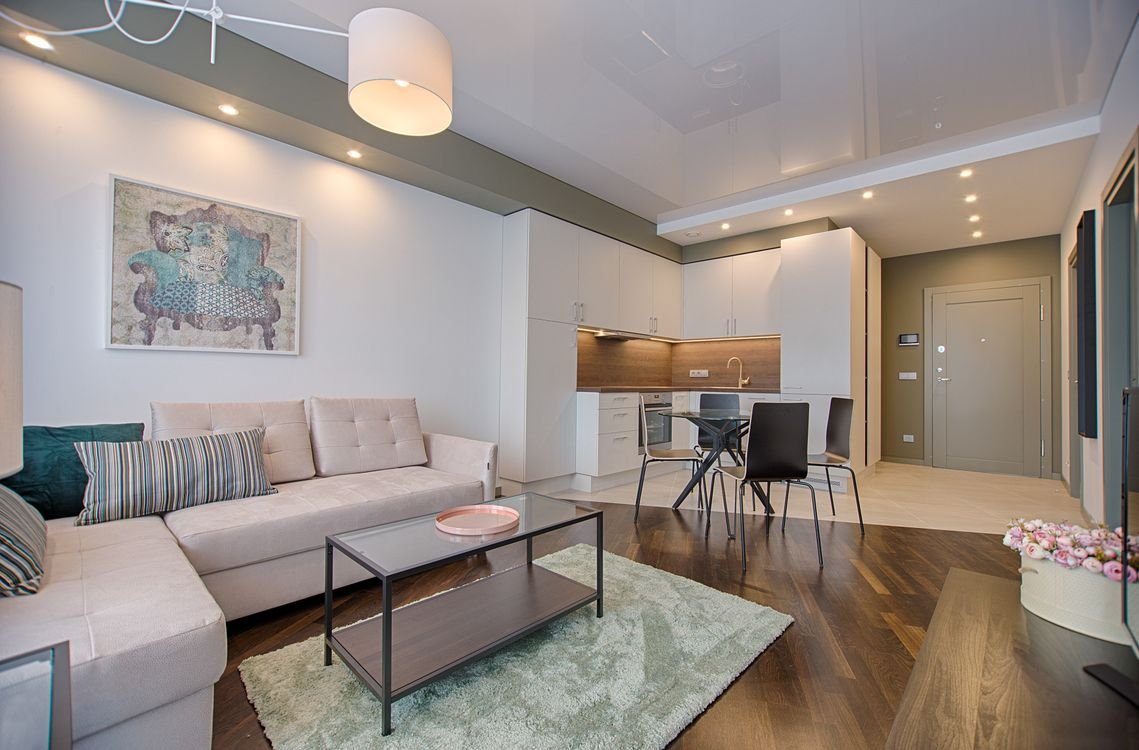
The living room is the room clients spend the most on and agonise over the longest — and with good reason. It is the first space a guest sees, the room the family uses most, and the zone that sets the visual tone for everything beyond it. In Dubai’s residential market in 2026, expectations have risen sharply: the era of a beige sofa in front of a white wall is firmly over, replaced by considered material palettes, layered lighting and furniture that responds to the Gulf’s indoor lifestyle.
This guide covers what a living room fitout actually costs in Dubai today, which design styles are leading the market, how to plan the layout before a single quote is issued, and what the fitout process looks like from brief to handover — drawn from V Square’s residential projects across Dubai, Sharjah and Abu Dhabi.
Cost Overview: Living Room Fitout in Dubai 2026
| Finish Level | AED/sqft | What You Get |
|---|---|---|
| Budget / Refresh | AED 80–180 | Repaint, LVP or ceramic tile flooring, off-the-shelf furniture, basic pendant lighting upgrade, ready-made curtains. No joinery work. Suits rental properties or a cosmetic refresh. |
| Mid-Range Renovation | AED 180–280 | New flooring (engineered timber or large-format porcelain), TV feature wall with integrated joinery and LED cove, custom display unit, layered ambient and task lighting, semi-bespoke sofa and curtain system. Suits most Dubai apartment living rooms. |
| Premium | AED 280–420 | Stone or marble flooring, fully bespoke joinery, smart-lighting controls, motorised curtain system, designer furniture, statement ceiling treatment (coffered or cove), high-end soft furnishings and artwork curation. |
| Luxury / Villa | AED 420–700+ | Full architectural transformation: natural stone flooring, hand-plastered walls, bespoke upholstered seating, imported European FF&E, full AV integration with concealed speakers, motorised TV unit, DALI or KNX lighting control, feature ceiling chandelier installation. |
These ranges assume a shell-and-core or existing-fit living room with standard ceiling height (2.8–3.2m). Buildings requiring slab levelling, structural wall removal or major HVAC rerouting will add 15–30% to the base cost.
Key Cost Lines — Where the Budget Goes
TV Feature Wall (AED 8,000–90,000+)
The TV wall has become the room’s focal anchor and its most visible design investment. At entry level, an MDF or laminate panel with cable management and basic LED strip runs AED 8,000–18,000 installed. A mid-range unit — fluted veneer or PU panels flanking the TV with integrated open shelving, a hidden cable route and indirect cove lighting — costs AED 18,000–40,000 for a 3.5–4 metre run. A bespoke marble or bookmatched veneer feature wall with built-in display niches, concealed equipment housing and motorised ambient lighting typically costs AED 45,000–90,000. None of these figures include the television.
The most common budget error in living room projects is under-specifying the electrical works for the TV wall. Plan for a minimum of four sockets, two HDMI conduits, a Cat-6 data point and at least two 5A lighting circuits built into the joinery from day one. Retrofitting these after the wall is built adds AED 4,000–8,000 and means cutting into finished joinery.
Flooring (AED 35–250/sqft installed)
Flooring is the room’s largest single surface and the material choice defines the entire colour temperature of the space. Luxury vinyl plank (LVP) at AED 35–60/sqft installed is the most cost-efficient option and performs well in Dubai’s humidity — it sits better under air conditioning than real timber and is acoustically kinder in apartments with thin slabs. Porcelain tile (AED 40–80/sqft for mid-range; AED 80–140/sqft for large-format 1200×1200 or 1600×800 formats) is the dominant choice in Dubai apartments. Engineered timber (AED 80–130/sqft) adds warmth and is widely used in villa living rooms and premium apartment projects. Marble (AED 120–250/sqft for Carrara, Calacatta or Botticino grades, installed and sealed) remains the prestige choice for luxury properties.
Custom Joinery and Display Units (AED 15,000–70,000)
Beyond the TV wall, most living room fitouts include at least one additional joinery element: a console with storage, floating display shelves, a drinks cabinet or a full floor-to-ceiling bookcase wall. A bespoke floor-to-ceiling shelving wall (3m wide, 2.8m tall, closed lower cabinets and open upper display section) in a mid-range lacquered MDF finish with push-open hardware and integrated lighting runs AED 18,000–35,000 fabricated and installed. In premium veneer or high-gloss lacquer with soft-close hardware and glass-fronted sections, expect AED 35,000–65,000 for the same footprint.
Lighting and Smart Controls (AED 15,000–80,000)
Lighting is where a living room transforms from functional to atmospheric. A standard recessed downlight grid with a single pendant over the seating area costs AED 8,000–15,000 for a 350 sqft room. A properly layered scheme — cove uplighting for ambient wash, directional spots for artwork and display niches, an architectural pendant or chandelier over the seating group, and integrated LED strips inside joinery — costs AED 25,000–50,000 in materials and installation. Adding a smart-lighting control system (Lutron, Legrand or similar) with scene presets, dimming and app control adds AED 15,000–30,000 for a single room.
Sofa, Furniture and Soft Furnishings (AED 15,000–200,000+)
Furniture and soft furnishings are the most variable line in any living room budget. For a mid-range Dubai apartment project — L-shape or 3+2 sofa configuration, two armchairs, coffee table, side tables and a rug — budget AED 30,000–70,000 from established local retailers. Fully bespoke upholstered seating made to measure in a designer fabric, with handmade cushions and a custom-framed rug, costs AED 70,000–150,000 for the same seating group. Motorised curtain and blind systems — now standard in premium projects across Dubai — add AED 12,000–45,000 depending on the number of drops and fabric specification.
Living Room Interior Design Styles in Dubai 2026
Contemporary Arabian
The strongest design movement in Dubai residential work in 2026 is a synthesis of modern clean lines with Gulf heritage references. Arched alcoves in joinery or plaster, mashrabiya-inspired laser-cut screens, warm sandstone and travertine tones, handmade ceramic accessories and woven palm or jute textures sit alongside contemporary furniture profiles and smart technology. The palette runs from warm cream through honey oak, dusty terracotta and deep olive, with brass and matte black hardware. For apartment living rooms in Dubai, this style photographs beautifully — a real currency in a market where social visibility matters.
Modern Minimalist
The perennial choice for smaller apartment living rooms where spatial clarity matters more than visual richness. White or very light stone walls, a monolithic TV wall in a single material (fluted oak or Venetian plaster), a low-profile sofa in a neutral boucle or linen, and a single statement pendant. Well-executed minimalism in Dubai relies on material quality to carry the room — it is no longer cold or stark but needs premium specification to land correctly. A minimalist living room in a Business Bay or JBR apartment typically runs AED 180,000–280,000 all-in, with the budget concentrated in flooring and joinery quality rather than decorative accessories.
Biophilic and Natural Materials
Biophilic design has moved from trend to mainstream expectation in Dubai’s residential market. Clients are specifying living moss walls (AED 8,000–25,000 for a 2×1m installation), large indoor olive or ficus trees in custom planters, natural timber ceilings with warm-tone woodstain, raw plaster and limewash finishes, and rattan or sisal seating accessories. The appeal in Dubai is partly psychological — in a city where outdoor greenery is limited for much of the year, bringing living plant material indoors addresses a genuine sensory need and supports air quality in sealed, air-conditioned environments.
Maximalist and Eclectic Luxury
At the upper end of Dubai’s villa market — particularly in Emirates Hills, Palm Jumeirah and DAMAC Hills — maximalist interiors are reasserting themselves after years of minimalist dominance. Rich jewel tones (emerald, cobalt, deep plum), pattern-on-pattern layering, handmade European furniture, large-scale artwork, statement chandeliers and curated objects from global sourcing. This style demands the highest joinery and material specification and the most thorough design development. Getting maximalism right requires an experienced compositional eye; getting it wrong is expensive to undo.
Layout Planning: Getting the Proportions Right
The layout determines whether every downstream decision — sofa size, TV size, lighting positions, rug dimensions — works or fights the room. In Dubai, the most common living room planning errors are: sofas too large for the circulation zone (leaving less than 800mm of walkway between sofa and coffee table), TV placement too high (ideal is screen centre at seated eye level, roughly 1.05–1.15m from floor), and rugs that are too small (a common tell of an under-designed fitout).
- Apartment living rooms in Dubai typically run 280–420 sqft. A 4.5m × 5.5m room fits an L-shape sofa up to 3.2m on its long side, a 1.3m coffee table, two armchairs and a 2.5m × 3.5m rug without the room feeling crowded.
- Villa living rooms in mid-range communities (Jumeirah Village, Arabian Ranches) typically run 480–700 sqft. At this scale, the room benefits from a furniture grouping that defines a seating island rather than pushing furniture to the walls — a common mistake in large rooms that makes them feel less intimate.
- Double-height living rooms in luxury villas (Palm, Emirates Hills) require a different approach: anchor the vertical space with a tall feature element (a bookcase wall, a chandelier or a large artwork) to avoid the room feeling like a hotel lobby.
For villa projects where the living room flows into a dining space, define the boundary between the two zones with a rug, a change in ceiling treatment or a console table placed back-to-back with the sofa — not a physical partition. This keeps the open-plan feel while giving each zone its own identity.
The Living Room Design and Fitout Process
Most clients come to us after an unsuccessful attempt to brief a fit-out contractor without a design. The result is almost always the same: a room that functions but has no coherence — mismatched material temperatures, poorly positioned lights, joinery that looked right in a sample but is wrong in context.
Our process starts with a space-planning session in the room itself, not in an office. We measure, photograph and note the natural light quality at different times of day (this matters in Dubai, where light shifts from warm amber to harsh white depending on the sun’s position relative to the window). We then develop a concept board, a material palette and a set of initial spatial options before moving to construction drawings for the joinery and MEP works.
For a standalone living room renovation in a Dubai apartment, the design phase runs 2–3 weeks and construction 4–6 weeks. Project management is embedded throughout: we coordinate joinery, MEP, flooring and soft furnishings to a single handover date.
Project Timeline
| Phase | Duration | Key Activities |
|---|---|---|
| Design and Planning | 2–3 weeks | Space planning, concept board, material palette, joinery drawings, MEP scope |
| Permit (if structural or MEP changes) | 2–4 weeks (parallel) | Dubai Municipality building modification permit if walls or major MEP are touched |
| Flooring and Base Works | 5–8 days | Existing floor removal, screed levelling if needed, new floor installation and grouting |
| MEP Works | 3–5 days | New lighting circuits, data points, HDMI/AV conduits, A/C repositioning if required |
| Joinery Installation | 5–10 days | TV wall unit, display shelving, console — fabricated off-site, installed in sequence |
| Painting, Lighting and Finishing | 3–5 days | Feature wall paint or plaster finish, lighting fixture installation, snagging |
| Furniture, Soft Furnishings and Styling | 2–3 days | Delivery, placement, curtain hanging, accessory arrangement, final photography |
Total on-site construction time for a mid-range living room renovation: 4–6 weeks. Custom overseas furniture ordered in the design phase runs in parallel and is typically delivered into a completed room. If furniture is sourced locally, the full project from brief to handover can be completed in 6–8 weeks.
What Drives Cost Up — and What Keeps It Down
Three things reliably push a living room project over budget: changing the flooring specification after the order is placed (restocking fees and delivery delays), discovering during demolition that the existing slab needs levelling or patching (add AED 8,000–20,000 for epoxy or screed repair), and furniture specified without firm dimensions relative to the room (a sofa 200mm too wide in a 3.8m width is not a minor problem).
Three things reliably keep a living room project within budget: locking the material palette before any orders are placed and treating any change after that point as a formal variation with a cost impact; using a single interior design team responsible for coordinating all trades rather than briefing joinery, MEP and flooring separately; and agreeing a fixed-fee design-and-build contract with a detailed scope of works rather than a lump sum with vague inclusions. The fit-out project management framework V Square applies across all residential projects is built around these three controls.
Redesigning Your Living Room in Dubai?
V Square manages the full process — design, joinery, flooring, lighting and soft furnishings — to a fixed timeline and transparent budget. We have delivered residential interiors across Dubai, Abu Dhabi and Sharjah.
Get a free consultation →Frequently Asked Questions
How much does living room interior design cost in Dubai in 2026?
A living room redesign in Dubai costs AED 180–280/sqft for a mid-range renovation (new flooring, TV feature wall, ambient lighting, custom display joinery and reupholstered seating), AED 280–420/sqft for a premium fitout (marble or stone flooring, bespoke furniture, full smart-lighting system, biophilic elements) and AED 420–700/sqft for a luxury concept with imported FF&E, motorised curtains and full AV integration. For a 350 sqft apartment living room, expect AED 65,000–150,000 all-in.
What is the most popular living room interior design style in Dubai 2026?
Contemporary Arabian — blending modern clean lines with warm tones, arched alcoves, mashrabiya-inspired detailing and natural stone — is the dominant style for Dubai homes in 2026, particularly in villa and luxury apartment projects. Modern minimalist (neutral palette, hidden storage, statement lighting) is popular in mid-range apartments. Biophilic design featuring indoor planting, natural timber and woven textures is growing strongly across all segments.
How much does a TV feature wall cost in Dubai?
A TV feature wall in Dubai costs AED 8,000–18,000 for a basic laminate or MDF panel with cable management, AED 18,000–40,000 for a mid-range unit with fluted panels, integrated shelving and concealed LED cove lighting, and AED 40,000–90,000+ for a bespoke marble-clad or veneer wall with built-in display niches, motorised TV lift and ambient backlighting. Cost depends on material, width (3m vs 5m+) and electrical works required.
What flooring is best for a living room in Dubai?
Porcelain tile (AED 40–80/sqft installed) is the most common choice in Dubai apartments for its durability. Engineered timber (AED 80–130/sqft) gives a warmer feel and is widely used in villas and premium apartments. Marble (AED 120–250/sqft) is the prestige choice for luxury properties. Luxury vinyl plank (LVP) at AED 35–60/sqft is popular in rental-market fitouts for its cost, acoustic performance and resistance to Dubai humidity.
How long does a living room renovation take in Dubai?
A living room renovation in Dubai typically takes 4–6 weeks from design sign-off to completion: 5–8 days for flooring, 3–5 days for MEP works, 5–10 days for joinery installation, and 3–5 days for painting, lighting and finishing. Custom furniture ordered from overseas adds 6–12 weeks lead time and should be factored into the project timeline from the first design session.
Cost figures reflect Dubai market rates as of mid-2026. Final budgets depend on existing shell condition, material specification and site access. Request a project-specific quote before committing to any budget.