What is interior lighting design and why does it matter in Dubai?
In this guide
Good interior lighting design Dubai 2026 projects share one characteristic: the lighting scheme is decided before the electrical first-fix, not after.
Most fit-out projects I review start with a lighting budget that is half of what it should be and an electrical plan that was drawn without a lighting concept in hand. The result is a beautifully finished space that feels flat in the evenings — downlights scattered at regular intervals, no cove or accent layer, and a single switch that turns everything on or off at once. Retrofitting a proper lighting scheme after completion easily costs twice as much as getting it right during the fit-out. This guide covers what good interior lighting design actually involves in Dubai in 2026, what it costs, and how to get the most from your electrical budget.
The 3 Core Layers of Interior Lighting Design
Professional lighting designers — and the best fit-out companies — work with three distinct layers. Every room needs all three, even if the budget limits the specification of each.
1. Ambient Lighting
Ambient lighting is the primary source of general illumination. In Dubai apartments and villas it typically comes from recessed LED downlights, surface-mounted ceiling fixtures or — for a more sophisticated result — cove lighting that bounces light off the ceiling rather than directing it downward. The goal is even, shadow-free brightness across the floor plane. A 30 sqm living room needs roughly 2,000–3,000 lumens of ambient light; downlights rated at 600–800 lumens each mean four to five fixtures at a minimum. Warm white (2,700–3,000 K) is standard for residential; neutral white (3,500–4,000 K) suits offices and commercial kitchens.
2. Task Lighting
Task lighting focuses light exactly where work happens: under kitchen cabinets for food preparation, a reading lamp beside a bed, pendant lights above an island, or a desk lamp angled toward a laptop screen. In kitchen fit-outs across Dubai, under-cabinet LED strips are now essentially standard — they add AED 800–2,500 depending on linear metres and are almost impossible to retrofit cleanly without opening the joinery again. The same principle applies to bedroom side tables: wall-mounted reading lights free up surface space and look far better than table lamps on a tight nightstand.
3. Accent Lighting
Accent lighting highlights — artwork, textured walls, display shelving, architectural niches, or the plants in a biophilic corner. Track lights with adjustable heads, wall washers and LED spotlights with narrow 15–24° beams are the most commonly specified options. A single track with four adjustable spots can transform a bland hallway into something that feels gallery-like. On average, accent fixtures add AED 2,000–8,000 to a room depending on the number of items being lit and fixture quality.
Key Fixture Types for UAE Interiors in 2026
Cove and Indirect LED Lighting
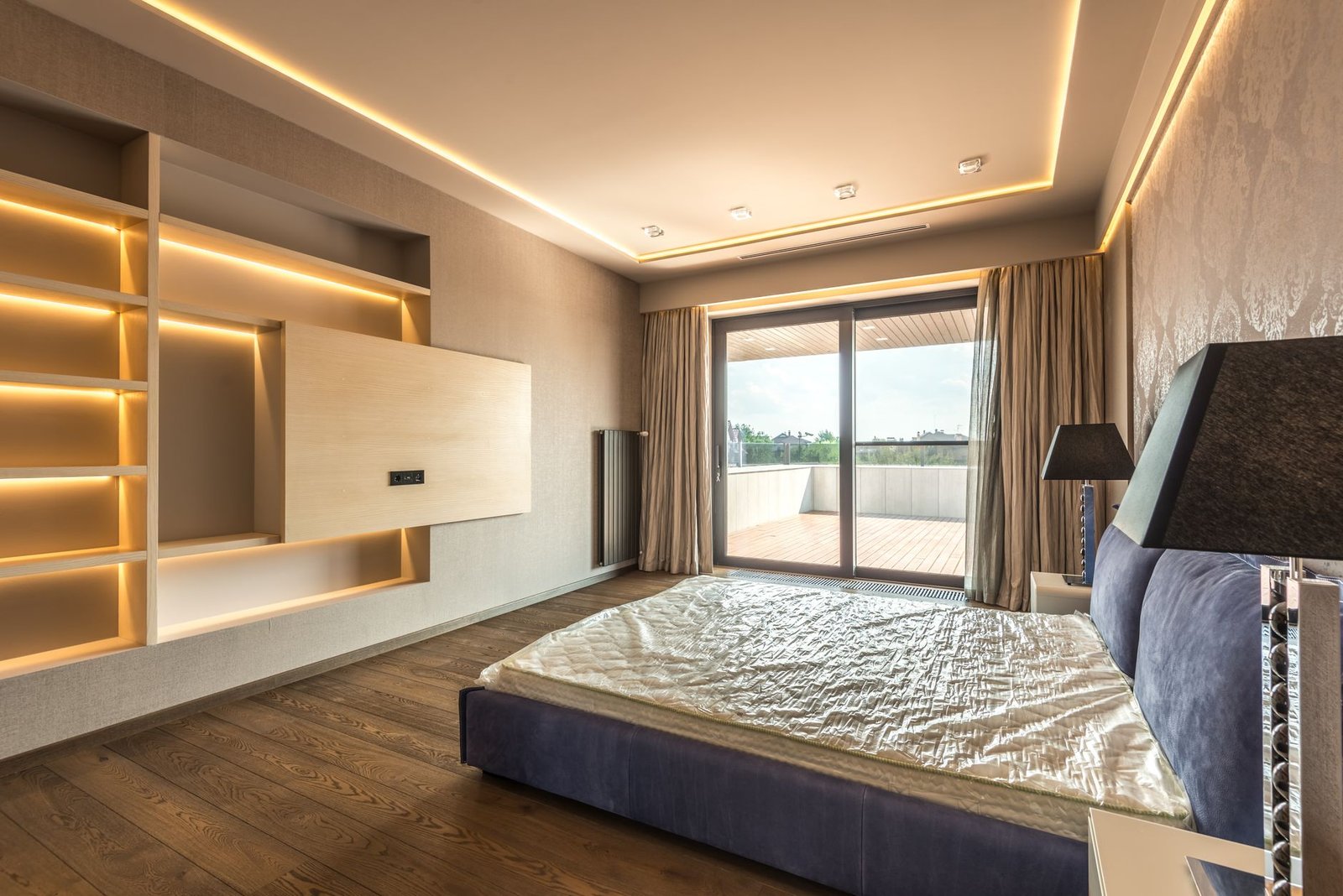
Cove lighting — LED strips tucked into a ceiling recess that face upward — is the single most requested lighting feature in Dubai interior design right now. It creates a soft, diffuse light that mimics natural skylight, makes ceilings feel higher, and works brilliantly in spaces with the tall ceilings common to UAE villas and newer apartments. Installed cost runs AED 150–350 per linear metre including the aluminium profile, quality LED strip (at least IP20 rated for dry environments), and wiring. The Illuminating Engineering Society (IES) publishes the international lux-level standards used by Dubai Municipality for commercial fit-out approvals. For a large open-plan living and dining area with 20 linear metres of cove, budget AED 3,000–7,000 for this element alone.
Recessed Downlights
Still the workhorse of residential lighting in the UAE. LED downlights have replaced halogen almost entirely — modern COB (chip-on-board) LEDs deliver 80–90 CRI (colour rendering index) at a fraction of the running cost. Good-quality downlights from brands like Philips, OSRAM or Fagerhult cost AED 80–250 per fixture; budget alternatives from Sharjah traders can be as low as AED 25 but often have poor CRI, inconsistent colour temperature and a 12-month lifespan. For a 3-bedroom apartment expect 30–50 downlights, so fixture quality compounds quickly.
Pendant Lights and Chandeliers
Above kitchen islands, dining tables and entrance lobbies, pendants and chandeliers act as both functional task light and the primary decorative statement of the space. In Dubai's 2026 market, oversized statement pendants — brushed brass, smoked glass or sculptural rattan — dominate high-end residential fit-outs. Imported pendants from Italian or German brands run AED 1,500–15,000 per piece; locally sourced equivalents from suppliers in Al Quoz or DIFC design district offer reasonable alternatives at AED 400–2,500.
LED Strip Lighting
Beyond cove applications, LED strips appear under floating TV consoles, along stair risers, inside wardrobes and behind bathroom mirrors. RGB and RGBW strips allow colour tuning — useful for home cinema or hospitality projects. The quality range is enormous: avoid the cheapest strips (which fade within months), and look for strips rated at a minimum 90 CRI and 5,000–8,000 lumen per metre output for visible runs. Installed cost: AED 80–200 per linear metre for standard single-colour, AED 200–450 per metre for RGBW tunable white with a quality driver.
Wall Sconces and Picture Lights
Wall sconces flanking a bed headboard, bathroom vanity or artwork niche are the detail that separates a polished design from a functional one. They cast side-wash light that eliminates the harsh shadows of ceiling-only illumination and are particularly important in spaces where you read or apply make-up. Budget AED 300–2,500 per sconce; account for the wiring chase in the wall during fit-out — adding a sconce after plaster and paint is a full day of repair work.
AED Cost Breakdown by Room Type (2026)
The table below reflects typical supply-and-install ranges for lighting in Dubai residential fit-outs. Commercial projects in offices, clinics and retail carry a 20–40% premium for compliance-grade fixtures and additional circuit requirements.
| Room / Space | Typical AED Range | What's Included |
|---|---|---|
| Living / Dining (open plan, 40–60 sqm) | AED 12,000–30,000 | Cove lighting, 8–12 downlights, 1–2 pendants, accent track |
| Master Bedroom (25–35 sqm) | AED 6,000–18,000 | Cove or indirect ceiling, 4–6 downlights, bedside sconces, wardrobe strip |
| Kitchen (10–20 sqm) | AED 4,000–12,000 | Ceiling downlights, under-cabinet LED strips, island pendants |
| Master Bathroom (8–15 sqm) | AED 3,000–8,000 | Vanity mirror lights, ceiling downlights, niche accent strip |
| Home Office (10–15 sqm) | AED 2,500–6,000 | Task ceiling zone, desk lamp provision, bias lighting |
| Full Villa (4–5 bed, 400–600 sqm) | AED 60,000–180,000 | Full fit-out including smart dimming system, landscape and pool lighting |
| Office (100 sqm, commercial) | AED 15,000–45,000 | Grid of LED panels or linear fixtures, meeting room accent, DM-compliant lux levels |
These ranges assume quality mid-market fixtures. Using imported high-end brands (Artemide, Flos, Louis Poulsen) doubles or triples the fixture cost but rarely changes the wiring or installation spend significantly.
Smart Lighting Systems in Dubai 2026
Interior lighting design Dubai 2026 increasingly means specifying smart controls from day one. Smart home adoption in the UAE has accelerated sharply since 2024. In the premium residential sector, lighting control is now almost the norm rather than the exception in new villas and high-end apartments. The main systems specified in Dubai:
- Lutron Caséta / RA3 (wireless, AED 15,000–80,000 for a villa) — the most common entry point for smart dimming in residential. Wireless dimmers mean no new wiring runs; existing switches are replaced. Works with Apple HomeKit, Google Home and Amazon Alexa.
- Crestron (AED 80,000–400,000+) — full whole-home automation including lighting, HVAC, AV and blinds. Typical for ultra-luxury villas and Grade A commercial spaces. Requires a certified integrator.
- Tuya / Zigbee ecosystem (AED 5,000–25,000) — budget-friendly smart lighting using Wi-Fi or Zigbee mesh. Popular in apartments and medium-spec offices. Quality has improved significantly; VSQR now specifies Tuya-compatible Philips Wiz or similar for projects where full Lutron is not in budget.
- KNX (AED 50,000–200,000) — the preferred protocol for commercial buildings in the UAE. Hard-wired bus topology, extremely reliable, integrates with BMS (Building Management Systems). Mandatory for many Grade A office fit-outs.
For LEED-certified office fit-outs, occupancy sensors and daylight-linked dimming are often mandatory. DALI (Digital Addressable Lighting Interface) control is the standard protocol for LEED-compliant commercial lighting and allows individual fixture-level dimming from a single bus.
Dubai's Natural Light Challenge — and Opportunity
Effective interior lighting design Dubai 2026 must also account for the Gulf's unique solar conditions. Most lighting guides written for temperate climates assume that maximising natural light is always the goal. In Dubai, the reality is more nuanced. From May through September, direct sunlight through south or west-facing glazing delivers harsh UV that fades fabrics and finishes, causes thermal discomfort, and creates extreme contrast that makes artificial lighting look weak. A well-designed Dubai interior manages natural light rather than simply admitting as much as possible.
Practical implications for lighting design:
- Blackout capability is standard in master bedrooms and home cinemas — pair with motorised blackout blinds (already common in UAE fit-outs) and ensure your lighting scheme works at full output during the day.
- East-facing rooms receive the best morning light in Dubai without the afternoon glare; artificial lighting in east rooms can be lower-powered and warmer in tone.
- Tunable white LEDs (2,700–6,500 K adjustable) allow the colour temperature of artificial light to track the time of day — warm in the evening, cooler and more energising during working hours. This is particularly effective in home offices and co-working spaces where the occupant is inside during peak daylight hours.
- Outdoor and pool lighting must be IP65-rated at minimum (IP67 for submerged pool lights) given the temperature swings, humidity spikes in September–October, and sand ingress common in Dubai conditions.
How to Brief Your Lighting Designer or Fit-Out Company
Interior lighting design Dubai 2026 decisions are easiest and cheapest to make before the electrical first-fix (the point where conduit runs and back boxes are set in walls and ceilings). Once the plaster is on, moving a downlight position or adding a cove channel means breaking open the ceiling. Brief your fit-out team on lighting at the same time as your interior concept — not after the furniture layout is finalised.
The five questions to answer before any lighting work starts:
- How is each room used, and at what times? A majlis used for family evenings needs very different lighting from a home office used 9 to 5.
- What is your dimming preference? Do you want scene control (pre-set moods at the touch of a button), simple dimmers, or a smart app-based system?
- Are there specific features to highlight? Artwork collections, architectural arches, a statement kitchen backsplash, or a landscaped garden visible through glazing all reward dedicated accent circuits.
- What is the fixture budget per room? This determines whether you are specifying entry-level Philips downlights or imported Italian pendants — and your lighting designer needs this number before specifying anything.
- Will there be any smart home integration? If yes, confirm the protocol (Lutron, Crestron, KNX, Tuya) before the electrical first-fix so conduit and wiring can be sized correctly.
At VSQR we manage lighting design as part of the overall fit-out project management process — coordinating the lighting consultant, MEP engineer and fit-out contractor so that fixture positions, lux-level requirements and dimming schedules are resolved before any ceiling is closed. It saves significant rework cost and gives clients a finished result that matches the design intent rather than a compromised version of it.
Get a Lighting Design Consultation for Your Project
V Square has delivered lighting design coordination for 500+ projects across Dubai, Sharjah and the wider UAE — offices, villas, hospitality and commercial fit-outs. Tell us about your space and we'll advise on the right approach and budget.
Request a Free ConsultationFrequently Asked Questions
How much does interior lighting design cost in Dubai?
Interior lighting design in Dubai typically costs AED 5,000–15,000 for a professional lighting plan (consultant fee) and AED 10,000–80,000 or more for fixture supply and installation across a typical apartment or villa. A single well-specified living room with cove lighting, recessed downlights and accent pendants generally runs AED 8,000–25,000 including fixtures and wiring. Smart lighting systems add AED 15,000–400,000 depending on brand and scale of automation.
What are the 3 types of interior lighting design?
The three core layers are: (1) Ambient lighting — general illumination from ceiling fixtures, recessed downlights or cove lighting; (2) Task lighting — focused light for specific activities such as reading lamps, under-cabinet kitchen strips or desk lamps; and (3) Accent lighting — directional light to highlight artwork, architectural features or display shelves, typically using spotlights, track lights or wall washers. A well-designed interior lighting scheme uses all three in every major room.
Is cove lighting popular in Dubai interior design?
Yes — cove lighting is one of the most requested features in Dubai interior design for 2026, especially in living rooms, master bedrooms and majlis spaces. It creates a soft skylight effect that reduces the harshness of direct downlights and works well with UAE high ceilings. LED strips in a ceiling recess cost roughly AED 150–350 per linear metre installed; the indirect light significantly enhances a space's mood at relatively low energy cost.
Do I need a lighting designer for my Dubai fit-out?
For a straightforward apartment renovation, a skilled interior designer or fit-out company can handle basic lighting layouts without a separate specialist. However, for large villas, high-end commercial spaces, hotels or any project specifying smart lighting, engaging a dedicated lighting consultant is worthwhile. Their fee (AED 5,000–15,000 for most residential projects) typically saves more than it costs by reducing expensive fixture mistakes and optimising the electrical layout from the start.