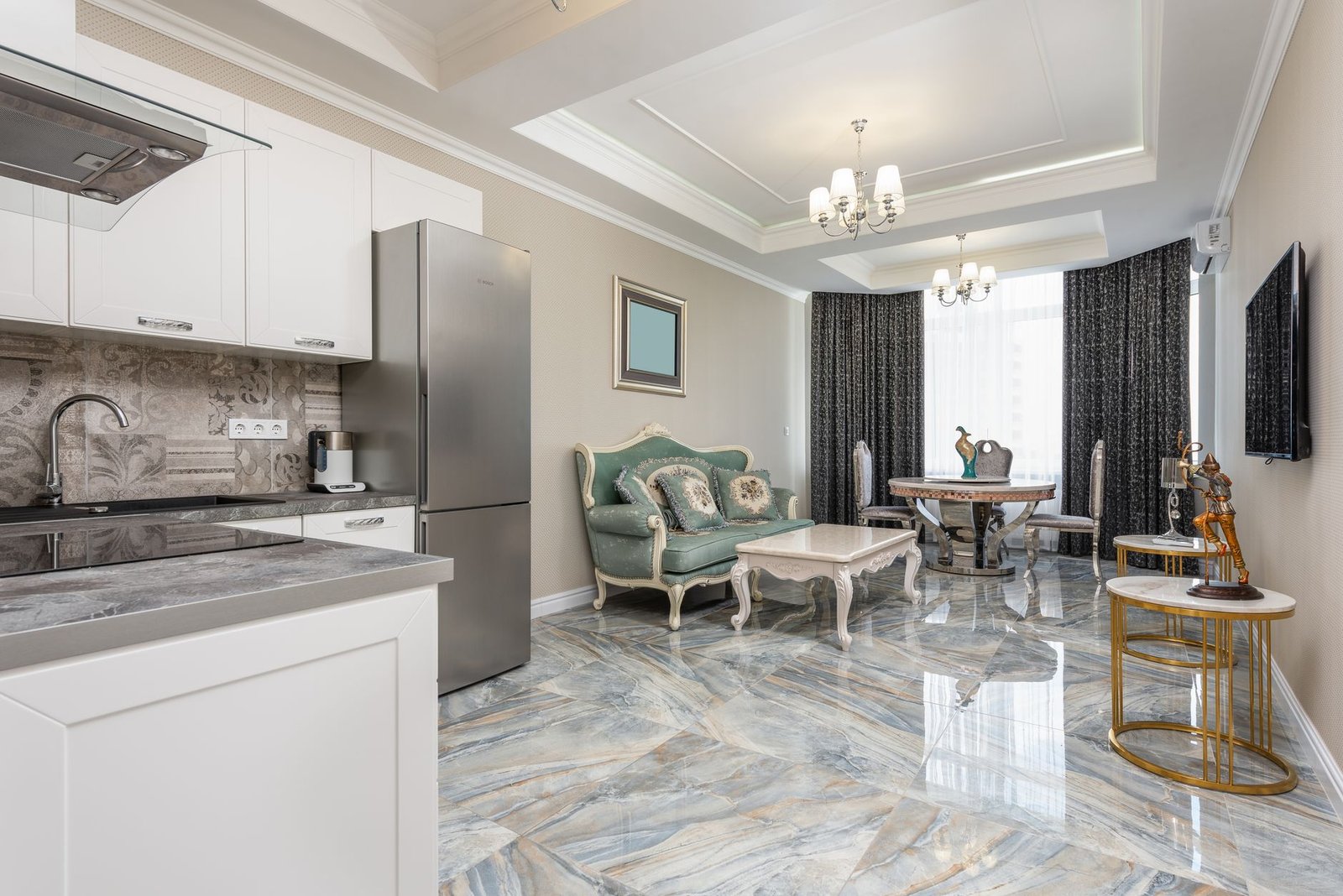
Flooring is the largest single surface in any interior space and the material choice that most visibly defines the quality and character of a fit-out. It is also one of the more permanent decisions in a renovation — unlike paint, soft furnishings or lighting, replacing flooring mid-tenancy or mid-ownership is disruptive and expensive. Getting the material right the first time, in a climate as demanding as the UAE, matters more than in most markets.
Over 500+ projects across Dubai, Abu Dhabi and Sharjah, V Square has specified and installed virtually every flooring type the market offers. The cost benchmarks below are drawn from those projects — actual procurement and installation figures from 2025–2026, not catalogue estimates.
Flooring Cost Dubai 2026 — Material Comparison
| Material | AED/sqft (installed) | Best For | Key Trade-off |
|---|---|---|---|
| Standard ceramic tile (300×300 or 300×600) | AED 40–70 | Secondary bathrooms, utility areas, staff quarters, budget rentals | Dated appearance; visible grout lines; not suitable for premium residential |
| Mid-range porcelain (600×600) | AED 60–100 | Apartments, townhouses, secondary spaces in villas | Good performance and appearance; entry-level for most Dubai projects |
| Large-format rectified porcelain (600×1200 or larger) | AED 90–160 | Living rooms, open-plan apartments, corridors, commercial spaces | Requires perfectly level substrate; higher installation skill required |
| Sintered stone (Dekton, Lapitec) | AED 150–260 | Premium kitchens, terraces, high-traffic commercial; UV-stable for outdoor use | Brittle at edges if improperly supported; heavy; specialist cutting required |
| Engineered wood (oak, walnut, herringbone) | AED 90–180 | Bedrooms, living rooms, studies; warm residential aesthetic | Requires stable AC; not suitable for wet areas or unshaded outdoor use |
| Natural marble (Calacatta, Carrara, Emperador) | AED 150–400 | Entrance lobbies, living rooms, master bedrooms, luxury villas | Porous — requires sealing; etches with acids; cool underfoot (asset in UAE) |
| Luxury vinyl tile / LVT | AED 40–90 | Rental units, offices, hospitality back-of-house, child-friendly spaces | Convincing wood/stone look; easy repair; not a premium material signal |
| Carpet (wall-to-wall) | AED 30–80 | Bedrooms (premium apartments and villas), majlis sitting areas, quiet offices | Comfortable underfoot; absorbs sound; requires regular deep cleaning in dusty UAE climate |
| Terrazzo (cast in-place or pre-cast tile) | AED 180–450 | Lobby floors, heritage-aesthetic projects, bespoke commercial designs | Long on-site programme; high skill requirement; sealing essential; stunning result |
Material Deep Dive
Natural Marble Flooring Dubai
Marble remains the aspirational flooring standard in Dubai’s premium residential market, and with good reason: it is genuinely cool underfoot in summer (a real thermal benefit in a country where floors can feel warm even indoors without this), takes on character as it ages, and is expected by buyers and valuers in the luxury segment. Calacatta and Statuario grades with bold white-and-grey veining run AED 200–400/sqft installed; Bianco Carrara (subtler, more consistent veining) sits at AED 150–250/sqft; warmer Crema Marfil and Emperador grades at AED 120–200/sqft.
The installation is more complex than porcelain. Marble must be laid on a perfectly flat substrate (any undulation telegraphs through the slab), with epoxy adhesive rather than standard cement-based tile adhesive (to prevent moisture staining through the back face), and with hairline movement joints at all room perimeters and every 4–5 metres across the field. A botched marble installation — lippage, hairline cracks at joints, adhesive bleed-through — is expensive to remediate and nearly impossible to disguise. V Square uses dedicated marble layers with UAE experience, not generalist tilers who tile everything the same way.
For Dubai villa projects where marble covers the ground floor living and dining areas plus the main staircase, budget AED 400,000–800,000 for the flooring scope alone on a 4,000–6,000 sqft villa, before the bedrooms are considered.
Porcelain Tile Flooring Dubai
Large-format rectified porcelain is the workhorse of Dubai’s mid-to-premium fit-out market, and in 2026 it accounts for the majority of new apartment and commercial flooring specifications. The 600×1200mm format, laid in a staggered or straight pattern with 2–3mm joints, creates a clean, contemporary surface that reads as almost seamless from a normal viewing distance. Concrete-effect, stone-effect, and wood-effect porcelain tiles have improved dramatically in print quality — a well-specified 1200×2400mm sintered stone-effect slab at AED 200–260/sqft installed is genuinely difficult to distinguish from real stone in a finished interior.
Rectified porcelain requires a substrate flatness of better than 3mm in 3 metres — tighter than the standard DM construction tolerance — which means a self-levelling compound layer is almost always required in renovation projects where an existing tile bed is removed. The levelling compound costs AED 8–15/sqft and adds 2–3 days to the programme for curing, but it is not optional if you want a lippage-free result in large-format tiles.
Engineered Wood Flooring Dubai
Engineered wood is the right choice for Dubai bedrooms and living areas where the warmth and acoustic softness of timber are prioritised over the cool hardness of tile. The key specification decision is the wear layer: a 4mm European oak wear layer on an 18mm plywood core gives 30+ years of use including two or three re-sanding cycles; a 2mm wear layer on HDF saves cost but halves the useful life. In Dubai’s premium market, we specify minimum 3mm wear layer with a 15–18mm total board thickness.
Installation method matters here more than the board grade. A fully bonded (glue-down) installation using a moisture-barrier adhesive rated to 40°C cures the board to the substrate and eliminates any movement under foot traffic. A floating installation (click-lock, no adhesive) is cheaper and faster but allows micro-movement that, over years in a climate where the slab temperature cycles between 18°C (air-conditioned) and higher when the AC is off, causes board separation and squeaking. We specify full-glue-down for all Dubai wood floor installations regardless of board format.
Herringbone and chevron patterns add 20–35% to the installation cost due to increased cutting waste and the more time-consuming layout, but they justify the premium in high-specification Dubai apartment bedrooms and studies where the pattern is as much a design feature as the wood species itself.
Luxury Vinyl Tile (LVT) and Vinyl Plank
LVT has moved from the budget end to a genuinely specified material in Dubai’s commercial, hospitality and family-residential segments. At AED 40–90/sqft installed, it undercuts porcelain by 30–50% while offering comfort underfoot, realistic wood and stone surfaces (some with genuine embossed texture), easy individual plank replacement, and complete water resistance. In offices, hotel corridors, staff accommodation and family apartments where children will be on the floor daily, LVT is a practical first choice rather than a compromise. It should not be specified in high-end residential where the material choice signals quality to buyers and valuers — the cost saving is real, but so is the perception gap.
Carpet
Wall-to-wall carpet is most consistently specified in three spaces in Dubai: master bedrooms (the comfort and acoustic softness underfoot in a sleeping space), formal majlis sitting rooms (where low seating and traditional aesthetics suit pile), and quiet executive offices or boardrooms. Cut-pile wool or wool-blend carpet at AED 60–120/sqft supply-and-lay is the standard specification for premium residential; commercial loop-pile nylon at AED 30–55/sqft handles heavy foot traffic better. The Dubai climate requires a tight-weave carpet that does not trap the fine desert dust that enters conditioned spaces daily — long-pile shag carpets look appealing in a showroom and are a maintenance burden in practice.
Flooring by Room: What Works Where
| Room | Primary Recommendation | Secondary Option | Avoid |
|---|---|---|---|
| Living room | Large-format porcelain or marble | Engineered wood (premium apartments) | Standard ceramic; carpet (high traffic) |
| Master bedroom | Engineered wood or carpet | Large-format porcelain (warm-toned) | Cold marble (comfort issue at night) |
| Kitchen | Large-format porcelain (anti-slip finish) | Sintered stone (heat and stain proof) | Marble (porous; staining risk), carpet, wood |
| Bathrooms | Rectified porcelain (R10 or R11 slip rating) | Natural marble (sealed; premium only) | Wood, carpet, unsealed stone |
| Entrance lobby / foyer | Marble or premium large-format porcelain | Terrazzo (bespoke; high-impact) | Carpet, wood (wear at threshold), LVT |
| Balcony / terrace | UV-stable sintered stone or porcelain (R11+) | Composite or treated hardwood decking | Standard porcelain (may crack in heat cycles); marble (outdoor staining) |
| Office / study | Porcelain, LVT or carpet (acoustic) | Engineered wood (executive offices) | Marble (cold; noise; not commercial-grade) |
| Majlis | Carpet (cut pile, wool blend) | Marble with area rug | LVT, standard ceramic |
Dubai-Specific Flooring Considerations
Thermal Performance
In a UAE climate where outdoor summer temperatures reach 42–48°C, flooring material affects how a room feels thermally. Natural marble and polished porcelain stay genuinely cool underfoot in a conditioned space because stone has high thermal mass and low surface resistance — a benefit that is not replicated by LVT or engineered wood. For spaces where barefoot comfort in summer is a priority (bedroom floors, pool areas, majlis), stone or tile is the material answer. Wood and carpet feel warmer but also feel softer, which is why bedroom floor specifications in Dubai often use a carpet or wood in the sleeping zone with tile or stone in the en-suite and corridor.
Dust and Maintenance
Dubai’s desert environment means fine silica dust enters every building daily through door gaps, AC intakes and human traffic. Polished marble and large-format porcelain with minimal grout lines are the most dust-manageable surfaces. Textured tiles, deep embossed wood-look porcelain, and long-pile carpet trap dust in a way that requires weekly deep cleaning versus the daily damp-mop that smooth stone and porcelain need. Grout joints should be sealed on installation and re-sealed every 12–18 months to prevent the grey staining from accumulated dust and cleaning chemical residue that makes grout the most visually aged element in a tile installation.
Subfloor Heating
Underfloor heating (UFH) is increasingly specified in premium Dubai projects — not for heating (which the climate rarely requires) but for the radiant comfort effect in air-conditioned spaces where floors can feel cold in winter months (December–February, when outdoor temperatures reach 14–18°C and indoor AC remains on). Electric mat UFH at AED 80–150/sqft for supply and installation is compatible with stone and large-format porcelain. It is not suitable under solid hardwood flooring and should only be used with engineered wood specified as UFH-compatible (stated by the manufacturer). The electrical supply circuit and thermostat must be planned before the floor covering is installed.
Flooring Installation Timeline
| Phase | Duration (1,500 sqft apartment) | Notes |
|---|---|---|
| Strip-out existing floor | 2–4 days | Tile removal requires chipping, which generates dust. Seal adjacent rooms before starting. |
| Substrate preparation and levelling | 3–5 days (including cure) | Self-levelling compound cure time is non-negotiable. Walking on it before full cure causes surface damage. |
| Tile laying (porcelain) | 8–12 days | 150–200 sqft per skilled tiler per day. Large-format tiles = slower progress, fewer lippage errors. |
| Grouting and jointing | 2–3 days | Epoxy grout (preferred) requires skilled application and cleaning within 20 minutes of setting. |
| Sealing (marble or natural stone) | 1–2 days + cure | Penetrating sealer applied after grouting; second coat after 24 hrs; full cure 72 hrs before heavy use. |
| Wood flooring (glue-down) | 5–8 days | Includes 48–72 hr board acclimatisation before installation begins. |
| Carpet fitting | 2–3 days | Fast to install; gripper rods and underlay must be in place before carpet cutting. |
| Snagging and final protection | 1 day | Floor protection boards installed immediately after laying to prevent damage by subsequent trades. |
Flooring is always installed before skirting, joinery and furniture, and after internal walls and ceiling are plastered and painted. The flooring subcontract is a critical-path item in any full interior fit-out: if it runs late, every subsequent trade is delayed. This is why V Square schedules flooring as a separate tracked work package within the overall fit-out programme, with dedicated progress reporting and early procurement of long-lead materials.
Budget by Project Type
| Project | Floor Area (sqft) | Mid-Range Budget (AED) | Premium Budget (AED) |
|---|---|---|---|
| Studio / 1BR apartment | 400–700 | 40,000–90,000 | 90,000–180,000 |
| 2BR–3BR apartment | 700–1,500 | 70,000–180,000 | 180,000–380,000 |
| Townhouse | 1,500–2,800 | 150,000–340,000 | 340,000–680,000 |
| 4–5BR villa (ground floor only) | 2,000–4,000 | 200,000–480,000 | 480,000–1,000,000 |
| 4–5BR villa (full building incl. bedrooms) | 4,000–8,000 | 400,000–900,000 | 900,000–2,000,000+ |
| Office fit-out (1,000 sqft) | 1,000 | 60,000–130,000 | 130,000–250,000 |
Mid-range budgets assume large-format porcelain (AED 90–120/sqft installed) for living areas and bedrooms, with standard porcelain in bathrooms. Premium budgets assume marble for living areas and entrance lobby, engineered wood in bedrooms, large-format porcelain in wet areas. All figures include strip-out of existing floor coverings, substrate preparation, materials, installation, grouting and sealing. Office interior design costs include flooring as a distinct line item in the fit-out budget.
Common Flooring Mistakes in Dubai Projects
The most common and most expensive flooring mistake is specifying large-format tile on a substrate that was not properly checked for flatness. A 1200×2400mm slab has zero tolerance for substrate undulation — any variation over 3mm per 3 metres will show as visible lippage (one tile edge sitting higher than its neighbour) that cannot be fixed without relaying the tiles. The fix costs as much as the original installation. The check takes 30 minutes with a 3-metre straight edge before a single tile is laid.
The second common error is ordering flooring without accounting for waste and pattern matching. Rectified porcelain laid in a straight run needs 10% waste allowance; large-format slabs laid diagonally need 15–20%; natural stone with veining that is matched across tiles (book-matching) needs 25–30%. Under-ordering means a mid-job tile purchase from a different production batch with a colour variation that is visible in the finished floor. Order once, correctly.
Third: not protecting the finished floor after installation. On a multi-trade project, the floor goes in before the joinery, doors, painting and electrical trim-out. Any one of those subsequent trades can scratch or chip the flooring. Corrugated protection boards cost AED 1–2/sqft and should be laid immediately after the floor is signed off, lifted only for the final clean at handover. Clients who skip the protection to save cost routinely spend more repairing scratches.
Planning a Flooring Project in Dubai?
V Square manages material selection, procurement, substrate preparation and installation for residential and commercial flooring projects across Dubai, Abu Dhabi and Sharjah — to a fixed timeline and transparent budget.
Get a free flooring consultation →Frequently Asked Questions
How much does flooring cost in Dubai in 2026?
Flooring cost in Dubai in 2026 ranges from AED 40–70/sqft installed for standard vinyl or ceramic tile to AED 80–160/sqft for large-format rectified porcelain, AED 90–180/sqft for engineered wood, and AED 150–400/sqft for natural marble or premium stone. A 1,500 sqft apartment floored in large-format porcelain costs AED 120,000–240,000 all-in. Full villa marble flooring runs AED 400,000–1,200,000+ depending on stone grade and total area.
What is the most popular flooring in Dubai apartments in 2026?
Large-format rectified porcelain (600×1200mm or 800×800mm) in a light stone or concrete-effect finish is the most popular flooring in Dubai apartments in 2026. It is durable, easy to clean, reflects light to make spaces feel larger, and is heat-stable in UAE temperatures. Engineered wood is the second most specified choice for bedrooms and living areas in premium apartments where the warmth of timber is preferred over the cool hardness of tile.
Is marble flooring a good choice in Dubai?
Natural marble flooring is excellent in Dubai for controlled-traffic areas — entrance lobbies, living rooms, master bedrooms, formal dining rooms. It is cool underfoot in summer, takes on a beautiful patina over time, and is expected in the luxury segment. Drawbacks are porosity (requires sealing every 12–18 months), susceptibility to acid etching, and scratch risk from grit. For kitchens and high-traffic corridors, porcelain or sintered stone is more practical.
Can you use engineered wood flooring in Dubai?
Yes — engineered wood performs well in Dubai when correctly specified. Key requirements are a minimum 3mm wear layer in a stable species, a full-glue-down installation with heat-rated adhesive, and 48–72 hour board acclimatisation before installation. AC must be maintained consistently; extended periods with AC off cause humidity-driven expansion and gaps. Avoid solid hardwood; the humidity differential between summer outdoor air and conditioned interiors causes unacceptable movement in solid planks.
How long does flooring installation take in Dubai?
For a 1,500 sqft apartment: strip-out 2–4 days, substrate levelling 3–5 days (including cure), porcelain tile laying 8–12 days, grouting and sealing 2–3 days. Engineered wood runs faster at 5–8 days for the same area. Total flooring programme: 3–5 weeks for a standard apartment. Marble installation is slower due to weight and precision requirements — allow 5–8 weeks for a full villa ground floor in natural stone.
Cost figures reflect Dubai and UAE market rates as of mid-2026. Final budgets depend on existing substrate condition, material specification, pattern complexity and site access. Request a project-specific quote before committing to any budget.