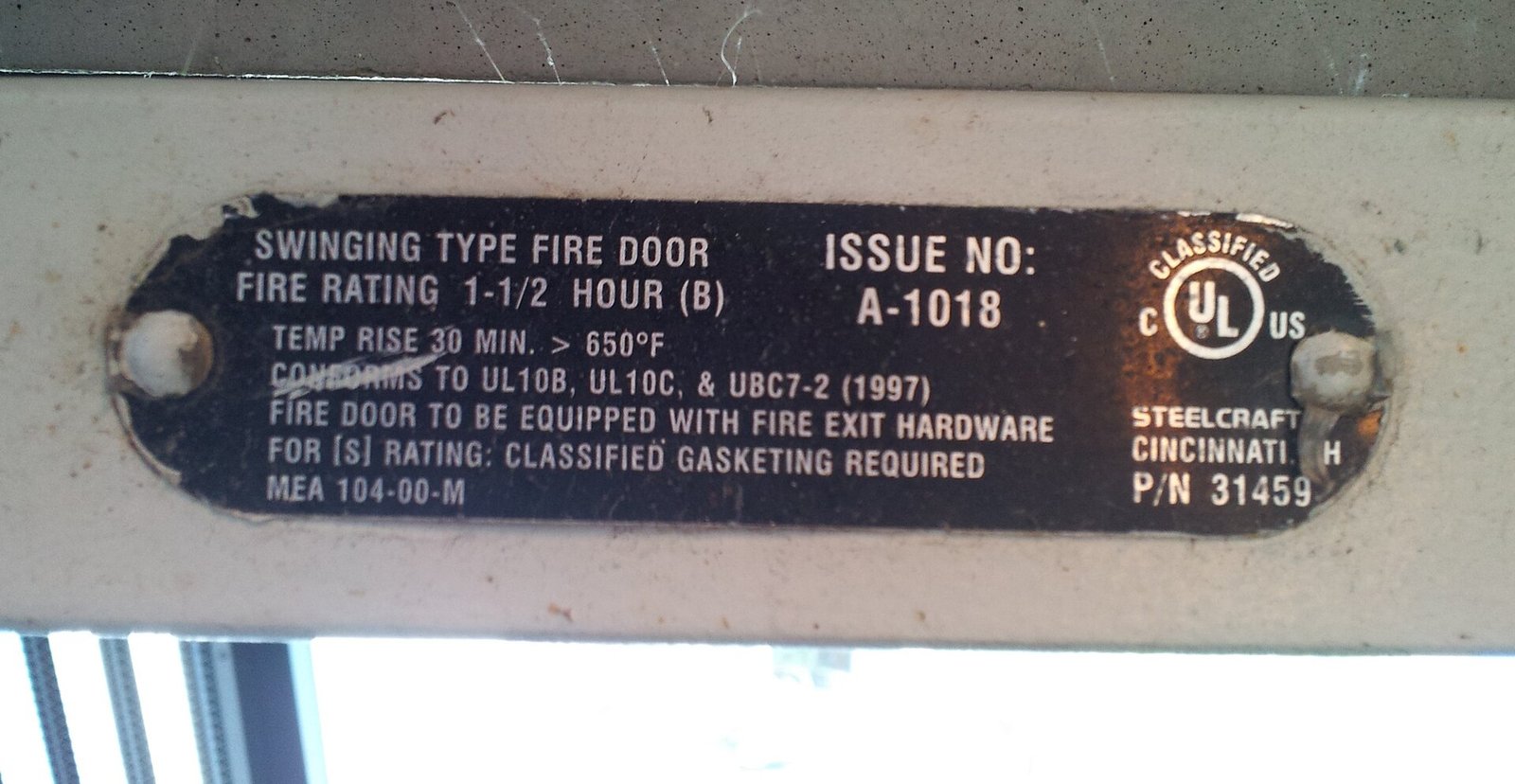
The label on the hinge edge is the inspector’s single point of truth. Paint over it and the door is unrated. Photo: Ben Schumin / Wikimedia Commons, CC BY-SA 3.0.
Fire rated door installation in Dubai is the last item most fit-out programmes take seriously and the first item an inspector walks to. They sit awkwardly between packages — the joinery contractor thinks of them as doors, the fire contractor thinks of them as somebody else’s scope, and the ironmongery schedule is often written by whoever priced the handles. That gap is where ratings get lost.
This guide covers what a fire rated door actually is in certification terms, which ratings Dubai applies by location, how the three competing test standards differ and which certificate to ask for, the document pack that has to reach Civil Defence, the installation tolerances that decide the inspection, current 2026 costs in AED, and the seven failures we see repeat across commercial fit-outs. For the approval chain that sits around all of this, start with our fit-out approval Dubai guide.
A Fire Door Is a Certified Assembly, Not a Door
This is the single most expensive misunderstanding in the category. Fire resistance is not a property of the leaf. It is a property of the tested assembly: the leaf, the frame, the intumescent and smoke seals, the hinges, the closer, the latch and lock case, and any vision panel and its glazing beads — all tested together as one specimen and certified as that combination.
The practical consequences run through the whole package:
- Substitution voids the certificate. A certified FD60 leaf hung on hinges outside the tested specification, or fitted with an uncertified lock case, is no longer covered by the certificate it shipped with.
- The frame is part of the product. Buying a rated leaf and hanging it in an existing or site-fabricated frame is not a rated installation, whatever the leaf label says.
- Ironmongery is a fire item, not a finish. Hinges, closers and locksets have to be fire-rated and correctly installed, and the schedule needs to be reconciled against the door certification before it is ordered, not after.
- Pre-hung sets exist for a reason. Complete assemblies supplied as frame, leaf, hinges, lockset, closer and seals — all certified for use together at the rated performance — remove most of the risk at a modest premium.
Treat the fire door schedule as a fire-safety submission item that happens to look like joinery. It belongs in the same conversation as firestopping and dampers, alongside the coordination issues covered in our guide to MEP coordination in fit-out projects.
Which Rating Dubai Requires, and Where
The governing document is the UAE Fire and Life Safety Code of Practice, whose 2018 edition remains the working reference across the emirates with local amendments issued by individual Civil Defence authorities. Ratings follow compartmentation logic: the door is rated to protect the opening in a rated barrier, so the barrier sets the requirement.
| Location | Typical rating | What else the opening needs |
|---|---|---|
| Stairwell enclosure (barrier) | 2 hours | Continuity of the enclosure through the ceiling void |
| Door into a stairwell | 1.5 hours min | Self-closing device and smoke seals, no mechanical hold-open |
| Corridor serving as access to exit | 1 hour | Rated door assembly, positive latching |
| Shaft and riser walls | 1 hour min | Rated access doors, firestopping at every penetration |
| Occupancy separation | 2 hours | Matching door rating both sides of the separation |
| Plant, electrical and store rooms | 1–2 hours | Self-closing, no hold-open, clear signage |
Two rules to carry into every schedule. First, hold-open devices must release on a fire alarm signal — a magnetic hold-open tied to the panel is compliant, a wedge or a mechanical catch is a finding. Second, ratings are driven by occupancy, building height and the approved fire strategy, so the table above is orientation, not a substitute for reading the stamped drawings opening by opening. Where a rated partition line changes during design development, the door schedule has to change with it; the same discipline applies to the partitions themselves, as covered in our gypsum partition Dubai guide.
BS 476, EN 1634-1 and UL 10C Are Not Interchangeable
Three test standards circulate in the UAE market, and specifications routinely name one while the delivered product carries another. They do not test the same thing.
| Standard | Furnace pressure | What it proves |
|---|---|---|
| BS 476 Part 22 (UK) | Neutral | Integrity and stability; the traditional FD30 / FD60 / FD90 notation |
| EN 1634-1 (Europe) | Positive | Integrity (E) separated from integrity plus insulation (EI) — E60 and EI60 are different products |
| UL 10C (USA) | Positive | Integrity plus a hose stream test for impact and thermal shock after exposure |
Positive furnace pressure is a harder test than neutral, which is why a BS 476 result and an EN 1634-1 result at the same nominal duration are not equivalent evidence. Across the Gulf, the trend over recent years has been toward EN 1634-1 as regional codes align more closely with European standards, though BS 476 certification remains widely held and widely accepted. Dubai and Abu Dhabi consultants often state a preference in the fire strategy — and on some building types ask for both.
The one distinction worth forcing into every specification: integrity alone versus integrity plus insulation. An E-rated door holds back flame and hot gases. An EI-rated door additionally limits the temperature rise on the unexposed face, which is what makes an escape route usable while people are still in it. Ordering E60 where the strategy assumed EI60 is a substitution that looks like a match on paper and is not.
The Certification Pack Civil Defence Asks For
Fire-rated material certificates for doors are one of the recurring reasons DCD submissions come back with comments. The pack below should exist before the doors are ordered, not assembled during commissioning.
| Document | Who produces it | Why it fails |
|---|---|---|
| Fire test certificate for the assembly | Manufacturer / test house | Covers the leaf only, not the frame and hardware as installed |
| Door schedule keyed to the stamped drawings | Consultant / PM | Openings renumbered after a layout change and never reconciled |
| Ironmongery schedule with fire ratings | Supplier | Handles and locks selected on finish, not certification |
| Intumescent and smoke seal specification | Manufacturer | Seal type not the one in the tested specimen |
| Glazing certificate for vision panels | Glass supplier | Rated glass in an unrated bead or frame detail |
| DCD-approved product label / compliance certificate | Supplier / installer | Issued generically rather than per opening |
| Installation method statement | Installer | Silent on fixing centres, frame anchoring and gap control |
| As-built door schedule | Installer / PM | Never updated after site substitutions |
The Tolerances That Decide the Inspection
Fire door clearances on UAE projects are measured against the limits established in NFPA 80, the reference standard for fire door installation and maintenance. The numbers are unforgiving because the intumescent seal is engineered around them.
Between the door edge and the frame. Tighter if the door’s own certification says so. Measured with a gauge, not by eye.
Unless the certification specifies less. Raised floors and late floor-finish build-ups are the usual cause of an oversized gap.
Intumescent seals are sized to the 3–5 mm gap and compress when the door closes. A seal spanning 6 mm of air is not doing its tested job.
The door must self-close and positively latch from any angle, not just from 45 degrees with a helpful push.
Site trimming is where ratings die quietly. A leaf cut down to suit an out-of-square opening, or a frame packed off-plumb to chase a floor level, produces gaps outside tolerance and takes the installation outside the scope of its certificate at the same time. If the opening is wrong, the correct move is to fix the opening — and that decision is far cheaper at first fix than after the joinery is delivered, which is why door openings belong on the critical path in the fit-out programme rather than in the snagging list.
What Fire Rated Doors Cost in Dubai in 2026
The figures below reflect commonly quoted UAE market ranges rather than a published tariff, and they are per opening thinking, not per leaf thinking.
| Item | Typical 2026 range (AED) | Notes |
|---|---|---|
| Certified fire rated wooden door leaf | 4,000 – 8,000 | Varies by rating, size, core type and finish; leaf only |
| Fire rated double-leaf metal door | 4,800 – 5,000 | Commonly quoted before accessories |
| Frame, seals and certified ironmongery | Separate line | Hinges, closer, lockset, intumescent and smoke seals |
| Vision panel with rated glazing | Separate line | Glass, bead detail and certificate must match the assembly |
| Installation and site works | Separate line | Frame anchoring, making good, gap verification |
Two commercial notes worth having before you price the package. Door schedules above roughly a hundred leaves typically attract factory-direct pricing, which changes the economics of standardising on one manufacturer across the project. And lead time is real: a standard FD60 single-leaf veneer door commonly runs around 4 to 5 weeks from approved shop drawings — approved, not issued. Add the shop drawing cycle and the fire door package needs to be released far earlier than most programmes assume.
The Seven Failures We See Repeat
- Leaf certified, assembly not. A rated leaf in an unrated frame, or with hardware outside the tested specification. The most common failure and the most expensive to correct.
- Label painted over or removed. The certification label on the hinge edge is how the inspector verifies what is installed. Once it is unreadable, the door is treated as unrated regardless of what the paperwork says.
- Site-trimmed leaves. Cut to fit an opening that was built wrong. Voids the certificate and usually produces out-of-tolerance gaps at the same time.
- Undercut opened up by floor finishes. The door was hung before the final floor build-up was decided, and the 8 mm limit is now 15 mm.
- Closer removed or adjusted out. Doors held open for operational convenience, closers wound down so they no longer latch, wedges left in place at inspection.
- E where EI was specified. A rating substitution that reads as a match in the submittal and is not one in the fire strategy.
- Schedule and drawings out of step. Openings renumbered or added during design development without the door schedule and DCD drawings being reconciled — the paperwork describes a building that is not the one built.
Every one of these is caught by verification before the inspection rather than during it. That verification pass is the same one that clears firestopping, damper access and as-builts, and it belongs in the programme — see our Civil Defence inspection checklist for how the visit itself runs.
Fire Doors Are Maintained Assets, Not a Handover Item
The certificate on the wall is a snapshot. The prevailing reference practice is an annual fire door inspection covering roughly thirteen visual and functional checks — clearance gaps, seal condition, label legibility, hinge and hardware integrity, latch engagement, and whether the door closes and latches fully from any open position.
In Dubai this now sits alongside a scheduling gate that catches finished projects: from 2026 the annual maintenance contract with a DCD-approved maintenance company must be in place when the Civil Defence inspection is booked, not afterwards. Both the AMC and the ongoing condition of passive fire protection are revisited at trade licence renewal and at any subsequent compliance visit. A tenant inheriting a fitted space inherits the door schedule and its defects with it.
Getting the Door Package Right Before It Is Ordered?
V Square develops and reconciles the fire door schedule against the stamped drawings, checks certification and ironmongery compatibility before purchase, supervises installation to tolerance, and verifies every rated opening ahead of the Civil Defence visit — so the doors are a closed item rather than a re-inspection cycle.
Request a Consultation →Frequently Asked Questions
Do fire rated doors need Civil Defence approval in Dubai?
Yes. Fire rated doors are passive fire protection and form part of the Dubai Civil Defence submission, not a finishes decision made later. The door schedule and rated openings appear on the DCD-stamped drawings, the product must carry certification traceable to a recognised test standard, and the installed assembly is verified at the Civil Defence inspection. Suppliers working in the Dubai market typically apply a DCD-approved product label to the leaf and issue a compliance certificate for the installation, and applications are routinely returned when fire-rated material certificates for doors are missing from the pack.
What fire rating does a stairwell door need in the UAE?
Stairwell enclosures are commonly built to a 2-hour fire resistance rating, with the doors into them rated at a minimum of 1.5 hours, fitted with self-closing devices and smoke seals. Corridor walls serving as access to exits and shaft or riser walls are typically 1 hour, with matching rated door assemblies. Any hold-open device must release on a fire alarm signal rather than being a mechanical catch. Ratings are driven by occupancy, building height and the approved fire strategy, so confirm each opening against the stamped drawings rather than applying a rule of thumb across the schedule.
Is BS 476 or EN 1634 accepted for fire doors in Dubai?
Both are used in the UAE market, along with UL 10C, and Gulf projects have shifted noticeably toward EN 1634-1 over the past several years as regional codes align with European standards. The practical difference matters: BS 476 Part 22 tests under neutral furnace pressure, while EN 1634-1 and UL 10C test under positive pressure, and UL 10C adds a hose stream test for impact and thermal shock. EN also separates integrity (E) from integrity plus insulation (EI), so an E60 door and an EI60 door are not interchangeable. Consultants on Dubai and Abu Dhabi projects often specify a preferred route, and occasionally both, so read the fire strategy before ordering.
What is the maximum gap allowed around a fire rated door?
The widely applied limit, drawn from NFPA 80 and used as the reference for fire door clearances on UAE projects, is 3 mm between the door edge and the frame at the head and sides, and 8 mm maximum at the bottom undercut, unless the door certification specifies a tighter figure. Intumescent seals are sized to work within that gap, expanding to close it in a fire, and a seal fitted to a 6 mm gap is not performing the job it was tested to do. Gaps are measured with a gauge at inspection, which is why site-trimmed leaves and out-of-square frames are among the most common reasons a door fails.
How much does a fire rated door cost in Dubai in 2026?
Certified fire rated wooden door leaves in the UAE are commonly quoted between AED 4,000 and AED 8,000 depending on rating, size, core type and finish, and that figure typically covers the leaf only. Frames, certified ironmongery, intumescent and smoke seals, vision panels and installation are separate lines and can add materially to the per-opening cost. Double-leaf metal fire doors are quoted around AED 4,800 to AED 5,000 before accessories. Budget per opening rather than per leaf, and expect around 4 to 5 weeks from approved shop drawings for a standard FD60 single-leaf veneer door.
Can a fire rated door be trimmed or painted on site?
Trimming is the faster way to void a rating. A fire door is certified as a complete assembly — leaf, frame, seals and ironmongery tested together — and cutting the leaf to suit an out-of-square opening, drilling it for an uncertified lock case or fitting hinges outside the tested specification takes the installation outside the scope of its certificate. Finishes are similarly constrained: only coatings compatible with the certification should be applied, and the certification label must remain legible. If the label has been painted over or the leaf cut down, the inspector has no way to verify what is installed and will treat it as unrated.
How often must fire rated doors be inspected in the UAE?
Fire doors are maintained assets, not a one-time handover item. The prevailing reference practice is an annual inspection covering roughly thirteen visual and functional checks — clearance gaps, seal condition, label legibility, hinge and hardware integrity, latch engagement and whether the door closes and latches fully from any open position. In Dubai this sits alongside the annual maintenance contract obligation that now has to be in place when a Civil Defence inspection is booked, and both are checked at trade licence renewal and any subsequent compliance visit.
Note on sources. Rating requirements, clearance tolerances, price ranges and lead times above are drawn from the UAE Fire and Life Safety Code of Practice, NFPA 80 fire door installation and maintenance practice, published fire door testing standards and current UAE supplier quotations. They reflect commonly applied figures rather than a published tariff, and requirements vary by authority, occupancy, building height and the approved fire strategy. Confirm the applicable code edition, the accepted certification route and current fees with Dubai Civil Defence or your governing authority, and verify every certificate against the specific assembly being installed, before relying on any figure for budget or programme purposes.