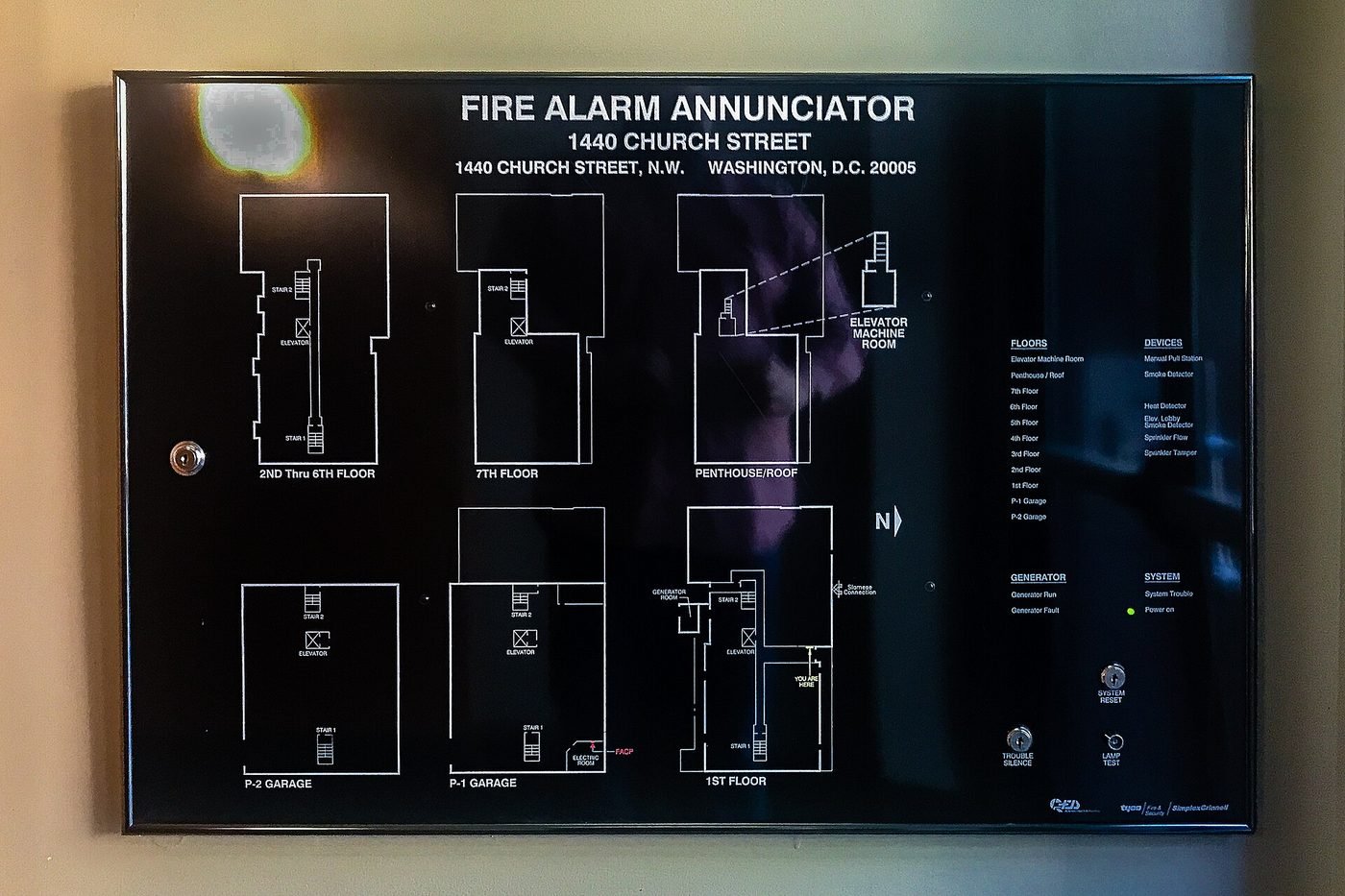
The annunciator is the first thing an inspector reads and the last thing most fit-out programmes budget time for. Photo: Wikimedia Commons, CC0.
Most fit-out programmes in Dubai are built backwards. The drawings get approved, the works run, the finishes land, and the Civil Defence inspection is pencilled in somewhere near handover as a formality. It is not a formality. It is the only stage of the approval chain where a person stands in your space and asks the systems to prove they work, and it is the stage that most reliably pushes a handover date to the right.
This guide covers what a Civil Defence inspection actually consists of in 2026, the two administrative gates that changed this year, the document pack that has to exist on the day, current fees and lead times, and the seven failures we see repeat across commercial fit-outs in Dubai, Sharjah and Abu Dhabi. If you have not yet secured your permits, start with our fit-out approval Dubai guide, which covers the drawing-stage submissions that precede everything below.
What a Civil Defence Inspection Actually Tests
Dubai Civil Defence approval runs as four stages: drawing approval, installation, inspection, and the completion certificate. The first stage is a paper exercise assessed against the UAE Fire and Life Safety Code of Practice, whose 2018 edition remains the working reference across the emirates, with local amendments issued by individual Civil Defence authorities. The third stage is where paper meets reality.
A Civil Defence inspection is a live functional test. The inspector is not verifying that certificates exist — those were uploaded days earlier. They are verifying that the installation in front of them matches the stamped drawings and behaves the way the design said it would. On a normal commercial fit-out that means:
- Fire alarm panel activation. The panel is put into alarm and device response is confirmed zone by zone against the annunciator layout and the approved device schedule.
- Sprinkler pressure verification. The installation is pressure-checked, and head positions are compared with the approved coverage layout and the reflected ceiling plan.
- Hassantuk signal test. The connection to the command centre is tested live, end to end, not simulated at the panel.
- Emergency lighting and egress. Mains power is dropped to confirm luminaires and exit signage run on battery, and exit doors are operated by hand.
- Passive protection. Firestopping at penetrations, fire damper locations and access, and compartment integrity where partitions cross rated lines.
- Suppression systems. On restaurants and commercial kitchens, the kitchen suppression system is discharged or functionally proven.
The working principle worth internalising: anything that cannot be demonstrated on the day is treated as not installed. A damper behind sealed plasterboard is a failed item, not a documented one.
The Two 2026 Gates That Stop the Visit Being Booked
The most expensive failures in 2026 are not on site at all. They happen at the booking screen, and they catch projects that are physically finished.
Gate 1: The AMC must be submitted at booking
From 2026, the annual maintenance contract with a DCD-approved maintenance company must be submitted at the time of booking the Civil Defence inspection, not after it. Inspectors will not attend a site without an AMC on file. This is a contractual and procurement item, not a construction one, which is exactly why it slips: the fit-out completes, the request goes in, and nobody has appointed a maintenance provider or allocated the budget line. Industry reporting puts the penalty exposure for a lapsed AMC at AED 1,000 to AED 50,000, alongside trade licence suspension and the very real risk of an invalidated insurance claim after an incident.
Gate 2: No live Hassantuk connection, no pass
Hassantuk is the national fire alarm monitoring network that reports directly to the Civil Defence command centre when a panel goes into alarm, into fault, or is disconnected. From 2026 the Hassantuk connection point must appear in the fire alarm panel specification at drawing submission stage, and the connection must be live and subscribed at inspection. A system not connected to Hassantuk fails the Civil Defence inspection regardless of whether every other system passes.
The trap here is procurement lead time. The panel that arrives on site has to be the panel that was specified, and a Hassantuk-capable panel is chosen months before anyone thinks about an inspection date. Discovering the requirement during commissioning means replacing a panel, re-terminating loops, and re-submitting drawings — a four to six week problem dressed up as a paperwork issue. The requirement now also reaches existing businesses at trade licence renewal, so tenants inheriting a fitted space are not exempt.
The Document Pack to Have On Site on the Day
Everything below should be on the portal and in a hard-copy folder in the unit. Inspectors ask for the folder.
| Document | Who produces it | Why it fails |
|---|---|---|
| Stamped DCD drawing approval and preliminary NOC | Fire consultant / contractor | Superseded revision brought to site |
| As-built drawings | Fire contractor | Never updated after ceiling or layout changes |
| Guarantee & Installation Certificate | DCD-approved fire contractor | Signed before the contractor's own self-audit |
| Component conformity certificates | Supplier | Devices substituted for unlisted equivalents |
| Testing & commissioning reports | Fire contractor | Pump and alarm tests not witnessed or dated |
| Fire alarm and fire fighting system certificates | Fire contractor | Issued for a different scope of works |
| Building management NOC | Landlord / FM | Generic wording — see below |
| Annual maintenance contract (AMC) | Tenant / maintenance provider | Not in place at booking — blocks the visit |
| Hassantuk subscription confirmation | Tenant / provider | Ordered but not activated |
The building management NOC deserves separate attention. A generic letter saying fire works are permitted is routinely rejected. The NOC has to confirm specifically that the proposed fire alarm system is compatible with the base building's head panel, that the sprinkler loop connection is agreed, and that any shared fire pump room access has been granted. Ask the landlord for that wording at the start of the project, because it takes weeks to get amended at the end of one.
Civil Defence Inspection Fees and Timelines in 2026
Authority fees are modest relative to the programme cost of getting this wrong. The numbers below are the current published ranges; they scale with area and system count, and exclude contractor, equipment and Hassantuk subscription costs.
| Item | Fee (AED) | Typical lead time |
|---|---|---|
| Drawing approval | 0.5–1 per m² | 7–10 working days simple; 15–30 complex |
| Fire system approval | 1,000 per system | Within drawing review |
| Resubmission review | 1,000 per review | Restarts the review clock |
| Field inspection visit | 500–1,000 | ~14 days to slot; up to 30 for major premises |
| Re-inspection visit | 500–1,000 each | Full booking cycle again |
| Completion certificate | 520 (incl. AED 20 innovation fee) | Issued after a clean pass |
| Typical total, commercial fit-out | 3,000–20,000 | 2–8 weeks, drawings to certificate |
The line that matters is the fourth one. A Civil Defence inspection slot is roughly a fortnight out from a compliant request. That is the real cost of a failure: not the AED 500 re-inspection fee, but the two to four weeks of rent, staff and fit-out preliminaries burned waiting for the next slot. On a project holding a rent-free period, one failed Civil Defence inspection can consume the whole remaining allowance.
The Seven Failures We See Repeat
The single most avoidable one. Appoint the maintenance provider at tender stage, not at handover.
Subscription ordered but not activated, or a panel that was never Hassantuk-capable. Automatic fail.
Detector and sprinkler positions drift when the ceiling design changes. Detector placement is the most common drawing rejection and it repeats on site.
No confirmation of head-panel compatibility, sprinkler loop connection or pump room access.
Penetrations sealed after the ceiling closed, with no photographic record of what is behind it.
Access panels omitted from the ceiling package because they were never on the reflected ceiling plan.
Drawings that describe the design intent rather than the installation the inspector is standing in.
Notice how many of these originate in the ceiling void rather than in the fire package. Failures three, five and six are all coordination problems that surface at the Civil Defence inspection, which is why our MEP coordination guide treats pre-closure verification as an approvals activity, not a services one.
Firestopping: The Item Most Often Closed Over
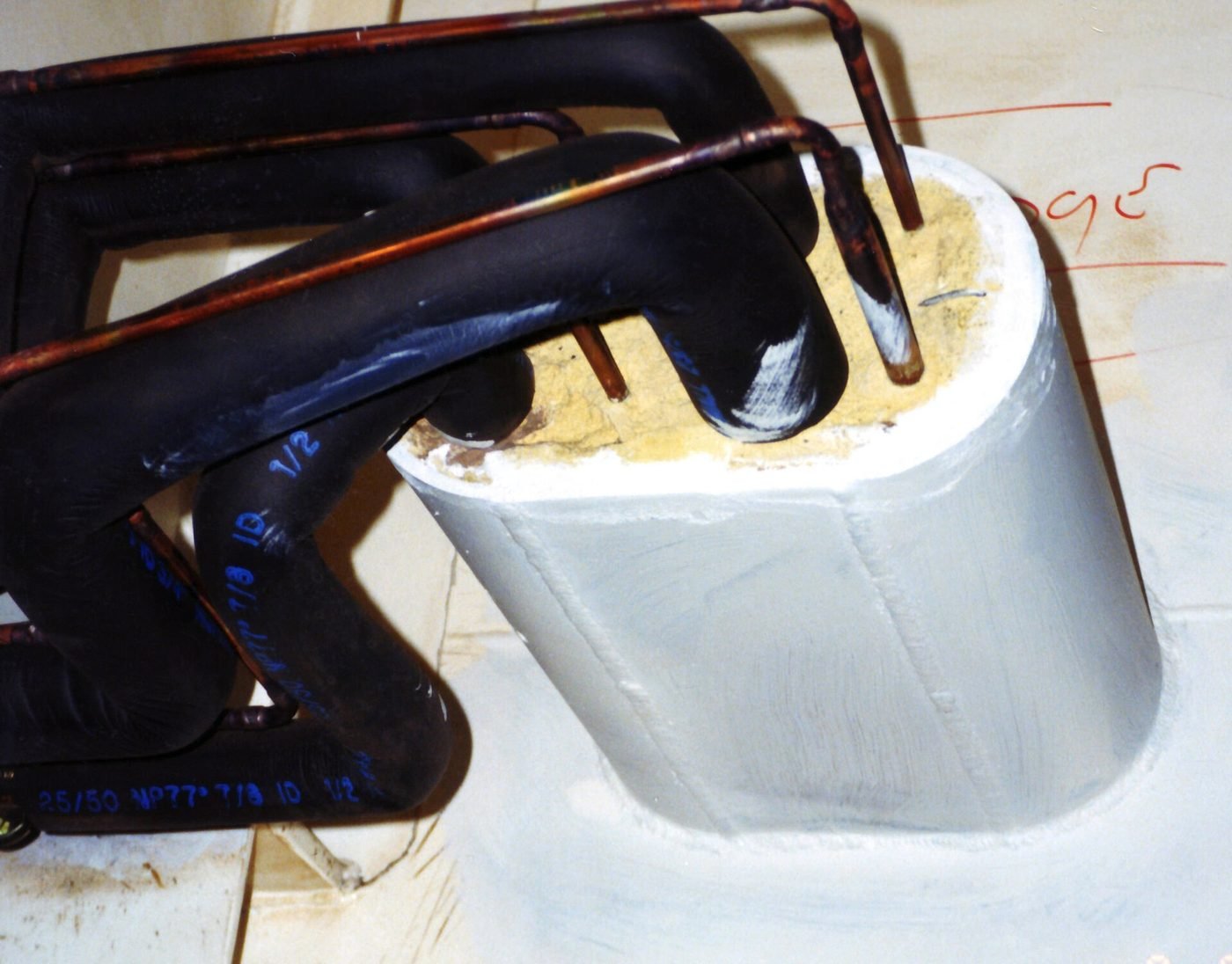
A rated penetration seal around insulated pipework. Photo: Wikimedia Commons, CC BY 3.0.
Firestopping is invisible, cheap to do correctly and expensive to prove after the fact. Every service that crosses a fire-rated wall or slab — ductwork, chilled water, drainage, conduit, cable tray, sprinkler branch — needs a tested seal appropriate to the penetration and the rating it crosses. Inspectors audit these penetrations closely, and a Civil Defence inspection is not a good moment to be opening ceilings to demonstrate them.
The discipline that works is photographic. Every penetration is photographed sealed, with a location reference and a date, and the images are filed by drawing grid reference before the ceiling package starts. When the inspector asks about a penetration above a closed ceiling, you open a folder rather than a ceiling. On projects where we run this properly, the firestopping conversation takes four minutes instead of four days.
The Pre-Inspection Sequence That Works
Two weeks before the requested date, run the visit yourself. The sequence below is what we use on commercial fit-outs and it converts most first-visit failures into first-visit passes.
- T-14 days: confirm the administrative gates. AMC signed and uploaded. Hassantuk subscription activated and a test signal confirmed with the provider. Building management NOC checked for the specific compatibility wording.
- T-12 days: reconcile drawings to reality. Walk the space with the stamped drawings and mark every device that has moved. Update as-builts before the inspection request goes in, not after a failure report arrives.
- T-10 days: contractor self-audit. The DCD-approved fire contractor performs its own audit and signs the Guarantee & Installation Certificate on the basis of what it found, not on the basis of the programme.
- T-8 days: access and passive protection sweep. Every fire damper, isolation valve and VAV box reachable through an access panel. Every penetration sealed and photographed.
- T-6 days: full functional dry run. Alarm activation, sprinkler pressure, emergency lighting on battery, exit doors, kitchen suppression. Test it exactly as the inspector will.
- T-4 days: assemble the folder. Hard copy and portal, in the order listed above, with revision numbers checked against what is installed.
- T-0: attend the inspection. The fire contractor, the project manager and someone who can open every locked door are all on site for the full visit.
This sequence sits inside the wider approvals programme described in our fit-out project management guide, and it is the reason the inspection date should appear on the programme at design stage rather than being added when the ceiling closes.
Beyond Dubai Civil Defence: Other Authorities
Not every UAE fit-out is inspected by DCD. Units inside Trakhees-governed areas — Jebel Ali, Dubai World Central and the Palm developments among them — are inspected by Trakhees Civil Defence rather than the DCD portal, with its own submission route and its own inspector pool. Abu Dhabi projects fall under Abu Dhabi Civil Defence, which applies the UAE Fire and Life Safety Code with local amendments. Sharjah has its own Civil Defence department.
The functional content of the Civil Defence inspection is broadly consistent across all of them — live testing, passive protection, documentation — but the portal, the fee schedule, the lead times and the accepted contractor lists are not. Establish which authority governs your unit before the first drawing is submitted, because a submission made to the wrong body is not transferable and typically costs three to four weeks.
The same applies to sector regulators layered on top. A clinic clears DHA or MOHAP as well as Civil Defence; a restaurant clears Dubai Municipality food safety alongside its kitchen suppression test, as covered in our restaurant fit-out approvals guide. Those inspections run in parallel, and sequencing them badly is its own source of delay.
What the Completion Certificate Does and Does Not Cover
A clean pass produces the DCD completion certificate, issued electronically, at AED 520 including the innovation fee. That certificate is what DET, DHA and Dubai Municipality ask for when issuing or amending a trade licence, and without it the space cannot legally be occupied for its licensed activity.
What it is not is a permanent state. The certificate itself does not carry an annual expiry, but the compliance behind it does: the AMC must stay live, the Hassantuk subscription must stay active, and both are checked at trade licence renewal. A certificate on the wall with a lapsed maintenance contract behind it is a finding, not a defence — and it is the scenario in which an insurer starts reading the policy carefully.
Planning a Fit-Out That Has to Pass First Time?
V Square manages the full approvals chain — DCD submission, Hassantuk and AMC coordination, pre-closure verification and inspection attendance — so the Civil Defence inspection lands as a scheduled milestone rather than a risk. Talk to us before the ceiling package is ordered.
Request a Consultation →Frequently Asked Questions
What happens during a Civil Defence inspection in Dubai?
The inspector verifies the installed fire and life safety systems against the stamped DCD-approved drawings, then tests them live rather than reading certificates. On a typical commercial fit-out that means activating the fire alarm panel and confirming device response, pressure-checking the sprinkler installation, testing the Hassantuk signal through to the command centre, dropping the mains to confirm emergency lighting and exit signage operate on battery, checking fire damper access and firestopping at penetrations, and discharging or simulating the kitchen suppression system where one is installed. Anything that cannot be demonstrated on the day is treated as not installed.
What documents are needed for a Civil Defence inspection?
The stamped DCD drawing approval and preliminary NOC, as-built drawings reflecting exactly what was installed, conformity certificates for every listed component, testing and commissioning reports for each system, the fire alarm and fire fighting system certificates, the Guarantee and Installation Certificate signed by the DCD-approved fire contractor after its own self-audit, the building management NOC, and from 2026 the annual maintenance contract. Bring the folder in hard copy as well as on the portal; inspectors routinely ask for it on site.
Do I need an AMC before the Civil Defence inspection?
Yes. From 2026 the annual maintenance contract with a DCD-approved maintenance company must be submitted at the time of booking the inspection rather than afterwards, and inspectors will not attend a site without one on file. It is a scheduling gate rather than a site item, which is why it catches so many projects: the fit-out is physically complete, the request is submitted, and nothing is allocated. Industry reporting puts fines for a lapsed AMC at AED 1,000 to AED 50,000, alongside the risk of trade licence suspension and an invalidated insurance claim.
How much does a Civil Defence inspection cost in Dubai in 2026?
The field inspection visit itself is generally quoted at AED 500 to AED 1,000, with each additional re-inspection visit charged at the same rate. Around it sit drawing approval at roughly AED 0.5 to AED 1 per square metre, fire system approval at about AED 1,000 per system, AED 1,000 per resubmission review, and the completion certificate at AED 520 including the innovation fee. Total authority fees on a normal commercial fit-out commonly land between AED 3,000 and AED 20,000 depending on area and system count. Contractor, equipment and Hassantuk subscription costs are separate.
Why do Civil Defence inspections fail?
Most failures are documentary or procedural rather than dramatic. The recurring causes are: no AMC submitted at booking; no live Hassantuk connection, which fails the inspection regardless of how well everything else performs; detector or sprinkler positions that no longer match the stamped drawings after a ceiling change; a generic building management NOC that does not confirm compatibility with the base building fire alarm panel; firestopping missing or closed over without evidence; fire dampers and valves buried behind sealed plasterboard with no access panel; and as-built drawings that were never updated to reflect what was actually installed.
How long does it take to get a Civil Defence inspection booked in Dubai?
Once a compliant request is submitted, an inspection slot typically comes back within about 14 days, extending toward 30 days for major or high-risk premises such as hospitals. Drawing approval ahead of it runs 7 to 10 working days for a straightforward fit-out and 15 to 30 working days for complex projects, and the whole sequence from drawing approval to completion certificate commonly takes 2 to 8 weeks. Build the inspection slot into the programme at design stage, not after the ceiling is closed.
Is Hassantuk connection mandatory for a Dubai fit-out in 2026?
Yes for commercial premises. From 2026 the Hassantuk connection point must be shown in the fire alarm panel specification at DCD drawing submission stage, and the connection must be live and subscribed at inspection. The requirement now extends to existing businesses at trade licence renewal, not only to new fit-outs. Because the panel that ships to site has to be the one specified, a Hassantuk-capable panel is a procurement decision made months before the inspection, and retrofitting it is the expensive way to discover the rule.
Does the DCD completion certificate expire?
The completion certificate itself does not carry an annual expiry, but the compliance behind it does. The annual maintenance contract must be kept live, the Hassantuk subscription must remain active, and both are checked at trade licence renewal and at any subsequent compliance inspection. A completion certificate on the wall with a lapsed AMC behind it is a finding, not a defence.
Note on sources. Fee ranges, lead times and the 2026 AMC and Hassantuk requirements described above are drawn from current UAE fire-safety compliance reporting and reflect commonly quoted figures rather than a published tariff. Requirements vary by authority, premises type and system count. Confirm the applicable edition of the UAE Fire and Life Safety Code of Practice and the current fee schedule with Dubai Civil Defence or your governing authority before relying on any figure for budget or programme purposes.