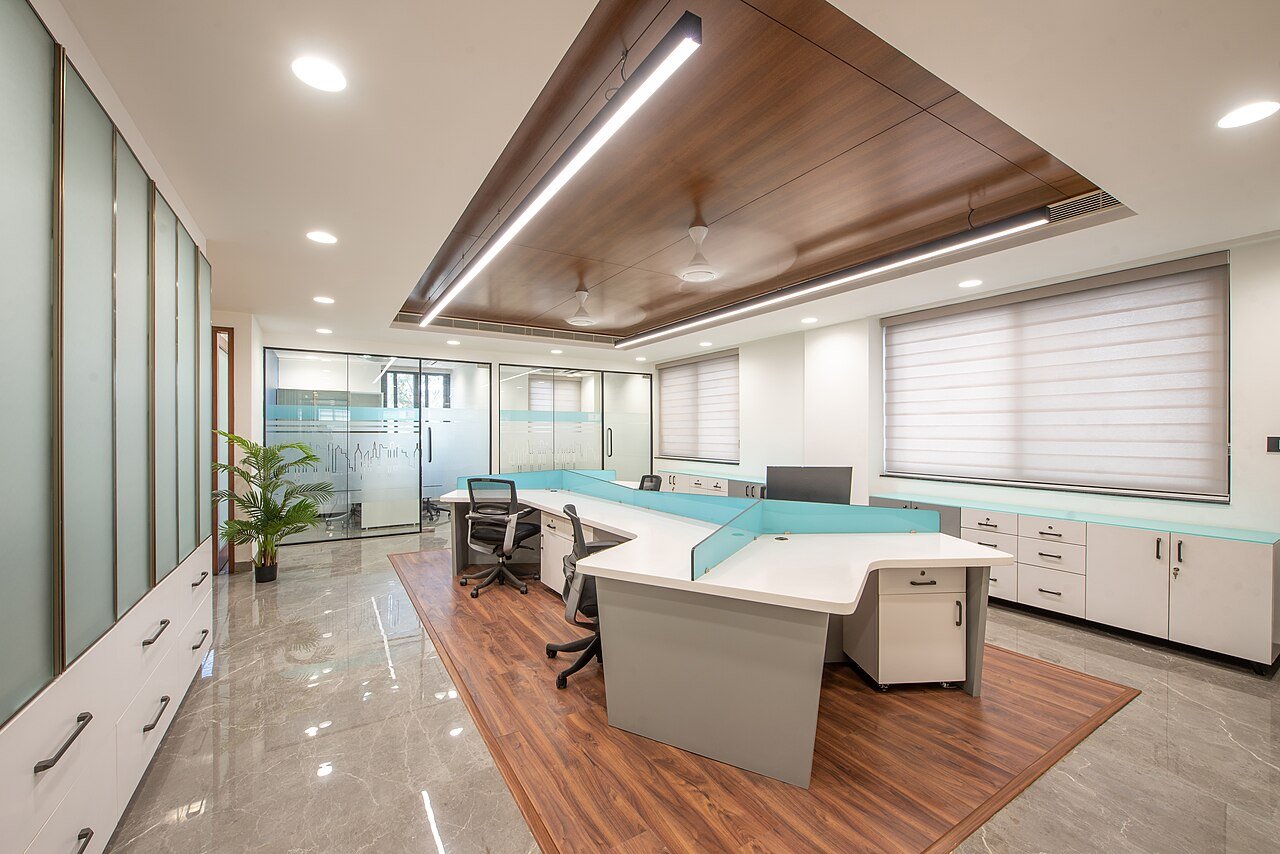
Every element here is a separate BOQ section: ceiling raft and cove lighting, glazed partitions, storage and workstation joinery, floor finish transitions, blinds and small power. A quotation that prices them as one figure cannot be compared with one that prices them separately. Photo: Nutan Parag, Wikimedia Commons, CC BY-SA 4.0.
Why commercial fit-out quotes in Dubai vary by 40 percent
Commercial clients, landlords, and facilities managers in the UAE routinely face a perplexing challenge when issuing tender packages for interior fit-out projects: five contractors receiving the exact same drawing set will frequently return pricing proposals that differ by 30 to 50 percent. A project that one contractor prices at AED 1,200,000 might be quoted at AED 850,000 by another and AED 1,450,000 by a third. This variance rarely indicates that the lowest bidder is exceptionally efficient or that the highest bidder is overcharging without cause. Instead, it reflects fundamental discrepancies in how individual fit-out contractors interpret unpriced drawings, calculate quantity take-offs, price risk, and structure their preliminaries.
When reviewing a fit-out quotation in Dubai, business owners must recognise that market pricing follows established cost bands per unit area. Commercial office fit-outs in the emirate generally fall within predictable financial boundaries based on specification levels:
- Light Category A Refurbishment: AED 200 to AED 400 per square foot (approximately AED 800 to AED 1,200 per square metre). This covers basic landlord handover condition, raised flooring, suspended grid ceiling, and basic MEP distribution.
- Standard Category B Fit-Out: AED 400 to AED 700 per square foot (approximately AED 1,500 to AED 2,400 per square metre). This includes complete space planning, glass partitions, executive offices, meeting rooms, secondary MEP distribution, joinery, standard flooring, and lighting.
- Premium and Turnkey Commercial Fit-Out: AED 700 to AED 1,200+ per square foot. Across the wider Dubai market, high-end commercial projects can range from AED 350 to AED 1,500 per square foot depending on acoustic requirements, imported finishes, custom architectural joinery, and smart office integration.
- Specialist Food & Beverage and Retail: Fitted F&B outlets, commercial kitchens, and luxury retail environments carry significant specialised MEP and joinery loads, pushing rates substantially above standard office baselines.
A broad variance between bids usually occurs because one contractor has priced strict base specifications while another has built in allowances for high-end materials, after-hours site labour, complex authority approvals, or extended maintenance liabilities. Without a rigid framework to normalise these proposals, selecting a contractor based solely on the bottom-line figure almost guarantees budget overruns, endless variation requests, and adversarial claims mid-project.
The fundamental difference between a lump-sum quote and a Bill of Quantities
The primary root of pricing discrepancy in the UAE construction market lies in the document structure used for tendering. A simple lump-sum quotation provides a aggregate price for a defined set of drawings or space. In contrast, a detailed Bill of Quantities (BOQ) breaks down every square metre of partition, linear metre of joinery, number of light fittings, and kilogram of structural steel into itemised, measurable components with assigned unit rates.
Comparing every fit out quotation Dubai contractors submit on a un-itemised lump-sum basis is an inherently flawed exercise. When contractors bid on layout drawings without a fully quantified BOQ, each estimator makes independent assumptions about material quantities, specifications, and scope boundaries. One bidder may assume 12mm single-glazed toughened glass partitions, while another prices double-glazed acoustic systems rated to 45dB. One may include full mechanical ductwork modification, while another assumes existing variable air volume (VAV) boxes remain untouched.
The legal framework in the UAE heavily impacts how these contracts operate once signed. Under UAE law, a lump-sum muqawala (construction contract) establishes a fixed overall price for an agreed scope. Historically, under the traditional Civil Code rules, a lump-sum price was not re-measured on completion, and a contractor had no automatic right to claim an increase even if actual material quantities exceeded initial expectations. However, statutory updates under Federal Decree-Law No. 25 of 2025 (the New Civil Code), which took effect on 1 June 2026, expanded hardship relief through Article 224 (general hardship) and Article 829 (muqawala-specific emergency cost adjustments). While this offers relief under extraordinary, unforeseen economic shifts, standard lump-sum contracts still bind clients to agreed scopes while leaving them vulnerable to variations whenever an ambiguous item falls outside the strictly drawn plans.
To eliminate these ambiguities during tendering, clients should engage a dedicated consultancy or interior design and fit-out consultant to draft a pre-tender BOQ. This ensures every tendering party prices identical quantities and precise material specifications, creating a true apples-to-apples basis for comparison.
Key pricing mechanisms in UAE fit-out contracts and who carries the risk
Commercial fit-out tenders in Dubai incorporate various pricing mechanisms within a single contract structure. Understanding how these mechanisms allocate financial and operational risk between the client and the contractor is vital when evaluating any quotation.
Contractors often mix fixed line items with provisional allowances, prime cost figures, and daywork rates. If a client fails to analyse how these pricing models interact, a project that appears cost-effective on paper can rapidly generate substantial price adjustments during execution.
| Pricing mechanism | How the price is fixed | Who carries the quantity risk | When it belongs in a fit-out quote |
|---|---|---|---|
| Lump sum | Single fixed figure for a complete, fully defined scope of work. | Contractor carries risk of material quantity errors within defined scope. | Fully detailed designs with zero pending spatial or technical changes. |
| BOQ / remeasurable | Unit rates are fixed; final cost depends on verified installed quantities. | Client carries quantity risk; contractor carries unit rate price risk. | Projects where final wall runs or floor areas require field verification. |
| Provisional sum | Estimated monetary allowance set aside for undefined work items. | Client carries full cost risk until design is finalised and priced. | Unspecified decorative lighting, art installations, or loose furniture. |
| Prime cost sum | Fixed allowance for materials or components supplied by a nominated vendor. | Client carries material cost risk; contractor adds agreed handling percentage. | Specialist imported acoustic panels, custom chandeliers, or owner-supplied items. |
| Dayworks | Agreed hourly or daily rates for labour and plant used on extra work. | Client carries duration risk for unquantified emergency or extra tasks. | Minor unforeseen site repairs or out-of-scope landlord remedial requests. |
| Cost-plus | Actual net outlay reimbursed plus an agreed percentage fee for management. | Client carries all quantity, labour, and material price risks. | Fast-track emergency restorations where design proceeds during construction. |
When changes occur on site, valuation of variations in UAE contracts generally aligns with standard FIDIC Clause 13 principles. Variations are valued at contract BOQ unit rates where work is of similar character and executed under similar conditions. If no identical item exists, analogous rates derived from contract figures are used. Where no relevant or analogous rates apply, variations are priced based on the contractor's actual cost plus an agreed, reasonable margin for overhead and profit.
Deconstructing the Bill of Quantities: how to structure a tender analysis
To conduct a rigorous tender evaluation, a project manager must build a comprehensive bid comparison matrix (tender analysis sheet). This matrix places every line item from every contractor side-by-side, exposing gaps, inflated rates, and missing scope elements.
In a standard commercial fit-out in Dubai, Mechanical, Electrical, and Plumbing (MEP) installations constitute the single largest cost element, routinely accounting for 30 to 40 percent of the total project budget. If a contractor presents an exceptionally low price, closer inspection of their matrix often reveals that critical MEP components, such as secondary ducting dampers, chilled water balancing, or emergency lighting batteries, have been omitted or under-budgeted. Ensuring proper MEP coordination and engineering analysis during tender review prevents these hidden gaps from surfacing later as expensive variations.
The table below illustrates the master framework used by professional project managers to normalise contractor quotations across fifteen major trade breakdown categories.
| Trade / Element | What it should cover | Typical share of a Dubai fit-out budget | The question to ask when a bid is low here |
|---|---|---|---|
| Preliminaries and site management | Site supervision staff, insurance, trade licences, site setup, safety, logistics, and protection. | 8% - 12% | Does the price cover full-time dedicated site engineers and compulsory CAR insurance? |
| Demolition and strip-out | Removal of existing fit-out, floor grinding, hazardous waste disposal, and site clearance. | 2% - 5% | Is legal off-site dumping at approved municipal sites included in the rate? |
| Partitions and drywall | Gypsum stud walls, acoustic insulation, glass partitions, framing, and fire-rated barriers. | 8% - 12% | Are acoustic insulation density and double-layer board specifications included? |
| Ceilings | Suspended gypsum ceilings, acoustic tiles, access panels, bulkheads, and perimeter coves. | 5% - 8% | Are frame gauges and access hatches for ceiling-mounted MEP equipment specified? |
| Flooring | Raised access floors, self-levelling screed, carpet tiles, luxury vinyl tile, stone, and skirtings. | 7% - 11% | Does the rate include subfloor surface preparation and high-traffic adhesive primers? |
| Joinery | Custom reception desks, pantry cabinetry, wall cladding, banquette seating, and display units. | 10% - 18% | Are core substrates marine plywood and high-pressure laminates or cheap chipboard? |
| Painting and finishes | Wall primers, emulsion coats, special effects, wallcovering installation, and touch-ups. | 2% - 4% | Does the rate include three full coats of low-VOC paint plus surface skim coating? |
| Doors and ironmongery | Solid core timber doors, glass doors, acoustic seals, hinges, access control locks, and closers. | 3% - 6% | Are fire-rated door assemblies certified by approved testing labouratories? |
| Electrical | DB dressing, containment, power cabling, floor boxes, light fittings, switches, and smart controls. | 12% - 16% | Are light fittings specified premium brands or unbranded commercial alternatives? |
| HVAC | Chilled water pipework, FCU/VAV modifications, air ducting, diffusers, dampers, and thermostats. | 12% - 18% | Is complete air balancing, duct pressure testing, and TAB report generation priced? |
| Fire protection | Sprinkler pipe drops, relocation, fire alarm sensors, strobe lights, and emergency call points. | 4% - 7% | Does the quote include ultimate Dubai Civil Defence inspection and interface mapping? |
| Plumbing | Water supply lines, pantry drainage, sanitaryware, water heaters, and grease traps. | 2% - 4% | Are pressure-tested copper or PPR pipes included alongside tested drainage runs? |
| Authority approvals and NOCs | Permit filing, fee management, mandatory third-party consultant sign-offs, and authority submission drawings. | 2% - 4% | Is the contractor handling actual authority submission management or just drawing handover? |
| Provisional sums | Unspecified high-end decorative elements, specialist features, or owner-selected finishes. | 3% - 8% | Are the provisional figures realistic market allowances or artificial low placeholders? |
| Contingency | Unforeseen site conditions, structural modifications, or client-driven rapid scope revisions. | 5% - 10% | Is the contingency explicitly ring-fenced for client authorization only? |
Demystifying provisional sums and prime cost allowances
One of the most frequent methods contractors use to make a financial proposal appear artificially competitive is the manipulation of Provisional Sums (PS) and Prime Cost (PC) allowances. When evaluating a commercial fit-out quotation in Dubai, clients must carefully examine how these figures are presented and managed.
A Provisional Sum is an allowance included in the contract for work that cannot be fully defined or detailed at the time of tendering. For example, if decorative acoustic wall paneling has not been finalised by the interior designer, a contractor might insert a Provisional Sum of AED 50,000. If Contractor A allocates AED 50,000 while Contractor B allocates AED 15,000 for the exact same undefined feature, Contractor B's overall quote will appear AED 35,000 cheaper on paper. During construction, when the actual paneling specification is confirmed at AED 50,000, Contractor B will issue a price adjustment for the difference, erasing their initial price advantage.
A Prime Cost (PC) Sum is an allowance designated for purchasing specific material items (such as feature marble, custom light fixtures, or executive ironmongery) from a nominated supplier, where the contractor provides labour for installation. When PC items are finalised, the contract value is adjusted based on actual material invoice costs plus the contractor's pre-agreed percentage markup for handling, overhead, and profit. A PC sum adjustment is processed directly within progress claims rather than framed as a complex contract variation.
To eliminate artificial bidding advantages during tender evaluation, project managers normalise all proposals by overriding each contractor's variable provisional and prime cost figures with uniform baseline allowances. This reveals true contractor pricing on fixed trade elements.
Dubai authority approvals, NOCs and compliance costs to verify
A critical area where low-cost fit-out quotations frequently disguise future cost increases is authority permitting and compliance management. Navigating Dubai's regulatory environment requires submissions to multiple municipal and master developer authorities. Failing to clarify which party pays official fees and manages statutory processes is a leading cause of project delays and cost overruns.
A comprehensive fit-out quotation in Dubai must clearly define responsibilities and financial allowances for the following regulatory processes:
Dubai Municipality (DM) and Building Permits
Commercial fit-outs within mainland Dubai require explicit Dubai Municipality fit-out permits, architectural design review, and structural sign-offs. Contractors must supply qualified engineers holding DM registration to act as the on-site contractor of record. Low bids often include drawing drafting while omitting official submission fees, structural consultant peer reviews, and final site inspection charges.
Dubai Civil Defence (DCD)
Fire and life safety systems represent a mandatory compliance barrier. Modifying partitions or suspended ceilings requires updating sprinkler drop layouts, smoke detector grids, emergency lighting circuits, and voice evacuation speakers. The quotation must specify who pays for DCD engineering drawing reviews, life safety material submittals, mandatory inspection bookings, and final DCD completion certificate issuance.
Free Zone and Master Developer Approvals (Trakhees, DCCA/TECOM, Nakheel)
If your property is located within a free zone or master-planned development, local jurisdiction rules supersede standard mainland pathways. Projects in JAFZA, Dubai Healthcare City, or Nakheel communities require approvals through authorities like Trakhees or DCCA/TECOM. Licensing fees, security deposits, plan review costs, and structural fit-out permits must be explicitly accounted for in the quotation.
Landlord, Building Management, and Mall NOCs
Commercial building management teams and retail mall operators mandate strict No Objection Certificate (NOC) guidelines. These often include mandatory refundable fit-out security deposits (typically AED 20,000 to AED 100,000), non-refundable structural review fees, and strict after-hours working restrictions. Contractors working in operational commercial towers are restricted to noisy work windows (often midnight to 6:00 AM). If a contractor fails to price night-shift labour premiums and specialised logistics, work will stall once building security enforces site access rules.
DEWA Electrical and Plumbing Connections
If your office design increases electrical load beyond existing circuit breaker capacity, a Dubai Electricity and Water Authority (DEWA) load upgrade is required. Quotes should state whether DEWA engineering fees, sub-meter installations, and permanent connection charges are included in the contractor's scope or designated as client direct payments. For detailed guidance on navigating regulatory approvals, refer to our comprehensive Dubai fit-out authority permit guide.
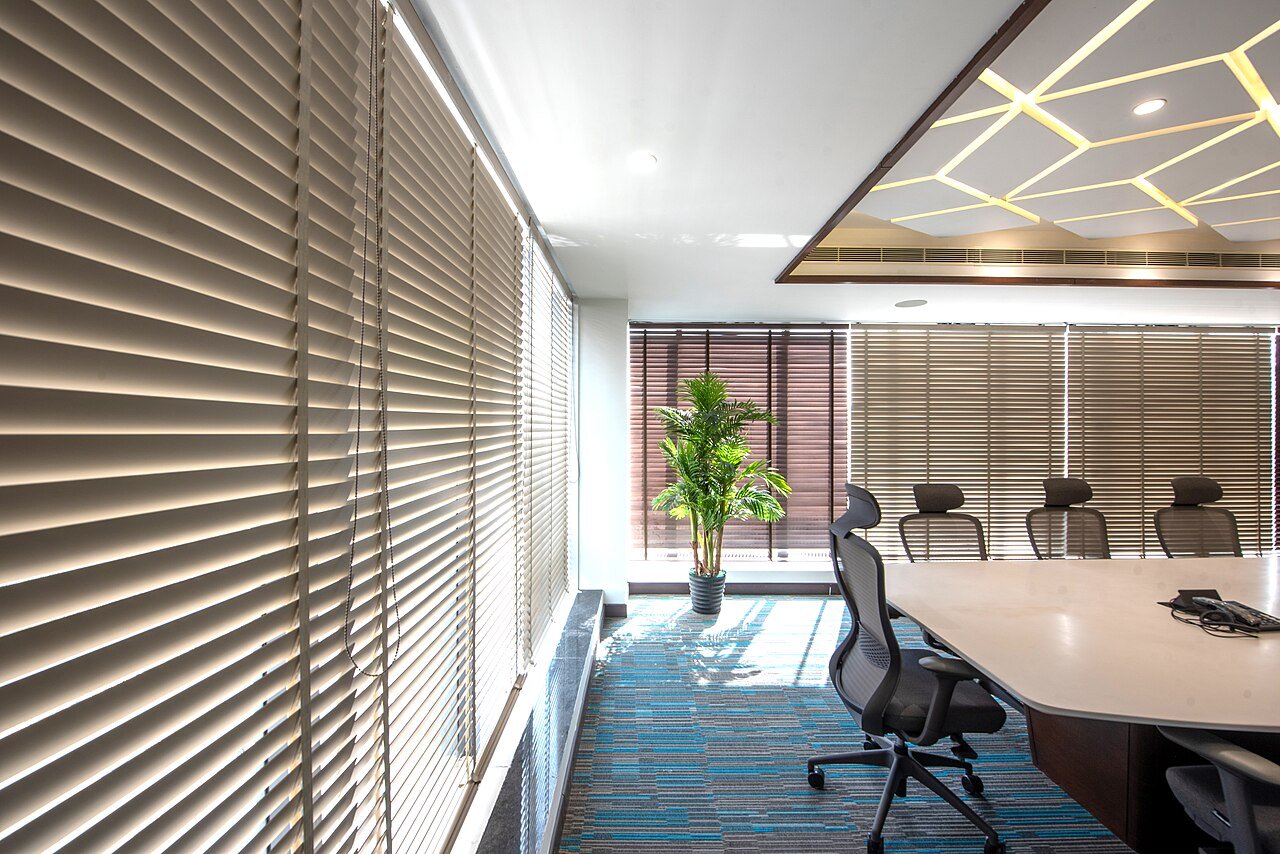
The ceiling void is where quotations diverge most. Grille positions, fire-stopping at penetrations, access panels and the cove detail are all cheap to leave out of a bid and expensive to add back as a variation. Photo: Nutan Parag, Wikimedia Commons, CC BY-SA 4.0.
Evaluating payment terms, advance guarantees and retention mechanics
A fit-out contractor's proposed commercial terms directly impact cash flow, security, and project risk. A low total quotation paired with aggressive advance payment demands and weak security guarantees can be far riskier than a slightly higher, standard contract offer.
Under established UAE construction practices, contract terms align with standard framework guidelines such as FIDIC conditions. The baseline parameters below highlight market standards alongside risk indicators to monitor during tender review.
| Commercial terms | UAE market practice | What to watch for |
|---|---|---|
| Advance / mobilisation payment | 10% to 20% of accepted contract value, aligned with FIDIC Clause 14.2 standards. | Requests exceeding 25% without an Advance Payment Guarantee (APG). |
| Interim payment certificates | Monthly progress payments based on actual verified completed work on site. | Demands for front-loaded progress payments tied to fixed calendar dates rather than verified physical milestones. |
| Certification period | 14 to 21 days from progress claim submission to certificate approval. | Periods under 7 days (restricting thorough verification) or over 30 days (creating site cash flow bottlenecks). |
| Payment period | 28 days from interim certificate approval to bank transfer funds release. | Payment terms extending beyond 45 days, which often leads to subcontractor site demobilisation. |
| Retention deduction | 5% to 10% deducted from every interim progress payment certificate value. | Contractor proposals attempting to cap total retention below 5% of total contract value. |
| Retention release at handover | 50% of accumulated retention released upon issuing the Taking-Over Certificate (TOC). | Demands for 100% retention release prior to practical completion sign-off and key turnover. |
| Retention release after DLP | Remaining 50% released at the end of the 12-month Defects Liability Period (DLP). | Attempts to reduce the standard DLP window from 12 months down to 3 or 6 months. |
| Advance payment guarantee | On-demand bank guarantee provided by contractor, reducing proportionally as advance is recovered. | Accepting simple corporate cheques or unbacked promissory notes instead of a formal bank guarantee. |
| Performance bond | 5% to 10% on-demand bank guarantee valid through completion and handover. | Omitting performance guarantees entirely on major commercial projects exceeding AED 1,000,000. |
Additionally, review the application of UAE Value Added Tax (VAT) across all bids. Standard VAT in the United Arab Emirates is 5 percent. Contractor quotes must explicitly state whether line-item unit rates and total figures are inclusive or exclusive of VAT. Misinterpreting VAT inclusive pricing across multiple bids can lead to a 5 percent budgeting miscalculation across the entire project budget.
Spotting hidden exclusions that become costly variations later
The fastest way for an artificially low fit-out quotation in Dubai to inflate mid-project is through omitted operational scope items. Unscrupulous contractors intentionally exclude essential secondary scope items, knowing they are mandatory for practical completion, and then charge premium variation rates once the contract is signed.
When normalising contractor tenders, project managers thoroughly audit proposals to verify that the following items are fully accounted for:
- Testing, Commissioning, and Air Balancing: Low-cost bids routinely omit full HVAC thermal balancing, duct leakage testing, water pressure testing, and electrical mega-testing. Requesting these post-contract results in mandatory, high-cost variations.
- Site Logistics, Protection, and Waste Removal: Protecting existing landlord common areas, elevator cabs, and raised flooring during construction requires heavy-duty protection materials. Verify whether daily site cleaning, legal debris removal, and approved municipal dumping fees are included.
- Acoustic and Fire-Rated Sealing: Installing acoustic drywall partitions without continuous acoustic sealant at perimeter junctions or fire-stop collars at ceiling MEP penetrations invalidates acoustic ratings and fails DCD inspections.
- Vertical Transportation and Hoisting: In high-rise office towers (such as those in Business Bay, DIFC, or JLT), material delivery must be scheduled via service elevators outside standard working hours. Ensure off-peak hoisting charges and manual material handling labour are included.
- As-Built Drawings and O&M Manuals: Handover requires submitting complete operation and maintenance manuals alongside updated as-built CAD and BIM drawings to the landlord and authorities. Verify that redline drawing updates are explicitly priced in preliminaries.
Nine operational red flags in a Dubai fit-out tender
Before entering into a binding muqawala contract, business owners should evaluate contractor submissions for operational warning signs. Bids displaying these characteristics routinely experience execution delays, disputes, or mid-project financial issues.
- Round Lump-Sum Figures: A quotation presented as neat round numbers without detailed, itemised quantity take-offs indicates that the estimator estimated figures rather than carrying out a proper quantity calculation.
- Cash-Only or Personal Account Payment Demands: Reputable fit-out contractors in the UAE operate through corporate bank accounts registered to their licensed entity. Demands for payments to personal accounts or unrecorded cash transactions indicate regulatory non-compliance.
- Total Absence of a BOQ: Refusal to provide a line-item Bill of Quantities prevents proper progress verification and leaves the client vulnerable to inflated variation charges.
- No Detailed Work Programme (Gantt Chart): A simple project completion date without a clear schedule showing baseline milestones, long-lead procurement paths, authority submission windows, and testing sequences indicates poor project planning. For guidance on setting realistic schedules, review our guide to commercial office fit-out timelines.
- Omission of Testing, Commissioning, and Air Balancing: Failure to explicitly list testing and commissioning within the MEP breakdown indicates the contractor plans to hand over unverified systems.
- Un-Named On-Site Project Management Team: Contracting entities that cannot assign dedicated, named project managers, site engineers, and safety officers usually rely on outsourced, uncontrolled day-labourers.
- An Unrealistically Short Programme: Promising to complete a complex 500-square-metre Category B commercial fit-out in three weeks just to win the bid indicates poor scheduling logic and risks low-quality execution.
- Unverified DED Trade Licence: Contractor trade licences issued by Dubai Economy and Tourism (DET) or relevant free zone authorities must explicitly list interior fit-out, joinery, or contracting activities. Operating with un-matched licence categories delays authority permit approvals.
- Ambiguous VAT Inclusion Statements: Failing to clearly state whether quoted prices are inclusive or exclusive of the 5% UAE VAT creates financial disputes upon initial invoice issuing.
Step-by-step guide to building your bid normalisation sheet
Normalisation is the process of adjusting varying contractor quotes to an equalised baseline, allowing you to accurately compare figures like-for-like. Follow this step-by-step methodology to establish an effective tender analysis sheet:
Step 1: Build a Standardised Master Breakdown
Create a master matrix using a standardised trade breakdown structure (similar to Table A). List every architectural, structural, joinery, MEP, and preliminary element required to deliver the design intent complete and fully operational.
Step 2: Transcribe Contractor Submissions
Populate the matrix by entering each contractor's submitted figures line by line into side-by-side columns. Ensure all values are entered exclusive of UAE VAT to maintain financial clarity.
Step 3: Identify Unpriced Items and Scope Gaps
Scan down each contractor's column to identify missing scope items marked as "by client," "excluded," or unpriced. Insert a fair market valuation into missing fields based on average rates from competing bidders. This ensures contractors who omitted necessary items are evaluated on equal footing with transparent bidders.
Step 4: Standardise Provisional and Prime Cost Sums
Equalise all provisional sums, prime cost allowances, and contingency budgets across every column. Replace varying contractor estimates with identical baseline allowances established by your project consultant.
Step 5: Normalise Site Preliminaries and Authority Fees
Ensure that preliminary costs reflect comparable duration assumptions, staffing levels, and insurance coverage. Equalise authority permitting fee budgets so that contractors managing the full submission process are properly compared against those charging only drafting fees.
Step 6: Adjust for Commercial and Payment Risk
Evaluate non-price terms across all proposals. If a contractor demands a 30 percent advance without providing a bank guarantee, calculate the financial holding cost and risk premium, adding an appropriate adjustment to their normalised tender score. Before finalising contractor selection, review our detailed guide on fit-out snagging, handover, and defect liability management to protect your investment long after construction finishes.
By executing this disciplined normalisation process, commercial clients eliminate initial bidding distortions, identify true cost benchmarks, and secure reliable fit-out delivery within approved budgets.
Careful normalisation ensures your commercial fit-out is awarded on true value and execution capability, protecting your business from sudden budget inflation once site works commence.
Holding three fit-out quotes that do not agree?
V Square prepares the tender BOQ, runs the tender on your behalf, normalises every bid onto a single comparison sheet, interrogates the exclusions and provisional sums, and manages the contract and variations through to handover.
Request a Bid ReviewFrequently asked questions
Why do fit-out quotes in Dubai vary so significantly for the same space?
Fit-out quotes vary widely because contractors make differing assumptions about unquantified drawings, material grades, scope boundaries, site access constraints, and authority approval allowances. Without a standardised Bill of Quantities, one contractor may price baseline materials while another includes premium finishes, night-shift labour, and extended warranties.
What is the difference between a provisional sum and a prime cost sum in a UAE fit-out quote?
A provisional sum is an estimated monetary allowance set aside for work items that cannot be fully detailed during tendering. A prime cost sum is a fixed allowance allocated specifically for materials purchased from a nominated supplier, where the contractor manages installation and charges an agreed overhead and profit margin.
How is a variation valued if the required work is not in the original BOQ?
Under standard FIDIC Clause 13 principles, variations are valued using contract BOQ rates if the work is similar. If no matching items exist, analogous adjusted rates are applied. Where no comparable rates exist, variations are valued based on actual execution cost plus an agreed margin for overhead and profit.
What happens if a contractor underquotes on Dubai authority approvals?
If a contractor underquotes or omits mandatory Dubai Municipality, Civil Defence, or free-zone approval management fees, these omitted charges return mid-project as expensive variations. The client remains legally required to pay authority fees and third-party consultant costs to obtain occupancy sign-offs.
How does the UAE Civil Code handle lump-sum fit-out contract disputes?
Under traditional UAE Civil Code rules, a lump-sum contract price cannot be re-measured without approved scope changes. However, Federal Decree-Law No. 25 of 2025, which took effect on 1 June 2026, expanded hardship relief under Articles 224 and 829, granting courts and arbitrators discretion to adjust contracts facing extraordinary, unforeseen economic hardship.
What is standard market practice for fit-out payment terms and retention in Dubai?
Standard UAE market practice includes a 10 to 20 percent advance payment secured by a bank guarantee, monthly progress payments evaluated within 14 to 21 days, payment within 28 days of certification, and a 5 to 10 percent retention deduction released evenly across practical completion and the defects liability period.
Note on sources. The AED per square foot bands, the 30–40% MEP share, advance payment and retention percentages, certification and payment periods and the treatment of provisional and prime cost sums reflect published 2026 UAE fit-out cost commentary and standard FIDIC-based market practice rather than a single official tariff. The position on any given project is governed by that project's contract. The statutory points are drawn from Federal Decree-Law No. 25 of 2025, in force 1 June 2026, and current UAE construction-law commentary. Authority fees and approval sequences change without a public changelog. Confirm current requirements with Dubai Municipality, Dubai Civil Defence, Trakhees and DEWA, and take legal advice before relying on any statement here about contractual or statutory liability.