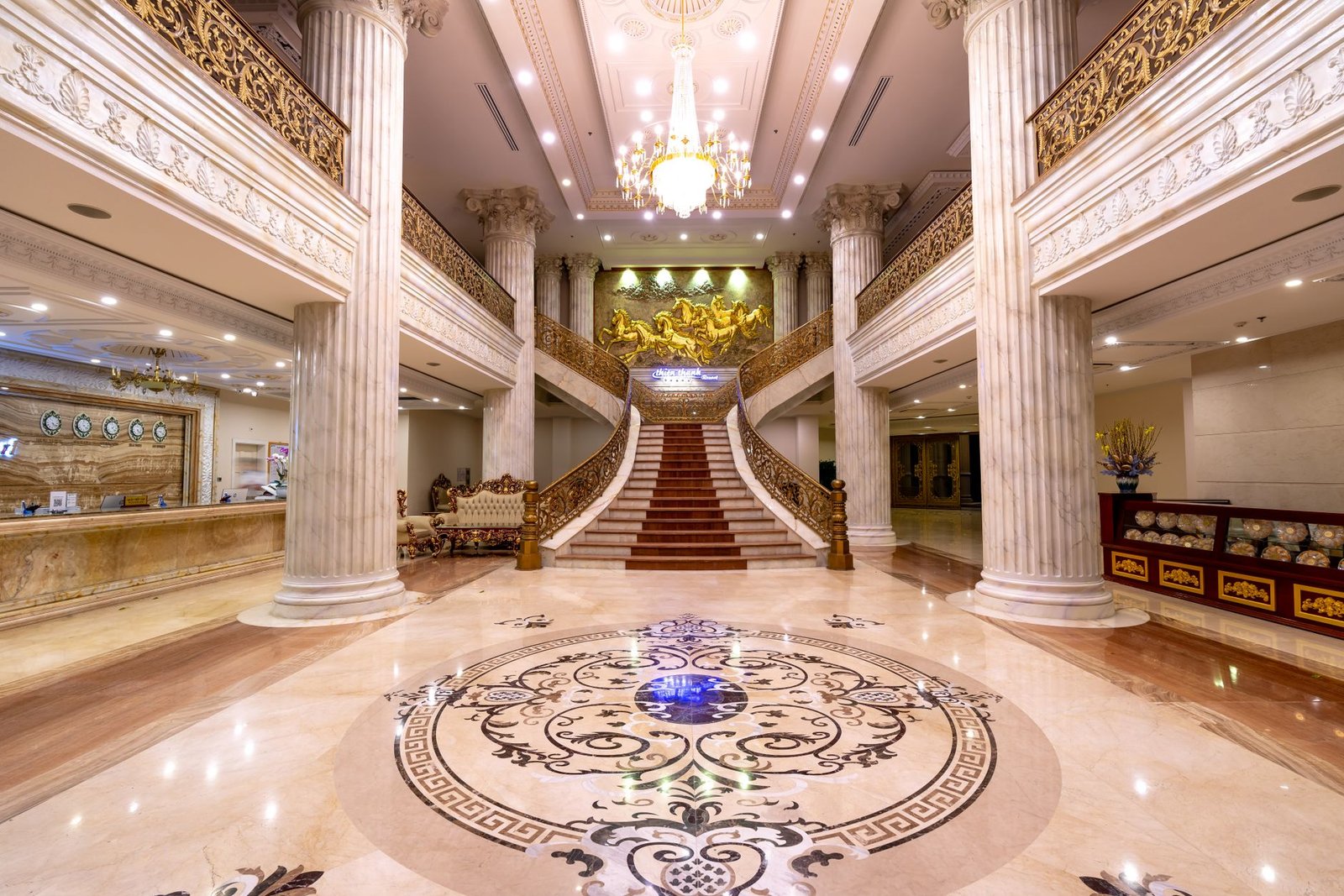
UAE hotel establishments generated AED 33.5 billion in revenue in the first nine months of 2024 — a 4% increase year-on-year — and that pipeline of new builds, rebrands and renovations has kept hospitality clinic one of the most active sectors in the UAE's construction market heading into 2026. The pressure on developers and operators is real: guests increasingly choose properties on the strength of the experience the space delivers, not just the location or the rate.
After working on hospitality fit-outs ranging from boutique business hotels in Sharjah to corporate hospitality suites in Dubai, what I find owners consistently underestimate is not the cost — it's the sequencing. A hotel interior design project has more interdependencies than any other commercial fit-out type, and the ones that go over budget almost always trace back to decisions (or the absence of them) in the first six weeks of the project.
What hotel interior design costs in the UAE in 2026
Hospitality fit-out pricing in the UAE is typically discussed in two ways: cost per square foot for the overall built environment, and cost per key for the guest room programme. Both matter, but the per-key figure is often more useful for early feasibility.
| Hotel Category | Cost Per Key (AED) | Fit-Out AED/sqft | Notes |
|---|---|---|---|
| Economy / Budget (2–3 star) | AED 120,000–200,000 | AED 600–750 | Standardised finishes, mass-market FF&E, minimal custom joinery |
| Upscale (4-star) | AED 200,000–350,000 | AED 750–950 | Upgraded bathrooms, some bespoke elements, brand-standard FF&E |
| Luxury (5-star silver/gold) | AED 350,000–600,000 | AED 950–1,200 | Premium stone, custom joinery throughout, high-spec lighting design |
| Ultra-Luxury (5-star platinum) | AED 600,000–1,000,000+ | AED 1,200–2,000+ | Bespoke everything — art curation, imported materials, smart room systems |
These are all-in numbers for the fit-out scope: design fees, civil and MEP works, fixed finishes, joinery and installation. They exclude FF&E (covered below), landscaping, signage, kitchen equipment (which has its own procurement track) and authority fees. Add 5% VAT across the board.
The UAE interior design market reached approximately AED 1.94 billion in 2026, reflecting continued growth driven by luxury tourism expansion and the sustained hotel development pipeline across all seven Emirates. Hospitality accounts for a significant slice of that figure — and rates have tightened against 2024 as material and labour costs stabilised after the post-pandemic spike.
DTCM classification and what it demands from your interiors
The Dubai Department of Economy and Tourism (formerly DTCM) rates hotel establishments on a 1-to-5-star scale, with distinct property categories including business, beach, desert and heritage hotels. Five-star properties are further graded platinum, gold and silver — a distinction that has real interior design implications, particularly on lobby and F&B standards.
To achieve and maintain a classification, a property must satisfy 100% of licensing criteria, 100% of operating criteria, and at least 50% of enhancing criteria for its tier. From a design perspective, this translates to:
- Minimum room sizes — DTCM specifies net floor area requirements per room type per star category; undersized rooms during design will fail inspection regardless of finish quality.
- Bathroom specifications — higher star tiers require separate bath and shower in standard rooms, specific fixture quality benchmarks, and accessible bathroom provision percentages.
- F&B and lobby area requirements — a 4-star property with no all-day-dining restaurant will not hold its classification; the spatial design must accommodate the required F&B footprint.
- Civil Defence material compliance — corridor linings, carpet, curtains and wall panelling must meet UAE fire-resistance standards; DTCM inspections cross-reference Civil Defence clearances. Specifying non-compliant materials is the single most common reason for costly last-minute material substitutions.
- Accessibility — designated accessible rooms, ramps, lift dimensions and signage are classification criteria, not just legal obligations.
The practical implication: DTCM classification documents should be in the design team's hands before concept design starts, not at submission stage. We have seen operators lose six weeks and AED 350,000 in redesign costs because a lobby was designed without reference to the minimum public-area requirements for their intended star tier.
The hotel fit-out timeline — phase by phase
Hotel projects have more phases than most commercial interiors, and the dependencies between them are tighter. Miss an FF&E order date and you delay the handover; delay the handover and you miss the revenue window. Here is a realistic phase breakdown for a mid-size UAE hotel:
Design and concept (weeks 1–12 for boutique; weeks 1–20 for full-service)
Concept design takes 8–12 weeks for a boutique property and 16–20+ weeks for a full-service hotel. This phase covers space planning, mood boards, material palettes, FF&E schedules and operator brand-standard alignment. Crucially, the FF&E specification package must be completed by the end of this phase — not after construction drawings — so procurement can be initiated in parallel with authority submissions.
Authority approvals (weeks 8–20, overlapping with design)
Dubai Municipality, Civil Defence, RTA (where the project affects road or utility interfaces) and — for hotel classifications — DET review packages are submitted in parallel. These approvals add 6–12 weeks and often trigger comment rounds. Running approvals concurrently with detailed design, not sequentially, is standard practice on UAE hotel projects and is the primary reason for maintaining a dedicated project manager throughout the design phase.
Fit-out execution (months 4–13 from project start)
Physical fit-out runs 4–9 months for smaller hotels and 12–18 months for large full-service properties. Sequence: structural enabling works and MEP modifications first; then fixed finishes (flooring, wall cladding, ceiling systems); then joinery installation; then loose FF&E delivery and installation; then snagging and pre-opening inspections. For operational hotels being renovated, this phase is managed in zones or floors to keep inventory available.
Total project duration
For a new build or full renovation, allow 12–18 months from design engagement to operational opening on a boutique hotel (under 80 keys), and 18–24+ months for a full-service hotel above 150 keys. These timelines assume design decisions are made on schedule. The two most common programme killers are late design freeze (typically 4–8 weeks lost) and FF&E delivery delays from international suppliers (typically 6–12 weeks at risk if not ordered early enough).
The six zones that define any hotel interior design brief
Unlike a single-use commercial fit-out, a hotel must perform as multiple distinct environments simultaneously. Each zone has its own brief, budget line and compliance requirements.
Arrival and lobby
The lobby is the project's most scrutinised space — by guests, by DTCM inspectors, and by the operator's brand standards team. It sets the entire tone and typically carries a disproportionately high budget per square metre. Spatial planning must accommodate check-in flow, luggage handling, seating, F&B activation and — on larger properties — retail. Natural light strategy and acoustic performance in a marble-floored lobby are design challenges that require specialist input early.
Guest rooms
The cost-per-key numbers above apply primarily to guest rooms. Room design must balance brand consistency (particularly for flagged properties) with construction efficiency — a repeating module of 150 identical rooms is a very different procurement exercise from a boutique with 40 individually styled rooms. The same principle applies to commercial fit-outs: standardisation drives cost down; bespoke variation drives it up.
Food and beverage
Hotel F&B interiors carry their own cost range — AED 400–1,500 per sqft for casual to high-concept dining — and their own compliance stream (food-authority approvals, kitchen extract systems, grease trap requirements). A hotel restaurant follows the same approval pathway as a standalone F&B venue, but must also coordinate with the hotel's overall MEP system, which adds coordination complexity.
Wellness, spa and gym
Spa and wellness spaces are moisture-sensitive environments that require waterproofing systems, specialist plumbing, ventilation for steam and heat, and materials rated for wet use. These are not items to value-engineer out of the specification — a spa that develops moisture-related defects two years after opening creates maintenance costs that will exceed the original savings.
Meeting and events
Meeting rooms require integrated AV infrastructure, acoustic wall treatments, flexible furniture systems and — for larger ballrooms — structural considerations for rigging points and floor-loading. The design and AV specification must be coordinated from concept stage; retrofitting AV into a finished ceiling system is expensive and rarely achieves the same result.
Back-of-house
Back-of-house — kitchens, laundry, staff areas, plant rooms, loading — accounts for 25–35% of a full-service hotel's floor area and is rarely designed with the rigour it deserves. Poorly planned back-of-house creates operational inefficiencies that persist for the life of the building. End-to-end project management that covers back-of-house with the same discipline as public areas is a distinguishing marker of experienced hospitality teams.
FF&E — the cost line that surprises every first-time hotel developer
Furniture, Fixtures and Equipment (FF&E) refers to the loose and fixed items that complete a hotel space — beds, chairs, tables, lighting, soft furnishings, artwork, in-room technology, bathroom accessories and kitchen equipment. FF&E is procured separately from the main fit-out contract and typically represents 30–40% of total project cost on a mid-to-luxury hotel.
On a 100-key 4-star hotel with an all-in room cost of AED 250,000 per key, total project cost is AED 25 million. Of that, AED 7.5M–10M is likely FF&E. For a 5-star platinum property at AED 700,000 per key across 150 rooms, the FF&E budget alone can reach AED 30M–40M before public areas are accounted for.
The most common FF&E mistake: treating it as a post-construction procurement exercise. Custom and imported FF&E from European or Asian manufacturers carries lead times of 10–16 weeks. If specification is not finalised before the fit-out commences, you will be in a situation where rooms are finished and ready — but cannot open because the furniture has not arrived. This is not a rare scenario; it is what happens on the majority of hotel projects where FF&E procurement is not managed as a parallel track from day one.
Sustainability in UAE hotel design
Sustainability compliance in UAE hospitality is shaped by two primary frameworks: Estidama's Pearl Rating System (Abu Dhabi) and Al Sa'fat or LEED (Dubai). An increasing number of international hotel operators now require minimum certification levels as a brand-standard condition. From a design standpoint, this means low-VOC materials, energy-efficient lighting (LED throughout, with dimming and occupancy control), water-saving sanitary fittings, and — for new builds — embodied-carbon tracking on structural and finish materials.
Sustainable specification does not have to mean higher cost. The unit cost of LED fittings, water-efficient fixtures and locally sourced materials has decreased substantially since 2022. Where cost is added is in the energy modelling, commissioning and certification process — budget AED 120,000–400,000 for LEED or Pearl certification on a mid-size hotel depending on scope and target rating.
Where hotel interior projects go over budget — and how to avoid it
In our experience managing hospitality projects across the UAE, budget overruns trace back to four recurring patterns:
- Late design freeze. Every change after a DTCM or DM submission triggers a re-submission fee and a 4–8 week delay. On a hotel project, one change can cascade across 150 identical rooms. Freeze the design before submission, not after.
- FF&E ordered late. Covered above — but worth repeating because it is the most common reason for a phased opening (which costs more in preliminaries than the savings on any delayed order).
- Civil Defence non-compliance discovered during inspection. Specifying non-fire-rated materials in corridors or guest rooms is caught at inspection, not at design review. Engage a Civil Defence consultant at concept stage, not after the design package is finalised.
- Contingency below 10%. A hotel project is one of the most complex fit-out types in terms of subcontractor coordination, regulatory interface and programme risk. A 5% contingency is appropriate for a straightforward office. A hotel needs 10–15%, and a phased renovation of an operational property needs 15–20%. Underprovisioning contingency does not reduce risk — it just means you have no budget to manage it when it materialises.
The common thread: decisions deferred to execution cost more than decisions made at design. A dedicated interior design team with hospitality experience can identify and close these gaps before they become programme risks. Experienced fit-out management ensures what is designed is built correctly and on time.
Frequently asked questions
How much does hotel interior design cost in the UAE in 2026?
Hotel interior design and fit-out runs AED 600–1,200 per sqft all-in, with cost per guest room at AED 120,000–200,000 for economy/3-star, AED 200,000–350,000 for 4-star upscale, and AED 350,000–800,000+ for 5-star luxury. FF&E (furniture, fixtures and equipment) adds a further 30–40% on top of the construction and fit-out cost.
What DTCM classification requirements affect hotel interior design?
DTCM rates hotels 1–5 star with categories including business, beach, desert and heritage. Five-star hotels are graded platinum, gold and silver. Properties must meet 100% of licensing and operating criteria and 50% of enhancing criteria. Interior requirements cover minimum room sizes, bathroom specification, F&B area provision, Civil Defence material compliance and accessibility standards.
How long does a hotel fit-out project take in the UAE?
Concept design takes 8–12 weeks (boutique) or 16–20+ weeks (full-service). Authority approvals add 6–12 weeks. Physical fit-out runs 4–9 months for smaller properties, 12–18 months for larger ones. Total from design start to operational opening: 12–18 months for boutique hotels, 18–24+ months for full-service properties.
What is FF&E and how much does it cost for a hotel project?
FF&E (Furniture, Fixtures and Equipment) covers all loose and fixed items that complete the guest experience — beds, seating, lighting, soft furnishings, artwork, in-room technology and kitchen equipment. On a mid-to-luxury hotel, FF&E typically represents 30–40% of total project cost and must be specified and ordered concurrently with construction due to 10–16 week lead times on imported or custom items.
Can a hotel renovation be carried out while the hotel stays operational?
Yes — phased renovation is standard for operational properties. Typical sequence: Phase 1 structural, MEP and back-of-house upgrades; Phase 2 public areas and F&B during low season; Phase 3 guest room floors on a rolling basis. A specialist fit-out team will schedule noisy works during low-occupancy periods and use acoustic hoarding to maintain guest experience throughout.
What are the most common reasons hotel interior projects go over budget?
The four most common causes are: (1) late design freeze causing re-submission fees and programme delays; (2) FF&E ordered too late, leading to a phased opening with ongoing preliminaries costs; (3) Civil Defence non-compliance found at inspection, requiring material substitution; and (4) a contingency budget below 10–15%, which is insufficient for a fit-out type with this level of coordination complexity.
Planning a hotel or hospitality fit-out in the UAE?
V Square has delivered interior design and project management for hospitality, commercial and residential projects across the UAE. From DTCM compliance to FF&E procurement and contractor management, we handle the full scope — concept to handover.
Request a project consultation