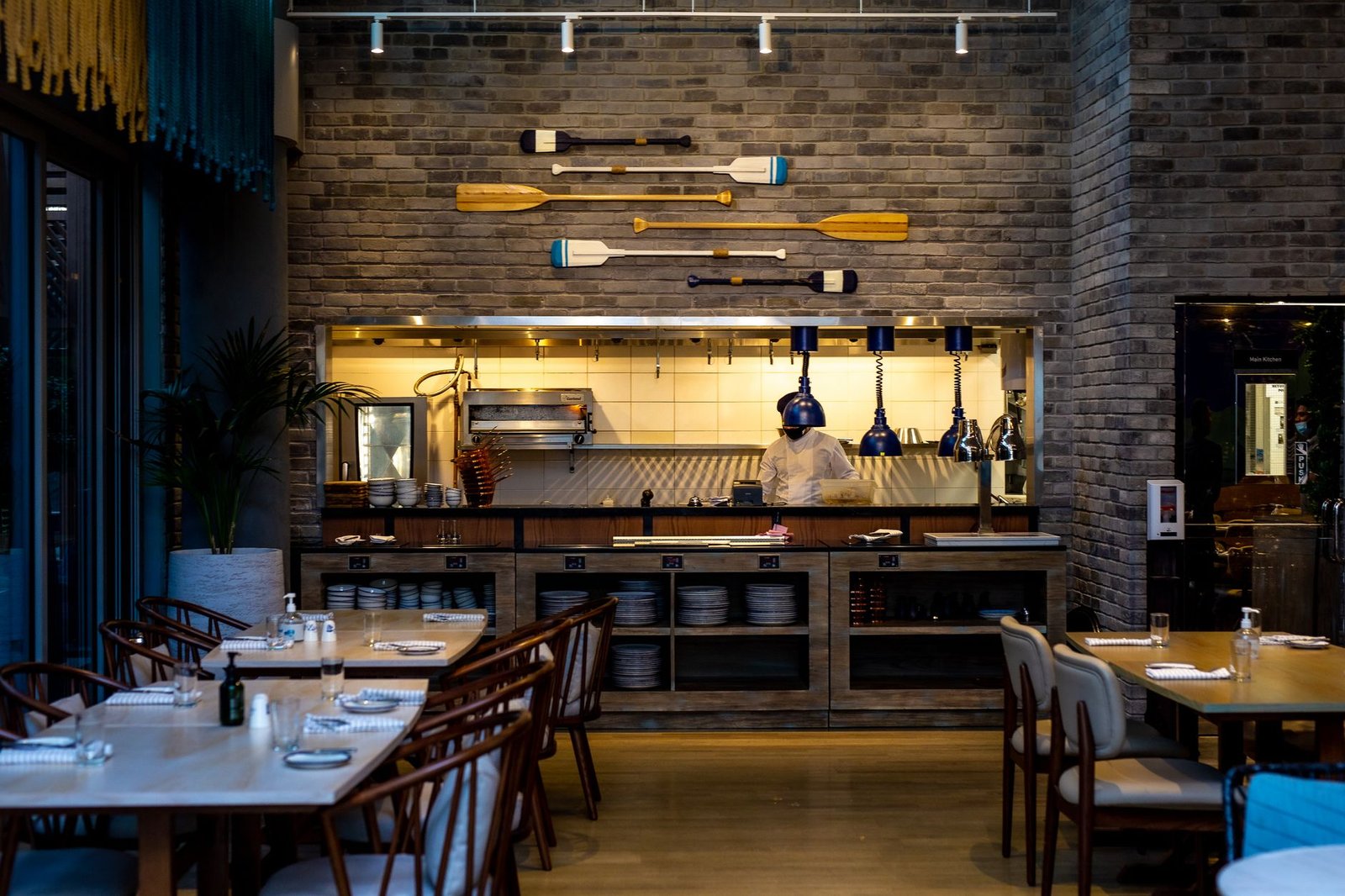
Dubai's F&B market is unforgiving in one specific way: the interior fit-out defines whether a concept survives its first twelve months. Rents in prime dining locations — DIFC, Downtown, JBR, City Walk — run AED 300–600 per square foot annually. That means a 200 sqm restaurant is carrying a rent bill of AED 600,000–1.2M per year before a single cover is served. The interior fit-out is not a branding exercise; it is infrastructure that has to earn its cost back through covers, average spend, and repeat visits.
I've managed commercial fit-out projects across Dubai and Sharjah since the early years of the UAE's post-pandemic dining surge, and the mistakes I see most often come from budget allocation — not total budget size. Operators underspend on acoustic treatment and kitchen extraction, then spend the equivalent fixing both within six months of opening. This guide gives you the real cost structure for 2026, the authority approval sequence, and the design choices worth the premium.
What Drives Restaurant Fit-Out Cost in Dubai
Concept type and spatial complexity
A cloud kitchen in a shared facility and a 120-cover fine-dining restaurant occupy opposite ends of the cost range for good reason. The cloud kitchen has no front-of-house to design, simplified seating, and a kitchen showroom focused entirely on throughput. A fine-dining venue needs custom millwork, imported stone surfaces, architectural lighting design, acoustic treatment, and a bar with display storage. The spatial programme — how many distinct zones (lounge, main dining, bar, private dining, outdoor terrace) — is the single biggest cost lever at the concept stage.
Kitchen scope and MEP density
The kitchen is consistently the most expensive square metre in any restaurant. Commercial ventilation hoods, grease trap systems, drainage falls, gas supply, high-load electrical circuits, and fire suppression all concentrate into a space that may be 20–30% of the total footprint. In shell-and-core spaces — common in new commercial buildings across Business Bay and Dubai Hills — the MEP build-out cost can equal or exceed the entire front-of-house fit-out cost. Always price MEP and kitchen infrastructure separately before comparing total project quotes.
Material specification and bespoke elements
The jump from mid-range to premium is almost entirely driven by material origin and fabrication method. Locally sourced porcelain tile vs. imported Italian stone; modular seating vs. custom-upholstered banquettes made to drawing; off-the-shelf pendant fittings vs. architectural lighting designed for the specific ceiling geometry. Each of these choices compounds. A 200 sqm restaurant with imported stone, custom seating and a designed lighting scheme will cost 60–80% more than the same footprint finished with local materials and standard specification — and both can look excellent on Instagram if the design concept is strong.
Cost Breakdown by Restaurant Type (Dubai, 2026)
| Concept Type | AED/sqft Range | 200 sqm Total (excl. kitchen equip.) | Key Cost Drivers |
|---|---|---|---|
| Cloud Kitchen | AED 180–320/sqft | AED 380,000–690,000 | Kitchen MEP, extraction, ventilation; minimal FOH |
| Café / Casual QSR | AED 300–500/sqft | AED 650,000–1,100,000 | Counter design, display cases, branded joinery, flooring |
| Casual Dining (mid-range) | AED 500–900/sqft | AED 1,100,000–1,940,000 | Custom seating, feature walls, upgraded lighting, stone tiling |
| Contemporary / Concept Dining | AED 750–1,200/sqft | AED 1,600,000–2,580,000 | Bespoke millwork, acoustic ceiling, imported surfaces, bar design |
| Fine Dining / Luxury | AED 900–1,500+/sqft | AED 1,940,000–3,230,000+ | Marble, custom furniture, architectural lighting, private dining room |
Kitchen equipment (cooking lines, refrigeration, extraction hoods, dishwashing) is excluded from all figures above. Budget an additional AED 100,000–350,000 for a café, AED 200,000–500,000 for a full-service restaurant kitchen.
Design fees typically run 8–15% of the total fit-out budget for a full-service design firm, or a fixed lump sum for smaller concept cafés. A project manager or fit-out coordinator who oversees design, tendering and construction management typically adds 10–15% on the construction value — and for operators who do not have a dedicated internal team, this is often the best money spent on the project.
The DM Approval Sequence: What Surprises Most Operators
Dubai Municipality approval for a restaurant is the most layered DM approval scenario in the commercial category. Most first-time operators budget for a single permit and discover they need four or five. Here is the actual sequence, in order.
1. DM Food Safety kitchen pre-approval (before fit-out begins)
This is the step most operators miss. DM Food Safety requires kitchen layout approval — including equipment positions, extraction hood placements, grease trap sizing, drainage plan and hygiene zone separation — before any construction work begins on the kitchen zone. Submit via the Montaji portal. Expect 1–2 weeks for initial review and allow another 1–2 weeks if drawings require revision. You cannot legally commence kitchen fit-out work without this clearance.
2. DM Fit-Out Permit (BPS portal)
Required for all interior works: seating layout, bar, service zones, wet areas, MEP modifications. Submit architectural and MEP drawings in current DBC format through the BPS portal. DM typically issues the permit within 5–10 working days from a complete and compliant submission. Drawings prepared without DM-registered engineers are rejected at submission; confirm your design firm carries the correct DM registration before engaging them.
3. Civil Defence approval
Required for kitchen hood fire suppression systems (Ansul or equivalent) and for any change to the building's fire alarm or sprinkler layout. Civil Defence reviews independently of DM and typically adds 3–7 working days to the approval cycle. For high-capacity restaurants (above 100 covers), an evacuation route review may also be required.
4. DEWA approval
Required if the fit-out adds new electrical panels, increases connected load, or installs three-phase supply for commercial kitchen equipment. DEWA approval can run concurrently with DM, which most experienced fit-out contractors will do. Adding it as an afterthought adds 1–2 weeks to the project end date.
5. Landlord / master developer NOC
Building management NOCs in towers at DIFC, Emaar properties, and master-planned developments like Business Bay run 3–15 working days depending on the developer. In DIFC, the DIFC Authority has its own approval layer on top of DM. Budget this into your pre-construction schedule, not your construction schedule.
The practical implication: begin all authority approvals before your fit-out contractor mobilises on site. A well-managed F&B project runs DM and Food Safety submissions in parallel with the final design freeze. Missing that window and submitting after mobilisation is the single most common reason restaurant openings slip by 4–6 weeks.
For a broader look at how approval timelines fit into a commercial project schedule, our office fit-out timeline guide covers the approval and construction sequencing logic that applies to commercial projects across Dubai and Sharjah.
2026 Design Concepts Working in UAE's F&B Market
Biophilic layering
Biophilic design has moved past trend status in Dubai dining and is now a baseline expectation in premium F&B. The most effective implementations are not wall-to-wall foliage — they are controlled interventions: a planted centrepiece or living wall feature, indirect natural-tone lighting (2,700–3,000K), natural timber and stone textures, and a layout that gives guests a sense of spatial depth rather than compression. Dubai's closed, climate-controlled environments make biophilic elements particularly valued because they signal what the street environment doesn't offer.
Arabic-contemporary fusion
The strongest design identity emerging in Dubai's mid-to-premium dining segment is a confident blend of traditional Arabic geometry — mashrabiya screens, arabesque tile patterns, arched joinery openings — with contemporary minimalism. When executed well, it reads as unmistakably Dubai while avoiding the pastiche quality that can undermine a concept's credibility with both local and international guests. The execution matters more than the concept: use pattern as punctuation, not wallpaper.
Acoustic zoning as a competitive differentiator
This is underinvested across the market and increasingly noticed by guests. A room where a table of four can hold a conversation without raising their voices is not the norm in Dubai dining; it is a distinguishing feature. The investment required is modest relative to overall fit-out spend — acoustic ceiling panels, upholstered banquettes as sound barriers, soft flooring zones in high-traffic areas. Budget AED 25,000–80,000 for a proper acoustic treatment package. The return is guest comfort and return-visit rate.
Industrial and raw materials in casual formats
Exposed concrete, brushed steel, raw brick and reclaimed timber remain the dominant visual language for cafés and casual-dining concepts across JLT, Al Quoz, Dubai Hills and emerging neighbourhoods. The materials are durable, the aesthetic photographs well, and the cost per square foot is typically lower than polished-finish alternatives. The risk is saturation — a concept defined solely by industrial materials needs a strong secondary design element (a distinctive bar, a graphic identity, a ceiling intervention) to carve out a memorable identity.
The Instagram-legible hero moment
Every successful restaurant opened in Dubai in the last three years has had one design element that guests photograph and share: a floral ceiling installation, a dramatic statement bar, a tiled archway, a floor-to-ceiling wine display, an open kitchen pass. This element is rarely the most expensive part of the fit-out — often it costs AED 30,000–80,000 — but it performs organic marketing work for the lifetime of the venue. Build it into the concept from day one, not as a last-minute addition.
Project Timeline: Design to Opening Day
| Phase | Duration | Key Outputs |
|---|---|---|
| Concept design & brief | 2–3 weeks | Space plan, concept boards, kitchen layout, authority submission drawings |
| Authority approvals (DM, Food Safety, CD, DEWA, developer NOC) | 4–7 weeks (run in parallel where possible) | DM Fit-Out Permit, DM Food Safety clearance, Civil Defence and DEWA sign-off |
| Contractor tendering & award | 2–3 weeks (concurrent with approvals) | Bill of quantities, 3 contractor quotes, contract award |
| Fit-out construction (BOH + FOH) | 6–10 weeks (casual dining); 10–16 weeks (fine dining, large footprint) | MEP rough-in, partitions, flooring, joinery, tiling, finishes, lighting |
| Kitchen equipment installation & commissioning | 1–2 weeks (last phase of construction) | Equipment delivered, installed, gas commissioned, extraction test |
| DM Food Safety final inspection | 1–2 weeks (after construction completion) | Food establishment permit issued; required before any soft or hard opening |
| Soft furnishings, FF&E, staff training | 1–2 weeks | Loose furniture, tableware, POS system, staff briefing, trial service |
Minimum realistic timeline for a 100–200 sqm café or casual-dining concept: 14–18 weeks. Fine dining or large-format venues with imported furniture and multiple authority touchpoints: 20–30 weeks. The operators who open on schedule are those who start authority submissions before they sign the fit-out contract, not after.
What to Ask a Fit-Out Contractor Before Signing
Dubai's fit-out contracting market has expanded significantly since 2023 and quality ranges widely. These questions sort good contractors from risky ones quickly:
- Is your company DM-registered and does your in-house engineer carry a valid DM practitioner registration? This is non-negotiable. Drawings from non-registered firms are rejected at the BPS portal.
- Does your quote include kitchen MEP or exclude it? Get the answer in writing. A quote that excludes MEP and kitchen infrastructure can look 30–40% cheaper than a fully inclusive quote while being more expensive in total.
- What is your approach to authority approvals — do you handle submissions or do we? A contractor who asks you to handle DM submissions is asking you to take on the most time-sensitive risk on the project. Full-service contractors handle authority submissions as part of their scope.
- Can you provide two to three completed restaurant references within the last 18 months in Dubai? Restaurant fit-outs are technically more demanding than office fit-outs; prior experience with F&B MEP density matters.
- What is your programme for achieving a 0% snagging list at handover? How a contractor answers this question reveals how they approach quality control. The right answer involves structured inspections at MEP completion, at finishes completion, and at FF&E completion — not a single walk-through at the end.
For projects above AED 1M fit-out value, appointing an independent project manager to oversee tendering, track programme, and manage contractor quality is typically the most cost-effective single decision an operator can make. See our project management services for how we structure this for F&B clients.
Planning a restaurant or café fit-out in Dubai?
We manage F&B fit-out projects from concept design through authority approvals to construction handover — design coordination, contractor tendering, DM submission, budget tracking and on-site supervision. Tell us about your concept and we'll set up a no-obligation consultation.
Book a free consultationFrequently asked questions
How much does a restaurant fit-out cost in Dubai in 2026?
Restaurant fit-out in Dubai runs AED 300–500 per square foot for a basic concept (functional kitchen, standard seating, simple finishes), AED 500–900 per square foot for mid-range (custom joinery, feature lighting, better stone and tiling), and AED 900–1,500+ per square foot for premium or fine-dining venues. A 200 sqm mid-range casual dining restaurant typically costs AED 1.2M–2.5M excluding commercial kitchen equipment, which adds another AED 100,000–500,000 depending on the concept.
What retail do I need before starting a restaurant fit-out in Dubai?
A restaurant fit-out in Dubai requires a DM Fit-Out Permit from the BPS portal, a DM Food Safety kitchen pre-approval (must be obtained before fit-out begins), Civil Defence clearance for kitchen hood fire suppression, DEWA approval for any additional electrical load, and a landlord or master developer NOC. In DIFC, a DIFC Authority approval layer is added. Allow 4–7 weeks to complete all approvals in parallel before construction begins.
How long does a restaurant fit-out take in Dubai from design to opening?
Realistically, 14–22 weeks for most casual-dining and café concepts of 100–300 sqm. Fine-dining and high-concept venues with imported furniture or large footprints take 20–30 weeks. The most common cause of delay is starting authority submissions after construction begins rather than before. Begin DM Food Safety and Fit-Out Permit submissions as soon as the kitchen layout and space plan are finalised.
Is kitchen equipment included in restaurant fit-out quotes?
Almost never. Commercial kitchen equipment — cooking lines, refrigeration, extraction hoods, dishwashing systems — is usually excluded from fit-out contracts and procured directly from specialist kitchen suppliers. Budget an additional AED 100,000–350,000 for a café concept and AED 200,000–500,000 for a full-service restaurant kitchen for 80–100 covers. Always confirm the kitchen equipment exclusion in writing before comparing quotes.
What are the leading restaurant design trends in Dubai for 2026?
The strongest design choices in Dubai's 2026 F&B market are biophilic layering (controlled planting, natural-tone lighting, breathable layouts), Arabic-contemporary fusion using geometric patterns and arched joinery with minimalist backdrop, acoustic zoning to give guests conversational comfort, and a signature hero element that anchors the venue's social-media identity — a statement bar, a tiled feature wall, or a distinctive ceiling treatment. Industrial raw materials remain the default for café and casual-dining formats.