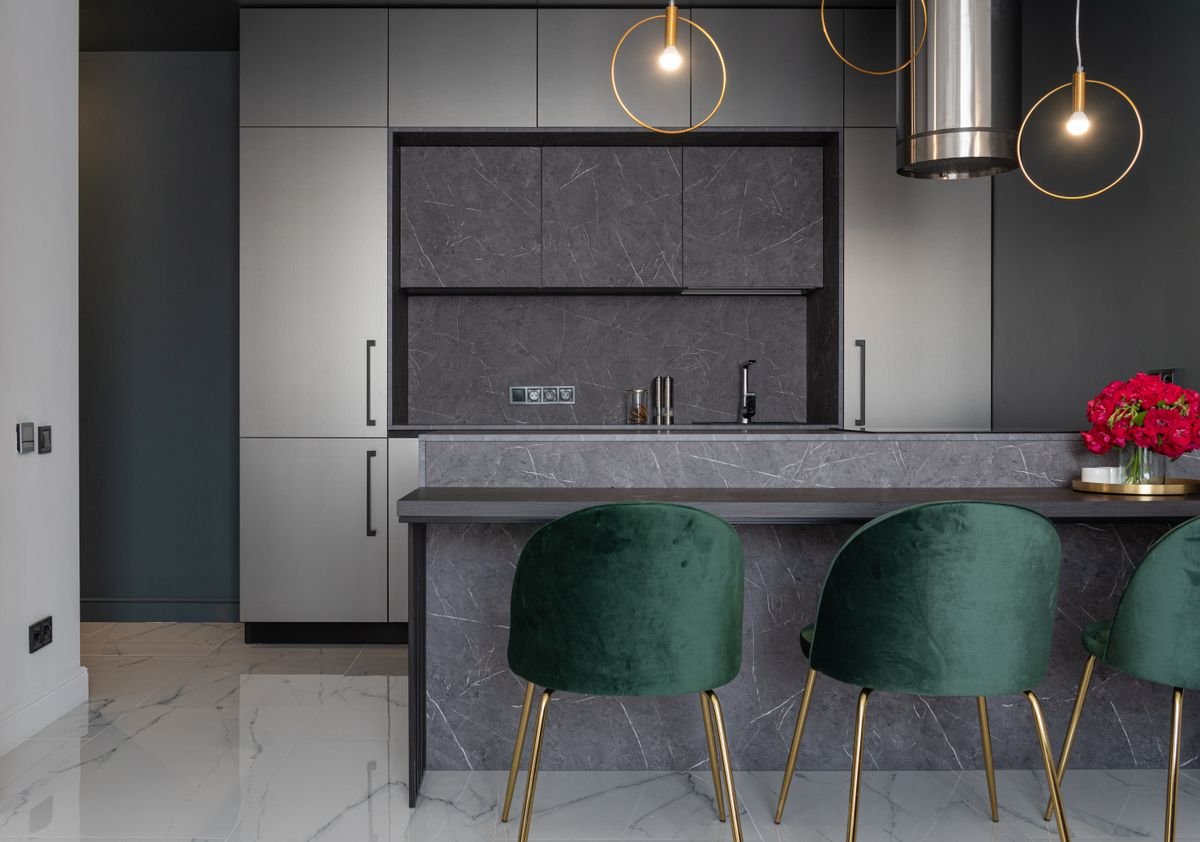
The kitchen is where most Dubai renovation budgets either get spent wisely or balloon out of control. It is also the room where the gap between a professionally managed fitout and an informal contractor job shows up most clearly — in the alignment of cabinet reveals, the quality of countertop templating, the precision of appliance integration, and whether the MEP works are done before or after the cabinets go in (a sequencing error that costs AED 8,000–20,000 to undo).
This guide draws on V Square’s kitchen projects across Dubai, Sharjah and Abu Dhabi to give you realistic 2026 cost benchmarks, a clear picture of what drives those costs, and the process that gets a kitchen from demolished shell to fully functioning fitout without surprises on the final invoice.
Cost Overview: Kitchen Fitout in Dubai 2026
| Finish Level | AED/sqft | What You Get |
|---|---|---|
| Budget / Refresh | AED 60–120 | Cabinet door and handle replacement (reskin, not full replacement), new countertop, retiling splashback, basic pendant and undercabinet lighting upgrade, new sink and tap. Existing cabinet carcasses retained. Suits landlord refreshes or short-tenure tenants. |
| Mid-Range Renovation | AED 120–200 | Full cabinet replacement (local or regional manufacture), quartz countertop, integrated hob and hood, floor and splashback retiling, new sink and tap, undercabinet LED lighting, one pendant or ceiling fixture. Suits most Dubai apartment kitchens. Labour and materials; excludes free-standing appliances. |
| Premium | AED 200–300 | Italian or German lacquered cabinetry with soft-close Blum or Grass hardware, sintered stone or engineered quartz countertops, integrated Bosch or Siemens appliances behind matching panels, undercabinet lighting system, cooker hood integrated into ceiling joinery, porcelain or stone floor tiling. Suits villa kitchens and premium apartment projects. |
| Luxury | AED 300–380+ | European bespoke cabinetry (Bulthaup, Poliform, Dada), natural stone or bookmatched sintered stone surfaces, Miele or Gaggenau appliance suite, island with waterfall countertop, integrated wine cooler, custom ceiling-mounted range hood, full MEP redesign, smart home integration. Villa and ultra-high-end apartment projects. |
These figures cover the kitchen fitout itself — cabinetry, countertops, tiling, MEP works, lighting, sink and tap. Appliances are priced separately and sit above the sqft cost unless stated. A mid-range apartment kitchen suite (hob, hood, oven, fridge) from Bosch or Siemens runs AED 12,000–30,000; a Miele or Gaggenau suite for a premium project runs AED 40,000–120,000+.
Key Cost Lines — Where the Budget Goes
Cabinetry (AED 20,000–200,000+)
Cabinetry is typically the single largest cost line in a kitchen renovation, consuming 35–50% of the fitout budget. The price spread is wider here than almost anywhere else in interior design — from AED 400–600 per linear metre for locally manufactured flat-pack-style carcasses with laminate fronts, up to AED 4,000–10,000 per linear metre for bespoke European cabinets with lacquered or veneer fronts, integrated pull-out systems, and architectural hardware.
For a 3.5m run of base and wall units in a mid-range Dubai apartment, budget AED 18,000–35,000 for local manufacture with a lacquer or foil finish and standard Blum hardware. For the same run in Italian lacquered cabinets with full-extension pull-outs, integrated lighting and premium hardware, budget AED 50,000–90,000. The performance difference is real: quality Blum or Grass soft-close drawer runners, properly adjusted hinge systems, and flush-integrated handles change how a kitchen functions daily over years — not just how it photographs.
One consistently under-budgeted item is the island. A kitchen island in a Dubai villa or large apartment adds AED 18,000–60,000 for a mid-range unit (800mm × 2,000mm, quartz top, base cabinets and three bar stools) and AED 60,000–150,000 for a feature island with waterfall countertop, integrated wine cooler, pendant lighting above, and bespoke joinery detailing.
Countertops (AED 180–800/linear metre installed)
The countertop is the kitchen’s most-used horizontal surface and one of the most visible — material choice here shapes the entire feel of the room.
- Engineered quartz (AED 180–350/linear metre): the market standard in Dubai apartments. Non-porous, scratch-resistant, and available in a range of finishes from carrara white to concrete grey. Brands like Silestone, Caesarstone and Compac are widely stocked locally, cutting lead time to 1–2 weeks.
- Sintered stone (AED 280–500/linear metre): Dekton and Lapitec have become the first choice for serious cooks and villa kitchens. Heat-proof, scratch-proof, and genuinely UV-stable — relevant for Dubai kitchens that receive direct sun through large windows. More brittle than quartz and requires professional templating and cutting.
- Natural marble (AED 300–800/linear metre for Calacatta, Bianco Carrara or Emperador grades): the luxury benchmark. Requires sealing every 6–12 months and will stain if acidic liquids (lemon juice, vinegar, tomato) are left on it. Still the most sought-after material in high-end Dubai villa projects for its irreplaceable visual warmth.
- Compact laminate (AED 100–160/linear metre): a practical choice for rental properties. Durable, easy to replace, and available in wood, stone and plain colour finishes.
Tiling: Floor and Splashback (AED 35–180/sqft installed)
Kitchen floors in Dubai are almost universally tiled — the combination of cooking oil, humidity, and constant foot traffic rules out timber and most carpet alternatives. Large-format porcelain (600×600 or 1200×600) at AED 45–80/sqft installed is the most popular choice: easy to clean, long-lasting, and visually extending the space. Rectified tiles that can be laid with 2–3mm joints give a cleaner look than older formats.
Splashbacks run AED 35–60/sqft for standard ceramic tile, AED 60–120/sqft for large-format porcelain or stone-effect tile, and AED 100–180/sqft for a sintered stone or natural stone slab splashback that continues the countertop material up the wall — a look that dominates premium Dubai kitchen projects in 2026.
MEP Works (AED 8,000–35,000)
Mechanical, electrical, and plumbing works are the hidden cost in kitchen fitouts, and the one most often underestimated by clients and inexperienced contractors alike. A like-for-like kitchen renovation with no layout change requires MEP scope to: reconnect the existing supply and waste stubs to the new sink position, relocate cooker socket to the island (if applicable), add undercabinet lighting circuits, and ensure the hood extract runs correctly. Budget AED 8,000–15,000 for this scope in a standard apartment kitchen.
A kitchen that changes layout — moving the sink from one wall to another, relocating the gas connection, adding a second oven location, or introducing an island with a sink — requires drainage rerouting, which in many Dubai buildings means cutting the slab or building a raised platform above the original stub location. This adds AED 15,000–35,000 to the MEP budget and, in community buildings, requires a building-modification permit and potentially a master-developer NOC. Always confirm this before the design is finalised.
Lighting (AED 5,000–25,000)
Kitchen lighting is one of the most impactful and underinvested lines in most fitouts. Task lighting over the countertop (undercabinet LED strips or discrete recessed spotlights) makes the kitchen safe and functional. A ceiling grid of recessed downlights provides ambient fill. A statement pendant or two over the island defines the kitchen’s character and connects it visually to the adjacent dining or living space.
A properly specified three-layer lighting scheme for a Dubai apartment kitchen costs AED 8,000–18,000 in fixtures and installation. An integrated smart-lighting system (dimmable scenes via app or wall pad) adds AED 5,000–12,000 more. In villa kitchens with open-plan living, the kitchen lighting scheme should be coordinated with the living room lighting plan from the outset to avoid an inconsistent ambience across the open zone.
Kitchen Layout: Getting the Fundamentals Right
The layout determines everything downstream. In Dubai, the most common apartment kitchens are L-shape (two adjacent walls), galley (two parallel runs), or single-wall. Villa kitchens more often accommodate a U-shape or island configuration. A few layout principles that matter in UAE kitchens specifically:
- Work triangle: sink, hob and fridge form the classical work triangle. In Dubai apartment kitchens where space is tight, the triangle is often compressed to a work zone along one L-leg. The minimum clear distance between the hob and the opposite counter is 900mm; 1,100mm is comfortable for one cook, 1,400mm for two.
- Ventilation: Gulf cooking involves high-heat, high-aromatic methods (frying, slow-cooking, spice-heavy) that generate more ventilative load than European cooking styles. A hood with a minimum 650m³/hr extract rate is the baseline for an apartment hob; villa hobs over 90cm need 900–1,200m³/hr. The hood extract duct must terminate outside the building, not into a ceiling void. This is a code requirement in Dubai, but non-compliant installations are common in older buildings and require correction at renovation.
- Maids’ room and service kitchen: in larger Dubai villas and some full-floor apartments, a second “dirty” or service kitchen adjoins the main kitchen and handles heavy cooking and washing-up. If the unit has this configuration, the main kitchen can be specified purely for aesthetics and light prep, which changes the material and appliance selection significantly.
- Open vs. closed kitchen: the closed kitchen remains common in UAE homes for the practical reason that cooking smells from Gulf cuisine can be strong and guests are often in the adjacent living area. Open-plan kitchens require more investment in ventilation and cooking discipline. If the client plans to have a domestic worker manage the kitchen, a closed layout with a pass-through or service window is often a better functional choice than a fully open kitchen that prioritises the architectural view.
Kitchen Design Styles in Dubai 2026
Handleless Contemporary with Warm Wood
The dominant look in Dubai’s residential market in 2026. Flat-front, handleless cabinets in a white, off-white or light grey lacquer combined with an oak or walnut veneer island, lower cabinets, or open shelving section. The warmth of the timber against the cool cabinet fronts prevents the kitchen from feeling clinical. This style works particularly well in Dubai apartment kitchens where the kitchen opens to the living room and needs to feel residential rather than commercial.
Arabian Contemporary
A growing segment in Dubai villa projects — warm sandy palette, fluted or reeded cabinet fronts, brushed brass or antique gold hardware, zellige or handmade ceramic tile splashbacks, and natural stone countertops. The kitchen reads as distinctly local without being pastiche. It pairs naturally with an Arabian-influenced dining room in open-plan villa configurations where both spaces share a sightline.
Full High-Gloss Lacquer
Still specified in premium apartment projects and ultra-high-end villas where the brief calls for a hotel or yacht-grade kitchen. White, black, deep navy or forest green high-gloss lacquer cabinet fronts with integrated pulls or J-groove handles. Requires European lacquering quality to avoid telegraphing the substrate through the finish — locally produced high-gloss finishes can look impressive in the showroom but show seams and temperature-related movement within 12–18 months in a Dubai climate. Specify European-market lacquered panels (Egger, Pfleiderer or equivalent) at minimum; prefer Italian factory lacquer for anything that needs to last.
Raw and Industrial
A minority but consistent niche in Dubai’s design-forward residential market, particularly in urban apartments in Downtown, DIFC and Design District. Exposed concrete walls, black or anthracite grey cabinetry with black stainless or brushed steel hardware, polished concrete floors, and a stainless steel professional-grade cooking setup. Visually strong and genuinely distinctive, but requires precise execution — an unfinished industrial kitchen looks neglected; a well-executed one looks intentional and elevated.
Permits and Process for Dubai Kitchen Renovations
Most apartment kitchen renovations in Dubai proceed without a permit if the layout does not change and no structural elements are touched. The renovation involves demolishing the existing cabinets, retiling, and installing the new fitout within the same footprint.
A permit from Dubai Municipality is required when any of the following apply:
- Removal or modification of a load-bearing wall or partition
- Relocation of the gas supply stub (requires DM-registered plumber and DM inspection)
- Extension of drainage runs (stub relocation)
- Changes to fire-rated compartmentation
- Any structural slab opening for drainage rerouting
In Emaar, Nakheel, DAMAC and other master-developer communities, a NOC from the master developer is required before any structural or MEP work begins, regardless of DM permit status. This process typically takes 2–4 weeks and requires submission of a fit-out drawing package prepared by a DM-registered design firm. V Square handles this submission as part of the project management scope on all Dubai renovation projects.
The Kitchen Fitout Process and Timeline
| Phase | Duration | Key Activities |
|---|---|---|
| Design and Planning | 1–2 weeks | Site survey, layout options, material palette, appliance selection, cabinet elevations, MEP assessment |
| Permits / NOC (if required) | 2–4 weeks (parallel) | DM building modification permit, master-developer NOC submission |
| Cabinet Manufacture | 2–3 weeks local / 8–14 weeks European | Cabinet fabrication off-site. Timed to arrive after demolition + MEP roughing-in. |
| Demolition | 2–3 days | Strip existing cabinets, countertop, tiles, fixtures. Disconnect services correctly (gas must be a registered contractor). |
| MEP Roughing-In | 3–5 days | Reroute drainage if needed, run new electrical circuits (undercabinet, hood, island), reposition gas, new socket positions |
| Tiling | 3–5 days | Floor and splashback tiling, grouting, sealant. Countertop templating done at this stage. |
| Cabinet Installation | 3–5 days | Base and wall unit installation, adjustment, door and drawer alignment |
| Countertop Installation | 1–2 days | Countertop templating took place during tiling; slabs cut and installed after cabinets are set |
| Appliance Fit-Off | 1–2 days | Hob, hood, oven, fridge, dishwasher commissioning; gas pressure test and sign-off |
| Lighting, Finishing and Snagging | 2–3 days | Undercabinet lights, pendants, sealant bead to countertop, accessories, final clean and inspection |
Total site time for a standard apartment kitchen renovation: 4–6 weeks with local cabinetry. If European cabinets are specified, the manufacturing lead time runs in parallel with the design and permit phase, so the total project timeline from brief to handover is typically 10–16 weeks.
Common Mistakes in Dubai Kitchen Renovations
The most expensive mistake I see in Dubai kitchen projects is finalising the cabinet layout before confirming the MEP routing. A client who falls in love with an island design that requires moving the sink 1.5m from its current position is looking at an additional AED 20,000–40,000 in drainage works and potentially a DM permit — costs that were not in the original contractor quote. The MEP assessment must happen in week one of the design process, not as an afterthought during demolition.
The second most common error is under-sizing the hood or specifying a decorative hood with inadequate extract power. Gulf cooking generates significant smoke and vapour, and a hood rated for 400m³/hr in a European kitchen will be overwhelmed within months. Clients who cut cost on the hood invariably spend more on repainting or redecorating walls and ceilings within two years.
Third: ordering appliances independently of the cabinet fabrication. The cabinet openings are fabricated to specific appliance dimensions from the manufacturer’s technical data sheet. If the appliance is substituted after the cabinets are ordered — even within the same brand — the cutout dimensions can differ by 20–50mm, requiring rework. Lock in the exact appliance model and obtain the technical data sheet before the cabinet fabrication begins.
For an end-to-end view of how we manage these sequencing risks across kitchen and multi-room projects, the fit-out project management guide covers the full stage framework from brief through to handover.
Budgeting by Kitchen Type and Property
| Kitchen Type | Typical Size (sqft) | Mid-Range Budget (AED) | Premium Budget (AED) |
|---|---|---|---|
| Studio / 1BR apartment | 60–100 | 25,000–45,000 | 45,000–85,000 |
| 2BR–3BR apartment | 100–160 | 45,000–90,000 | 90,000–170,000 |
| Townhouse kitchen | 150–220 | 70,000–130,000 | 130,000–250,000 |
| Villa kitchen (no island) | 200–350 | 100,000–180,000 | 180,000–350,000 |
| Villa kitchen with island | 280–500+ | 150,000–280,000 | 280,000–600,000 |
These budgets exclude appliances and cover cabinetry, countertops, tiling, basic MEP works, sink, tap, and lighting. Add AED 15,000–80,000+ for a mid-to-premium appliance suite depending on brand and configuration.
For clients renovating the kitchen as part of a full apartment or villa redesign — alongside living room, bedrooms and dining spaces — bundling the project under a single design-and-build contract allows the kitchen and the adjoining spaces to be coordinated in palette, material temperature, and project timing, typically delivering a 5–10% combined cost saving versus separate contracts.
Planning a Kitchen Renovation in Dubai?
V Square handles design, cabinetry, MEP, tiling, appliance coordination and full project management — to a fixed timeline and transparent budget. We’ve delivered kitchens across Dubai, Abu Dhabi and Sharjah.
Get a free kitchen consultation →Frequently Asked Questions
How much does kitchen interior design cost in Dubai in 2026?
A kitchen fitout in Dubai costs AED 120–200/sqft for a mid-range renovation (new cabinetry, quartz countertop, integrated appliances, and lighting) and AED 220–380/sqft for a premium finish (Italian or German cabinetry, sintered stone surfaces, Miele or Gaggenau appliances). For a 150 sqft apartment kitchen, budget AED 40,000–80,000 mid-range and AED 80,000–160,000 premium, excluding appliances. A full villa kitchen with island can reach AED 250,000–600,000 at the luxury end.
What is the most popular kitchen style in Dubai in 2026?
Handleless contemporary with warm wood accents is the dominant kitchen style in Dubai in 2026. White or light grey high-gloss or matt lacquer cabinets are paired with natural oak or walnut veneer islands or open shelving sections, quartz or sintered stone countertops, and integrated appliances behind matching panels. Arabian-influenced kitchens with warm sandy tones, fluted cabinet fronts and brass hardware are growing strongly, particularly in villa projects.
Do I need a permit for kitchen renovation in Dubai?
Most apartment kitchen renovations in Dubai do not require a Dubai Municipality permit if there are no structural changes and no wet area (drainage) extensions. However, any changes to load-bearing walls, relocation of the gas line, moving waste and water stubs, or changes to fire-rated compartments require a DM permit. In master-developer communities (Emaar, Nakheel, DAMAC), an NOC from the developer is required before any structural or MEP work begins, regardless of DM permit status.
How long does a kitchen fitout take in Dubai?
A standard apartment kitchen renovation in Dubai takes 4–6 weeks: 1–2 weeks for design and cabinet fabrication (local), 3–5 days for demolition and MEP roughing-in, 3–5 days for tiling, 3–5 days for cabinet installation, and 2–3 days for appliance fit-off, lighting and finishing. European bespoke cabinetry adds 8–14 weeks manufacturing lead time, extending total project duration to 10–16 weeks from brief to handover.
What is the best kitchen countertop material for Dubai homes?
Engineered quartz (AED 180–350/linear metre installed) is the most widely used kitchen countertop in Dubai for its durability and stain resistance. Sintered stone (Dekton, Lapitec; AED 280–500/linear metre) is specified in premium projects for its scratch and heat resistance — important in a climate where intense cooking is standard. Natural marble (AED 300–800/linear metre) is the prestige choice but requires sealing. Compact laminate (AED 100–160/linear metre) is the cost-efficient rental-market option.
Cost figures reflect Dubai market rates as of mid-2026. Final budgets depend on existing shell condition, layout change scope, material specification and site access. Request a project-specific quote before committing to any budget.