A showroom has exactly one job: it must make someone want what you are selling, right now, in this room. That sounds obvious, but it is remarkable how many fit-outs I have seen in Dubai where the design actively works against the product — a car parked on reflective white tiles that bounce glare onto the bonnet, or a furniture showroom lit so uniformly that nothing reads as premium. The space itself has to sell.
What makes showrooms genuinely different from other commercial spaces is the relationship between product, movement and light. A well-designed showroom choreographs the customer through a sequence of impressions: a strong entry moment, a clear journey through the product range, a private space for serious conversation, and a handover or checkout experience that feels like a conclusion rather than an afterthought. Every AED spent on fit-out should either create one of those moments or support it technically. This guide covers what that costs in Dubai in 2026, what the approvals process requires, and what separates effective showroom design from expensive decoration.
Showroom fit-out costs in Dubai: 2026 price tiers
Dubai's commercial fit-out market has seen material costs rise 18–23% between 2023 and 2025, with skilled trades labor up another 12–15% over the same period. Showrooms sit at the higher end of the commercial cost spectrum because they demand more from lighting, flooring and bespoke display elements than a standard office or retail unit.
Porcelain or polished concrete floor, standard suspended ceiling with recessed LED, off-the-shelf display fixtures, painted feature walls, basic joinery counter. Suited to multi-brand electronics or appliance showrooms.
Custom millwork and display risers, engineered stone or large-format tile, track lighting with product-tuned colour temperature, branded focal wall, private consultation zone. Covers fashion, furniture and B2B showrooms.
Marble or natural stone floors, circadian/smart lighting per zone, full brand architecture (materials, finishes, graphic integration), VIP lounge, bespoke reception. Automotive franchises, jewellery and luxury fashion.
These are all-in fit-out figures covering MEP modifications, flooring, ceiling, joinery, lighting and basic furniture. Design fees — typically 8–15% of the fit-out budget for commercial projects — sit on top. A 3,000 sqft mid-range branded showroom should be budgeted at AED 1,500,000–2,550,000 before design fees and authority permits.
Cost breakdown by component
| Component | Standard (AED/sqft) | Mid-Range (AED/sqft) | Luxury (AED/sqft) |
|---|---|---|---|
| Flooring | 40–70 | 80–160 | 180–400+ |
| Ceiling & lighting | 50–80 | 90–160 | 180–350 |
| Joinery & display fixtures | 60–100 | 120–200 | 220–450 |
| MEP modifications | 50–80 | 70–110 | 100–180 |
| Partitions & feature walls | 30–60 | 50–90 | 80–200 |
| Entry / facade treatment | 20–40 | 40–80 | 80–200+ |
| Consultation / VIP zone | — | 40–70 | 80–200 |
| Signage & brand integration | 15–30 | 30–60 | 60–150 |
| Authority fees & permits | AED 1,000–7,500 (fixed, not per sqft) | ||
Automotive showrooms: what the design actually has to do
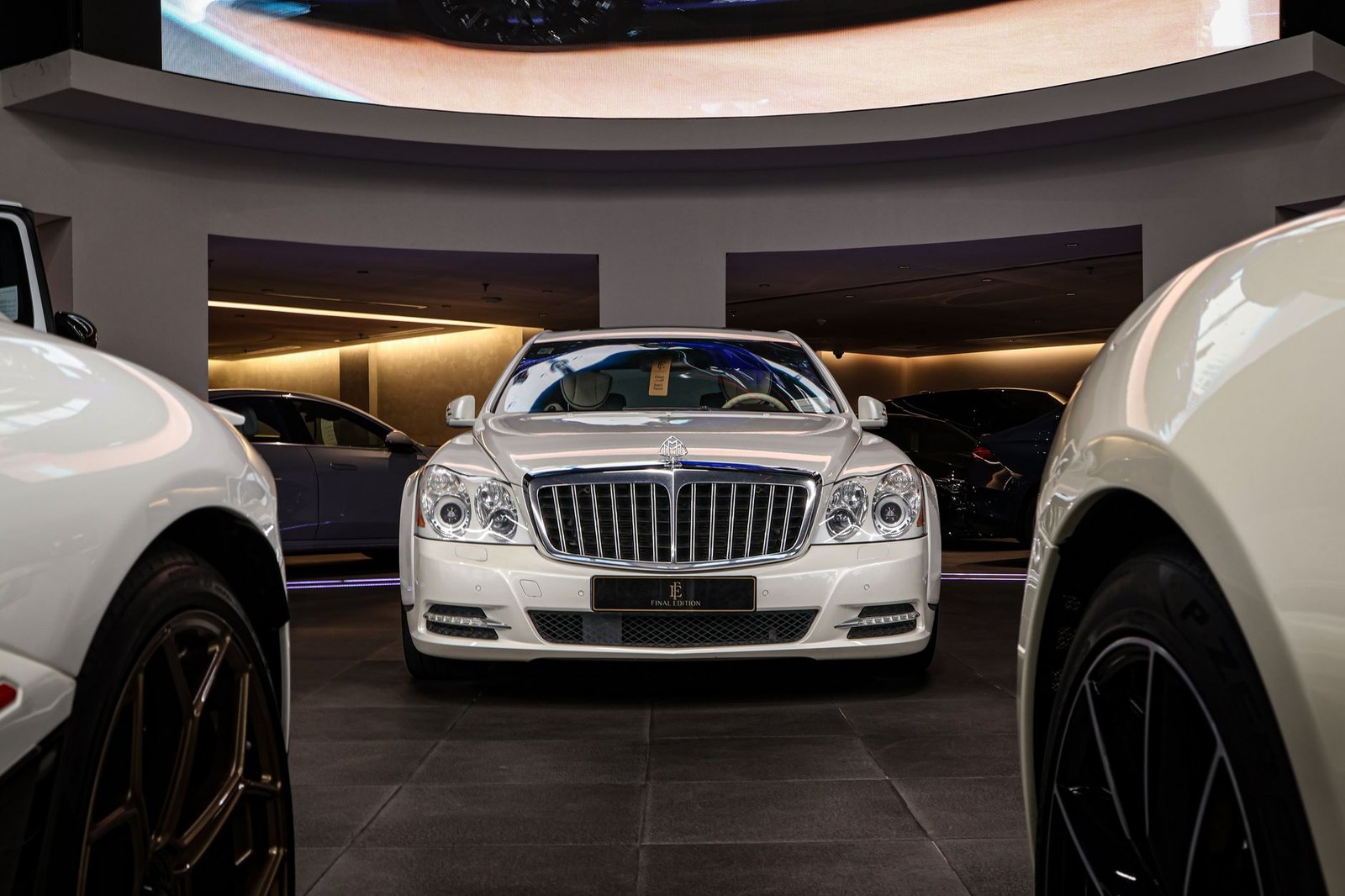
Automotive showrooms are the most technically demanding showroom type in the UAE. Dubai Municipality requires a minimum dedicated display area — typically 200–500 sqm depending on the number of vehicles — and location zoning must be confirmed before any fit-out begins. Franchise brands impose their own design standards on top: BMW, Mercedes and their counterparts issue CI (Corporate Identity) manuals that specify floor materials, lighting colour temperature, reception desk geometry and even the exact height of the brand logo on the facade.
Flooring for vehicle display
The flooring decision in an automotive showroom carries outsized consequences. Polished concrete or large-format porcelain (1200×600mm or 600×600mm in a matching tone) tends to outperform high-gloss white tiles in practice — white tiles create specular reflections on vehicle paintwork that read as scratches or imperfections under halogen or LED lighting. A warm light grey or mid-tone stone-effect ceramic in a matte or semi-polished finish frames the car without competing with it. Floor load ratings also matter: a display vehicle weighing 1,800–2,500 kg requires structural assessment if the showroom is on anything above ground floor.
Lighting: the make-or-break element
Vehicle display lighting in Dubai's luxury automotive market has moved almost entirely to LED track systems with tunable white temperature (2,700–4,500K). The logic is that different vehicle colours read best under different temperatures: dark metallics read under cooler 4,000K light; white and silver vehicles photograph and present better under warmer 3,000–3,500K. A track system with individually addressable fixtures allows the same floor to shift its lighting configuration when a new model is placed on display. Budget-grade showrooms wire recessed downlights into a fixed grid; mid-range and above use track. The cost difference is AED 30–80/sqft in the ceiling package, but the impact on product presentation is not comparable.
Luxury and fashion showrooms: the architecture of exclusivity
A luxury showroom's primary design challenge is creating the physical feeling of scarcity and elevation — which is harder than it sounds when you have 200 products to display. The instinct is to show everything; the right answer is almost always to show less, better. Dubai's luxury retail market has trended consistently toward experiential retail since 2023: brands that create genuine spatial moments — a double-height entry void, a custom fragrance at the threshold, bespoke copper or brass joinery that cannot be purchased anywhere else — consistently outperform those that simply fit out a shell with branded fixtures.
Material and finish specification at luxury tier
At AED 900–1,500+/sqft, the budget is largely consumed by three things: natural stone, bespoke millwork and imported fixtures. Italian Calacatta marble running floor-to-wall in a VIP room can cost AED 350–600/sqft for supply and installation alone. Bespoke joinery in brushed brass or powder-coated steel, built to brand specification, runs AED 1,200–3,000 per linear metre for the fabrication and fit. Lead times for imported stone and custom metalwork from Europe or the Levant are typically 8–14 weeks — which is why luxury showroom projects have longer overall timelines regardless of when construction starts.
Furniture and home décor showrooms
Furniture showrooms present a different design problem: the product itself is the décor, so the backdrop needs to feel aspirational without upstaging what's for sale. The most effective furniture showroom interiors we work on in the UAE use a restrained palette — off-white walls, warm oak or concrete flooring, soft diffuse ceiling lighting — that functions as a neutral canvas. Zoning matters enormously: distinct vignettes for living room, dining and bedroom settings, each with its own mood and lighting scene, help customers visualise a product in context rather than standing alone on a showroom floor.
Biophilic design elements — living plant walls, natural textures, daylight-mimicking circadian lighting — have moved from being a trend marker to a commercial expectation in Dubai's mid-to-premium furniture segment. The data from the UAE luxury furniture market supports this: the experiential dimension of how a showroom feels is now the primary differentiator between brands selling at similar price points. Clients are not just buying a sofa; they are buying a version of how they want their home to feel, and the showroom has to make them feel it first.
Authority approvals for showroom fit-outs in Dubai
A Dubai showroom fit-out cannot legally proceed without the relevant authority approvals in place. The core approvals vary by location but typically involve:
- Dubai Municipality (DM): Required for any structural changes, MEP modifications, or additions to the existing fit-out. Submit NOC from the building owner, trade license, full MEP and architectural drawings, and a fire safety plan. DM approval fees for commercial fit-outs typically range from AED 1,000–7,500 depending on project scope.
- Dubai Civil Defence (DCD): Fire suppression, emergency lighting and evacuation plan compliance. DCD sign-off is mandatory before occupancy; an inspection is required post-fit-out.
- DEWA: Any electrical load additions or plumbing connections require a DEWA NOC. This is particularly relevant for automotive showrooms installing EV charging infrastructure, or food-and-beverage zones within showroom environments.
- Free zone authority (Trakhees, JAFZA, DAFZA, etc.): If the showroom is within a free zone, DM jurisdiction is replaced by the zone's own regulatory body. Trakhees in Palm Jumeirah and Dubai World areas has its own submission portal and approval workflow.
Processing time for a full DM + DCD approval cycle runs 3–6 weeks in our experience on commercial fit-outs in Dubai, assuming drawings are compliant on first submission. Allow additional time for revisions. For projects on tight opening deadlines, we recommend submitting authority drawings in parallel with detailed design — not waiting for DM sign-off before finalising specifications.
For context on the fit-out permit process in more detail, our retail store fit-out approvals guide walks through the DM submission workflow step by step. The same approval chain applies to showrooms, with additional structural requirements for automotive spaces.
Design principles that translate to sales in UAE showrooms
Entry moments matter more than anything else
The first 10–15 seconds inside a showroom set the frame for everything that follows. A strong entry moment — a double-height ceiling, a statement product on a plinth, a sensory cue like cooled air or ambient sound — communicates that this is a space worth slowing down in. Weak entry moments (a reception desk immediately blocking sightlines, or a flat-lit corridor) cause customers to move through quickly rather than explore. In our work on commercial interiors across the UAE, the highest-ROI single investment in a showroom fit-out budget is almost always the entry zone, not the product display.
Climate management at the threshold
This is specific to the UAE context: the transition from outdoor summer heat (45°C+) into a showroom must be managed. An airlock vestibule or powerful overhead air curtain at the entry does two things — it protects the product environment from humidity ingress, and it gives the customer a moment to acclimatise before they start browsing. Showrooms without this transition see customers make rushed purchase decisions or leave quickly during summer months. It is not a luxury consideration; it is a UAE-specific requirement for any showroom expecting consistent foot traffic from June to September.
Consultation zones convert browsers into buyers
Every showroom selling products above AED 10,000 should have a dedicated private or semi-private consultation area. The psychology is simple: a customer who has sat down with a sales advisor in a comfortable, visually distinct zone is significantly more likely to proceed than one who finalises a decision standing in the main floor. The consultation zone needs comfortable seating, a table large enough to spread product samples or documents, good lighting for colour matching, and some acoustic separation from the main showroom floor. At mid-range fit-out budget, this does not require a full enclosed room — a raised platform with a back wall and overhead pendant lighting achieves the same psychological effect.
For a broader breakdown of how project management disciplines apply to commercial spaces from concept through handover, see our project management services page, which outlines our UAE delivery process in detail.
Frequently asked questions
How much does showroom interior design cost in Dubai in 2026?
Showroom fit-out in Dubai costs AED 350–500/sqft for a standard commercial finish, AED 500–850/sqft for mid-range with custom joinery and branded display systems, and AED 900–1,500+/sqft for luxury or automotive showrooms. Material costs have risen 18–23% since 2023, so budgets set in 2024 will need revision. Design fees (8–15% of fit-out) sit on top of these figures.
What approvals are needed for a showroom fit-out in Dubai?
A Dubai showroom fit-out typically requires Dubai Municipality (DM) approval for structural and MEP drawings, Dubai Civil Defence (DCD) for fire safety, and a DEWA NOC for any electrical or plumbing additions. Free-zone showrooms replace DM with the relevant zone authority (Trakhees, JAFZA, etc.). Approval fees range from AED 1,000–7,500, and the approval cycle takes 3–6 weeks assuming compliant first-submission drawings.
How long does a showroom fit-out take in Dubai?
A standard branded showroom fit-out in Dubai takes 8–14 weeks from design sign-off to handover. Automotive showrooms with structural or heavy MEP modifications run 16–24 weeks. Luxury showrooms with imported stone, bespoke metalwork or brand-specified imported fixtures should allow 4–6 additional weeks for material lead times from Europe or the Levant.
What is the minimum size for an automotive showroom in Dubai?
Dubai regulations require a minimum 200–500 sqm of dedicated vehicle display area depending on the number of vehicles shown. Franchise brands impose additional requirements through their CI manuals. Larger multi-brand dealerships typically operate from 20,000–30,000 sqft facilities covering display, service reception, customer lounge and office space. Location zoning approval must precede any fit-out work.
What co-working elements matter most in a UAE showroom?
The highest-impact elements are: (1) a strong entry moment that slows the customer down, (2) layered feature lighting tuned to product colour and material, (3) flooring that frames the product without competing with it, (4) a private consultation zone for high-value transactions, and (5) effective climate management at the entry threshold — essential given UAE summer temperatures. Experiential retail elements like biophilic features and smart lighting have moved from trend to baseline expectation in Dubai's mid-to-premium showroom market.
Planning a showroom fit-out in the UAE?
V Square manages showroom projects across Dubai and the wider UAE — automotive, luxury, furniture and commercial spaces — from concept and authority approvals through construction and handover. Tell us about your space and timeline.
Get a consultation →