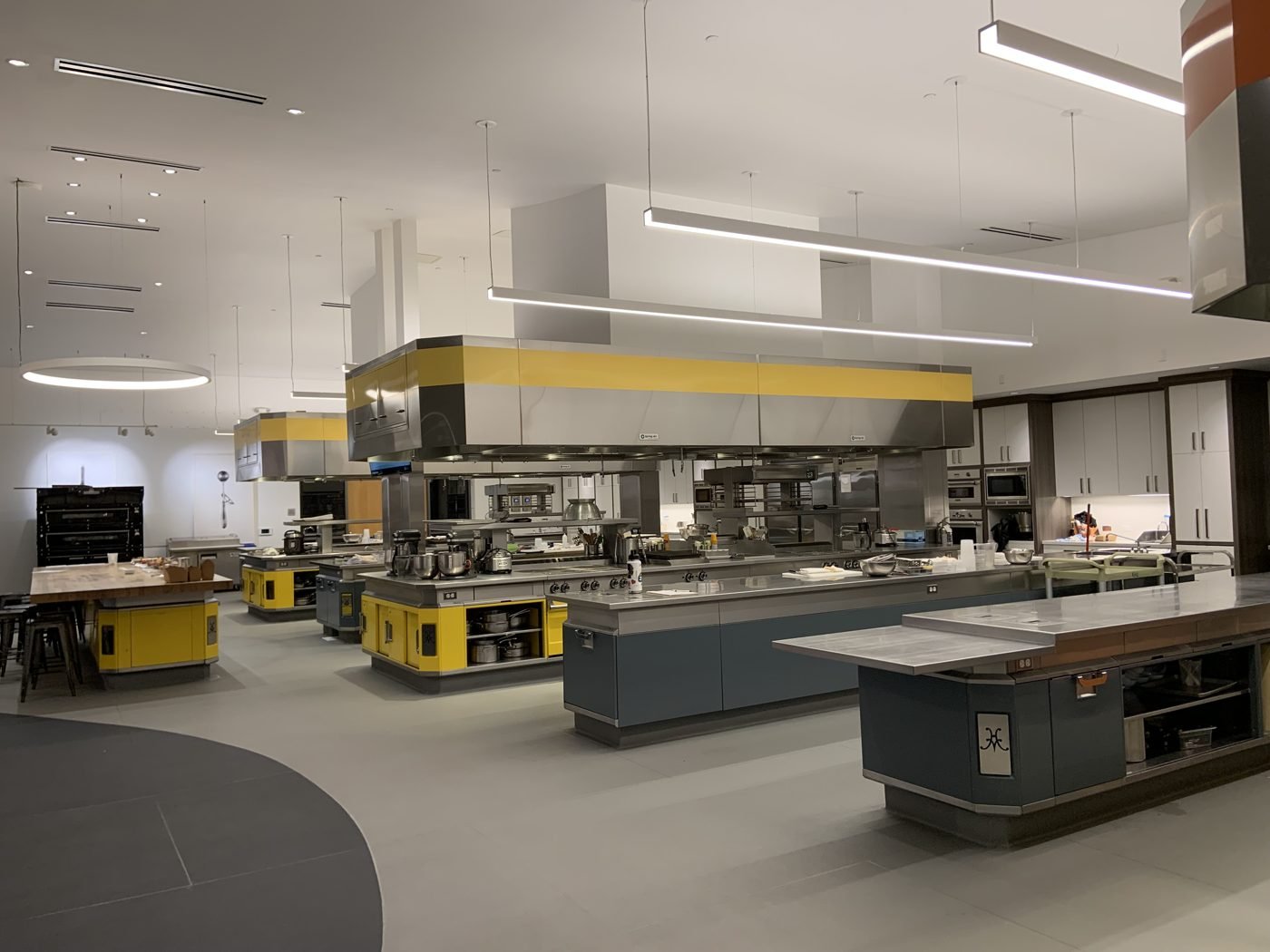
A delivery kitchen is a production line, not a restaurant: separate bays, one-way flow, and everything sized around the extraction above it. Photo: Wikimedia Commons, CC0.
The pitch for a delivery-only kitchen is that it strips out everything expensive about a restaurant. No prime retail rent, no dining room, no front of house payroll, no AED 400,000 of joinery for a space customers photograph once. On paper it is the same food business with the costly half deleted.
In practice, deleting the dining room does not make the project simpler — it concentrates it. Everything that was difficult about a restaurant fit-out, the extraction, the grease, the fire suppression, the Food Safety process flow, is still there, but now it is all of the project rather than a third of it. That is why a cloud kitchen fit-out Dubai budget so often lands within reach of a small restaurant despite having none of the visible finishes.
This guide covers what a cloud kitchen fit-out Dubai budget actually buys in 2026, the three approval tracks and which one dictates the design, the extraction and grease rules that decide whether a unit is viable at all, the layout that clears Food Safety review, a realistic programme, and the seven places these budgets break. If you are weighing a delivery-only concept against a dine-in one, read it alongside our restaurant interior design Dubai guide.
Why a Delivery Kitchen Is Not a Cheap Restaurant
The demand case is not in doubt. The UAE is one of the most delivery-dense food markets anywhere, with online food delivery commonly projected to pass USD 2.8 billion in 2026 and a user base heading toward 5.5 million, and the country's cloud kitchen segment widely estimated in the region of AED 7 billion by late 2026. In a city where the overwhelming majority of residents are expatriates ordering in several times a week, the delivery channel is not a supplementary revenue line. It is the market.
What that demand hides is the cost structure underneath it. Aggregator commissions are commonly quoted at 15–30% on Talabat, with most operators paying 20–25%, and 25–35% on Deliveroo. Add service fees, featured placement and advertising and the effective take rate typically runs several percentage points above the headline number in the contract. A delivery-only brand therefore operates on thinner contribution per order than a dine-in restaurant on the same menu, which means a cloud kitchen fit-out Dubai scheme has to be judged on throughput per square metre, not on how it looks.
That reframes the whole design brief. In a restaurant, the kitchen is sized to serve a known cover count in a known service window. In a delivery kitchen, it is sized to absorb an order spike that arrives all at once, from several brands at the same time, with riders standing at a dispatch window waiting. Circulation, holding space and dispatch sequencing matter more than any finish.
Cloud Kitchen Fit-Out Dubai Cost: The 2026 Numbers
There is no single cloud kitchen fit-out Dubai figure, because two genuinely different projects share the name. One is a tenancy decision. The other is a construction project.
| Route | Indicative cost | What it includes | What it does not |
|---|---|---|---|
| Serviced pod in an existing delivery-kitchen facility | AED 75,000–100,000 to launch | Existing extraction, grease trap and suppression; small works; equipment; licensing | Any control over layout, and rent is materially higher per sqft |
| Revenue-share operator model | Near zero capital; AED 30,000–50,000 licensing and launch | Kitchen, equipment and often staffing provided against a share of sales | Ownership of the asset, and margin |
| Raw shell, single-brand production kitchen (~30 m²) | AED 180,000–360,000 | Full MEP, extraction, grease trap, suppression, stainless line, drawings and approvals | Licensing, deposits, opening stock |
| Raw shell, multi-brand kitchen (~75 m²) | AED 450,000–900,000 | Multiple cooking lines, expanded cold chain, separate dispatch | Licensing per brand, aggregator onboarding |
| Multi-brand operation, all-in to trading | Up to ~AED 350,000 (pod route) | Several brand registrations, packaging, launch marketing | Working capital for the first ninety days |
The per-area benchmark worth carrying into a feasibility study is that commercial and hospitality kitchen work in Dubai is widely quoted at AED 600–1,200 per square foot, against AED 400–1,800 per square foot for restaurant fit-out generally. A delivery kitchen sits in the upper half of the kitchen band despite having no customer-facing area, because the expensive elements — ductwork, stainless, drainage, suppression, power — are precisely the ones you cannot delete.
Licensing, separately
Licensing is not part of the build but it is part of the launch budget, and it is commonly quoted as a trade licence at AED 12,000–18,000 a year plus a food production permit at AED 1,500–3,000, with all-in licensing landing at AED 16,000–40,000 on the mainland and AED 12,500–30,000 in a free zone. Multi-brand operators should budget registration per brand, not per kitchen. For a comparable breakdown on the dine-in side, see our cafe and coffee shop fit-out cost guide.
The Three Approval Tracks
Delivery-only does not mean lightly regulated. A cloud kitchen is a food production facility, and in some respects it is scrutinised more closely than a restaurant precisely because no customer ever sees inside it. Three tracks run in parallel.
From whichever authority governs the unit — Dubai Municipality, DDA, Trakhees or the free zone. Establishes that you may build.
Kitchen suppression over the cooking line, heat detection, emergency lighting, and the smart monitoring connection. Ends in a live inspection.
Dubai Municipality Food Safety review of the kitchen drawing: HACCP flow, hand wash, cold chain, grease trap, waste. This one dictates the design.
The sequencing error that costs the most money is treating Track 3 as a formality to be handled after the equipment arrives. Food Safety approves a layout, and it approves it against process flow rather than against your equipment wish list. If the drawing is rejected, the correction is not a document revision — it is moving equipment that has already been bought, and often moving the drainage under it. Do not order the line until the layout is approved.
Track 2 changed this year. Dubai Civil Defence revised its kitchen suppression specification in the first quarter of 2026, including the required suppressant agent quantities, and new submissions are assessed against the 2026 standard. Because a wet chemical system is designed around the specific appliances under the canopy, swapping a fryer for a chargrill after approval is a resubmission rather than a substitution. Our Civil Defence inspection guide covers what the inspector tests live on the day, and the fit-out approval Dubai guide covers which authority governs which unit.
Extraction, Grease and Make-Up Air: The Real Site Test
If there is one paragraph in this guide worth acting on before signing a lease, it is this one. The viability of a cloud kitchen fit-out Dubai project is decided by whether a compliant extraction route can reach roof level, and that is a base-building and landlord question, not a contractor question.
The requirements that shape it:
- Discharge height. Current guidance places the exhaust discharge at least two metres above the nearest building to control odour nuisance. In a multi-tenant industrial unit with occupied floors above, that route may not exist at any price.
- Grease trap. All drainage from cooking and wash areas must pass through a grease trap before reaching the main sewer, sized for the kitchen’s actual load. Retrofitting one into a slab after the fact is disruptive and expensive.
- Filtration for heavy grease. Chargrills, burger lines and anything producing heavy grease-laden vapour generally require electrostatic precipitators and carbon filtration on the discharge. That is capital cost, plant space and an ongoing maintenance contract.
- Make-up air. Extract without a calculated supply puts the kitchen into negative pressure: doors that fight you, canopies that stop capturing, and a cooling load nobody budgeted. Make-up air is not optional and it is routinely the item value-engineered out first and reinstated last.
- Duct fire rating and access. The riser needs rated construction and access for cleaning, and access panels have to survive the ceiling design rather than be discovered after it closes.
These are MEP-led decisions, and they are where the programme is won or lost. Our guide to MEP coordination in UAE fit-out projects sets out the sequence, and because most delivery kitchens sit in light-industrial stock, the warehouse and industrial fit-out guide covers the base-building constraints those units bring.
The Layout That Clears Food Safety Review
Food Safety assesses process flow. The principle is linear, one-way movement from dirty to clean, with no point at which raw product crosses finished product. In a small unit that is a discipline problem, not a space problem.
A layout that reviews well generally reads in this order:
- Goods in. A receiving point with somewhere to check and decant deliveries that is not the prep counter.
- Storage, split. Dry store, chilled and frozen, with raw and ready-to-eat separated within the cold chain, not merely labelled.
- Preparation. Separate raw and ready-to-eat prep zones, dedicated hand wash basins within reach of each (a hand wash sink is not a pot sink), and colour-coded equipment.
- Cooking line. Under the canopy, arranged to the suppression design, with adequate clearance behind for cleaning and service access.
- Assembly and packing. The station most often undersized. Delivery volume is packed, labelled and bagged, and it happens in bursts.
- Dispatch. A hatch or window riders reach without entering the kitchen, with hot and cold holding beside it.
- Wash-up and waste. Physically separated from assembly, with a waste route that does not cross the clean line.
Two things distinguish a multi-brand kitchen from a single-brand one. First, the cooking line is shared but the assembly and dispatch stations usually are not, because two brands packing into the same bench is where order errors are made. Second, brand separation is a licensing and traceability question as much as a spatial one, and it is easier to plan at layout stage than to explain at inspection.
A Realistic Programme
| Stage | Duration | Runs in parallel with |
|---|---|---|
| Unit and duct-route feasibility | 1–2 weeks | Lease negotiation — do not sign first |
| Layout design and equipment schedule | 2–3 weeks | Trade licence application |
| Food Safety layout approval | 2–4 weeks | Fit-out permit and DCD drawing submission |
| Fit-out works (shell route) | 6–8 weeks | Equipment procurement and delivery |
| Testing, commissioning, DCD inspection | 1–2 weeks | Food permit and aggregator onboarding |
| Food Safety opening inspection | 1 week | Menu photography, launch marketing |
Twelve to sixteen weeks is a fair planning assumption for a cloud kitchen fit-out Dubai shell project, and four to six weeks for a serviced pod where the services already exist and the critical path is licensing rather than building. Licensing itself is commonly quoted at two to four weeks once documentation is complete. Note that the fit-out is rarely the long pole; the extraction route and the approvals attached to it are.
Seven Places These Budgets Break
- The lease was signed before the duct route was proven. The most expensive mistake available, and the most common. There is no fit-out solution to a building that will not accept a discharge.
- Equipment ordered before Food Safety approved the layout. Rejection then means relocating paid-for equipment and the drainage under it.
- Make-up air value-engineered out. Reinstated later at multiples of the original cost, usually after the canopies stop capturing.
- Suppression designed to last year’s specification. The 2026 DCD revision means an under-specified system does not clear review, and the system is tied to the appliance line beneath it.
- Grease trap undersized to fit the space available. A compliance finding at inspection and a blockage problem in operation.
- Assembly and dispatch treated as leftover space. Throughput collapses at exactly the moment the business is proving itself.
- Power capacity assumed rather than confirmed. A combi oven and an induction line are a substantial load, and a DEWA upgrade is a programme item with its own lead time.
Most of these are procurement and sequencing failures rather than construction failures, which is why a cloud kitchen fit-out Dubai project is won at tender stage as much as on site, and why the tender documents matter. Our guide to comparing fit-out quotations and BOQ bids covers how to make three very different-looking kitchen quotes comparable, and the fit-out project management guide sets out the stage gates that keep the order above from slipping.
Pod or Shell? A Straight Answer
Below roughly one or two proven brands, take the serviced pod. The capital cost of extraction, grease trap, suppression and drawings is genuinely large relative to an unproven concept, and paying it as rent while you test the menu is rational. Above that, the arithmetic inverts: pod rent per square foot is high, the layout is fixed, and you cannot re-plan the line as the menu evolves. A self-built unit you control usually wins across a three to five year horizon, and it is the only route that lets you design assembly and dispatch around your own order profile rather than someone else’s.
Either way, a cloud kitchen fit-out Dubai decision should be made on a feasibility study of a specific unit — duct route, drainage, power, rider access — and not on a rent comparison. That study takes a week or two and is the cheapest part of the entire project.
Planning a Cloud Kitchen in Dubai?
V Square runs cloud kitchen fit-out Dubai projects end to end: unit and duct-route feasibility before you sign, HACCP layout design, Dubai Municipality Food Safety and Civil Defence submissions, tendering, site supervision and opening inspection close-out.
Request a ConsultationFrequently Asked Questions
How much does a cloud kitchen fit-out Dubai project cost in 2026?
It splits into two very different numbers. Taking a serviced pod in an existing delivery-kitchen facility means the extraction, grease trap and suppression already exist, so the spend is largely equipment, small works and licensing, and industry guides commonly quote a total launch cost of AED 75,000 to AED 100,000, rising toward AED 350,000 for a multi-brand operation. Fitting out a raw shell is a construction project: commercial kitchen work in Dubai is widely quoted at AED 600 to AED 1,200 per square foot, which puts a 30 square metre production kitchen at roughly AED 180,000 to AED 360,000 and a 75 square metre kitchen at AED 450,000 to AED 900,000 before licensing. The single biggest variable in any cloud kitchen fit-out Dubai budget is whether the unit already has compliant extraction and drainage.
Do you need a special licence for a cloud kitchen in Dubai?
No. A delivery-only kitchen is licensed as a food business like any other. You need a trade licence from DET on the mainland or from a free zone authority, plus a food establishment permit from the Dubai Municipality Food Safety Department, which is what actually gates opening. What makes it a cloud kitchen is the absence of a dining room, not a different licence category. Trade licence costs are commonly quoted at AED 12,000 to AED 18,000 a year and the food permit at AED 1,500 to AED 3,000, with all-in licensing typically landing between AED 16,000 and AED 40,000 on the mainland and AED 12,500 to AED 30,000 in a free zone. Each brand you trade under normally needs its own registration, which is why multi-brand operators budget licensing per brand rather than per kitchen.
What approvals does a delivery-only kitchen need in Dubai?
Three tracks, and they run in parallel rather than in sequence. First, a fit-out permit from the authority that governs the unit: Dubai Municipality, DDA, Trakhees or the relevant free zone. Second, a Civil Defence NOC covering kitchen suppression over the cooking line, heat detection in the kitchen, emergency lighting and the smart monitoring connection. Third, Dubai Municipality Food Safety approval of the kitchen layout drawing, covering HACCP process flow, hand wash provision, cold chain, grease trap and waste. The Food Safety layout review is the one that dictates the design of a cloud kitchen fit-out Dubai operators can actually license, and it must be cleared before equipment is ordered because a rejected layout means moving equipment that has already been paid for.
How long does a cloud kitchen fit-out take in Dubai?
For a serviced pod with existing extraction, four to six weeks from signature to first order is realistic, and most of that is licensing rather than building. For a raw shell, a cloud kitchen fit-out Dubai programme runs twelve to sixteen weeks: two to three weeks for design and Food Safety layout review, two to four weeks for fit-out and Civil Defence drawing approval running together, six to eight weeks of works dominated by ductwork and MEP, then testing, the Civil Defence inspection and the Food Safety opening inspection. Licensing itself is commonly quoted at two to four weeks. The long pole is almost never the kitchen equipment; it is the extraction route and the authority sign-offs attached to it.
What are the Dubai Municipality kitchen extraction and grease trap rules?
All drainage from cooking and wash areas must pass through a grease trap before it reaches the main sewer, sized for the kitchen rather than fitted as a token unit. Extraction needs a canopy with filters, a calculated make-up air supply so the kitchen is not put into negative pressure, and a discharge point that current guidance places at least two metres above the nearest building to control odour nuisance. Heavy grease production such as chargrilling and burger lines generally requires electrostatic precipitators and carbon filtration on the discharge. Because the duct route has to leave the building, it is a landlord and base-building question long before it is a contractor question, and it is the single most common reason a cloud kitchen fit-out Dubai project cannot proceed in an otherwise attractive unit.
What changed for kitchen fire suppression in Dubai in 2026?
Dubai Civil Defence revised the kitchen suppression specification in the first quarter of 2026, including the quantity of suppressant agent required, and new restaurant and kitchen submissions are assessed against the 2026 standard. Practically this means a wet chemical system sized under the previous specification may not clear review, and the nozzle layout is tied to the specific appliance line under the canopy. Because the system is designed around the equipment schedule, changing a fryer for a chargrill after approval is a resubmission, not a swap. Confirm the current specification with a DCD-approved fire contractor before the equipment schedule is frozen.
Is a shared cloud kitchen pod cheaper than building your own?
Cheaper to start, more expensive to hold. A serviced pod removes the capital cost of extraction, grease trap, suppression and authority drawings, and turns them into rent, so a single brand can be trading for a fraction of a shell fit-out. Some operators go further and take a revenue-share model with no upfront kitchen cost at all. The trade-off is unit economics: rent per square foot in a serviced facility is high, the layout is fixed, and you cannot re-plan the line as the menu changes. The break-even on a cloud kitchen fit-out Dubai decision is usually volume. Below roughly one or two established brands, a pod is the rational choice; above that, a self-built unit that you control tends to win over a three to five year horizon.
Where are cloud kitchens usually located in Dubai?
In industrial and light-industrial areas rather than retail frontage, because there is no walk-in trade to pay for: Al Quoz, Dubai Investments Park, Jebel Ali and JAFZA, Dubai South, Ras Al Khor and Dubai Silicon Oasis are the recurring clusters. The site selection test is not footfall but delivery radius, rider access and whether the base building will permit a compliant extraction route to roof level. A cheap unit with no viable duct route is not cheap.
Note on sources. Cost ranges, licence fees, commission rates and lead times above are drawn from current UAE business-setup and hospitality fit-out reporting and reflect commonly quoted figures rather than a published tariff. Requirements vary by authority, premises type, unit condition and menu. Confirm the applicable food establishment requirements with Dubai Municipality and the current kitchen suppression specification with Dubai Civil Defence or a DCD-approved contractor before relying on any figure for budget or programme purposes.