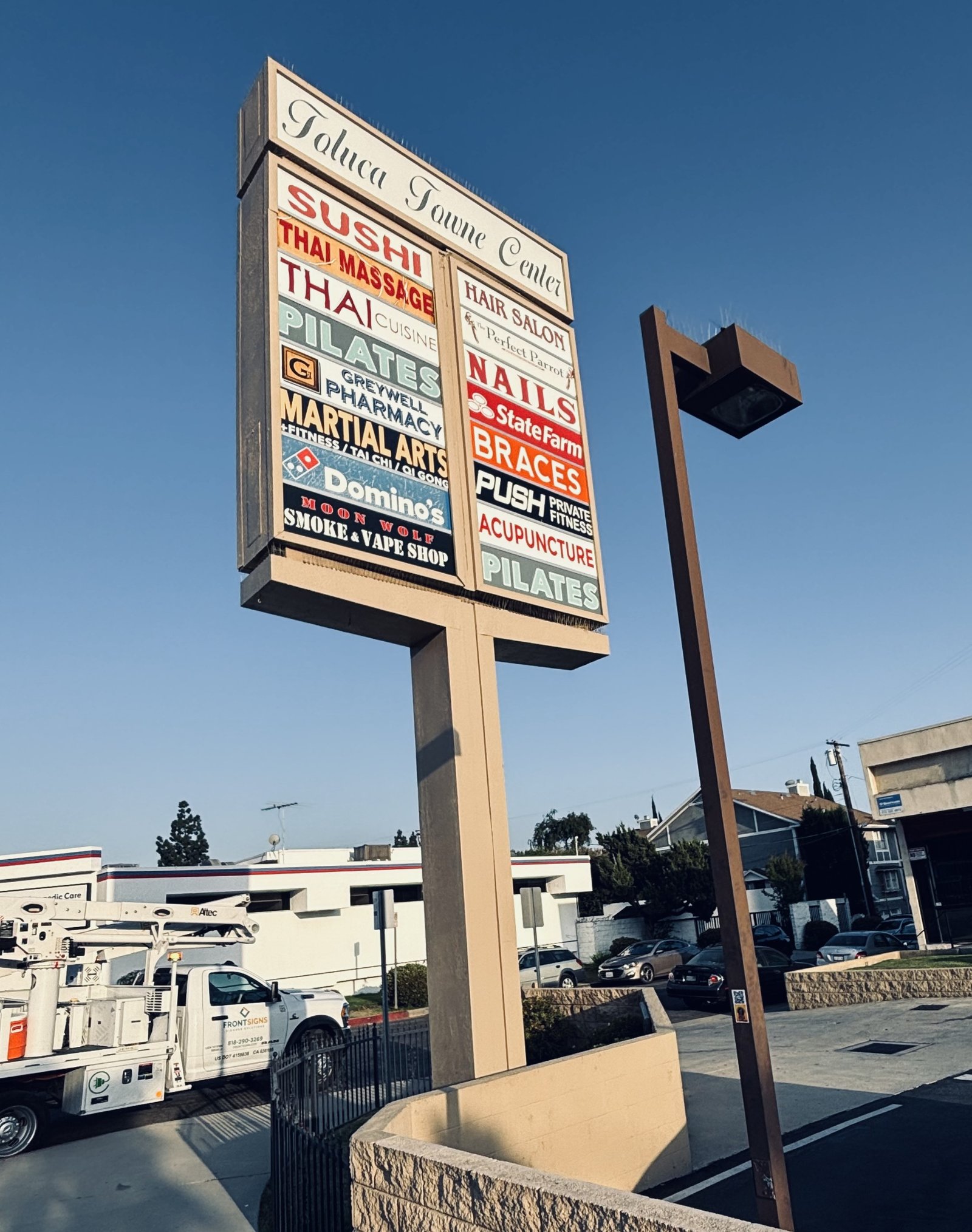
A freestanding pylon or monument sign is reviewed as a structural element in its own right, not just a graphic. Photo: Helene.3160, Wikimedia Commons, CC BY-SA 4.0.
Exterior signage is the part of a Dubai fit-out that operators most often treat as an afterthought, ordered from a sign shop in the final week before opening, and it is also the part most likely to stop a launch cold. A fascia sign, a lightbox, a pylon at the kerb or a set of illuminated channel letters is not covered by the building's main fit-out permit — it is a separate application to a separate authority, with its own document set, its own DEWA electrical step where the sign is lit, and its own annual renewal. Ordering the sign before the permit is approved, or assuming the landlord's blanket NOC for interior works also covers the exterior facade, are the two mistakes that put a finished sign in a van outside a unit with nowhere legal to hang it.
The rules exist for a reason that goes beyond bureaucracy. A facade in Dubai is shared visual real estate — the building owner, the neighbouring tenants and, for anything visible from a road, the Roads and Transport Authority all have a stake in what gets fixed to it, how bright it is at night and how far it projects from the wall. Getting that right at design stage, before fabrication, is materially cheaper than a rejected sign coming back off the wall for rework.
This guide sets out who approves exterior signage in Dubai, the DEWA electrical step every illuminated sign needs, the size and placement rules that decide what a sign can look like, what it costs by type in 2026, and the most common reasons a submission gets sent back. For the interior side of a retail or F&B fit-out that this signage sits in front of, see our guides to retail store fit-out in Dubai and cafe and coffee shop interior design, which cover the space this signage announces rather than the sign itself.
What Counts as Exterior Signage on a Dubai Fit-Out
"Signage" covers a wider set of physical products than most first-time tenants expect, and each type sits under slightly different design and structural scrutiny even though all of them go through the same broad approval pathway.
- Fascia signage. The primary brand sign mounted flat above a shopfront — individually mounted 3D acrylic or metal letters, a fabricated channel-letter set (illuminated or not), or a printed/vinyl panel. This is the sign every reviewing authority expects to see and sizes against the unit's own frontage width.
- Lightbox signage. A shallow illuminated box, typically acrylic-faced over an internal LED module, mounted flush to the facade or projecting from it. Because it is inherently illuminated, every lightbox triggers the DEWA electrical step below.
- Pylon and monument signs. Freestanding structures set into the ground or a plinth, usually at a plot entrance or roadside frontage, carrying one or several tenants' branding. These are reviewed as structural elements in their own right — footing design, wind loading and foundation depth — not simply as graphics.
- Window graphics and vinyl. Printed film applied directly to glazing. Generally the lightest-touch category, though large-format or fully frosted glazing can still be asked to demonstrate it does not obstruct a required means-of-escape sightline.
- Projecting and blade signs. Signs mounted perpendicular to the facade rather than flat against it, common on pedestrian streets and older souk-style retail frontages, reviewed for minimum pedestrian headroom and projection distance from the building line.
Every one of these categories needs its own permit before fabrication begins, and mixing categories on one application — submitting a fascia sign drawing that does not disclose an accompanying pylon, for instance — is a common source of a partial rejection rather than a clean approval.
Who Approves Exterior Signage in Dubai
Signage approval follows the same land-authority jurisdiction as the rest of a fit-out, but it is a genuinely separate submission from the building permit, reviewed by a different desk within the same authority in most cases. Both the Department of Economic Development and the land authority typically need to have given their consent before an illuminated sign can legally go up, and the landlord or master developer's own NOC sits alongside both.
| Authority | Jurisdiction | Submission Route | Typical Review Time |
|---|---|---|---|
| Dubai Municipality (DM) | Mainland Dubai plots | DM's advertising/signage permit channel, alongside the DED trade licence | 5–10 working days for a complete application |
| Dubai Development Authority (DDA) | TECOM free zones — Dubai Media City, Dubai Internet City, Dubai Studio City, Dubai Knowledge Park | Smart Advertising Single Window portal, reviewed and issued by DDA | Commonly around 4 working days |
| Trakhees | DP World-managed zones — JAFZA, Dubai South, Palm Jumeirah, and Special Development Zones | Direct application to Trakhees; the DM portal cannot be used in these zones | Broadly comparable to DM, varies by zone |
| DEWA | All jurisdictions, wherever the sign is electrically illuminated | Separate electrical connection permit and NOC, run alongside the land-authority signage approval | Runs in parallel; adds to the overall timeline for illuminated signs |
| Roads and Transport Authority (RTA) | Signage visible from or oriented toward a public road | Referred in by the land authority where road-visibility or driver-distraction is a factor | Adds to the review cycle; not a standard step for a typical shopfront sign |
The land-authority distinction matters because the three portals are not interchangeable: a tenant inside JAFZA cannot submit through the standard DM channel simply because their office is administratively easier to reach, and doing so produces a rejection rather than a slower approval. Confirming which of the three applies to a specific plot — the same jurisdictional check that governs the underlying fit-out permit — is the first call to make, before a sign designer is even briefed. Our guide to DDA fit-out approval in Dubai covers the equivalent building-permit process for TECOM free zones, which runs on the same jurisdictional logic as signage.
The DEWA Illuminated Sign NOC
Illumination is the single factor that most changes a signage application's complexity, cost and timeline, because it pulls in a fourth authority that a non-illuminated sign never touches. Any sign carrying its own electrical load — internally lit lightboxes, backlit or front-lit channel letters, LED modules, or neon — needs a Dubai Electricity and Water Authority (DEWA) electrical connection permit and NOC in addition to the land authority's signage approval, and the physical electrical work has to be carried out by a DEWA-licensed contractor rather than the sign fabricator's own electrician working informally.
Two practical consequences follow from that. First, the DEWA step is not optional paperwork that can be skipped for a small sign: a single backlit letter set on a modest shopfront carries the same DEWA-NOC requirement as a large-format pylon, because the trigger is illumination itself, not sign size. Second, illuminated signage design should specify glare and brightness at the drawing stage, not leave it to the fabricator's default LED module — illuminated signs must not cause glare to neighbouring properties, pedestrians or drivers, and lightbox and LED brightness is reviewed against that standard as part of the approval, not just checked informally after installation.
Non-illuminated signage — painted fascia lettering, vinyl-applied graphics, non-lit 3D letters — skips the DEWA step entirely and generally clears the land-authority review faster as a result. Where budget or timeline is tight, choosing a non-illuminated primary sign and reserving illumination for a smaller secondary element is a genuine way to compress the approval cycle, not just a cost-saving move.
Documents You Need Before Submitting
A complete signage application, regardless of which of the three authorities reviews it, generally asks for the same core document set, with extra items layered on for illuminated, freestanding or elevated signs.
Core Documents (Every Sign Type)
- Valid trade licence copy.
- Site plan showing the unit and the facade the sign is mounted on.
- A current photograph of the existing building facade, unmodified.
- A scaled sign drawing showing exact dimensions, colours, typography and mounting position.
- A 3D visual mock-up of the sign in position on the actual facade, not a generic render.
- Landlord or master-developer No Objection Certificate for exterior works specifically — a general fit-out NOC does not automatically extend to the facade.
Additional Documents (Illuminated, Elevated or Freestanding Signs)
- DEWA electrical load and connection application, prepared by a DEWA-licensed contractor.
- Structural drawings and a risk assessment for any sign fixed above roughly 2.5 metres, or any freestanding pylon or monument sign, covering wind loading and fixing/foundation design.
- Structural engineer's certification of the fixing method for a sign mounted on an existing facade element rather than a purpose-built bracket.
The same document-completeness discipline that governs a building fit-out permit applies here: a submission missing the landlord NOC or the facade photograph is typically returned for resubmission rather than approved with a condition, which is what turns a five-to-ten-working-day review into a much longer one. Our guide to the landlord NOC process in Dubai covers how to secure that document early enough that it is not the item holding up signage submission.
Size, Height and Placement Rules
Dubai's signage authorities do not publish a single universal formula for maximum sign size — the reviewing desk assesses proportionality case by case against the specific facade — but several consistent principles recur across DM, DDA and Trakhees reviews and are worth designing to from the outset rather than discovering at rejection.
- Proportionality to frontage. Sign dimensions are expected to read as proportional to the shop or building frontage the sign sits on, and a sign cannot exceed the width of that facade — an oversized sign relative to a narrow unit is one of the more common design-stage rejections.
- Height above 2.5 metres. A sign fixed higher than roughly 2.5 metres above ground or pavement level moves into a different review tier, requiring a structural risk assessment in addition to the standard drawing set, because wind loading and the consequence of a fixing failure both increase materially at height.
- Glare and brightness. Illuminated signs must not create glare that affects neighbouring properties, pedestrians or approaching drivers — a factor that becomes a hard constraint, not a design preference, for any sign near a road frontage.
- Projection and pedestrian clearance. A projecting or blade sign mounted perpendicular to the facade needs enough headroom clearance over a pedestrian walkway and a limited projection distance from the building line, following the same egress-and-clearance logic used for canopy and awning approvals.
- No encroachment onto a neighbouring unit's frontage or above the roofline. Signage is reviewed against the tenant's own leased frontage; extending onto an adjoining tenant's facade or above the building's roofline is treated as a materially different, harder application, often pulling in RTA review where road visibility is a factor.
Because these principles are applied by the reviewing engineer's judgement rather than a fixed lookup table, the fastest route to a clean first approval is a facade elevation drawing that shows the proposed sign at true scale against the existing building — not just the sign in isolation — so proportionality is obvious to the reviewer rather than something they have to estimate.
Signage Types and What They Cost to Fabricate
Fabrication cost varies more by sign type and illumination than by any other single factor, and pricing is generally quoted per square metre of sign face once a design is finalised, with fixed costs (mould-making, structural brackets, electrical first-fix) absorbed more efficiently on a larger sign.
| Sign type | Indicative cost (AED) | Illumination | Typical use |
|---|---|---|---|
| 3D / channel letters, standard shopfront | AED 1,500 – AED 8,000 | Optional (backlit or front-lit adds 30–50% to materials) | Primary fascia branding for retail, F&B and office units |
| 3D letters, large-format tower/hotel | AED 15,000 – AED 40,000+ | Usually illuminated | Building-top or high-rise identification signage |
| Lightbox, standard size | AED 800 – AED 4,500 | Always illuminated (internal LED) | Flush-mounted fascia sign, common in malls and strip retail |
| Pylon / monument sign | Fabrication priced per project; advertising permit AED 500–1,000 per m²/year | Usually illuminated | Roadside or plot-entrance branding, often multi-tenant |
| Window graphics / vinyl | Priced per m², lowest-cost category | Non-illuminated | Glazing branding, promotional graphics, privacy film |
Custom-shaped lightboxes with curved profiles or non-rectangular forms typically add 25–40% to fabrication cost over a standard rectangular unit, and backlit LED modules generally add 30–50% to materials cost compared with an equivalent non-illuminated sign of the same size. Pylon and roadside advertising rights are priced differently again — annual permit fees run from around AED 500 per square metre per year for signage on a commercial building frontage up toward AED 1,000 per square metre per year for higher-visibility roadside advertising along a route such as Sheikh Zayed Road.
Total Signage Project Cost, Including Permits
Fabrication is only part of the budget line. Permit, structural and electrical approval fees sit on top, and are worth planning for separately since they recur annually in the case of the permit fee itself.
| Cost item | Indicative amount (AED) | Frequency |
|---|---|---|
| DM ground-floor signage permit | Around AED 500 | Annual, must be renewed before expiry |
| Structural engineering certificate | AED 800 – AED 2,500 | One-time, for elevated or freestanding signs |
| DEWA electrical permit and connection | AED 500 – AED 2,000 | One-time at installation; illuminated signs only |
| Sign fabrication and installation | See sign-type table above | One-time, plus periodic maintenance/relamping for illuminated signs |
For a typical single-unit retail or F&B fit-out choosing one illuminated fascia sign, a realistic combined signage budget — fabrication plus the first year of permits and the DEWA connection — commonly lands in the AED 4,000–15,000 range for a standard lightbox or backlit channel-letter set, before any pylon or secondary signage is added. This sits as a distinct line item from the interior fit-out budget covered in our office fit-out cost UAE 2026 guide and the retail-specific figures in our retail store fit-out cost guide, and should be budgeted alongside them rather than assumed to be absorbed into the general fit-out allowance.
The Approval Timeline, Step by Step
A realistic signage approval programme, from design brief to an installed and legally approved sign, runs four to eight weeks for a standard shopfront sign, longer for anything illuminated, freestanding or requiring RTA input.
- Week 1: Jurisdiction Check and Landlord NOC. Confirm which authority — DM, DDA or Trakhees — controls the plot, and request the landlord or master-developer's exterior-works NOC in parallel, since a general interior fit-out NOC does not cover the facade.
- Week 1–2: Design and Facade Elevation Drawing. Brief the sign designer against the true facade dimensions, producing a scaled drawing and a 3D mock-up that shows proportionality against the existing building rather than the sign in isolation.
- Week 2: Submission. Submit the full document set to the relevant authority — DM's signage channel, DDA's Smart Advertising Single Window portal, or directly to Trakhees — alongside the DEWA electrical application if the sign is illuminated.
- Weeks 2–4: Technical Review. DDA applications commonly clear in around 4 working days; DM applications commonly take 5–10 working days for a complete submission. Illuminated or elevated signs run the structural and DEWA reviews concurrently with the land-authority review, which is what extends the overall timeline rather than any single review step being unusually slow.
- Weeks 4–6: Fabrication. Fabrication typically begins only once the design is approved, not before, since a rejected or modified drawing after fabrication has started means remaking the sign rather than simply resubmitting paperwork.
- Weeks 6–8: Installation and DEWA Connection. Physical installation, followed by the DEWA-licensed contractor's electrical connection for an illuminated sign, completes the process; some authorities carry out a brief post-installation check against the approved drawing before the permit is finalised.
Running the signage application in parallel with the main interior fit-out permit — rather than waiting until the shop is built and only then thinking about the sign — is the single biggest lever for hitting an opening date, since the two approval tracks share almost no dependency on each other until the very final installation step. Our guide to Dubai Civil Defence inspection covers the equivalent parallel-track logic for the fire-safety approval that runs alongside the main fit-out permit.
Eight Reasons Signage Submissions Get Rejected
Signage applications are returned for resubmission more often than tenants expect, and the majority of rejections trace back to a handful of recurring, avoidable issues.
- Missing or generic landlord NOC. A blanket interior fit-out NOC that does not specifically authorise exterior facade works is the single most common paperwork gap.
- Sign oversized relative to the frontage. A design that looks proportionate on a designer's render but exceeds the facade width or reads as visually dominant against the actual building is a frequent design-stage rejection.
- No facade elevation drawing at true scale. Submitting the sign in isolation, without showing it against the existing building facade, forces the reviewer to estimate proportionality rather than see it, and slows approval even when the design itself is compliant.
- Illumination without a DEWA application. Submitting a lightbox or backlit letter design to the land authority without the accompanying DEWA electrical NOC application is treated as an incomplete submission, not a partial approval.
- No structural certification for an elevated or freestanding sign. Any sign above roughly 2.5 metres, or any pylon/monument structure, submitted without a structural drawing and risk assessment is returned rather than conditionally approved.
- Glare or brightness not addressed at design stage. A sign specified with a generic high-brightness LED module, without a glare assessment for a roadside or residential-facing position, is a common cause of a request for redesign.
- Sign extending onto a neighbouring frontage or above the roofline. Even a well-designed sign is treated as a different, harder category of application once it crosses the tenant's own leased frontage boundary.
- Fabrication started before approval. Manufacturing ahead of a formal permit, to save time, backfires whenever the approved design differs even slightly from what was built — the sign then has to be remade rather than simply reinstalled.
Renewal and Enforcement
A Dubai signage permit is not a one-time approval. Advertising and signage permits are issued for one year and must be renewed before the expiry date, even where the physical sign itself is unchanged — a detail that gets missed once the original fit-out excitement has passed and the sign becomes background furniture to the business rather than a compliance item on a facilities calendar.
Enforcement is active rather than theoretical: unapproved signage is subject to fines and can be ordered removed at the owner's or tenant's expense, and a lapsed renewal exposes the same risk as a sign that was never approved at all. Under most Dubai commercial leases, the tenant carries this liability directly rather than the landlord, since the signage permit is issued in the operating business's name. Building a signage renewal date into the same facilities-management calendar that tracks trade licence and Civil Defence NOC renewals is the simplest way to avoid an entirely preventable fine on a sign that has been correctly approved from day one.
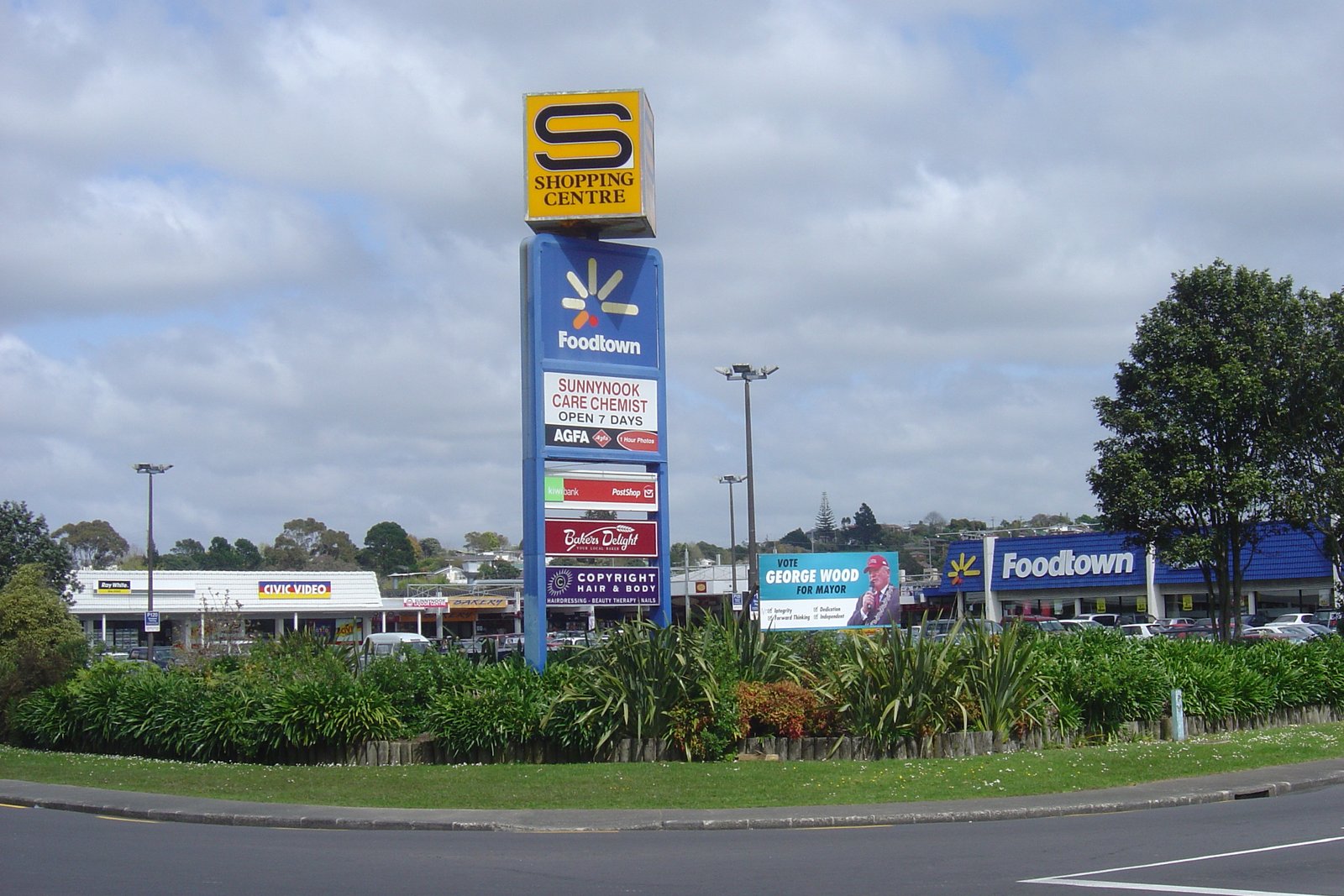
Reviewers assess a sign's proportionality against the whole facade elevation, not the sign in isolation — the drawing set should show both. Photo: Follash, Wikimedia Commons, public domain.
How V Square Runs an Exterior Signage Fit-Out
At V Square Project Management Services, we treat exterior signage as a parallel-track approval from the first week of a project, not a final-week add-on chased after the interior fit-out is already complete. Our team confirms the correct jurisdiction — DM, DDA or Trakhees — and secures the landlord's exterior-works NOC alongside the main fit-out NOC, so the signage submission is never waiting on a document that could have been requested weeks earlier.
Where a sign is illuminated, elevated or freestanding, we coordinate the DEWA electrical application and structural certification directly with the sign fabricator and a DEWA-licensed electrical contractor, and we submit a true-scale facade elevation drawing with every application so proportionality is demonstrated rather than left to the reviewer's estimate. On renewal, we track each client's signage permit against the same facilities calendar as their trade licence and Civil Defence NOC, so an annual renewal never lapses into an avoidable fine.
To plan compliant, budgeted exterior signage alongside your Dubai fit-out for 2026, visit our dedicated fit-out services page or contact our Dubai office to schedule a technical review with our design team.
Planning Exterior Signage for a Dubai Fit-Out?
V Square runs your signage submission in parallel with the main fit-out permit, coordinates the DEWA electrical NOC and structural certification for illuminated or elevated signs, and tracks annual renewal so your branding stays compliant from day one.
Book a Consultation →Frequently Asked Questions
Do I need approval for exterior shop signage in Dubai?
Yes. Every exterior sign on a Dubai storefront — fascia, lightbox, pylon or window graphics — needs a permit from whichever authority controls the plot before it is manufactured and installed, plus a landlord or master-developer No Objection Certificate. Mainland Dubai plots go through Dubai Municipality, TECOM free zones such as Dubai Media City and Dubai Internet City go through the Dubai Development Authority, and DP World-managed zones such as JAFZA, Dubai South and Palm Jumeirah go through Trakhees. Installing signage before the permit is issued is one of the most common causes of a forced removal and re-approval cycle.
Do illuminated signs need a separate DEWA approval?
Yes. Any sign that is electrically illuminated — internally lit lightboxes, backlit channel letters, LED modules or neon — needs a DEWA electrical connection permit and NOC in addition to the land authority's signage permit, and the electrical work itself must be carried out by a DEWA-licensed contractor. A non-illuminated sign such as painted or vinyl-applied fascia lettering does not trigger the DEWA step, which is why illuminated signage generally sits at the slower end of the four-to-eight-week approval range.
How big can my shop sign be in Dubai?
Sign dimensions must stay proportional to the shop or building frontage and cannot exceed the width of the facade the sign is mounted on; the exact ratio is set case by case by the reviewing authority rather than a single published formula. A sign fixed higher than roughly 2.5 metres above ground or pavement level also triggers a structural review and risk assessment, since wind loading on a raised panel becomes a life-safety question, not just a design one.
What documents do I need for a Dubai signage permit?
A standard application needs a copy of the trade licence, a site plan, a photograph of the existing building facade, a scaled sign drawing showing exact dimensions, colours and typography, a 3D mock-up of the sign in position on the facade, and a landlord or master-developer No Objection Certificate. An illuminated, freestanding or elevated sign additionally needs structural drawings, a risk assessment and the DEWA electrical NOC described above.
How much does signage cost in Dubai in 2026?
Fabrication cost depends heavily on sign type: standard acrylic or 3D channel letters for a shopfront run AED 1,500–8,000, with large-format tower or hotel installations reaching AED 15,000–40,000 or more; a standard internally lit lightbox runs AED 800–4,500. Permit and approval fees sit on top of fabrication — a ground-floor Dubai Municipality signage permit is commonly around AED 500 per year, a structural engineering certificate for an elevated or freestanding sign adds AED 800–2,500, and the DEWA electrical permit for an illuminated sign adds a further AED 500–2,000.
How long does Dubai signage approval take?
A straightforward non-illuminated shopfront sign commonly clears Dubai Municipality review in five to ten working days once a complete application is submitted, and the whole process from design to installed sign typically spans four to eight weeks. Illuminated signage, pylon or monument signs, large-format installations and anything needing Roads and Transport Authority sign-off for visibility near a road sit at the longer end of that range because they carry the additional DEWA and structural review steps.
Does my signage permit need to be renewed every year?
Yes. Dubai advertising and signage permits are issued for one year and must be renewed before the expiry date to remain compliant, even where the physical sign itself has not changed. A lapsed permit exposes the tenant to the same fines and forced-removal risk as signage that was never approved in the first place, so renewal is a recurring facilities item, not a one-time fit-out task.
What happens if I install signage without approval in Dubai?
Unapproved signage in Dubai is subject to fines and can be ordered removed at the tenant's own expense, and a landlord will typically hold the tenant liable for both the fine and the reinstatement cost under the fit-out lease terms. Because the removal-and-resubmission cycle almost always costs more than getting the permit right the first time, submitting the signage application in parallel with the main fit-out permit — rather than installing signage on move-in day and applying afterward — is the cheaper path in every case we have run.
Note on sources. Signage permit routes, document requirements, DEWA electrical-NOC obligations, height/glare thresholds and indicative fabrication and fee figures are summarised from current UAE signage-approval and fit-out-consultancy reporting for Dubai Municipality, DDA and Trakhees jurisdictions, since none of the three authorities publishes a single consolidated public signage tariff or size-formula document. Fees, permitted dimensions and processing times vary by zone, sign type and individual authority discretion, and change without a public changelog. Confirm current requirements and fees for your specific plot with Dubai Municipality, Dubai Development Authority, Trakhees or DEWA before relying on any figure for budget or programme purposes.