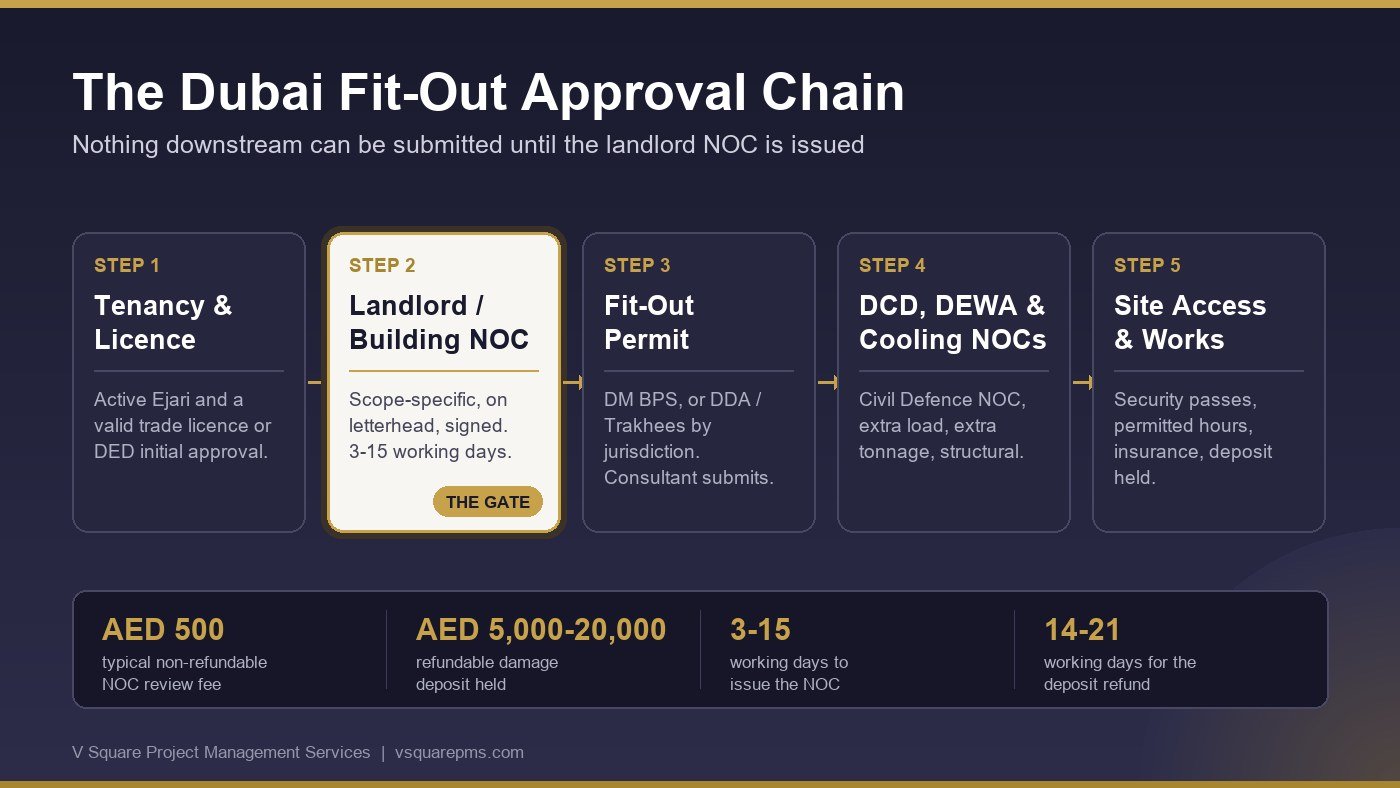
The landlord NOC is the only gate in the chain that sits entirely outside the tenant’s control. Diagram: V Square Project Management Services.
Every delayed fit-out we are called into has a Gantt chart somewhere with a two-day bar on it labelled “NOC.” It was drawn by someone who assumed that because the landlord had already signed a lease worth several hundred thousand dirhams, signing a one-page letter would be a formality. Six weeks later the drawings are complete, the contractor is mobilised and idle, the trade licence renewal is looming, and the building manager is asking why the electrical single-line diagram was not attached to the original request.
The landlord NOC is the least technical document in a Dubai fit-out and the one most likely to cost you a month. It is worth understanding precisely because it is boring: it has no design content, no engineering to resolve and no authority fee schedule to look up, so nobody assigns it an owner. This guide sets out who actually issues it in each building type, the wording that gets it accepted by Dubai Municipality rather than bounced, what it really costs once the deposit and access charges are counted, and the eight ways it quietly eats a programme.
What a Landlord NOC Is, and What It Deliberately Is Not
A landlord NOC is a private contractual document. The owner of the unit — or the owners association manager or building management company acting for them — states in writing that they have no objection to a named tenant executing a described scope of works in an identified premises, usually subject to conditions and usually for a limited period.
What it is not, and this catches people out, is any form of technical approval. Nobody at the building has checked your fire strategy. Nobody has verified that your proposed lighting load fits the sanctioned supply. A landlord NOC says the owner does not object; it does not say the works are compliant, safe or buildable. That verification happens downstream at Dubai Municipality, the Dubai Development Authority, Trakhees or Dubai Civil Defence, and it is entirely possible to hold a valid landlord NOC and still have a scheme that will never be permitted.
The reverse is also true and more painful. A perfectly compliant, fully coordinated design cannot be submitted at all without the letter. That asymmetry — no technical weight, absolute procedural weight — is the whole reason it belongs at the front of the programme rather than in the general paperwork pile.
Why It Sits Before Every Other Approval in the Chain
Dubai’s fit-out approvals run in sequence, not in parallel, and the landlord NOC is the first link. The authority portals are built to enforce this: the owner or building NOC is a required upload in the application pack, so a submission cannot be opened without it. Building security enforces the same thing physically, refusing material deliveries and contractor access until the approved NOC and the permit behind it are produced.
The consequence is that every day lost on the NOC is a day added to the end of the project, not absorbed somewhere in the middle. If you are working to the benchmarks in our office fit-out timeline for the UAE, the NOC sits on the critical path before drawings are even submitted, which is why we start it in week one against a scope narrative rather than waiting for a finished drawing set.
Who Actually Issues It: Five Ownership Models
“The landlord” is rarely one party. Who signs, and how many signatures you need, is set by the building’s ownership structure — and it is worth establishing this in the first week, because the two-signature models take roughly twice as long.
| Building model | Typical NOC lead time | Who signs | What catches people out |
|---|---|---|---|
| Single-owner commercial tower | 2–5 working days | Owner’s in-house facilities or leasing team | Fastest route, but the letter is often generic and needs redrafting for scope |
| Strata tower, unit bought by an investor | 8–15 working days | Individual owner and the OA / building manager | Two separate approvals; the owner cannot bind the building manager |
| Master-developer community | 10–15 working days | Building manager, then developer community portal | A second NOC above the building; portal fees and deposits are separate |
| Shopping mall unit | 10–20 working days | Mall tenant-coordination / retail delivery team | Design review against mall criteria before any NOC is issued at all |
| Free zone unit (DDA, Trakhees, JAFZA, DIFC) | 7–15 working days | Free zone facilities team, sometimes doubling as the authority | The zone is landlord and regulator; one rejection stops both tracks |
The distinction that matters most is between the owner of your unit and the manager of the building. Your landlord owns the demise; the building manager runs the systems your works will touch. In a strata tower these are different parties with different interests, and the manager frequently wants an engineering review that your individual owner has no ability to provide. Establish early which model you are in, because it changes the programme by a fortnight.
The Scope Wording That Decides Whether It Passes
If there is one thing to take from this guide, it is this: a landlord NOC is accepted or rejected on its scope wording, not on its format. A reviewer at Dubai Municipality is matching the letter against the drawings in front of them. A letter that does not name the works cannot be matched, and generic letters are the most common reason a fit-out application is returned.
| Element | Verdict | Why |
|---|---|---|
| “No objection to fit-out works in Unit 1204” | Rejected | No scope named; cannot be matched to a drawing set |
| Lists partitions, ceiling, electrical, HVAC, plumbing, coring | Accepted | Each item maps to a discipline drawing in the submission |
| Tenant name differs from the Ejari or trade licence | Rejected | Applicant identity must match across every document |
| Contractor not named, or substituted later | Rejected | The NOC is issued for a specific contractor; a change reopens it |
| Validity shorter than the permit process | Rejected | An NOC that expires mid-review invalidates the application |
| Forwarded email, no letterhead, no signature or stamp | Rejected | Must be a signed, stamped letter on the issuing party’s letterhead |
Two items deserve emphasis. Coring — drilling through the slab for drainage, containment or services — must be named explicitly, because it triggers a structural review that a generic letter silently omits. And validity is worth negotiating up front: ask for a period that comfortably outlasts the permit process, because a letter that expires during review has to be reissued and the application restarted.
Draft the wording yourself and send it to the building manager for signature. Almost every landlord will sign a well-drafted letter that names a reasonable scope; very few will write one for you, and the one they write from a template will be generic.
The Document Pack That Gets It Issued First Time
Building managers are not slow by nature. They are slow when a request arrives incomplete, because the file then sits in a queue twice. The pack below covers the overwhelming majority of Dubai buildings.
| Document | Required | Notes |
|---|---|---|
| Ejari-registered tenancy contract | Always | Must be active; an expired or unregistered contract stops the request |
| Trade licence or DED initial approval | Always | Activity on the licence should match the intended use of the space |
| Title deed or ownership proof | Usually | Supplied by the owner where the building manager is a third party |
| Scope of works narrative | Always | The document that becomes the NOC wording — write it yourself |
| Marked-up layout plan | Always | Concept level is enough; IFC drawings are not needed to start |
| MEP drawings or load schedule | Often | Required wherever the works touch power, cooling or the fire system |
| Contractor trade licence and insurance | Always | Third-party liability and workmen’s compensation, in-date |
| Contractor appointment letter | Often | Named contractor; substitution later reopens the NOC |
| Passport and Emirates ID of the signatory | Usually | Plus a power of attorney where a consultant applies on your behalf |
Note what is not on that list: a tender-ready package. A concept layout and a written scope are enough to open the request, which is exactly why it can run alongside design development rather than after it.
What a Landlord NOC Costs: The Full Stack
Because it is a private approval rather than a government service, there is no published tariff. The cost is a stack, and the deposit line is the one that most often goes missing from a budget.
| Line | Typical range (AED) | Refundable? | When it is charged |
|---|---|---|---|
| NOC application / review fee | 500 – 2,500 | No | On submission of the request |
| Refundable damage deposit | 5,000 – 20,000 | Yes | Before access is released |
| Building consultant drawing review | 1,500 – 6,000 | No | Where the manager appoints its own reviewer |
| Contractor access / security passes | 50 – 200 per person | No | Weekly or per pass, for the works duration |
| Out-of-hours or night working charge | 500 – 2,000 per shift | No | Where the building restricts daytime noisy works |
| Service lift booking | 200 – 800 per booking | No | Per slot, in towers with a single goods lift |
| Community / master-developer portal fee | 500 – 3,000 | No | Only where a developer NOC sits above the building |
The deposit is not a cost — it is working capital, held for the full duration of the works and returned after inspection. It belongs in the cash-flow forecast, not in the cost plan, and confusing the two distorts both. If you are building a budget from scratch, our office fit-out cost guide for the UAE covers where these approval lines sit against the construction rate, and the guide to comparing BOQ bids explains why a quotation that omits NOC, permit and deposit lines is not comparable to one that names them.
Timeline: Three to Fifteen Working Days, and What Makes It Thirty
Three to fifteen working days is the honest planning range. Where you land is decided less by the complexity of your works than by how many parties have to sign and how clean the first submission is.
| Scenario | Realistic window | Driver |
|---|---|---|
| Single owner, in-house FM, clean pack | 2–5 working days | One decision-maker, no external review |
| Strata tower, OA manager involved | 8–15 working days | Two approvals in series, not in parallel |
| Master-developer community portal | 10–15 working days | Building NOC first, then the portal above it |
| Mall unit with design criteria review | 15–25 working days | Shopfront and signage review precedes the NOC |
| Any of the above, returned once | +7–14 working days | A returned file re-queues; it does not resume |
That last row is the one worth internalising. A rejected request does not pick up where it left off — it goes to the back of the queue. This is why the marginal effort spent drafting precise scope wording before the first submission has a far better return than any amount of chasing afterwards.
Where It Feeds Into DM, DCD, DEWA and District Cooling
The landlord NOC is an input to almost every downstream application, and the conditions written into it can constrain those applications in ways that are hard to unwind later.
| Downstream approval | Needs the NOC? | How the NOC affects it |
|---|---|---|
| DM fit-out permit (BPS) | Yes, in the upload pack | Scope wording must match the submitted drawings |
| DDA or Trakhees permit | Yes, owner and building NOC | Free zone acts as landlord and regulator together |
| Civil Defence NOC | Indirectly | Fire system alterations must be permitted by the building first |
| DEWA additional load | Yes, owner consent | Building management checks the unit’s allocated load first |
| District cooling capacity change | Yes | Provider deals with the building, not the tenant |
| Structural / coring approval | Yes, explicitly | A generic NOC will not cover slab penetration |
Two of these are worth checking before you finalise the design rather than after. Building management routinely verifies that additional air conditioning or electrical load does not exceed the unit’s allocated supply — the mechanism we set out in the DEWA load upgrade guide. The equivalent test on the mechanical side is chilled water capacity, covered in our HVAC modification guide. Discovering at NOC stage that your unit’s allocation will not carry the design is far cheaper than discovering it at DEWA stage. The full downstream sequence is mapped in our Dubai fit-out approval guide covering DM, DCD and Trakhees.
The Conditions Buried in the NOC That Bind Your Contractor
Tenants read the NOC for the word “approved” and stop. The operational value is in the conditions underneath, because they are contractually binding on works your contractor has already priced.
- Approved contractor lists. Some buildings mandate their own contractors for fire, HVAC or waterproofing works, which removes those packages from competitive tender entirely.
- Permitted working hours. Occupied towers commonly bar noisy works during business hours, pushing demolition and coring to nights and weekends at a premium.
- Access routes and lift allocation. A single goods lift shared across a tower is a real programme constraint, not an administrative note.
- Insurance thresholds. Third-party liability limits and workmen’s compensation cover are specified, and a contractor below the threshold cannot be mobilised.
- Protection obligations. Lift lobbies, corridors and floor finishes must be protected, at your cost, and failures are deducted from the deposit.
- Reinstatement. Some NOCs restate a reinstatement obligation at lease end — a liability that interacts directly with the tenant improvement allowance and cost-recovery position.
Read these before the contractor is appointed, not after. An approved-contractor clause discovered post-tender can move a package price by twenty per cent with no recourse, and a night-works restriction discovered after award is a variation rather than an allowance.
Sector Notes: Where the NOC Carries Extra Weight
Some uses attract conditions that a standard office fit-out never sees, and in each case the building has a legitimate interest in the answer.
Food and beverage draws the heaviest conditions of any use: grease extraction routing to roof level, drainage interceptors, and gas supply all touch base-building infrastructure, and the NOC is where the building sets the terms. The interaction with the wider approval set is covered in our restaurant fit-out guide. Clinics and healthcare add lead shielding weight, dedicated drainage and clinical waste routing on top of the regulator’s own approvals — see the clinic fit-out and DHA compliance guide. Retail units in malls invert the usual order, with a shopfront and signage design review preceding the NOC rather than following it, as set out in our retail store fit-out guide. And warehouses raise structural questions immediately, particularly where a mezzanine floor is proposed, because that is a structural modification rather than a fit-out.
Getting the Deposit Back
The refundable deposit is returned when the building manager is satisfied that the works match the approved scope and that the common areas were not damaged. Both halves are evidential, which means the recovery is won before the works start, not after.
- Photograph everything before mobilisation. Lift lobbies, corridors, service risers, loading bay, floor finishes. Have the building manager acknowledge the record in writing.
- Work only within the permitted hours and routes. Out-of-hours access and cleaning charges are usually deducted from the deposit rather than invoiced.
- Keep the scope inside the NOC. Works beyond the permitted scope are the fastest route to a withheld deposit and a stop-work notice.
- Request the building inspection in writing. Close their snag list in the same pass as your own — the process is the one described in our snagging and handover checklist.
- Return every access card and close the file. Refunds typically start within fourteen to twenty-one working days of sign-off; the usual delays are documentary, not disputed.
Eight Ways a Landlord NOC Delays a Fit-Out
Every one of these is avoidable, and every one of them we have watched cost a project real weeks.
- Starting it after the drawings are finished. The single most common cause. A concept plan and a written scope are enough to open the request.
- Accepting a generic letter. It will be signed quickly and rejected downstream, which is the worst of both outcomes.
- Not knowing who signs. In a strata tower, the owner’s signature alone is half an approval.
- Omitting coring from the scope. Slab penetration needs to be named; a generic letter silently excludes it.
- Naming a contractor you later replace. Substitution reopens the NOC and often the permit behind it.
- Missing the validity window. A letter that expires during permit review invalidates the application.
- Ignoring the conditions. Approved-contractor and working-hour clauses are priced variations if found after tender.
- Treating the deposit as a cost. It distorts the cash-flow forecast and it is the line most often forgotten entirely.
The Sequence That Actually Works
The pattern that consistently delivers is unglamorous and entirely front-loaded. In week one, establish the ownership model and identify every party whose signature is needed. In parallel, draft the scope narrative yourself, in the language the authority reviewer will use, and issue it to the building manager for signature with a marked-up concept plan, the Ejari, the trade licence and the contractor’s licence and insurance attached. While that sits with the building, develop the design — but check the unit’s allocated electrical and cooling capacity before you commit to a scheme that needs more than it has.
When the letter comes back, read the conditions before the contractor is appointed and reflect them in the tender. Then submit downstream, mobilise, and photograph the common areas before the first delivery arrives. None of this requires leverage over the landlord. It requires assigning the NOC an owner in week one instead of week five, which is the part almost every delayed project got wrong — and it is the same discipline we apply across fit-out project management and MEP coordination, where the cost of a decision rises with every week it is deferred.
Get the NOC moving in week one, not week five
V Square identifies every party whose signature your building actually needs, drafts the scope wording so authority reviewers can match it to the drawings, and runs the landlord NOC in parallel with design development — then holds the conditions against the contractor so the deposit comes back.
Request a fit-out approvals review →Frequently Asked Questions
What is a landlord NOC in Dubai?
A landlord NOC is a written no-objection certificate issued by the building owner, the owners association manager or the appointed building management company, confirming that they do not object to a named tenant carrying out a defined scope of fit-out works in a specific unit. It is a private document, not a government permit, and it carries no authority approval of its own. Its power is procedural: Dubai Municipality, the Dubai Development Authority and Trakhees all require it in the submission pack before they will open a fit-out application, and building security will not release site access without it. In practice the landlord NOC is the first gate in the chain and the only one that sits entirely outside your control, which is why it deserves to be started on day one rather than after the drawings are finished.
Is a landlord NOC the same as a building management NOC?
Not always, and assuming they are the same is one of the more expensive mistakes in a Dubai fit-out programme. The landlord NOC comes from whoever owns the unit and answers the question of whether the tenant is permitted to alter the demise. The building management NOC comes from the entity that operates the tower and answers a different question: whether the proposed works are compatible with shared systems, fire zoning, riser capacity, structural elements and the building’s allocated services. In a single-owner building one document covers both. In a strata tower where you rent from an individual investor, they are two separate approvals from two separate parties, and the building manager frequently wants an engineering review your individual landlord cannot provide. Confirm which model applies to your building before you build the programme, because the two-document route routinely adds one to two weeks.
How long does a landlord NOC take in Dubai?
Three to fifteen working days is the realistic planning range, and where a file lands in that range depends almost entirely on the ownership model rather than on the complexity of your works. A single-owner commercial building with an in-house facilities team can turn a clean, scope-specific request around in two to five working days. A managed strata tower that routes the request through an owners association engineer, then through the developer’s community portal, commonly runs ten to fifteen. Assume the longer end whenever a master developer sits above the building manager, whenever your scope touches the fire system or the ceiling void, or whenever your request lands across a public holiday. The single largest controllable variable is the quality of the first submission: files that go back for missing drawings or vague scope wording restart the clock rather than continuing it.
What does a landlord NOC cost in Dubai?
There is no published tariff, because it is a private approval rather than a government service, but the cost is a predictable stack rather than a single number. Expect a non-refundable administration or review fee in the region of AED 500 to AED 2,500, a refundable damage deposit typically between AED 5,000 and AED 20,000 held against the common areas, and in many towers a separate access, security-pass or out-of-hours working charge billed weekly. Where the building manager insists on its own consultant reviewing your drawings, that review is charged on top. The deposit is the line most budgets omit, and because it is held for the whole programme rather than spent, it is a cash-flow item rather than a cost item — which is exactly why it belongs in the cash-flow forecast and not in the fit-out cost plan.
Why do Dubai Municipality reviewers reject a landlord NOC?
Overwhelmingly for scope, not for form. A letter that says the owner has no objection to fit-out works in the unit is generic, and generic wording is the single most common rejection reason, because the reviewer cannot match it against the drawings in front of them. The NOC has to name the works: partitions, false ceiling, electrical alterations, HVAC modification, plumbing, any structural element, and specifically any coring of the slab. Other recurring failures are an expired NOC where the letter carries a validity date shorter than the permit process, a mismatch between the tenant name on the letter and the name on the Ejari or trade licence, an unnamed or later-substituted contractor, and an unsigned or unstamped letter arriving as a forwarded email rather than on letterhead. Every one of these is fixable in the drafting stage and expensive to fix afterwards.
Can a Dubai landlord refuse to give a fit-out NOC?
They can refuse a specific scope, but a blanket refusal to engage sits awkwardly with the law. Article 19 of Dubai Law No. 26 of 2007 requires the tenant not to make changes, renovations or maintenance works without the landlord’s permission and without the necessary authority approvals, so the landlord’s consent is genuinely a precondition. Article 18 pulls in the other direction: it requires the landlord to provide the tenant with the approvals required by the competent authorities where the tenant wishes to execute decoration or other works, provided those works do not affect the construction of the premises and the tenant holds the documents evidencing the application. Read together, a landlord may legitimately object to works that alter the structure or the building’s systems, and may attach reasonable conditions, but the paperwork a compliant tenant needs for an authority submission is an obligation rather than a favour. The practical answer is almost always to narrow the scope until the objection disappears, and to have the reinstatement position written down at the same time.
Do I need a landlord NOC for minor works like painting or furniture?
For loose furniture, no. For anything fixed, almost certainly yes, and the threshold is lower than most tenants expect. Repainting within an existing colour scheme and installing free-standing furniture generally fall outside the permit regime, though many towers still want an access notification so security can log contractors and lifts can be booked. The moment the work touches a wall, a ceiling, a sprinkler head, a smoke detector, a socket, a data point or a plumbing connection, it is an alteration, it needs the landlord NOC, and in most jurisdictions it needs an authority permit behind it. The reliable test is not how small the job feels or what it costs. It is whether anything is being fixed to the building, and whether the building’s fire, electrical or mechanical systems are touched.
How do I get the fit-out security deposit refunded?
By making the end state match the approved paperwork, and by proving the common areas were left as you found them. Photograph the lift lobbies, corridors, service risers and loading bay before a single contractor enters, and have the building manager countersign or acknowledge that record. Work only within the permitted hours and access routes written into the NOC conditions, because charges for out-of-hours access and for cleaning are commonly deducted from the deposit rather than invoiced separately. On completion, request the building manager’s inspection in writing and close out their snag list in the same pass as your own. Refunds are typically initiated within fourteen to twenty-one working days of that final sign-off, and the delays that follow are almost always documentary rather than disputed: a missing completion certificate, an unreturned access card, or an outstanding service charge on the unit that the building offsets against the deposit.