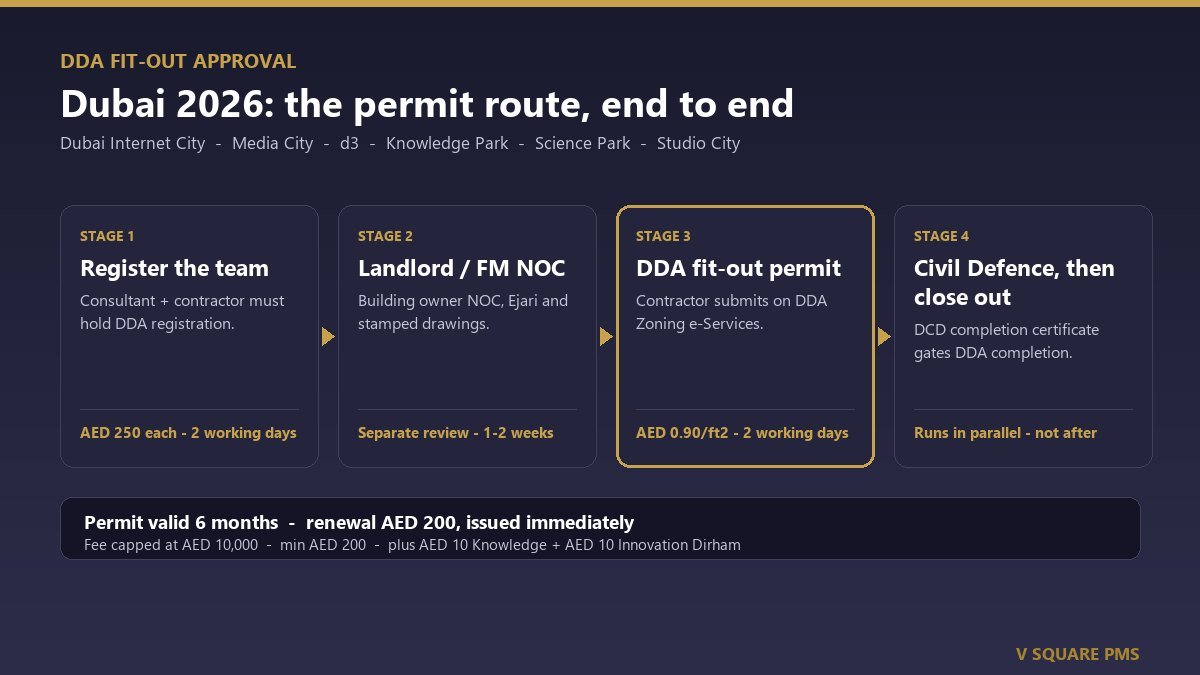
The DDA fit-out permit itself takes two working days. Everything either side of it does not. Diagram: V Square Project Management Services.
Most Dubai fit-out delays are not caused by the authority that eventually issues the permit. They are caused by a tenant discovering, three weeks into a lease with a two-month rent-free period, that the contractor they signed cannot legally submit anything in their building — because the building is not under Dubai Municipality at all, and the contractor is not registered with the authority that actually governs it.
That authority, across a substantial slice of Dubai’s commercial floorspace, is the Dubai Development Authority. If your office is in Dubai Internet City, Dubai Media City, Dubai Knowledge Park, Dubai Design District, Dubai Science Park, Dubai Studio City, Dubai Production City or Dubai Outsource City, your fit-out is a DDA matter, and very little of the generic “Dubai fit-out approval” advice in circulation applies to you without modification.
The useful part is that DDA is unusually transparent. It publishes its fee, its document list and its service turnaround for every permit it issues, which is more than can be said for several other Dubai authorities. This guide uses those published figures rather than market hearsay, then sets out the part DDA does not publish: what the permit sits inside, why the two-day service level is not the timeline you should plan against, and where DDA submissions actually lose their weeks.
What a DDA Fit-Out Permit Actually Is
DDA describes the service plainly. In the authority’s own words, the fit-out permit “enables the contractor to obtain a permit to start fit out works (for any part of the building, office, retail etc.) and then submit for completion to ensure compliance with permit requirements.”
Three things in that sentence matter more than they look.
It is issued to the contractor, not to you. The applicant of record is the fit-out contractor. The tenant appoints them and the tenant pays for it, but the tenant cannot lodge the application. This is why contractor selection is an approvals decision as much as a commercial one, and why the cheapest quotation from a firm that is not DDA-registered is not really a quotation at all.
It permits works to start. It is a permission to begin, not a sign-off on a finished room. Everything built under it stays provisional until the completion stage closes it out.
“And then submit for completion” is half the service. The fit-out permit and the fit-out completion certificate are two ends of one process. A tenancy that gets its permit, builds out, then never closes the completion loop has an unpermitted fit-out on the record. That surfaces later — at licence renewal, at lease assignment, or when the next tenant tries to get their own permit against a drawing set that does not match the space.
How to Confirm DDA Is Actually Your Authority
Dubai’s regulatory map is a patchwork and the boundaries are not intuitive. Two towers on the same road can sit under different authorities. Before anything else, establish which body governs your specific plot, because every downstream decision — contractor eligibility, fee, document set, portal — follows from it.
Four checks, in order of reliability:
- Ask the building management, in writing. The FM team in a DDA building processes fit-out NOCs constantly and will tell you immediately. Get it by email rather than verbally, because you will need to forward it to your consultant.
- Check the DDA mapping tools. DDA publishes an e-Map and a Development Information System that locate a plot against the authority’s jurisdiction.
- Read your lease and Ejari. The master developer and the free zone named on the tenancy contract are usually decisive.
- Ask a DDA-registered consultant to confirm. Any consultant already registered with DDA Planning & Development will recognise the address on sight.
What you should not do is assume. The single most expensive assumption in a Dubai fit-out is that a building falls under Dubai Municipality because it is in Dubai. Our broader guide to fit-out approval across DM, DCD and Trakhees sets out how the other authorities differ; this article deals only with the DDA route.
The Dubai Districts Where DDA Fit-Out Approval Applies
DDA regulates master planning and construction activity within the zones under its jurisdiction. For a commercial tenant, that means the Dubai Holding and TECOM business clusters. The districts most commonly encountered are:
| District | Typical tenant profile | Fit-out characteristics |
|---|---|---|
| Dubai Internet City | Technology, software, IT services | Office Cat B, dense data and power provision, frequent server room packages |
| Dubai Media City | Media, advertising, broadcast | Studios and acoustic treatment, high electrical loads, irregular layouts |
| Dubai Design District (d3) | Design, fashion, creative retail | Showroom and retail units, high finish specification, shopfront scrutiny |
| Dubai Knowledge Park | Training, HR, education services | Classroom and seminar layouts, occupancy and egress sensitivity |
| Dubai Science Park | Life sciences, healthcare, laboratories | Laboratory services, specialist extract, secondary authority approvals |
| Dubai Studio City | Production, broadcast, studios | Large-volume spaces, temporary structures, heavy power |
| Dubai Production City | Publishing, printing, media production | Mixed office and light industrial, warehouse-office splits |
| Dubai Outsource City | BPO, contact centres, shared services | High-density open plan, large occupancy counts, extensive cabling |
Treat that as a starting point rather than a legal boundary. Jurisdictions are periodically restructured, individual plots inside a district can sit under a different regime, and the authoritative answer for your unit is the DDA mapping tools or the building management — not a table on a blog, including this one.
DDA Fit-Out Permit Fees in 2026
This is where DDA is genuinely helpful, and where most third-party guidance is wrong. The authority publishes exact figures. Here they are, as published:
| Service | Published fee | Stated turnaround |
|---|---|---|
| Fit-Out Permit | AED 0.90 per ft² (min AED 200, max AED 10,000) | 2 working days |
| Renewal of Fit-Out Permit | AED 200 | Immediately |
| Consultant or contractor registration (new) | AED 250 | 2 working days |
| Consultant or contractor registration (renewal) | AED 250 per renewal | 2 working days |
| Building Modification Permit | AED 1.00 per ft² of additional or relevant built-up area | 2 working days |
| Knowledge Dirham and Innovation Dirham | AED 10 + AED 10 per transaction | Applied at payment |
Because the rate is area-based with a floor and a ceiling, the fee behaves in three bands. Below roughly 222 square feet the minimum bites; above roughly 11,111 square feet the cap bites; in between you simply multiply. Worked through, for the permit fee plus the two dirham charges:
| Fit-out area | Total DDA permit cost | Which rule applies |
|---|---|---|
| 200 ft² (about 19 m²) | AED 220 | Minimum fee of AED 200 applies |
| 1,000 ft² (about 93 m²) | AED 920 | 1,000 × 0.90 = 900 |
| 2,500 ft² (about 232 m²) | AED 2,270 | 2,500 × 0.90 = 2,250 |
| 5,000 ft² (about 465 m²) | AED 4,520 | 5,000 × 0.90 = 4,500 |
| 10,000 ft² (about 929 m²) | AED 9,020 | 10,000 × 0.90 = 9,000 |
| 20,000 ft² (about 1,858 m²) | AED 10,020 | Capped at the AED 10,000 maximum |
Your Consultant and Contractor Must Be DDA-Registered First
This is the prerequisite that catches tenants who have fitted out elsewhere in Dubai, and it sits before everything else in the programme.
DDA operates its own registration regime. The service “enables Consultants and Contractors holding a valid trade license from Dubai Department of Economic Development (DED) or Dubai Development Authority (DDA) to register with DDA Planning & Development to be eligible to apply for services.” Unregistered firms cannot apply. Not slowly — at all.
The published terms:
- Fee: AED 250 for new registration; AED 250 per renewal.
- Turnaround: 2 working days.
- Validity: one year, renewing on DED licence expiry at the same fee.
- Documents, new registration: Master User Emirates ID copy front and back; Master User Delegation of Authority on company letterhead; valid trade licence copy; and, for Building Surveyor activity only, a Dubai Land Department registration certificate.
- Documents, renewal: valid trade licence copy, plus the DLD certificate for Building Surveyor activity only.
Two practical consequences follow, and both belong in your tender documents rather than in a conversation after award.
Ask for the registration, not the claim. “We work in Media City all the time” is not evidence. Ask every bidding contractor for their current DDA registration reference and its expiry date, and ask the same of the consultant who will stamp the drawings. Put it in the bid comparison alongside price.
Check the expiry against your programme. Registration tracks the DED trade licence. A contractor whose registration lapses mid-project cannot submit your completion application, and you will be waiting on their licence renewal rather than on your own works. On a four-month fit-out with a registration expiring in week six, that is a foreseeable and entirely avoidable stoppage.
The Documents DDA Asks For
DDA publishes the document set for the fit-out permit. It is short, which is misleading — each line conceals a process that has to have finished before the line can be produced.
| Document required by DDA | Who produces it | What has to happen first |
|---|---|---|
| Fit-out Permit Request form | Contractor | Contractor appointed and DDA-registered |
| Contractor Appointment Letter by Tenant | Tenant | Contract awarded and signed |
| Copy of Ejari | Tenant | Tenancy contract registered with Ejari |
| NOC from Building Owner | Landlord or building management | Drawings issued to and reviewed by the FM team |
| NOC from relevant Authorities | Varies by scope | Any secondary approvals your activity triggers |
| Approved stamped drawings and proposed drawings | DDA-registered consultant | Design complete, coordinated and stamped |
Three of those deserve expansion, because they are where submissions stall.
Ejari is a hard gate, not a formality
No Ejari, no permit. If your tenancy contract has not been registered — because the lease is still in negotiation, because the licence is not issued, or because the landlord has not completed their side — the fit-out application cannot proceed regardless of how complete the drawings are. Tenants routinely try to run design and Ejari in parallel and then discover the registration is the item holding the permit.
The building owner NOC is its own mini-project
The NOC from the building owner is issued by the landlord or, far more often, by the building management company acting for them. It is a separate review with its own rules, its own turnaround and frequently its own fee, and it typically looks at matters DDA does not: base building interfaces, working hours, lift and loading bay access, waste routes, insurance, and a security deposit against damage to common areas. It is covered in more detail in our guide to the landlord NOC in Dubai, and it is the item most likely to be underestimated, because it is a commercial negotiation dressed as an administrative step.
“NOC from relevant Authorities” is doing a lot of work
That single line is where your activity type enters the process. A standard office may trigger nothing beyond the base route. A clinic, a laboratory, a nursery, a food outlet or a salon will each pull in a sector regulator whose approval must be in hand before or alongside the DDA submission. If your fit-out is one of those, the sector approval — not DDA — is almost certainly your critical path, and it needs to start on day one rather than after the drawings are finished.
The DDA Fit-Out Approval Process, Stage by Stage
DDA runs its permitting through Zoning e-Services, its online portal, available around the clock, with a customer service centre at Dubai Studio City as the in-person alternative. In sequence:
Establish that the unit is under DDA before appointing anyone. Building management or the DDA e-Map settles it.
Consultant and contractor must hold current DDA registration. AED 250 each, two working days if either needs to register.
Architectural and MEP drawings coordinated and stamped by the DDA-registered consultant.
Drawings to the FM team for the building owner NOC. Independent review, independent timeline, often a deposit.
Contractor logs in, creates the project, completes the fit-out permit application, uploads documents, pays.
Stated review time is two working days. The permit is valid for six months from issue.
The fire package is a parallel track through Dubai Civil Defence, not a step that follows construction.
Civil Defence completion certificate first, then submit for the DDA fit-out completion certificate.
Note what stage 5 does not include. There is no separate design-approval submission before the permit application in this route — the drawings go in with the permit request. That is why the quality and coordination of the drawing set determines whether you get a clean issue or a comment cycle, and why sending an uncoordinated set to save a week reliably costs two. Our guide to MEP coordination in fit-out projects covers the clashes that most often generate comments.
Civil Defence Runs in Parallel and Gates Your Completion Certificate
This is the single most important sequencing fact in the DDA route, and DDA states it explicitly: a “Dubai Civil Defence Completion Certificate is required prior to obtaining Fit-Out Completion Certificate.”
Read that as a dependency, not a footnote. Your DDA completion — the document that closes out the fit-out and lets the tenancy operate cleanly — sits behind a Civil Defence certificate that has its own submission, its own registered-contractor requirement, its own inspection and its own comment cycles.
The failure mode is predictable. A tenant treats fire as a subcontract item to be dealt with when the fire alarm devices are installed. By then the ceiling is closed, the partitions are up, and any comment from Civil Defence — a sprinkler head in the wrong relationship to a new partition, a detector coverage gap, an exit sign in the wrong place, an unsealed penetration — is a rework item rather than a drawing revision. Our Civil Defence inspection checklist sets out the failures that recur most.
Published Turnaround Versus the Real Programme
DDA says two working days. That figure is accurate and it is also, on its own, misleading — because it measures the authority’s review of a complete application, not the elapsed time from lease signature to a contractor on site. Here is the honest version for a straightforward office fit-out in a DDA zone:
| Step | Realistic elapsed time | Runs in parallel? |
|---|---|---|
| Confirm jurisdiction, appoint consultant | 3–7 days | No — it is the start |
| DDA registration, if either party lacks it | 2 working days plus document gathering | Yes, alongside design |
| Design, coordination and stamping | 2–3 weeks | No — drives everything |
| Building owner / FM NOC | 1–2 weeks | Partly, once drawings exist |
| Ejari registration, if outstanding | Days to weeks | Yes, and should start immediately |
| DDA fit-out permit review | 2 working days if the file is complete | No |
| Civil Defence submission and approval | 2–4 weeks, assume one comment cycle | Yes — and must be started early |
| Lease to on-site, realistic | 4–6 weeks | — |
Those durations are planning assumptions drawn from how these projects typically run, not published DDA figures — only the two-working-day review is official. A well-prepared submission with a registered team, drawings already stamped and Ejari in hand can beat this comfortably. A tenancy that starts the approval conversation after the contractor is appointed and the design is half-finished will not.
If you are building a programme from scratch, our guide to the office fit-out timeline in the UAE sets the approval window in context against procurement and construction.
Validity, Renewal and What Happens If You Overrun
The DDA fit-out permit is valid for six months from issue. Most office fit-outs finish comfortably inside that. Projects that do not — because of long-lead joinery, a scope change, a landlord dispute or a phased occupation — need the renewal service, and DDA has made this deliberately painless.
- Fee: AED 200, plus the AED 10 Knowledge Dirham and AED 10 Innovation Dirham.
- Coverage: a period of three months up to one year from the original permit issuance date.
- Turnaround: immediate. The renewed permit arrives by email on completion.
- Documents: none for online applications. The request form is only needed if you apply at the customer service centre.
An immediate, AED 200, no-documents renewal is about as low-friction as authority processes get. There is no reason to let a permit lapse. Diarise the expiry at permit issue, and if the programme is drifting, renew before the date rather than after — working on an expired permit is a materially different problem from renewing an active one.
Fit-Out Permit or Building Modification Permit?
These are distinct DDA services with distinct fees, and picking the wrong one costs a resubmission.
| Aspect | Fit-Out Permit | Building Modification Permit |
|---|---|---|
| Purpose | Start fit-out works to part of a building, office or retail unit | Modify a completed building after its building completion certificate |
| Fee | AED 0.90 per ft², min 200, max 10,000 | AED 1.00 per ft² of additional or relevant built-up area |
| Renewal | AED 200 | AED 200, three months up to one year from issue |
| Turnaround | 2 working days | 2 working days |
| Key documents | Ejari, contractor appointment, owner NOC, stamped drawings | Modification application, appointment letter signed by owner, consultant and contractor |
The practical dividing line is whether you are fitting out inside a demised tenancy or altering the building itself. New partitions, ceilings, finishes, joinery and internal services distribution inside your leased area are fit-out. Changes to the built-up area, the structure, the envelope or the building’s permanent configuration are modification — and the appointment letter for modification has to be signed by the owner, not just by you as tenant, which is a materially harder document to obtain. If your scheme is ambiguous, ask the consultant to confirm the route before drawings are finalised.
How DDA Compares With Dubai’s Other Fit-Out Authorities
Tenants who have fitted out elsewhere in the emirate arrive with expectations that do not transfer. The broad shape of the process is similar everywhere — registered parties, stamped drawings, landlord NOC, permit, fire approval, completion — but the detail differs enough to break a programme.
| Authority | Where it applies | What is distinctive |
|---|---|---|
| Dubai Development Authority (DDA) | Dubai Holding and TECOM clusters: Internet City, Media City, d3, Knowledge Park, Science Park, Studio City, Production City, Outsource City | Own registration regime for consultants and contractors; fees and turnarounds published openly; submissions via Zoning e-Services; DCD completion certificate gates the fit-out completion certificate |
| Dubai Municipality | Mainland Dubai outside the free zone and special development areas | Building Permits System route; the default most generic guidance assumes |
| Trakhees (Ports, Customs and Free Zone Corporation) | Nakheel and Dubai World communities, including Jebel Ali and Palm districts | Its own EHS regime and inspection culture; separate contractor registration |
| DMCC | Jumeirah Lakes Towers | Free zone portal route, tightly coupled to the building management approval |
| Dubai Civil Defence | Everywhere, alongside whichever authority applies | Not an alternative to the above — an additional, parallel approval in every case |
The recurring error is treating Civil Defence as one of the options in that list. It is not. Whichever authority owns your plot, the fire package is a separate submission running alongside — and under DDA it is explicitly the gate on your completion certificate. Our comparison of the DM, DCD and Trakhees routes covers the non-DDA options in more depth.
Where DDA Fit-Out Submissions Actually Lose Time
DDA reviews in two working days. If your approval took six weeks, the time went somewhere else. In our experience across Dubai free zone tenancies, it goes to the same handful of places.
- Discovering the registration requirement late. The contractor is appointed on price, then cannot submit. Best case, two working days and AED 250. Worst case, the contractor is not eligible at all and you re-tender.
- Ejari not registered. A hard document gate, often outside your control, and routinely left until the drawings are done.
- Landlord NOC treated as a formality. It is a separate review with its own queue, its own conditions and often a refundable deposit. Building managers in busy DDA towers process many of these at once.
- Uncoordinated drawings. Architectural and MEP sets that do not agree generate comments. Each comment cycle costs days, and the fix is upstream in coordination, not in resubmitting faster.
- Civil Defence started after the DDA permit. The most expensive sequencing error available, because it converts a parallel activity into a serial one at the end of the programme.
- A sector approval nobody scoped. Clinics, laboratories, nurseries, salons and food outlets all bring a regulator with them. Discovering this after design freeze is a redesign, not a delay.
- Completion never closed out. The team demobilises at handover and the fit-out completion certificate is never obtained. It costs nothing today and surfaces at the worst possible moment later.
Every item on that list is knowable in week one. None of them is a DDA problem. They are programme problems that show up as approval delays, which is why they get misattributed to the authority.
Budgeting the Full Cost of DDA Approval
The permit fee is the smallest and the only precisely knowable number. A realistic budget line has four components:
- The DDA permit fee. Published, calculable to the dirham from your area — see the worked table above. For most office tenancies, AED 900 to AED 5,000.
- DDA registration. AED 250 per party, only if your consultant or contractor is not already registered. On a competent team, usually zero.
- Consultant fees. The design, coordination, stamping and submission management. This is the largest professional cost in the approval, it varies widely with scope and area, and it should be quoted specifically rather than estimated from a rule of thumb.
- Civil Defence and landlord costs. The DCD submission and the building owner NOC each carry their own charges, and the landlord may require a refundable damage deposit that is a cashflow item rather than a cost.
For the wider picture — where approvals sit against construction, procurement and fees across the whole job — see our guides to office fit-out cost in the UAE and fit-out project management stages and costs.
A Practical Checklist Before You Submit
Run this before the contractor opens Zoning e-Services. Every item is a document, a confirmation or a date — nothing on it is a judgement call.
- Jurisdiction confirmed in writing as DDA, by building management or the DDA e-Map.
- Consultant DDA registration reference and expiry date on file.
- Contractor DDA registration reference and expiry date on file, checked against the programme end date.
- Ejari registered, certificate in hand.
- Contractor appointment letter signed by the tenant.
- Building owner NOC issued, with its conditions read and priced — working hours, access, deposit, insurance.
- Any sector or secondary authority NOC your activity requires, identified and started.
- Architectural and MEP drawings coordinated, stamped by the registered consultant, and matching what will actually be built.
- Civil Defence submission already lodged or ready to lodge, not scheduled for later.
- Permit expiry date diarised for six months from anticipated issue.
- Completion certificate named as a deliverable in the contract, with retention tied to it.
That last point is worth the whole checklist. Making the DDA fit-out completion certificate a contractual deliverable, with a meaningful retention held against it, is the most effective single mechanism for ensuring the approval loop actually closes. Handled loosely it is the item most likely to be abandoned once the client has moved in and the contractor has moved on — a detail worth building into your snagging and handover process from the outset.
Fitting Out in a DDA Zone?
V Square manages the whole approval route — jurisdiction confirmation, registered consultant and contractor appointment, landlord NOC negotiation, the DDA submission and the parallel Civil Defence track — so the permit is not the thing holding your rent-free period.
Talk to our approvals team →Frequently Asked Questions
How much does DDA fit-out approval cost in Dubai?
The Dubai Development Authority publishes the fit-out permit fee as AED 0.90 per square foot, subject to a minimum of AED 200 and a maximum of AED 10,000, plus AED 10 Knowledge Dirham and AED 10 Innovation Dirham per transaction. In practice that means a 1,000 square foot office pays about AED 920, a 2,500 square foot office about AED 2,270, and anything above roughly 11,111 square feet pays the AED 10,020 ceiling. If your consultant or contractor is not already registered with DDA, add AED 250 per party for registration. Those are the authority’s own charges and they are the only precisely knowable ones. The larger costs in obtaining approval are the consultant’s professional fees for design, coordination, stamping and submission management, the Dubai Civil Defence submission, and any landlord or building management NOC fee and damage deposit, none of which are centrally published and all of which vary with scope and building.
How long does a DDA fit-out permit take?
DDA states a service turnaround of two working days for the fit-out permit, and that figure is realistic for a complete application from a registered contractor. It is not, however, the time from lease signature to starting on site. A realistic end-to-end planning figure for a straightforward office fit-out in a DDA zone is four to six weeks, and the two-day review is a small part of it. The elapsed time goes to design, coordination and stamping of drawings at two to three weeks, the building owner NOC at one to two weeks, Ejari registration if it is outstanding, and the Dubai Civil Defence submission at two to four weeks assuming one round of comments. The projects that beat this are the ones where Civil Defence and the landlord NOC run in parallel with design rather than sequentially after it.
Which Dubai areas need DDA approval rather than Dubai Municipality approval?
DDA governs the Dubai Holding and TECOM business clusters. The districts commonly encountered by commercial tenants are Dubai Internet City, Dubai Media City, Dubai Design District, Dubai Knowledge Park, Dubai Science Park, Dubai Studio City, Dubai Production City and Dubai Outsource City. Dubai Municipality handles mainland Dubai outside the free zones and special development areas, Trakhees covers Nakheel and Dubai World communities, and DMCC covers Jumeirah Lakes Towers. Because Dubai’s regulatory map is a patchwork and jurisdictions are periodically restructured, no list should be treated as a legal boundary. Confirm the authority for your specific unit before appointing anyone, either by asking the building management in writing or by checking the plot against DDA’s e-Map and Development Information System. Getting this wrong at appointment stage is expensive, because contractor eligibility, fees, documents and portal all follow from it.
Does my contractor need to be registered with DDA?
Yes, and so does your consultant. DDA operates its own registration regime that allows consultants and contractors holding a valid trade licence from the Dubai Department of Economic Development or from DDA itself to register with DDA Planning and Development in order to be eligible to apply for services. A firm that is not registered cannot lodge your application at all. Registration costs AED 250 for a new registration and AED 250 per renewal, takes two working days, and is valid for one year, renewing on DED licence expiry. New registrations require the master user’s Emirates ID front and back, a delegation of authority on company letterhead, and a valid trade licence copy, with a Dubai Land Department certificate additionally required for Building Surveyor activity. Ask for the registration reference and its expiry date during tender rather than after award, and check the expiry against your programme end date, because a registration that lapses mid-project will stop your completion submission.
What documents does DDA require for a fit-out permit?
DDA publishes the required set as the fit-out permit request form, a contractor appointment letter issued by the tenant, a copy of the Ejari, an NOC from the building owner, an NOC from any relevant authorities, and approved stamped drawings together with the proposed drawings. The list is short but each line has a process behind it. Ejari is a hard gate, so a tenancy still in registration will stall the application no matter how complete the drawings are. The building owner NOC is a separate review by the landlord or building management with its own timeline, conditions and often a fee and a refundable damage deposit. The reference to NOCs from relevant authorities is where your activity type enters the process, and clinics, laboratories, nurseries, salons and food outlets will each bring a sector regulator whose approval is likely to be the real critical path rather than DDA itself.
How long is a DDA fit-out permit valid, and how do I renew it?
The approved permit is valid for six months from issue. If the works overrun, DDA offers a renewal service that is deliberately low-friction: the fee is AED 200 plus the AED 10 Knowledge Dirham and AED 10 Innovation Dirham, the renewal covers a period of three months up to one year from the original permit issuance date, and the processing time is immediate, with the renewed permit sent by email on completion. Online applications require no document submission at all; the request form is only needed if you apply through the customer service centre at Dubai Studio City. Because renewal is immediate and inexpensive, there is no good reason to let a permit lapse. Diarise the expiry when the permit is issued and renew ahead of the date if the programme is drifting, since working under an expired permit is a materially different problem from renewing an active one.
Do I need Civil Defence approval as well as the DDA permit?
Yes, and the relationship between them is the most important sequencing fact in the whole route. DDA states explicitly that a Dubai Civil Defence completion certificate is required prior to obtaining the fit-out completion certificate. Civil Defence is therefore not an alternative to DDA approval and not a step that follows it. It is a parallel track with its own submission, its own requirement for registered consultants and contractors, its own inspection and its own comment cycles, and it gates the document that ultimately closes out your fit-out. The common and costly mistake is treating the fire package as a subcontract item to be handled once the alarm devices are being installed. By then ceilings are closed and partitions are up, so any Civil Defence comment about sprinkler head positions, detector coverage, exit signage or unsealed penetrations becomes rework rather than a drawing revision. Lodge the Civil Defence submission at the same time as, or before, the DDA permit application.
What is the difference between a DDA fit-out permit and a building modification permit?
They are separate DDA services with separate fees, and choosing the wrong one costs a resubmission. The fit-out permit enables a contractor to start fit-out works to any part of a building, office or retail unit, and is charged at AED 0.90 per square foot with a minimum of AED 200 and a maximum of AED 10,000. The building modification permit applies to a completed building after its building completion certificate has been issued, and is charged at AED 1.00 per square foot of the total additional or relevant built-up area. Both have a stated turnaround of two working days and both renew at AED 200 for three months up to one year from issue. The practical dividing line is whether you are working inside a demised tenancy or altering the building itself: partitions, ceilings, finishes, joinery and internal services distribution within your leased area are fit-out, while changes to built-up area, structure, envelope or permanent configuration are modification. Note that the modification route requires an appointment letter signed by the owner, consultant and contractor, which is a harder document for a tenant to obtain than a straightforward contractor appointment.