What are the most popular interior design styles in Dubai?
Dubai's interior design market sits at an unusual intersection. You have Emirati homeowners who want spaces rooted in Gulf cultural heritage, expatriate professionals who want clean European aesthetics, and property investors who want designs that photograph well and command premium rents. The result is a market that genuinely supports more than one aesthetic at the top end — and a client base that increasingly wants two or three styles blended rather than a single look applied throughout.
After managing 500+ concept-to-handover projects across offices, residences, clinics, hospitality spaces and commercial fit-outs across Dubai and Sharjah, the team at V Square has a clear picture of which interior design styles are actually being built — not just pinned on mood boards. This guide covers the eight interior design styles Dubai professionals actually build most often, with honest AED cost ranges and guidance on which works best for each property type.
In this guide
1. Warm Minimalism
Warm minimalism is the single most-requested of all interior design styles Dubai apartment owners and villa buyers choose in 2026. It keeps the structural simplicity of pure minimalism — uncluttered layouts, flush cabinetry, restrained decoration — but replaces the cold white-and-grey palette with warmer tones: travertine, sand, warm oak, aged brass and textured linen.
The style works particularly well in Dubai because it bounces light effectively (useful in apartments with limited windows), reads as premium without requiring bespoke joinery throughout, and ages well — there are no strong colour commitments that date a space in two years. Warm minimalism also photographs cleanly, which matters for developers and holiday home operators aiming for high-quality listing images on Airbnb or Bayut.
What warm minimalism costs in Dubai
- Mid-range (AED 200–350/sqft): Porcelain floor tiles in a stone-effect finish, flat-panel joinery, brass or matte-black hardware, off-white walls with a textured finish in one zone, simple cove lighting.
- Premium (AED 350–600/sqft): Large-format travertine floors, custom built-in joinery throughout, feature wall in fluted oak panels or Venetian plaster, concealed LED coves, bespoke kitchen with stone island.
For a room-by-room breakdown in this style, see our guide to living room interior design costs in Dubai 2026.
2. Modern Arabic (Contemporary Gulf Style)
Modern Arabic is one of the interior design styles Dubai clients request most for villas and large family homes — it is what you get when traditional Gulf architecture is reinterpreted through a contemporary lens. The heavy domes, dark wood panelling and intricate tilework of traditional Arabic interiors are replaced with cleaner references: arched doorways and niches, mashrabiya-inspired screen panels used as room dividers or feature walls, geometric tile borders at floor or dado height, and a warm palette of cream, sand, camel and old gold.
This interior design style dominates the villa market in Dubai — particularly in established communities like Emirates Hills, Palm Jumeirah and Arabian Ranches where larger floor plates allow the defining architectural features to breathe. It is also the standard choice for dedicated majlis rooms, where cultural and social function shapes the design. Our detailed guide to majlis interior design in the UAE covers the regulatory and cultural requirements for these spaces specifically.
What modern Arabic costs in Dubai
- Mid-range (AED 300–550/sqft): Arched plasterwork features, geometric patterned tile accents, custom joinery in a warm stained oak or walnut, brass light fittings, feature niches with lighting.
- Premium (AED 550–900/sqft): CNC-cut mashrabiya screens in solid wood or metal, Italian marble with Arabic border inlays, cast plaster ceilings, bespoke Arabic calligraphy artwork, full majlis fit-out with custom seating.
For full villa project costs across all rooms, see villa interior design cost Dubai 2026.
3. Biophilic Design
Biophilic design — bringing natural elements, patterns and materials indoors to create a sensory connection with nature — has moved from a niche wellness concept to a mainstream choice among interior design styles Dubai office developers specify, particularly in LEED-targeting commercial projects. The combination of living plant walls, abundant indirect natural light, natural stone surfaces, timber ceilings and water features creates a measurably calmer environment: a genuine draw for companies competing for talent and for residential buyers who spend the bulk of the day indoors in an air-conditioned city.
In commercial settings, biophilic office design often runs in tandem with LEED or WELL Building Standard certification, which adds regulatory rigour to the design brief. In residential settings the style tends to be less structured: internal planters, a bathroom that uses unfinished stone textures, a kitchen that opens to a planted courtyard. The degree of formality depends on budget and how central biophilic thinking is to the overall brief.
What biophilic design costs in Dubai
- Residential, soft biophilic (AED 220–400/sqft): Natural material palette throughout (timber, stone, rattan), curated indoor plants, large-format windows maximised, earthy terracotta-and-green palette.
- Commercial, full biophilic (AED 350–650/sqft): Engineered living plant walls with integrated irrigation, feature timber slatted ceilings, full-spectrum LED tuned to circadian rhythms, water features, WELL-compliant finishes.
4. Scandinavian / Nordic
Scandinavian design — white walls, light wood, functional furniture with soft curves, minimal decoration and an emphasis on cosiness — was one of the most popular imported interior design styles Dubai apartment buyers chose through the early 2020s. It remains a strong choice for compact units: studio and one-bedroom apartments where the clean lines and reflective palette make a modest space feel larger and better lit.
The style needs one Dubai-specific adaptation: Scandinavian interiors developed for northern European light (overcast, diffuse, low-angle) can feel flat in the UAE's intense direct sunshine. Specifying warm-white walls rather than bright white, adding one or two warm-toned accent pieces, and layering lighting carefully all help the look read as intended rather than clinical. The blended Japandi direction — combining Japanese wabi-sabi principles with Nordic simplicity — is the version of this style gaining most ground in Dubai's higher-end apartment market. Our apartment interior design cost guide breaks down costs for the compact layouts where Scandinavian works particularly well.
What Scandinavian style costs in Dubai
- Budget–mid (AED 150–300/sqft): Light oak laminate floors, white satin-finish walls, flat-pack-quality joinery in white or pale wood, pendant lighting in simple shapes, textile accessories.
- Elevated Scandinavian / Japandi (AED 300–450/sqft): Engineered oak floors, custom flat-front cabinetry, Venetian plaster feature wall, boucle soft furnishings, furniture with handcrafted Japanese joinery influences.
5. Quiet Luxury
Quiet luxury is the interior design equivalent of Old Money style in fashion: exceptional materials, no visible logos or decorative excess, and a precision to the detailing that announces quality without announcing itself. In practical terms this means bespoke cabinetry with inset handles rather than bar pulls, large-format Italian stone floors with invisible grout joints, hand-applied Venetian plaster or grasscloth wall finishes, custom bronze hardware, and furniture you cannot identify from a catalogue.
This is one of the interior design styles Dubai's upper-market segment is gravitating toward, growing fastest among buyers who previously specified maximalist luxury — high-net-worth buyers and executives who want spaces that feel curated rather than decorated. It is also the emerging direction for boutique offices and professional services firms where restraint signals confidence. Costs are high because the style is inherently labour-intensive: the craftsmanship is the design.
What quiet luxury costs in Dubai
- Residential (AED 500–900/sqft): Full bespoke joinery programme, Italian stone throughout, specialist plaster finishes, custom bronze or gunmetal hardware, FF&E sourced from European craft makers.
- Boutique commercial (AED 600–1,100/sqft): As above, plus acoustic wall panels in wool felt, fully concealed mechanical services, bespoke reception desk in solid stone or bronze-clad timber.
6. Industrial Chic
Industrial interiors — exposed concrete ceilings, polished screed or dark tile floors, steel-framed partitions, Edison pendants and raw brick or board-formed concrete feature walls — have a natural home in Dubai's studio apartments, creative offices, co-working spaces and F&B venues. Among interior design styles Dubai creative professionals specify, industrial chic is the most cost-efficient on this list because it celebrates rather than hides structural elements, which reduces the amount of applied finishes required.
The key challenge in Dubai is heat: exposed metal surfaces can retain warmth, so industrial schemes need to be designed around effective zonal air conditioning and solar control, especially in spaces with significant glazing. Well-executed industrial fit-outs in the right venue — a co-working floor in DIFC, a specialty coffee shop in Al Quoz, a creative agency office in Dubai Design District — are genuinely striking. In a high-floor Marina apartment with skyline views, the contrast between the raw aesthetic and the luxury context works well too.
What industrial style costs in Dubai
- Entry–mid (AED 150–280/sqft): Polished screed or dark large-format tile, exposed MEP ductwork painted or left raw, steel-frame glass partitions, track lighting, reclaimed-wood accents.
- Refined industrial (AED 280–450/sqft): Board-formed concrete panels, specialist micro-cement finishes on floors and walls, custom steel shelving, designer pendant clusters, acoustic ceiling tiles disguised as perforated metal.
7. Coastal / Mediterranean
Coastal design — whitewashed walls, natural rattan and wicker, sand tones, linen textiles, driftwood accents and a palette drawn from the sea and shore — is among the interior design styles Dubai waterfront property owners choose most naturally: Palm Jumeirah villas, Dubai Creek Harbour apartments, marina-facing units in JBR or Dubai Marina. This interior design style works because it references the natural setting rather than fighting it, and because its light, airy palette suits the UAE climate better than most imported aesthetics.
The closest reference point in the UAE market is the Hamptons look that has been popular in The Palm for several years, which overlaps substantially with coastal in materials and tone but adds American preppy cues (shiplap, navy accents, brass fixtures). For holiday homes in particular, coastal styling tends to outperform in short-term rental bookings — it is universally appealing, photographs exceptionally well, and communicates relaxation to international guests. See our holiday home interior design guide for more on maximising rental yield through design.
What coastal style costs in Dubai
- Mid-range (AED 180–350/sqft): White or sand-toned paint, natural-fibre rugs, rattan or wicker accessories, whitewashed or bleached oak joinery, linen upholstery, ceramic tile bathrooms.
- Premium coastal (AED 350–600/sqft): Limewash plaster walls, bleached oak herringbone floors, custom shiplap joinery, slab-front vanities in a stone-effect porcelain, outdoor-grade fabrics on terraces and pool areas.
8. Maximalist Luxury
Maximalist luxury — the full expression of opulence through layered materials, statement pieces, rich colour and irreducible complexity — remains among the interior design styles Dubai's top-end residential market continues to build at the highest price points. Penthouses, villas above the AED 10 million price point and the top tier of luxury hotel residences are still designed and built in this mode. The market has not shrunk; it has simply been joined at the upper-middle end by the quieter luxury aesthetic described above.
Maximalism in Dubai draws from Italian neoclassical references (book-matched marble, coffered ceilings, French doors opening to terraces), Arab palatial motifs (mother-of-pearl inlay, gold leaf, carved plasterwork), and contemporary luxury hotel aesthetics (custom lighting installations, large-format art, bespoke furniture in rare materials). Managing these projects requires dedicated project management as much as interior design skill. Our penthouse interior design guide covers how these projects are costed, scoped and delivered from concept to handover.
What maximalist luxury costs in Dubai
- High-end residential (AED 600–1,200/sqft): Book-matched marble throughout, custom coffered or decorated plaster ceilings, bespoke joinery with specialist finishes, designer FF&E, statement art lighting programmes.
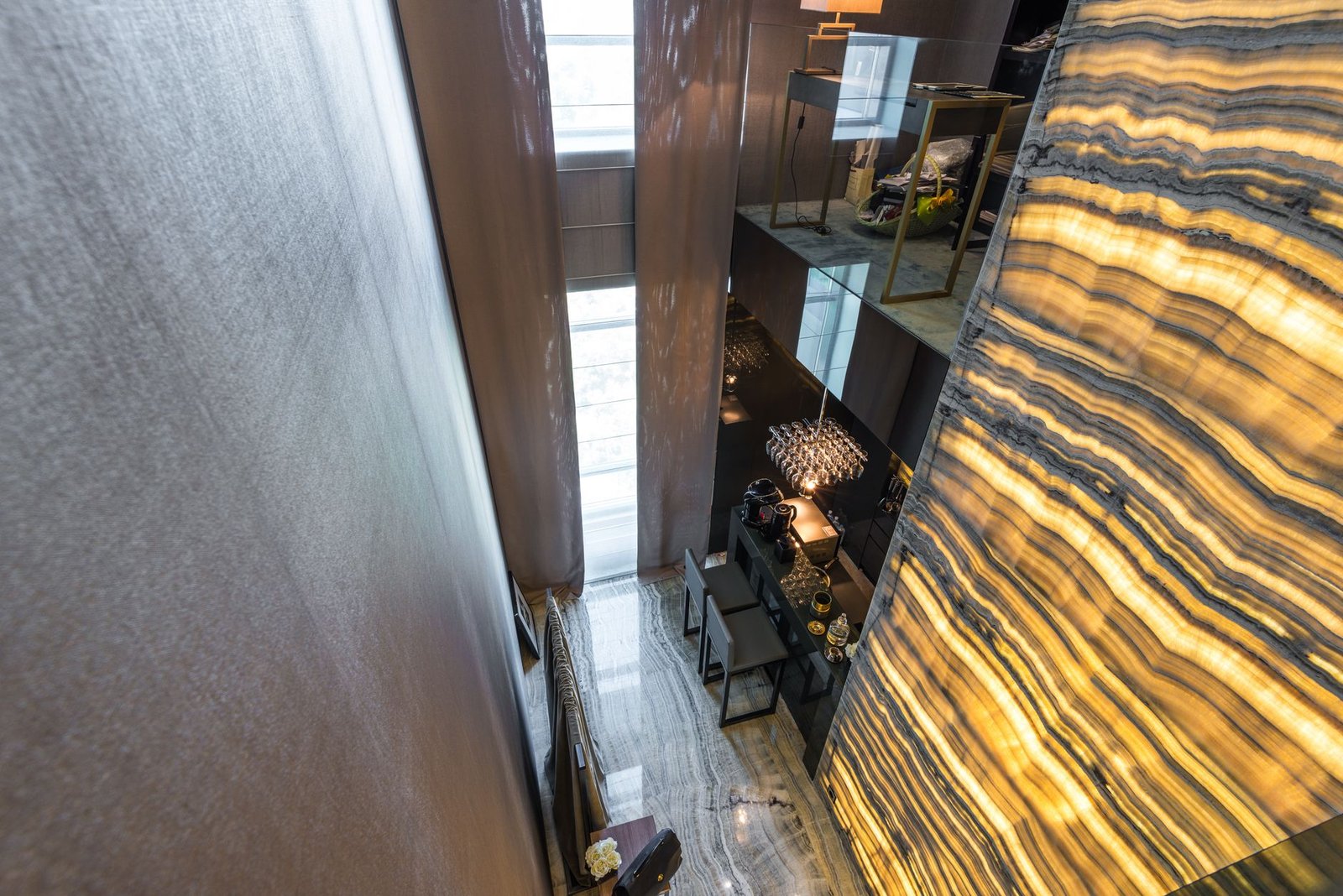
- Ultra-luxury (AED 1,200–2,000+/sqft): Onyx, semi-precious stone feature walls, gold-leaf ceiling details, bespoke furniture from international makers, full home-automation integration, dedicated interior design project management.
Interior Design Style Comparison: Dubai 2026
Use this table to quickly compare all eight interior design styles Dubai buyers consider most, by budget, property type and climate suitability, before building your brief.
| Interior Design Style | AED/sqft Range | Best Property Type | UAE Climate Fit |
|---|---|---|---|
| Warm Minimalism | 200–600 | Apartments, modern villas | Excellent |
| Modern Arabic / Contemporary Gulf | 300–900 | Villas, penthouses, majlis | Excellent |
| Biophilic Design | 220–650 | Offices, wellness, homes | Good (solar control needed) |
| Scandinavian / Nordic | 150–450 | Studios, 1–2BR apartments | Good (warm-tone adaptation) |
| Quiet Luxury | 500–1,100 | Premium villas, boutique offices | Excellent |
| Industrial Chic | 150–450 | Studios, creative offices, F&B | Moderate (AC planning critical) |
| Coastal / Mediterranean | 180–600 | Marina, Palm, waterfront | Excellent |
| Maximalist Luxury | 600–2,000+ | Penthouses, ultra-luxury villas | Good (lighting strategy required) |
Interior design costs in Dubai are driven more by specification — material quality, joinery complexity, finish level — than by style label alone. A Scandinavian project with top-grade engineered stone and full bespoke joinery will cost more than a maximalist luxury project executed in mid-range materials. Use the style framework to shape your brief, then let the specification define the budget. For a detailed breakdown of costs by room see our office interior design cost guide and bedroom interior design Dubai 2026 guides.
Not sure which interior design style suits your space?
V Square's designers work with you from concept through to fit-out handover across Dubai and the wider UAE. Tell us about your project — we will recommend the right approach for your brief, budget and timeline.
Request a free consultationFrequently Asked Questions
What is the most popular interior design style in Dubai?
Warm minimalism and modern Arabic are the two most requested interior design styles in Dubai right now. Warm minimalism — clean lines with travertine, oak and linen — suits apartments and modern villas. Modern Arabic blends geometric motifs, arched features and gold tones with contemporary layouts and is especially popular for villas, penthouses and majlis rooms.
How much does interior design cost in Dubai by style?
Industrial and Scandinavian styles are the most budget-friendly at AED 150–350 per sqft. Warm minimalism and biophilic design run AED 200–500 per sqft. Modern Arabic and quiet luxury start around AED 350–900 per sqft. Maximalist luxury for penthouses or villas can reach AED 600–1,500 or more per sqft depending on materials and bespoke joinery requirements.
Which interior design style works best for Dubai's hot climate?
Warm minimalism, biophilic design and modern Arabic all perform well in Dubai's climate. They use light-reflecting palettes that keep spaces feeling cooler, specify heat-resistant natural materials such as travertine and porcelain, and work with the strong Gulf light rather than against it. Heavily dark or all-glass maximalist schemes need careful lighting design to avoid feeling oppressive in summer.
Can I mix interior design styles in a Dubai home?
Yes, and most successful Dubai interiors do exactly that. A common blend is a warm minimalist base with modern Arabic accents — mashrabiya-inspired screens, geometric tile borders or a statement brass light fitting. The key is choosing one dominant style and one accent style, then keeping the material palette consistent throughout to avoid a disjointed result.