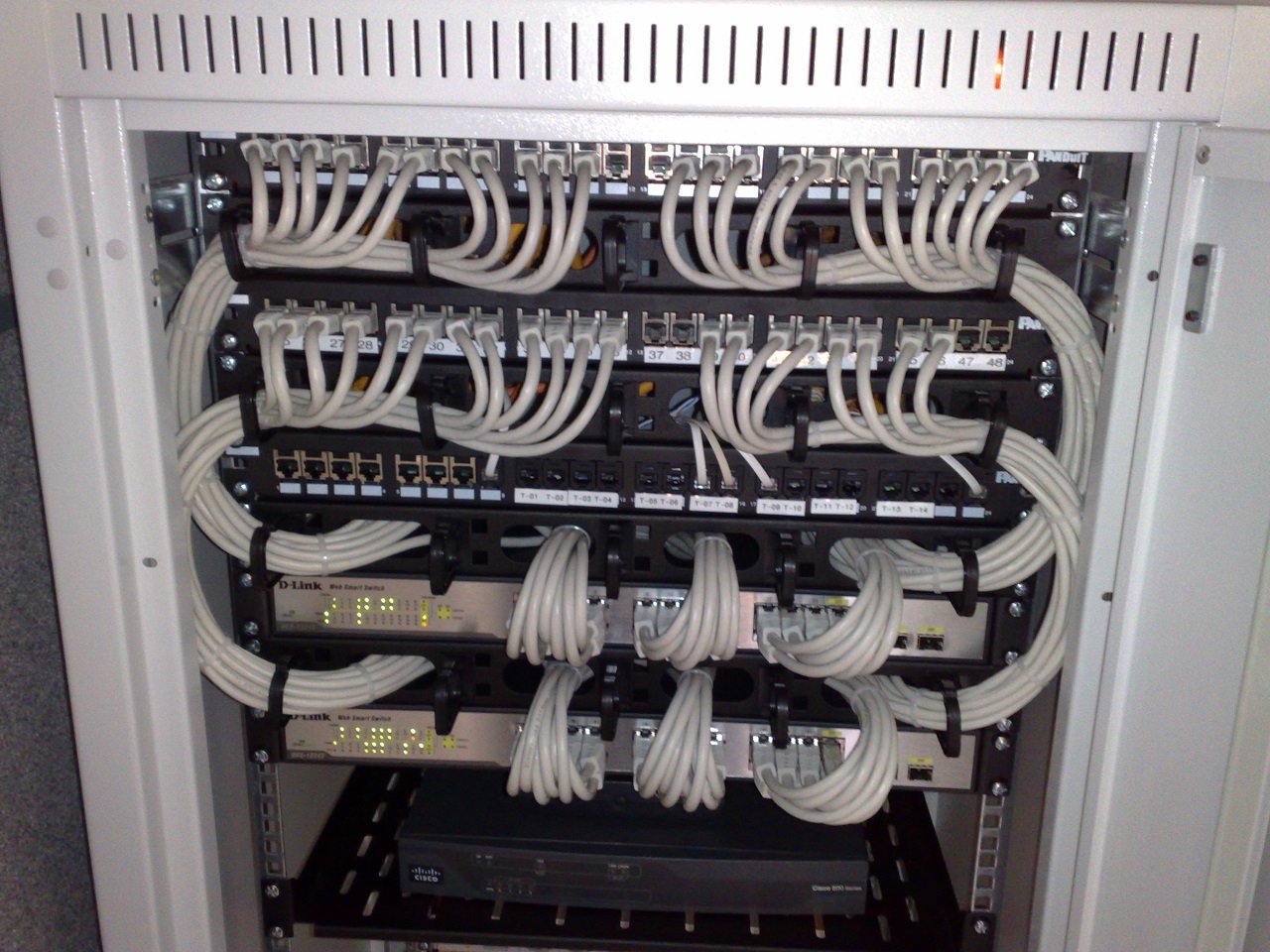
A tenant's local cabling cabinet: patch panels and switches, the termination point for every horizontal Cat6/Cat6A run on the floor. Photo: Dsimic, Wikimedia Commons, CC BY-SA 4.0.
Structured cabling is the one fit-out trade almost nobody budgets properly for until the internet doesn't work on move-in day. Unlike a partition wall or a ceiling grid, a network's physical layer is invisible once the ceiling closes — which is exactly why mistakes made during first fix stay hidden until an operator engineer opens the cabinet weeks later and rejects the connector, or until the office is full of staff and a 10-Gigabit link is quietly running at a fraction of its rated speed. A well-run structured cabling fit out dubai project is planned at the same time as the civil and MEP works, not bolted on in the final week before handover.
The rules exist because a commercial building's data network touches three separate parties with three separate standards: the land authority that licenses the physical works, the TDRA that licenses the installer, and the telecom operator — du or Etisalat — that has to actually accept the cabling before it will activate a live connection. Getting the connector type, the fire-stopping and the containment design right the first time is materially cheaper than a rejected cabinet coming apart for rework after the ceiling is already closed.
This guide sets out what a structured cabling fit out dubai project actually covers, who approves it, the ANSI/TIA-568 testing standard that proves it works, how to choose between Cat6, Cat6A and fibre, what it costs per data point and by office size in 2026, and the most common reasons an installation fails the operator's acceptance test. For the wider budget this sits inside, see our guide to office fit-out cost in Dubai, and for how it is sequenced against the rest of the trades, see our guide to MEP coordination on a UAE fit-out.
What a Structured Cabling Fit-Out Covers
A commercial structured cabling installation is a highly engineered subsystem of a building's wider MEP infrastructure, not a bundle of loose cables run by whoever is free that day. A properly scoped structured cabling fit out dubai project addresses three physical layers in sequence: the backbone, the tenant's own termination cabinet, and the horizontal runs to every outlet.
Usually on the building's ground floor or basement. du and Etisalat terminate their incoming multi-core fibre here, on the operator's own optical distribution frame. No tenant-side changes happen in this room without the operator's and building management's direct supervision.
The tenant's own server rack or wall-mounted cabinet. Houses the fibre patch panel (LIU) fed from the MTR, copper patch panels, the active switches and routers, and a UPS. Every horizontal cable in the office terminates here.
RJ45 faceplates at desks, wireless access points, IP cameras and VoIP handsets — the horizontal Cat6/Cat6A copper run from the LCC to each individual outlet, capped at 90m for the permanent link.
The Backbone: Copper vs Fibre Optic Media
The backbone connects the building's MTR to the tenant's own cabinet, and on a modern structured cabling fit out dubai project it is almost always fibre rather than copper. Single-mode fibre (OS2) uses a narrow ~9-micron core that carries a single light path with virtually no modal dispersion, which is why it is the mandatory medium for the primary operator link and for backbone runs between floors. Multi-mode fibre (OM3/OM4) uses a larger ~50-micron core and multiple light paths; it works well for short, high-bandwidth links inside a single server room but is rarely accepted as the primary operator link. Copper voice backbones (Cat3/Cat5e) are effectively obsolete on a new Dubai fit-out, replaced by VoIP running over the same fibre-fed data network.
The Tenant's Local Cabling Cabinet
Inside the leased office, the Local Cabling Cabinet — the server rack, data cabinet or intermediate distribution frame — is the central termination point for every horizontal run. It holds the copper patch panels that horizontal Cat6/Cat6A cables terminate onto, the fibre patch panel (LIU) that the backbone from the MTR lands on, the active switches, routers and firewall, and a UPS to ride through power fluctuations. For anything beyond a small office, the cabinet needs its own dedicated, well-ventilated space with independent cooling — active equipment overheats fast in a closed cupboard during a Dubai summer.
Dubai Regulatory Framework and Approvals
Navigating approvals for a structured cabling fit out dubai project means satisfying three separate authorities before a single cable is live: the land authority, the TDRA, and the operator itself. Skipping any one of them does not save time — it just moves the delay to the point where the operator refuses to activate the line.
Dubai Municipality, DDA/Trakhees and TDRA
Any physical modification to a commercial unit — including low-voltage containment and data cabling — needs approval from Dubai Municipality on the mainland, or the relevant free zone authority (the DDA in TECOM zones, Trakhees in DP World zones) elsewhere. On top of that land-authority approval, the physical installation itself must be carried out by a TDRA-licensed telecommunications contractor: the Telecommunications and Digital Government Regulatory Authority regulates all telecom infrastructure in the UAE, and an unlicensed installer cannot sign the compliance certificate the operator needs to connect the office to the public network. Our guide to the DDA fit-out approval process covers the equivalent building-permit route for TECOM free zones that a cabling scope has to sit inside.
du vs Etisalat (e&): the Connector Distinction That Fails Inspections
Two licensed operators serve Dubai — du and Etisalat (rebranded e&) — and while both deliver fibre-to-the-office connectivity, their physical termination standards are genuinely different, not just cosmetically different. Getting this wrong is the single most common reason a structured cabling fit out dubai project fails its first operator inspection.
| Parameter | du Specification | Etisalat (e&) Specification |
|---|---|---|
| Connector type | LC/APC — small 1.25mm ferrule | SC/APC — standard 2.5mm ferrule |
| Coupling mechanism | Snap-in / latch | Push-pull |
| Polish | Angled (APC), 8° | Angled (APC), 8° |
| Colour code | Green body | Green body |
Both are angled-polish (APC) connectors, coloured green, and both are frequently confused with the flat-polish UPC connector used on non-operator fibre links — that confusion, not the du/Etisalat distinction itself, is what actually causes most rejected handovers. Mating an APC ferrule against a UPC ferrule leaves an air gap at the join, which spikes optical return loss and can damage the operator's own transmitter equipment. Confirm which operator serves the building, and therefore which connector the fit-out's fibre contractor needs to terminate to, before ordering patch cords.
Containment, Risers and Fire-Stopping
The physical routing of cabling through a commercial building is governed by civil defence and engineering codes, not left to the electrician's judgement:
- Riser fire-stopping. Every floor-slab penetration a backbone cable passes through must be sealed with certified intumescent firestop sealant, pillows or collars, to stop the riser acting as a chimney for fire and smoke.
- Cable tray covering. Trays in publicly accessible areas, or below 4.8m from finished floor level, must be fully covered with sheet-metal lids.
- Accessibility in common areas. Trays through corridors and shared ceilings must stay reachable — access hatches or lay-in tiles, never permanently sealed behind solid gypsum — so future cable additions don't mean opening a ceiling.
- Separation from power. A minimum 150mm gap between data containment and high-voltage electrical containment is standard practice, to keep electromagnetic interference off the data pairs.
Before du or Etisalat will activate a connection, the entire cabling system also has to pass the operator's own physical inspection against their quality checklist — bend radii, cable tension, patch-panel grounding and permanent labelling all get checked before a fusion splice is made.
The ANSI/TIA-568 Standard and Certification Testing
A link light on a switch proves almost nothing. Confirming that an installation can actually carry high-speed data without packet loss over its rated life needs the whole system tested and certified against an international standard, and on a structured cabling fit out dubai project that standard is ANSI/TIA-568.
TIA-568.2-D governs balanced twisted-pair (copper) cabling and TIA-568.3-D governs optical fibre. Together they define two test configurations: the permanent link — the horizontal cable, wall outlet and patch panel connection, capped at 90 metres — and the channel, which adds the patch cords at both ends and is capped at 100 metres overall. The permanent link is the more important test for a cabling contractor, since it is the part actually installed behind walls and under floors and cannot easily be redone once civil works close in around it.
What Gets Tested
- Wire mapping — confirms all eight conductors land on the correct pins at both ends, catching opens, shorts, reversed, split or transposed pairs.
- Insertion loss (attenuation) — measures signal strength lost over the run; usually driven by excess length or poor terminations.
- Near-end crosstalk (NEXT) and power-sum NEXT — measures how much signal leaks between pairs, which is exactly what over-untwisting a pair at termination causes.
- Return loss — measures signal reflected back toward the transmitter from impedance mismatches, commonly from kinks or excessive pulling tension.
Certification runs through a calibrated field tester — a Fluke DSX-8000 CableAnalyzer or an IDEAL LanTEK are the two names that come up on almost every UAE commercial project — which produces an automated pass/fail report for the exact cable category being tested, and every point on a structured cabling fit out dubai project should have its own PDF report on file, not a single summary line for the whole floor.
| Test parameter | Typical Cat6A permanent-link result | TIA limit | Outcome |
|---|---|---|---|
| Length | 42.3 m | 90.0 m max | PASS |
| Insertion loss | 12.1 dB | 31.1 dB max | PASS |
| NEXT (worst pair) | 48.2 dB | 41.8 dB min | PASS |
| Return loss | 21.5 dB | 18.0 dB min | PASS |
The handover package a tenant should insist on receiving includes as-built drawings labelled to the TIA-606 standard, the raw and PDF certifier reports showing a pass on every single link, and the manufacturer-backed system warranty — commonly 15 to 25 years — which most cable manufacturers (CommScope, Panduit, Excel, Legrand) only issue once a certified installer has submitted the actual test data, not just an invoice.
Cat6 vs Cat6A vs Fibre Optic Comparison
Media selection is one of the highest-leverage decisions in the design phase, because it is one of the few fit-out elements genuinely expensive to change once the ceiling is closed. Category 6 has been the commercial default for two decades, but Category 6A is now the practical baseline for a new structured cabling fit out dubai project, for three concrete reasons rather than just future-proofing marketing.
First, bandwidth over distance: Cat6 supports 10 Gigabit Ethernet only up to roughly 37-55 metres under good conditions, while Cat6A holds a full 10 Gigabit over the entire 100-metre channel. Second, alien crosstalk: Cat6A's thicker insulation and tighter twists resist the electromagnetic interference that builds up between adjacent cables bundled tightly in a shared tray, where Cat6 is materially more exposed. Third, and increasingly the deciding factor in a modern office, is PoE: Wi-Fi 6E/7 access points, IP cameras, access-control readers and even PoE-driven lighting now routinely draw PoE+ (30W) or PoE++ (60-90W), and the heat that generates inside a bundled cable run is dissipated far better by Cat6A's larger 23 AWG conductor than Cat6's 24 AWG.
Fibre is not a replacement for horizontal copper to the desk — it is the right choice for inter-cabinet backbone links on a multi-floor or very large single-floor office, for routing through high-EMI zones such as plant rooms or near lift motor shafts, and for keeping the uplink able to scale from 10 Gbps toward 40/100 Gbps without a full recable later.
| Parameter | Cat6 | Cat6A | Single-mode fibre (OS2) | Multi-mode fibre (OM4) |
|---|---|---|---|---|
| Max data rate | 1 Gbps to 100m / 10 Gbps to ~55m | 10 Gbps to full 100m | 100+ Gbps, 10km+ | 40/100 Gbps, 150-400m |
| Operating frequency | 250 MHz | 500 MHz | N/A (optical) | N/A (optical) |
| Conductor / core | 24 AWG | 23 AWG | 9-micron core | 50-micron core |
| PoE compatibility | Up to PoE+ (30W) | Full PoE++ (90W) | None (non-conductive) | None (non-conductive) |
| Alien crosstalk resistance | Moderate | High | Immune | Immune |
| Typical use | Legacy voice, basic points | Desks, Wi-Fi APs, PoE | Operator/backbone link | Switch-to-switch, SAN |
2026 Cost per Data Point in AED
The most common budgeting mistake on a structured cabling fit out dubai project is comparing a bare cable-pull-and-termination quote against a fully certified, documented, turn-key one — the two numbers can differ by two to three times for what looks like "the same" data point.
A fully realised data point cost bundles five things: the materials (LSZH low-smoke-zero-halogen cable as Dubai Civil Defence requires, the RJ45 keystone, faceplate and patch cords), the containment pathway (GI trunking, cable tray, conduit or under-floor trunking), the labour to pull, dress and terminate it, the Fluke or LanTEK testing and certification, and the as-built/TIA-606 documentation.
| Point type | Basic (AED) | Fully certified (AED) |
|---|---|---|
| Cat6 (UTP), concealed conduit | 150 – 250 | 350 – 450 |
| Cat6A (F/UTP), raised floor | 200 – 350 | 450 – 600 |
| Cat6A (S/FTP), exposed ceiling | 250 – 400 | 550 – 700 |
| Fibre optic drop (SM/MM, LC or SC/APC) | — | 900 – 2,100 |
A basic-tier rate covers only the cable pull and termination through an existing, easily accessible pathway, with no test documentation at all — fine for a like-for-like replacement, risky for a new commercial fit-out with a warranty attached. The fully certified rate is the one that actually gets a manufacturer warranty issued. Containment choice moves the number too: raised-floor systems are the cheapest and fastest to install, concealed gypsum-ceiling runs cost more in labour because of restricted access, and fully exposed industrial-ceiling containment — increasingly common in creative offices — adds 20-35% because every visible cable tray and conduit has to be dressed and painted to a design finish, not just functional.
Total Project Cost by Office Size
Project-level budgets for a structured cabling fit out dubai scope scale non-linearly, because the server room, core switching and operator handover carry fixed costs regardless of desk count.
30-80 data points, Cat6/Cat6A UTP, a small 9U-12U wall cabinet with a single 24/48-port switch. Cost driven mainly by ceiling access and distance from the riser to the cabinet.
80-250 points, shielded Cat6A F/UTP, a floor-standing 42U rack with fibre LIUs, managed PoE+ switches and a UPS. Floor count and dedicated cooling are the main cost drivers.
250+ points, fully shielded Cat6A plus an OM4/OS2 fibre backbone across multiple IDF cabinets, raised flooring, precision cooling, gas suppression and dual-feed UPS redundancy.
These figures cover the cabling scope alone. Wider technology integration — cabling plus AV, IP CCTV, biometric access control and smart lighting/BMS controls — typically adds a further AED 50-200 per square foot on top, and needs the same MEP coordination discipline covered in our MEP coordination guide to keep power and data containment properly separated. Where a server room is part of the scope, see our dedicated guide to server room fit-out in Dubai for suppression and cooling requirements, and where the office sits on a technical floor, our raised access flooring guide covers the void depth and load-class choices that affect how cable trays route underfoot.
Step-by-Step Fit-Out Programme and Timeline
A structured cabling fit out dubai project has to sit inside the master construction programme at exactly the right point — too early and first-fix cabling risks damage from ongoing civil works, too late and the ceiling is already closed over an unrun containment route.
Site survey for EMI sources and existing containment, schematic design and drop schedule, DM/DDA approval submitted.
GI trunking and cable trays installed, raw Cat6A/fibre pulled at ≤110N tension, 150mm clearance kept from power runs.
Terminate RJ45 jacks and patch panels once painting/ceiling work is largely done to limit dust; pairs untwisted to ≤13mm.
Fluke DSX-8000 permanent-link testing on every copper point; OLTS/OTDR testing on every fibre link; labelling applied.
du/Etisalat inspect the LCC and backbone fibre, verify the correct APC connector type, fusion-splice and activate service.
Common Reasons a Cabling Installation Fails Operator Acceptance
Most failures in a structured cabling fit out dubai project trace back to a handful of avoidable, recurring errors rather than genuinely difficult technical problems.
- Incorrect fibre connector polish. Terminating with flat-polish UPC connectors instead of the angled-polish APC connectors du and Etisalat require leaves an air gap at the mating point, causing high optical return loss the operator's test will not pass.
- Unsealed riser penetrations. Dubai Civil Defence enforces fire-stopping at every floor-slab penetration; an unsealed riser blocks the Fit-Out Completion Certificate for the whole floor, not just the telecom scope.
- Inaccessible or overfilled cable trays. Trays sealed behind solid gypsum with no access panel, or filled beyond roughly 40% of rated capacity, get rejected on sight by facilities management.
- Bend-radius violations. Pulling copper around a tight drywall corner or fibre into a shallow floor box below the minimum bend radius (4x diameter for copper, 10-20x for fibre) causes impedance mismatches or macro-bending that fails testing outright.
- Power/data containment run together. Sharing a trunking compartment with high-voltage cable, rather than keeping the 150mm separation, introduces electromagnetic interference that shows up as intermittent packet loss long after handover.
- Missing certification documentation. An installation that "works" on a link light but has no Fluke/LanTEK pass report per point cannot get a manufacturer warranty registered, leaving the tenant with an uninsured physical layer.
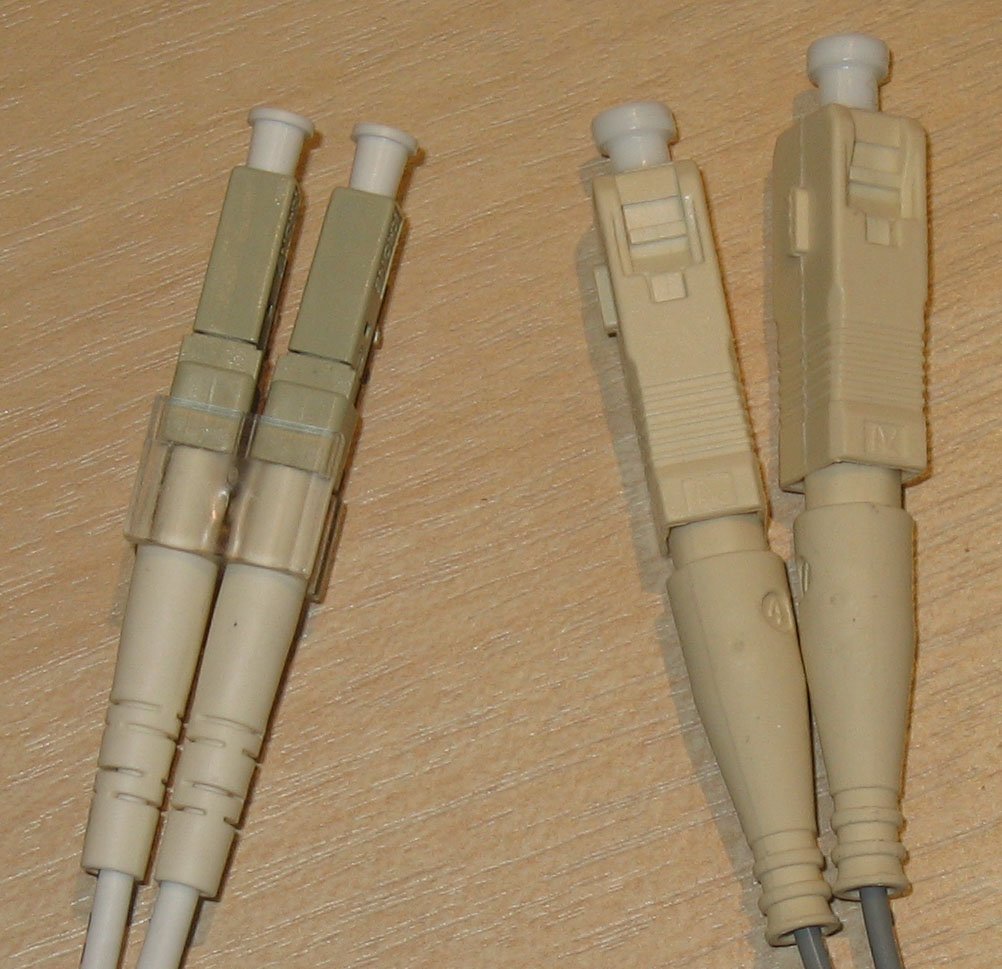
LC connectors (left) use a 1.25mm ferrule and snap-in latch; SC connectors (right) use a 2.5mm ferrule and push-pull coupling — the physical difference behind the du/Etisalat connector rule. Photo via Wikimedia Commons, CC BY-SA 3.0.
How V Square Runs a Structured Cabling Fit-Out
At V Square Project Management Services, we treat a structured cabling fit out dubai scope as a parallel-track engineering discipline from week one, coordinated directly against the civil, electrical and HVAC programme rather than left to a subcontractor working in isolation behind a closing ceiling. Our team confirms which operator serves the building and specifies the correct LC/APC or SC/APC connector before a single patch cord is ordered, and every containment route is checked against the 150mm power-separation rule before first fix begins.
We test and certify every copper and fibre link ourselves with calibrated Fluke DSX-8000 equipment, so the handover package — as-built drawings, TIA-606 labelling, per-point pass reports and the manufacturer warranty registration — is ready the day the operator activates service, not chased down weeks later.
To plan a compliant, correctly specified structured cabling fit out dubai project alongside the rest of your commercial fit-out, visit our fit-out services page or contact our Dubai office to schedule a technical design review.
Planning a Structured Cabling Fit-Out in Dubai?
V Square specifies the right connector standard for your operator, sequences containment and first fix against the rest of your programme, and certifies every link to TIA-568 before handover.
Book a Consultation →Frequently Asked Questions
What is the main difference between du and Etisalat requirements for structured cabling?
Both operators deliver high-speed fibre connectivity, but their physical connector specifications at the demarcation point differ. du typically mandates LC/APC (green, small-form) fibre connectors, while Etisalat (e&) specifies SC/APC (green, standard-size) connectors. Terminating a structured cabling fit out dubai project with the wrong connector type will fail the operator's acceptance test and block service activation.
Why is Cat6A preferred over Cat6 for a commercial fit-out in Dubai?
Cat6A supports a full 10 Gigabit Ethernet channel over the entire 100-metre length, where Cat6 is only reliable for 10 Gigabit up to roughly 37-55 metres. Cat6A's thicker 23 AWG conductors also dissipate heat better under high-wattage PoE++ loads (up to 90W) for Wi-Fi 6E/7 access points and IP cameras, and resist alien crosstalk far better than Cat6.
Is Dubai Municipality approval required for structured cabling and data network fit-out work?
Yes. Any physical modification to a commercial unit, including low-voltage containment and data cabling, needs approval from Dubai Municipality or the relevant free zone authority such as the DDA or Trakhees. The installer must also be TDRA-licensed, and fire-stopping at every riser penetration is enforced by Dubai Civil Defence before a Fit-Out Completion Certificate is issued.
What does a structured cabling fit out dubai project cost per data point in 2026?
A basic copper point with no testing documentation starts around AED 150-250. A fully installed, tested and TIA-606 documented Cat6A point realistically runs AED 350-700 depending on containment type. A certified single-mode fibre drop costs roughly two to three times a copper drop because of the termination and OTDR testing precision it demands.
What is the ANSI/TIA-568 standard and why does it matter?
ANSI/TIA-568 defines the design, termination and testing limits for structured cabling — the permanent link (up to 90m) and the full channel including patch cords (up to 100m). A calibrated field certifier such as a Fluke DSX-8000 tests wire mapping, insertion loss, crosstalk and return loss on every point, and a pass on all of them is what a manufacturer's system warranty is conditioned on.
What handover documents should a cabling contractor provide?
A complete handover package includes as-built drawings with TIA-606 labelling for every data point, the raw and PDF Fluke certification reports showing a pass on every copper and fibre link, and the manufacturer-backed system warranty certificate — only issued once the certified test data is submitted to the cable manufacturer.
How long does a structured cabling fit out dubai project take?
A small office of 10-30 desks typically needs 1-2 weeks for physical installation, testing and certification. A medium-to-large office of 30-100+ desks generally needs 4-6 weeks, sequenced around ceiling closing, painting and the du or Etisalat operator handover.
Can data cables share a conduit with electrical power cables?
No. Running data cables in the same trunking compartment as high-voltage power cables breaches both the TIA-568 standard and standard UAE electrical practice, since the power cable's electromagnetic field induces interference on the data pairs. A minimum 150mm separation between power and data containment is the standard design rule on a structured cabling fit out dubai project.
Note on sources. Regulatory routes, du/Etisalat connector and MTR requirements, TIA-568 testing parameters and indicative 2026 AED cost figures are summarised from current UAE structured-cabling contractor and telecom-operator guidance, since neither operator nor the TDRA publishes a single consolidated public cost tariff. Fees, exact technical requirements and per-point pricing vary by building, operator and contractor, and change without a public changelog. Confirm current requirements with TDRA, du or Etisalat before relying on any figure for budget or programme purposes.