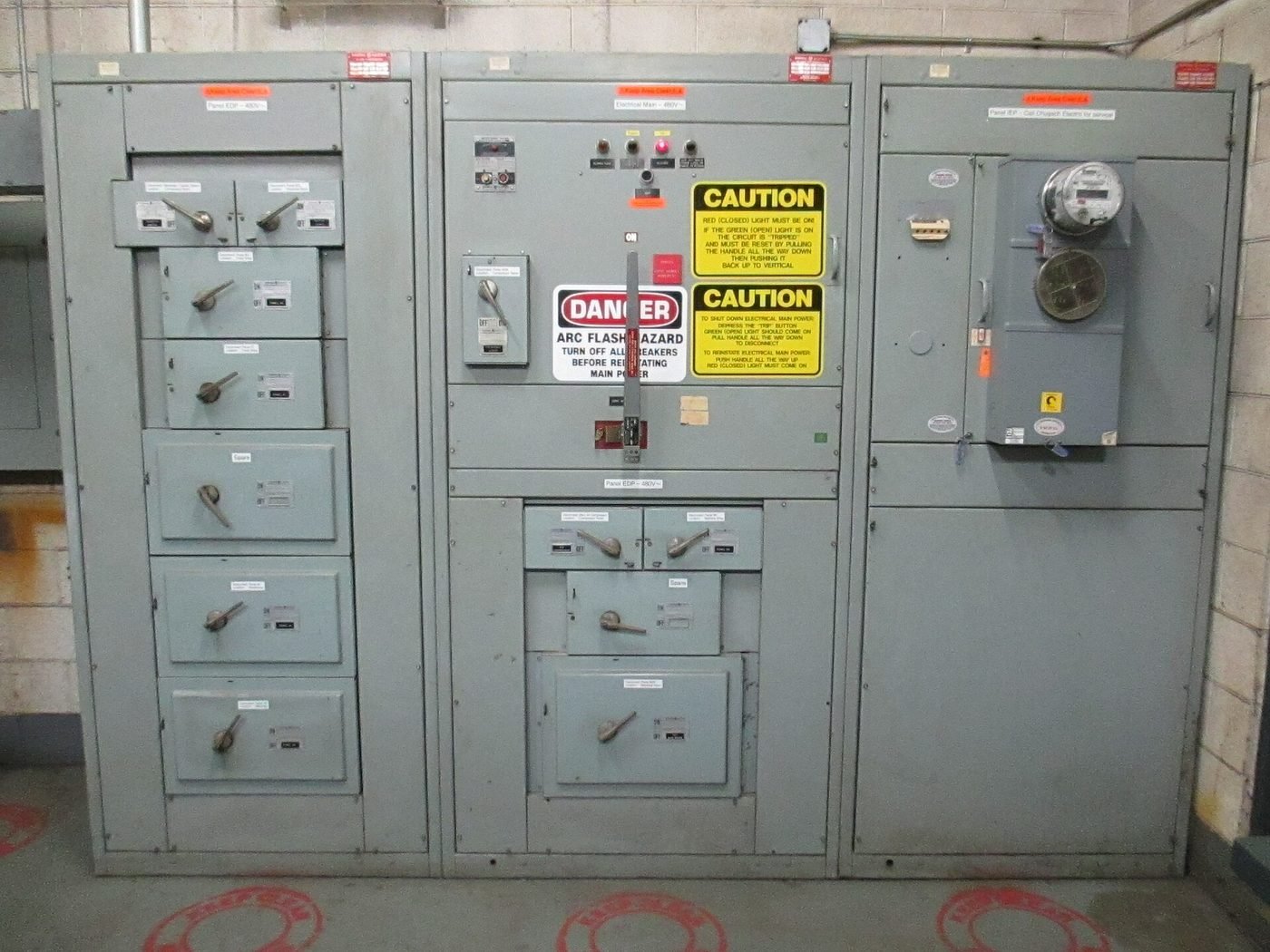
The MDB is where a load upgrade lands physically: incomer rating, busbar capacity and outgoing ways all have to carry the new demand. Photo: Zaereth via Wikimedia Commons, CC BY-SA 4.0.
A fit-out budget usually breaks in one of two places. The first is Civil Defence. The second is power. And of the two, power is the more expensive surprise, because a failed inspection costs you weeks while an unavailable electrical load can cost you the unit entirely.
The pattern is always the same. A tenant signs a lease on a shell or a Category A office, the designer produces a scheme, the MEP consultant totals the equipment, and the number that comes back is larger than what DEWA has sanctioned against that meter. At that point the project needs an additional load application, and the DEWA load upgrade cost becomes a live line item that nobody priced. This guide sets out what that line item actually contains, what triggers each tier of it, and how to find out where you stand before the lease is signed rather than after the joinery is ordered.
What a DEWA Load Upgrade Actually Is
DEWA does not call it an upgrade. In the regulations it is an additional load application, and it is not optional. Clause 1.14 of the DEWA Regulations for Electrical Installations, 2017 Edition is direct about it: the consumer shall not make any extensions or alterations to their electrical installation without obtaining prior approval from DEWA, and the application for getting electricity for additional load or modification shall be made online for every project or installation whatsoever, large or small, new or additions.
Two things follow from that wording, and both matter commercially.
First, there is no de minimis. A small workshop adding a three-phase machine is caught by the same clause as a tower adding a chiller. The scale of the works changes the cost, not the obligation.
Second, the approval is a precondition, not a formality to be caught up on later. Energising an installation that draws more than its sanctioned load without approval puts the consumer on the wrong side of the regulations and, more practically, puts the project's final connection and any handover certification at risk. It is not a risk worth taking to save three weeks.
The Two Numbers That Decide Everything
Every conversation about a load upgrade comes down to a comparison between two figures, and the gap between them is the entire project.
Sanctioned load is what DEWA has already approved and provisioned for that premise. It is a property of the meter and the supply arrangement, not of your tenancy, and it was set by whoever built or last upgraded the unit — often for a completely different use.
Maximum demand is what your installation will actually draw at its busiest, after diversity is applied to the total connected load. Connected load is the arithmetic sum of everything you install; maximum demand is the realistic simultaneous draw. On a restaurant these two numbers can differ by 40 per cent, because the extraction, the combi ovens and the standby refrigeration do not all peak together.
The application is simply the case you make that the gap between the sanctioned load and your new maximum demand is real, justified and safely supported by the network. Get the diversity assumptions wrong in either direction and the application comes back — too aggressive and DEWA does not believe it, too conservative and you have just bought yourself a feeder upgrade you never needed.
How to Find the Sanctioned Load Before You Design Anything
This is the single highest-value hour on a fit-out programme, and it costs nothing.
- Ask the landlord for the unit's sanctioned load in writing. Not "roughly", not "should be fine" — a figure in kW, and the incoming feeder rating in amps. A building with a properly managed fit-out guide will have this to hand.
- Ask what spare capacity remains at the floor or riser. A building can have sanctioned capacity on paper that has already been allocated to other tenants. The busbar tap-off serving your floor has a rating of its own.
- Read the existing MDB. The incomer rating stamped on the main breaker tells you the practical ceiling of the current arrangement in about ten seconds.
- Pull the DEWA account details for the premise number. The meter type and the account's load registration are the authoritative record; the landlord's memory is not.
- Get it into the heads of terms. If the deal depends on 120 kW being available, the availability of 120 kW belongs in the lease, not in an email.
We treat this as a gate in our own fit-out project management process: no concept design is signed off until the sanctioned load is confirmed in writing. It has killed two deals for clients and saved them both a great deal more than it cost.
The Feeder Bands That Set Your DEWA Load Upgrade Cost
Electrical capacity is not sold by the kilowatt in a smooth curve. It steps. DEWA's regulations publish, for guidance, the maximum demand permitted at a main distribution board connected to a DEWA supply feeder for normal residential and commercial premises without large motor loads. Those steps are what actually price your upgrade, because staying inside a band is cheap and crossing one is not.
| DEWA supply feeder / transformer | Maximum demand permitted | What this typically serves |
|---|---|---|
| 60 A feeder | 30 kW | Small retail unit, kiosk, single-tenant office suite |
| 100 A feeder | 50 kW | Mid-size shop, small clinic, compact office floor |
| 125 A feeder | 60 kW | Salon, small café, showroom with display lighting |
| 160 A feeder | 80 kW | Restaurant with a modest kitchen, dental practice |
| 200 A feeder | 100 kW | Full-service restaurant, gym, medium medical centre |
| 300 A feeder | 150 kW | Large F&B, cloud kitchen cluster, imaging-equipped clinic |
| 400 A feeder | 200 kW | Whole-floor office fit-out, large gym, production kitchen |
| 1000 kVA transformer | 800 kW | Building-level supply; 650 kW where motor / AC loads dominate |
| 1500 kVA transformer | 1200 kW | Building-level supply; 950 kW where motor / AC loads dominate |
Source: DEWA Regulations for Electrical Installations, 2017 Edition, clause 4.7.2 (Maximum Demand), with transformer connected-load limits from the same clause for motor and air-conditioning loads where no individual motor exceeds 100 kW. Application column is V Square's own mapping to typical Dubai fit-out types.
Read that table as a pricing ladder. A design that lands at 95 kW and one that lands at 105 kW look almost identical on paper and are separated by a 200 A to 300 A feeder change — new incomer, potentially new sub-main cable from the riser, revised MDB, revised protection coordination. That is the difference between an upgrade that costs five figures and one that costs low six figures, decided by ten kilowatts.
Which is why the most profitable design review on any fit-out is the one that asks: can we get under the band? Very often the answer is yes, and it costs nothing but attention.
What Actually Eats the Load in a Fit-Out
Clients consistently over-estimate lighting and under-estimate everything mechanical. Since the 2018 tightening of efficiency requirements and the near-total move to LED, lighting design is rarely what breaks a load schedule. Cooling, cooking and motors are.
| Fit-out type | Typical demand driver | Where the load concentrates |
|---|---|---|
| Office | Cooling and small power | FCU / VAV fans, server or comms room cooling, workstation small power, AV in boardrooms |
| Restaurant | Kitchen equipment | Combi ovens, induction ranges, dishwashers, walk-in refrigeration, kitchen extract and make-up air |
| Cloud kitchen | Density | Multiple independent cooking lines and extract systems in a small footprint — the worst load-per-square-foot of any common fit-out |
| Clinic | Diagnostic equipment | Imaging, sterilisers, autoclaves, dedicated UPS, and the redundancy the equipment supplier specifies |
| Gym | Cooling and cardio | High air-change cooling, treadmills and cardio banks, laundry, water heating for showers |
| Salon and spa | Water heating | Instantaneous water heaters, dryers, steam and sauna plant, treatment room cooling |
| Retail | Display and cooling | Accent lighting runs, refrigerated display, entrance air curtains, back-of-house |
| Warehouse and light industrial | Motors | Compressors, dock levellers, process machinery, and the starting current they draw |
The starting-current point in that last row deserves emphasis. The DEWA regulations treat motor loads separately for good reason: a transformer sized comfortably for a steady 800 kW is limited to 650 kW where motor and air-conditioning loads dominate and no individual motor exceeds 100 kW. Where individual motors or chillers exceed 100 kW, DEWA approves the connected load case by case against the equipment specification — rating, starter type, maximum starting current, number of compressors and their staging. A soft starter or a variable speed drive is therefore not just an energy measure; it is sometimes the difference between an approvable scheme and an unapprovable one.
DEWA Load Upgrade Cost: The Full Cost Stack
Here is the honest structure of the bill. DEWA's own charges are the part everyone asks about and the part that matters least; the works triggered by the approval are where the money goes.
| Cost component | Indicative 2026 range | Notes |
|---|---|---|
| MEP consultant load study and DEWA drawing set | AED 3,500 – 12,000 | Load schedule, SLD, MDB/SMDB schedules, cable sizing and voltage drop calculations |
| DEWA-registered contractor submission and liaison | AED 2,500 – 8,000 | Online lodgement, comment responses, resubmission; the tenant cannot submit directly |
| DEWA service charges and deposit adjustment | Per application | Commercial security deposits are calculated from premises load, not flat-rated; larger meters carry higher activation and disconnection service fees |
| MDB replacement or re-rating | AED 18,000 – 60,000 | Driven by incomer rating, busbar capacity, number of outgoing ways and form of separation |
| Sub-main cabling and containment from riser to MDB | AED 200 – 450 per metre | Highly route-dependent; a long horizontal run through occupied floors costs far more than the cable |
| Automatic power factor correction (capacitor bank) | AED 12,000 – 45,000 | Required for commercial premises on service feeders of 200 A and above where individual compensation is not achievable |
| Earthing works | AED 4,000 – 15,000 | Installations with a main incomer of 200 A and above require a minimum of two earth pits |
| Substation provision (above ~400 kW) | Six figures and up | Room, civils, access, ventilation and clearances are the consumer's responsibility — see below |
| Programme cost of the approval itself | 1 – 6 weeks | Frequently the largest real cost; see the timeline section |
DEWA-set items are described qualitatively because DEWA prices connections case by case rather than by published tariff. Money ranges are V Square's observed 2026 market ranges on Dubai fit-out projects and are indicative only — they are not DEWA charges and should not be used in place of a priced quotation.
Set against a whole project, a mid-range load upgrade is often 3–8 per cent of the fit-out value — meaningful, but survivable if it is in the budget from day one. It is catastrophic when it appears in week six, because by then the contract is let, the programme is fixed, and every option is a variation. Whether it arrives as a planned line or a variation is the entire difference, and that is decided during tender and BOQ review, not on site.
The 400 kW Line: When a Load Upgrade Becomes a Substation Project
Clause 3.1.4 of the regulations is the most consequential sentence in this whole subject: in general, where the total connected load exceeds 400 kW, provision shall be made within the building or plot for DEWA's substation, and in some circumstances a substation may be required for connected loads of less than 400 kW. The requirement is confirmed when DEWA issues its No Objection Certificate, which must be revalidated at the end of the period DEWA specifies.
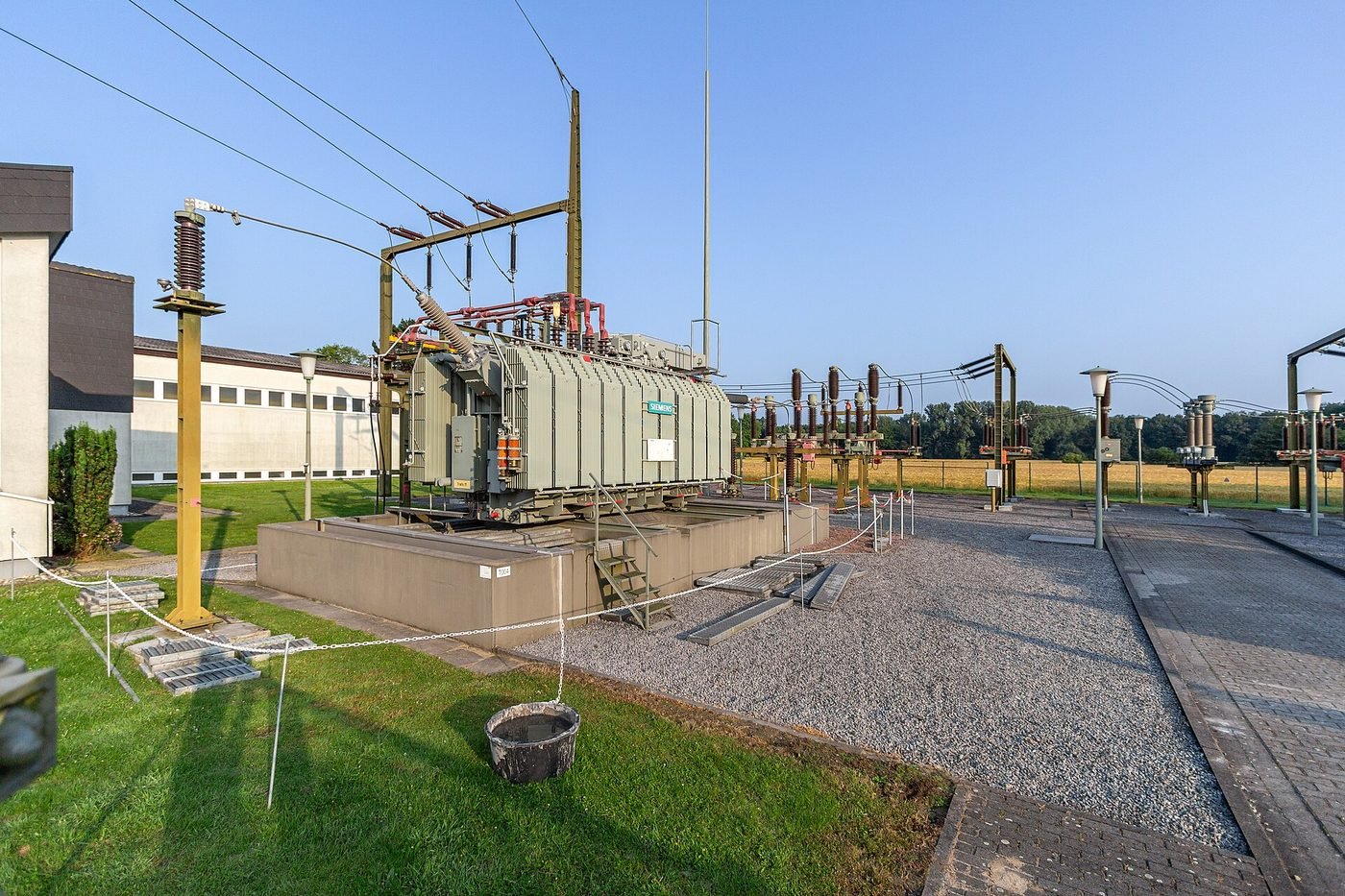
Above roughly 400 kW connected load, the conversation stops being about switchgear and becomes about land, access and civils. Photo: Dietmar Rabich via Wikimedia Commons, CC BY-SA 4.0.
For a tenant fitting out inside an existing tower, this is normally the landlord's boundary rather than yours — the building already has its substation. It becomes your problem in exactly two situations: when your demand pushes the building past its own sanctioned capacity, and when you are fitting out a standalone plot, a warehouse or a villa conversion where there is no existing provision.
If it does land on your project, the regulations set out physical requirements that a designer cannot value-engineer away, and which have to be reflected in the architectural layout from the very first plan:
- Clear height. A single-room substation at ground floor requires a minimum clear height of 3.7 m. An RMU room in a split or basement arrangement requires a minimum of 3.0 m, and a basement transformer room a minimum of 3.0 m.
- Levels. The finished floor level of the substation room must sit 0.15 m to 0.30 m above the adjacent outside ground level on the door side. For a basement transformer room the difference is 0.075 m to 0.15 m.
- Access. The substation or RMU room must be located directly on an RTA or public road, or on a sikka. Where it is on a sikka, that sikka needs a minimum clear width of 6.1 m — reduced to 3.0 m only if the room is less than 12 m from the main road. DEWA requires 24-hour open-to-sky access from the plot limit.
- What cannot sit above it. No wet area is permitted above a substation. Exceptional cases must be referred to DEWA specifically.
- Structure. No expansion joints are allowed in the RMU or transformer room, or in the roof of the room.
- Ventilation. A ground-floor substation must be naturally ventilated with a minimum of two sides of ventilation; basement transformer rooms require adequate independent mechanical ventilation to maintain ambient temperature.
- Sequence. Construction should not commence prior to obtaining the substation approval.
That last bullet is the one that turns a technical requirement into a programme catastrophe. A substation is not a late variation you absorb — it is a precondition to starting. If it emerges mid-design, the honest advice is usually to stop, re-plan and re-baseline rather than to push on and hope.
Documents DEWA Expects With an Additional-Load Application
Applications are lodged online by a DEWA-registered consultant or contractor. A complete package for a commercial fit-out normally contains:
- Trade licence and tenancy contract or Ejari for the premises
- Landlord or building NOC, and the developer NOC where the community requires one
- Existing DEWA account number and premise number, matched exactly to the tenancy
- Electrical load schedule setting existing sanctioned load against proposed connected load and calculated maximum demand — the comparison is the heart of the submission
- MDB and SMDB schedules, final DB load distribution, and the diversity assumptions stated explicitly rather than buried
- Single line diagram, with protection coordination and relay settings where a substation or MV equipment is involved
- Electrical room and equipment layouts, and the setting-out plan with meter location indicated
- Cable sizing and voltage drop calculations
- Power factor correction details where the feeder is 200 A or above
- Approved architectural layout, consistent with the drawings already lodged for the DM, DDA or Trakhees fit-out permit
The consistency requirement in that final line causes more delay than any single missing document. DEWA, Dubai Municipality and Civil Defence are looking at versions of the same building. If the electrical room grew by 400 mm to fit a bigger MDB and only the DEWA set was updated, one of the other authorities will find it.
The Approval Sequence and a Realistic Timeline
Confirm sanctioned load, spare riser capacity and existing feeder rating in writing. Before design, not after.
Freeze the equipment schedule, then build the load schedule and maximum demand calculation from it.
Test the design against the feeder table. If you are 5–10% over a step, redesign before you submit.
Registered consultant or contractor lodges online, in parallel with the DM and DCD permit route.
Answer DEWA comments in one consolidated resubmission rather than in drips.
Install to the approved scheme, pass inspection, then activation typically follows within 24–48 hours.
| Application type | Realistic duration | What drives the variance |
|---|---|---|
| Small, simple load increase | 3 – 7 working days | Completeness of the first submission |
| Connection up to 150 kW | 2 steps, ~5 days | DEWA supports this where service conditions and requirements are fully met |
| Medium commercial fit-out (shop, office, restaurant) | 1 – 3 weeks | Diversity justification, landlord NOC, drawing consistency |
| Large or technically complex | 3 – 6 weeks | Transformer capacity checks, motor starting studies, MV protection |
| Substation-triggering scheme | Re-baseline the programme | Construction should not commence before substation approval |
| Activation after approval | 24 – 48 hours | Account, deposit and meter readiness |
Note what these durations measure: they start at a complete submission. The three weeks a client remembers as "DEWA took three weeks" is frequently one week of DEWA review and two weeks of the project assembling a document set it should have had ready. That portion is entirely within your control, and it is why the DEWA route belongs on the fit-out programme as a critical-path activity with its own owner rather than as an assumption.
Power Factor and Diversity: Why Applications Come Back
Two technical issues account for most of the returned applications we see, and both are cheap to fix in advance.
Power factor
DEWA requires the power factor of every consumer installation to be within the range of 0.9 lagging and unity. Equipment such as air-conditioning plant and lifts is expected to incorporate integral correction sufficient to maintain 0.95 lagging or above throughout its normal working range. Critically for fit-outs: for commercial premises requiring DEWA service feeders of 200 A and above, where individual compensation is not achievable, an automatic capacitor bank must be provided. For residential premises that limitation applies at 400 A.
If your upgrade takes you from 160 A to 200 A, you have not just bought a bigger feeder — you may also have bought an APFC panel, the space to put it in, and the ventilation it needs. Capacitor banks require forced ventilation and double enclosures to limit temperature rise. That space has to exist on the plan, which is a design decision, not a procurement one.
Diversity
Diversity is where good-faith applications fail. The load schedule applies factors to convert connected load into maximum demand, and those factors must be defensible against the actual equipment. A kitchen schedule that applies a 60 per cent diversity to cooking equipment in a venue that serves a single fixed-time buffet is not credible. Neither is a clinic schedule that diversifies imaging equipment the supplier specifies as continuously energised.
The productive discipline is to write the justification into the submission rather than leaving DEWA to infer it. A one-page note explaining why each diversity factor is what it is turns a query into an approval remarkably often.
Where a Load Upgrade Wrecks the Fit-Out Programme
The cost of a load upgrade, like the cost of an MEP clash, is set almost entirely by when it is discovered.
| Discovered at | Typical consequence | Why |
|---|---|---|
| Before heads of terms | Negotiating position | You can price it into the deal, ask the landlord to fund it, or walk to a better-served unit |
| Concept design | A design decision | Equipment can be re-specified, layouts adjusted, and the scheme kept inside the existing feeder band |
| Detailed design | 2 – 3 weeks and a redesign fee | MEP set is reworked; architectural coordination usually follows |
| Tender / BOQ stage | Rebid or a priced provisional sum | Scope changes after pricing; contractors reprice the electrical package |
| After contract award | Variation plus 3 – 6 weeks | Every change is now a variation at variation rates, with the approval on the critical path |
| On site, at first fix | Ceilings and risers reopened | Containment and sub-main routes were sized for the old load; closed ceilings come back down |
| At inspection or energisation | Handover slips a month or more | No approval, no supply; the rent is running and the business cannot open |
The same upgrade, physically identical in every respect, can therefore be a negotiating chip or a month of lost trading. Nothing about the electrical engineering changes across that table. Only the timing does.
Eight Ways to Reduce Your DEWA Load Upgrade Cost
- Design to the band, not to the number. If the calculation lands at 105 kW against a 100 kW ceiling, spend a day looking for 5 kW before you spend AED 60,000 on a feeder change. It is usually findable.
- Attack the biggest single loads first. One induction range or one oversized water heater frequently accounts for the entire overage. Specification changes are far cheaper than infrastructure changes.
- Use variable speed drives and soft starters on motors. They cut starting current, which is what constrains transformer allocation on motor-heavy schemes.
- Correct power factor deliberately rather than reactively. Specifying equipment with integral correction can keep you below the threshold that forces a full APFC panel.
- Stage the load if the business can. Sanction what phase one actually needs, and design the containment and MDB spare ways so phase two is a straightforward addition rather than a rebuild. This works well on phased office refurbishments.
- Reuse the existing MDB where the busbar allows. Re-rating an incomer and adding ways is materially cheaper than a new board, and is often viable one step up.
- Take the efficiency route seriously. High-efficiency HVAC, LED throughout, and the measures behind a green fit-out reduce both the sanctioned load you need and the bill that follows it, permanently.
- Submit once, completely. The cheapest week on the whole DEWA programme is the one you do not spend on a resubmission.
What to Put in the Budget Before You Sign the Lease
If you take one thing from this guide, make it a pre-lease checklist rather than a cost table:
- Sanctioned load for the unit, in kW, in writing
- Incoming feeder rating in amps, and the spare capacity at the riser or floor
- A first-pass maximum demand estimate for your intended use, even a rough one
- The gap between those two figures, and which side of a feeder band it puts you on
- Written confirmation that the landlord will issue an NOC for a load increase if one is needed
- A budget allowance sized to the tier you are realistically in, not the tier you hope for
- The DEWA route shown on the programme as a critical-path item with a named owner
None of that requires a full design. It requires an afternoon, an MEP engineer's opinion and a landlord willing to put numbers in an email. On a project where the DEWA load upgrade cost turns out to be zero, you have lost an afternoon. On a project where it turns out to be AED 200,000 and a substation, you have found out while you still had the option to say no.
Know your power position before you commit
V Square verifies sanctioned load, models your real maximum demand, and manages the DEWA additional-load route alongside the DM and Civil Defence approvals — so power is a known number in your budget, not a variation in week six.
Request a load feasibility review →Frequently Asked Questions
What is a DEWA load upgrade?
A DEWA load upgrade, formally an additional load application, is DEWA's approval to draw more electrical power at an existing premises than the load already sanctioned against that meter. Clause 1.14 of the DEWA Regulations for Electrical Installations states that a consumer shall not make any extensions or alterations to an electrical installation without prior approval from DEWA, and that the application for additional load must be made online for every installation, large or small. In a fit-out it is triggered whenever the new design demand exceeds what the unit was originally sanctioned for, which is common in kitchens, clinics, gyms, salons and data-heavy offices.
How much does a DEWA load upgrade cost in Dubai?
There is no single fee. The DEWA load upgrade cost is a stack, and on most Dubai fit-outs the DEWA charges themselves are the smallest part of it. A modest upgrade inside the existing feeder capacity is usually an engineering and paperwork exercise costing roughly AED 6,000 to 20,000 in consultant and submission fees plus any deposit adjustment. An upgrade that forces a larger feeder, a new MDB and re-cabling typically lands between AED 45,000 and 150,000 all in. Once the connected load crosses 400 kW and a substation is required, the figure moves into the hundreds of thousands because the civil works, room and access are the consumer's responsibility.
At what load does DEWA require a substation?
Clause 3.1.4 of the DEWA Regulations for Electrical Installations says that in general, where the total connected load exceeds 400 kW, provision shall be made within the building or plot for a DEWA substation, and that in some circumstances a substation may be required for connected loads below 400 kW. The requirement is confirmed in DEWA's No Objection Certificate, which must be revalidated at the end of the period DEWA specifies. For a tenant fit-out inside an existing tower this threshold is normally the landlord's problem rather than yours, but it becomes yours the moment your unit's demand pushes the building past its own sanctioned capacity.
How long does DEWA take to approve a load increase?
Plan on one to three weeks for a typical commercial fit-out load increase, measured from a complete submission rather than from the day you started drawing. Small, simple applications clear in roughly three to seven working days. Large or technically complex cases, including anything touching a transformer or substation, run three to six weeks and sometimes longer. DEWA supports connections up to 150 kW in two steps within five days where the service conditions and requirements are fully met. Once approval is issued, activation generally follows within 24 to 48 hours.
What documents does DEWA need for an additional load application?
A complete additional-load package normally contains the trade licence and tenancy or Ejari, the landlord or building NOC, the existing DEWA account and premise number, an electrical load schedule showing existing sanctioned load against proposed connected load and maximum demand, MDB and SMDB schedules with diversity assumptions stated, a single line diagram, electrical room and equipment layouts, cable sizing and voltage drop calculations, power factor correction details where applicable, and the approved architectural layout. The submission must be lodged online by a DEWA-registered consultant or contractor, not by the tenant directly.
Why do DEWA load applications get rejected?
The two most common technical rejections are diversity and power factor. Applications are returned when the load schedule applies diversity factors that the equipment schedule does not support, so the declared maximum demand looks lower than the installation can actually draw. They are also returned on power factor: DEWA requires the power factor of every consumer installation to sit between 0.9 lagging and unity, and for commercial premises on service feeders of 200 A and above an automatic capacitor bank is required where individual compensation is not achievable. Beyond that, most rejections are administrative: mismatched premise numbers, an expired tenancy, a missing landlord NOC, or drawings that do not match the architectural layout already approved.
Can a landlord refuse a load upgrade?
Yes, and it happens more often than tenants expect. The building has a sanctioned capacity of its own and the landlord allocates it across units. If the riser, the busbar tap-off or the floor distribution board cannot carry your increase, or if the landlord has already committed the spare capacity to another tenant, the NOC will not be issued regardless of what DEWA would otherwise permit. This is why the sanctioned load and available spare capacity should be confirmed in writing before heads of terms are signed, not after the design is complete.
Does a load upgrade change my DEWA bill?
It changes the fixed side of the bill more predictably than the variable side. A higher sanctioned load usually means a larger meter and a higher security deposit, since commercial deposits are calculated from the load of the premises rather than set at a flat rate, and larger meters attract higher activation and disconnection service fees. The energy charge itself still follows consumption, so an upgrade only raises the running bill to the extent you actually use the new capacity. Poor power factor is the exception worth watching, because it inflates the current drawn for the same useful output.