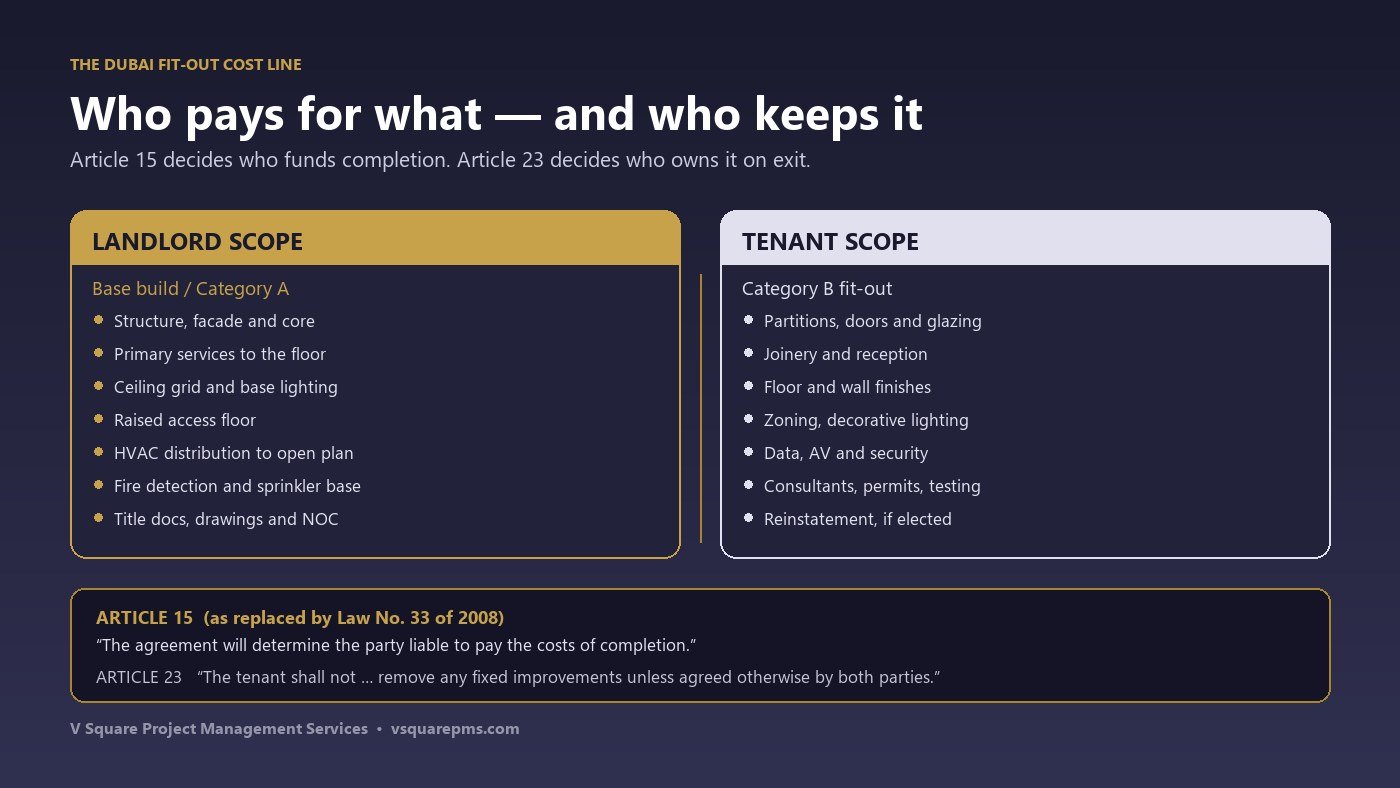
The cost line between landlord scope and tenant scope is the whole negotiation. Diagram: V Square Project Management Services.
Every fit-out budget in Dubai starts with the same optimistic line item: "landlord contribution — TBC." It is written by someone who has read an American commercial real estate blog, where a tenant improvement allowance is a standard part of an office deal and is quoted in dollars per square foot the way rent is. That expectation does not survive contact with the Dubai market, and the disappointment usually arrives at the worst possible moment — after heads of terms are agreed and before the contractor is appointed.
This guide is about what is actually available and how to capture it. A tenant improvement allowance Dubai landlords will sign up to looks nothing like its American namesake, and the gap is structural rather than cultural. It is written for a commercial tenant taking office, retail, clinic, warehouse or F&B space in Dubai, and it deals with the mainland regime under Law No. 26 of 2007 as amended. It covers the statutory position, the four structures a contribution can take, how to size the ask against a real cost plan, the drawdown mechanics that decide whether the money ever reaches you, and the reinstatement liability sitting at the other end of the lease.
What a Tenant Improvement Allowance Means in Dubai
In the American usage the term is narrow: a sum, expressed in currency per square foot, that the landlord pays or credits towards the tenant's build-out, released against invoices, capped, and forfeited if unspent. In Dubai the same commercial idea exists but it is distributed across several instruments and hardly ever carries the label. Ask three Dubai landlords for a tenant improvement allowance and you will get three different structures back, only one of which involves money moving in your direction.
The distinction that matters is not what the contribution is called but where it sits relative to the rent line and when it lands. A landlord who reduces your first-year rent, a landlord who pays your contractor, a landlord who builds your ceiling and raised floor before hand-over, and a landlord who funds everything and charges you 8 per cent more rent for five years are doing four economically distinct things. Only the first two feel like a discount. Only the second and third relieve your capital expenditure. Only the fourth is invisible in the deal summary.
| Structure | What the tenant receives | Who carries the cash risk | How common in Dubai in 2026 |
|---|---|---|---|
| Rent-free fit-out period | One to three months of rent waived, timed to the construction programme | Tenant — still funds the whole build from own capital | The default. Almost always available in some form |
| Cash contribution against certified works | A capped sum released in tranches on certification | Shared — landlord funds a defined slice | Occasional. Needs a weak letting position or a strong covenant |
| Scope transfer into the base build | Landlord completes named elements before hand-over | Landlord — it becomes their construction contract | Realistic. The most under-used route in Dubai |
| Amortised contribution | Landlord funds the works, recovers it through higher rent | Landlord funds, tenant repays with an implicit finance cost | Seen on longer terms. Rarely priced transparently |
The fourth row deserves a warning. An amortised contribution is a loan wearing a lease's clothing. If a landlord offers to fund AED 900,000 of works and adds AED 22,000 a month to the rent over five years, you have borrowed at a rate you should calculate before you accept it. Ask for the amortisation schedule in writing. If none exists, the number was picked, not derived.
The Clause Dubai Law Already Requires and Almost Nobody Uses
The single most useful fact in this entire subject is buried in an amendment. Article 15 of Law No. 26 of 2007 was superseded by Law No. 33 of 2008, and the replacement text does two things. It restates the landlord's basic obligation, and then it adds an express regime for space that is let unfinished.
Read that final sentence again. Dubai law contemplates a lease of incomplete space, requires the tenant to finish it, and then requires the agreement to determine who pays for that completion. That is a statutory instruction to write the cost allocation into the lease. It is the closest thing Dubai has to a tenant improvement allowance provision, and it applies to precisely the situation most commercial tenants are in: shell and core, or a unit stripped back between tenancies.
What this gives you in negotiation is not a right to money. It is a right to the conversation, on the record, at the right time. A landlord's agent who says "we don't do fit-out contributions in Dubai" is answering a question about market practice. The answer to "Article 15 requires this lease to state who bears the costs of completion — what does your draft say?" is a drafting answer, and drafting answers get escalated to someone who can decide. Ask the second question.
Note also what Article 15 does not do. It does not say the landlord pays. It says the agreement determines who pays. A lease that says the tenant bears one hundred per cent of completion costs complies with Article 15 perfectly well. The value of the clause is that silence is not an option — and a landlord forced to write the allocation down is a landlord who has to think about it.
Article 23: You Are Building an Asset You Will Leave Behind
The other half of the frame is the one that determines whether your fit-out has any residual value to you at all.
Article 23 was not among the articles superseded by Law No. 33 of 2008 — that law replaced Articles 2, 3, 4, 9, 13, 14, 15, 25, 26, 29 and 36 — so it stands today exactly as enacted in 2007. The default in Dubai is therefore that fixed improvements stay. Your gypsum partitions, your raised access floor, your feature ceilings, your bonded flooring, your built-in joinery and your hard-wired lighting are, on exit, the landlord's.
This is not an injustice; it is a pricing input. Once you accept that the fit-out is an asset transfer with a delay, three things follow that most tenants work out too late:
- The allowance and the term are the same negotiation. A landlord receiving a fully fitted floor at the end of year three is receiving a lettable asset. That is worth something to them, and it is the strongest argument you have for a contribution.
- The exceptions must be scheduled by name. "Unless agreed otherwise by both parties" is an open door, but only if you walk through it before signing. A removal schedule listing the items you may take — server racks, specialist kitchen equipment, demountable partitions, branded signage, loose and semi-loose furniture — is a two-page annexure that saves a six-figure argument.
- What is "fixed" is decided by how it is installed. The same reception desk is a chattel when it is bolted to a floor plate and a fixed improvement when it is scribed into a plasterboard bulkhead. If you intend to take something, tell the designer at concept stage, not the contractor at handover.
This is one of the reasons a properly structured bill of quantities matters beyond price comparison. A BOQ that separates fixed works from demountable and loose items is the evidence base for the removal schedule you will need in three years.
Article 21 and Article 23 Point in Opposite Directions
Here is a tension almost no lease negotiation in Dubai addresses explicitly, and it is a genuine one.
Article 21 requires the tenant, on expiry, to "return the premises to landlord in the same condition as handed over to him at the time of contracting except, shortages resulting from normal use or for reasons beyond his control." Article 23 simultaneously bars the tenant from removing fixed improvements. If you took a bare shell, built forty linear metres of partitions and a full ceiling, and are then told to return the premises in the condition you received them, you cannot comply with Article 21 without breaching Article 23, and you cannot comply with Article 23 without breaching Article 21.
In practice the contract resolves it, which is exactly why the reinstatement clause is one of the highest-value clauses in a Dubai commercial lease and one of the least read. Three drafting outcomes are common:
Tenant strips back to the hand-over condition at its own cost. The worst outcome: you pay to build it and pay again to remove it, and the landlord keeps neither.
Landlord decides near expiry whether to require reinstatement. Common, and workable only if the notice period is long enough to price and programme the strip-out.
Tenant hands over as-is, subject to a defined condition standard. Cleanest, and the natural counterpart of an Article 23 world. Aim here.
Outcome 2 is where most Dubai leases land, and its danger is the notice period. A landlord election exercisable "at any time prior to expiry" allows a demand for reinstatement three weeks before you vacate, when every fit-out contractor in the city is quoting a premium and you have already committed to your new premises. Negotiate the election down to a fixed date — six months before expiry is defensible — and require it in writing.
If you are handing back a space, the discipline is the same as at practical completion. Run the exit like a snagging and handover process, with a photographic condition record on the day you vacate. The dilapidations argument you avoid is worth more than the survey costs.
What the Civil Code Adds When the Lease Says Nothing
Dubai's tenancy law sits on top of the federal UAE Civil Code, Federal Law No. 5 of 1985, which supplies the general law of lease. Two of its articles get quoted in fit-out disputes, and both are narrower than tenants hope.
Article 767 puts the obligation to repair defects that affect the tenant's use and enjoyment on the landlord, and provides that where such a defect is minor, or urgent and admitting of no delay, and the tenant asks the landlord to repair it and the landlord delays or cannot be contacted, the tenant may carry out the repair and deduct the reasonable expense from the rent due.
Article 768 goes slightly further: if the tenant repairs any item in or on the leased property which has the effect of preserving the leased property, the tenant is entitled to recover fair and reasonable expenses, even without an express agreement to that effect.
Dubai's own Article 16 runs in parallel, making the landlord liable during the contract for maintenance of the property and rectification of defects affecting the tenant's intended benefit, "unless the two parties agree otherwise."
Note too the words "unless the two parties agree otherwise" in Article 16. Many Dubai commercial leases contract out of the landlord's maintenance obligation and pass it to the tenant. If yours does, the Civil Code floor is lower than you think and your fit-out budget should carry a contingency for base-build defects you will end up fixing.
Who Applies for the Approvals: Articles 18 and 19
The permit route is a cost, a programme risk and, in Dubai, a shared statutory duty. It is worth knowing which half is whose because a landlord who delays paperwork is often delaying an obligation rather than granting a favour.
| Provision | Duty falls on | What it actually requires |
|---|---|---|
| Article 18 | Landlord | To provide the tenant with all approvals required by competent authorities where the tenant wishes to carry out decoration or other works needing them, provided the works do not affect the structure and the tenant holds the documents evidencing the application |
| Article 19 | Tenant | Not to make changes, renovations or maintenance works without the landlord's permission, after obtaining the necessary approvals from the relevant authorities |
| Article 17 | Landlord | Not to make changes to the premises, its utilities or ancillaries affecting the intended benefit, and to bear liability for changes made by them or their agents |
| Article 25(1)(e) | Tenant | Eviction ground where the tenant makes a change endangering the property's safety in a manner that makes restoration to its original state impossible |
The practical reading is that the tenant runs the submissions and the landlord supplies the raw material for them: title documents, approved building drawings, the building's own no-objection certificate, and access for surveys. Build those deliverables into the lease as landlord obligations with dates attached. A fit-out programme that assumes a landlord NOC arrives in three days and gets it in three weeks has lost three weeks of a rent-free period that was sized against the original programme.
For the authority side of the same picture — which of Dubai Municipality, Civil Defence, Trakhees or a free-zone authority owns your submission, and in what order — the sequence is set out in our Dubai fit-out approval guide, and the inspection that closes it out in the Civil Defence inspection checklist.
The 2026 Market Reality: Why the Cheque Is Rare
Any honest guide to a tenant improvement allowance Dubai tenants can negotiate has to say plainly how much leverage exists, and in 2026 the answer is: not much, and less than last year.
| Indicator (Dubai offices, Q2 2026) | Figure | What it means for your negotiation |
|---|---|---|
| Average market rent | AED 238 per sq ft | The baseline against which any rent-free period is valued |
| Occupancy | Approximately 94% | Very little vacant Grade A stock. The landlord has alternatives |
| Average rent growth | +13% year on year | A landlord holding out for a better tenant is usually right |
| Prime rent growth | +16% year on year | Prime is the hardest place to extract any contribution at all |
| Quarterly rent movement | Flat — first quarter without growth since H1 2021 | The one genuinely encouraging line. Momentum is easing |
| Share of demand under 500 sq ft | 66% | Small-unit demand is intense; contributions concentrate in larger lettings |
Market figures above are from Savills' Dubai office market report for Q2 2026. The flat quarter is the line to watch: after four years of uninterrupted growth, the first quarter without an increase is where incentive conversations start becoming possible again. It is not yet a tenant's market, but it is the first quarter in a while that has not actively got worse for tenants.
Three consequences follow for how you pitch:
- Scale matters more than covenant. A 12,000 sq ft letting gets a conversation about a contribution. A 900 sq ft letting gets a rent-free month and a polite no.
- Term is the currency you actually have. In a 94 per cent occupancy market a landlord values certainty over cash flow. Five years with a break at three buys more than three years with an option.
- Ask for scope, not money. The single most winnable version of a contribution in Dubai right now is persuading the landlord to complete elements of the base build. It costs them contractor rates rather than cash, it improves their asset permanently, and it does not appear as an incentive in their reporting.
Sizing the Ask: The Cost Base an Allowance Has to Cover
A request for a tenant improvement allowance Dubai landlords will engage with has a cost plan behind it. One without gets treated as an opening bluff. One with a priced, element-by-element breakdown gets treated as a commercial position. Before you name a number, you need to know what the fit-out actually costs and which parts of it are arguably base-build scope.
| Element | V Square observed range (AED / sq ft) | Arguably landlord scope? |
|---|---|---|
| Raised access floor and floor levelling | 25 – 60 | Yes — frequently a Category A item |
| Suspended ceiling and grid | 20 – 55 | Yes — often base build in Grade A stock |
| Base lighting and emergency lighting | 18 – 45 | Partly — base grid yes, decorative no |
| HVAC distribution to open plan | 35 – 90 | Partly — primary distribution yes, zoning no |
| Fire detection and sprinkler distribution | 15 – 40 | Yes — base coverage is a building system |
| Partitions, doors and glazing | 40 – 120 | No — tenant scope |
| Joinery, reception and specialist rooms | 50 – 180 | No — tenant scope |
| Floor and wall finishes | 25 – 95 | No — tenant scope |
| Data, AV and security | 20 – 70 | No — tenant scope |
| Consultant fees, permits and testing | 8 – 25 | Shared — landlord NOCs and drawings are theirs |
All AED ranges above are V Square's own observed 2026 market ranges on Dubai fit-out projects. They are indicative planning figures, not published tariffs, not authority fees and not a quotation. Actual pricing moves with specification, floor plate, building access restrictions and programme. For a fuller cost model see our office fit-out cost guide and the per-square-foot design cost breakdown.
The third column is where the negotiation lives. Roughly the top half of that table is scope that a well-specified Category A hand-over would already include. If your "shell and core" unit is missing those items, you are not asking for a favour when you ask the landlord to complete them — you are asking them to deliver a market-standard base build, which is a much easier conversation than asking for cash.
Rent-Free Versus Cash: Run the Comparison Properly
Landlords offer rent-free because it is cheap to give and easy to explain. Tenants accept it because it looks like a number. The two are only equivalent if your cash position is comfortable, which for a business simultaneously funding a fit-out and running double rent it usually is not.
Take a 6,000 sq ft office at AED 130 per sq ft, so AED 780,000 a year, on a three-year term, with a Category B fit-out costing AED 1.5 million.
| Incentive on offer | Face value | When it lands | Effect on peak cash requirement |
|---|---|---|---|
| Three months rent-free | AED 195,000 | Spread across months 1–3 as rent not paid | Reduces outflow, but the AED 1.5m build is still funded in full by the tenant |
| Cash contribution of AED 150,000 | AED 150,000 | On certification, typically 50% at 50% completion and 50% at handover | Directly offsets contractor payments. Lower face value, higher practical value |
| Landlord completes ceiling and raised floor | AED 270,000 – 690,000 of scope | Before hand-over, at the landlord's cost and risk | Removes the scope from the tenant's contract entirely. Usually the largest of the three |
| All three combined | — | — | Ask for all three. Landlords concede on different lines than they refuse on |
The third row is why scope transfer is the under-used route. A ceiling and raised floor priced at 45 to 115 AED per sq ft across 6,000 sq ft is a larger number than either cash offer, it improves the landlord's asset permanently, and it is delivered through their own contractor at their own rates. It also comes off your critical path, which on a fit-out is worth real money — see the sequencing in our fit-out timeline guide.
One caution on rent-free periods: check whether the free months sit at the start of the term or at the end of the first year, and whether service charges, chilled-water capacity charges and DEWA standing charges are also waived. In most Dubai leases they are not. A "rent-free" fit-out period during which you still pay service charge and a district cooling capacity charge is meaningfully less valuable than the headline suggests, and the capacity charge in particular is fixed against contracted tons rather than consumption — a point we cover in the HVAC modification and BTU meter guide.
Drawdown Mechanics: How Allowances Quietly Evaporate
An agreed allowance that cannot be drawn is not an allowance. In the minority of deals where a tenant improvement allowance Dubai landlords have conceded involves real cash, the loss usually happens in the release mechanism rather than in the headline figure. Six conditions do most of the damage.
- Certification by the landlord's consultant. If release depends on a certificate from a consultant the landlord appoints and pays, build in a time limit for issuing it and a deemed-approval fallback.
- Full occupation as a condition precedent. "Payable on the tenant taking beneficial occupation" moves the whole allowance behind your last contractor payment. Push for milestone releases instead.
- Sunset dates. Allowances that lapse if not drawn by a fixed date are common, and a permit delay you do not control can extinguish the entire sum. Tie the sunset date to practical completion, not the calendar.
- Set-off against arrears. A clause allowing the landlord to net the allowance against any sum owed converts your fit-out funding into a rent deposit. Limit set-off to undisputed arrears.
- Restriction to landlord-approved contractors. Reasonable in principle, expensive in practice if the approved list prices at a premium. Ask for the list before signing and test two quotes against the market.
- Invoice-matching to a fixed scope schedule. If the allowance is tied to named elements and your design develops, spend on the "wrong" line becomes non-recoverable. Negotiate the schedule as indicative.
The discipline that protects all six is the same one that protects the build: an independent cost consultant certifying value of work done, on a schedule agreed before works start. That is a core part of what fit-out project management exists to do, and it is the difference between an allowance on paper and an allowance in the bank.
Category A, Category B and Where Dubai's Line Actually Falls
The Category A and Category B vocabulary came from London and is used loosely in Dubai, which creates expensive misunderstandings. There is no Dubai regulation defining either term. What the words mean in your deal is whatever the lease's specification annexure says they mean, and if there is no annexure they mean nothing at all.
| Hand-over standard | What is usually present | Typical tenant exposure |
|---|---|---|
| Shell and core | Structure, facade, core, primary services to the floor, no internal finishes | Highest — the tenant builds everything inside the demise |
| Category A | Ceiling grid, base lighting, raised floor, HVAC distribution, fire detection, blank walls | Moderate — tenant funds fit-out only |
| Category A+ / plug and play | Category A plus meeting rooms, kitchen and basic furniture | Lowest — usually reflected in a higher rent |
| Second-hand fitted | Previous tenant's fit-out, condition variable | Unpredictable — may need strip-out before build |
Two practical rules. First, demand a written specification annexure listing what will be present at hand-over, item by item, and make the lease's hand-over date conditional on it. Second, inspect before you sign, not after. A "Category A" floor missing its raised floor and half its lighting is a discovery worth 25 to 100 AED per sq ft, and the moment to raise it is while you still have the option of walking away.
Where you are taking a second-hand fitted space, the strip-out cost is a hidden line that belongs in the allowance conversation. Removing an unwanted previous fit-out, disposing of the waste and making good is real money and it benefits the landlord's next letting as much as yours. It is one of the more persuasive scope-transfer asks available. The phasing considerations are the same as those in our office renovation and refurbishment guide.
Free Zones and the DIFC: A Different Rulebook
Everything above is the Dubai mainland regime. Two categories of tenant should stop and check before relying on it.
The DIFC has its own leasing law. DIFC Leasing Law No. 1 of 2020 governs leases of premises within the Centre, and Law No. 26 of 2007 does not apply there. It has its own provisions on alterations requiring landlord consent, on the condition in which premises must be handed back, and on registration. If your office is in the DIFC, the Article 15 and Article 23 arguments in this guide are not available to you in that form — read the DIFC law and your lease, and take advice on both.
Other free zones operate as landlord and regulator at once. In most Dubai free zones the authority owns the building, sets the fit-out guidelines, approves the drawings and inspects the works. That concentration cuts both ways. The fit-out rules are usually clearer and published, which reduces programme risk; but the "landlord" is an authority with standard terms and limited appetite for bespoke allowance clauses. Where free zones do give ground, it is almost always through fit-out period rent relief and pre-approved contractor packages rather than cash.
Whichever regime applies, the lease has to be registered. Ejari registration is mandatory for commercial tenancies in Dubai and is a prerequisite for downstream steps including trade licence activity at the address and utility connections. Any fit-out letter, side letter or allowance annexure referenced by the lease should be attached to it and registered with it, not left as a loose email chain. An allowance agreed in correspondence and absent from the registered contract is an allowance you will struggle to enforce.
Accounting, VAT and Corporate Tax: Get the Order Right
The commercial deal and the accounting treatment are not independent. The wording of the allowance clause decides the accounting, and the accounting can change the after-tax value of the deal materially. Involve your finance function before the clause is drafted, not after.
IFRS 16 and the lease incentive question
Under IFRS 16, where the leasehold improvements are the tenant's asset, a landlord reimbursement is generally a lease incentive: it reduces the lease payments used to measure the lease liability and reduces the right-of-use asset, rather than being taken to income when received. But the classification is a judgement, not a default. In 2020 the IASB amended Illustrative Example 13 to IFRS 16 specifically to make clear that reimbursements of leasehold improvements cannot automatically be treated as lease incentives, and pointed to indicators including whether the improvements would be needed by most entities to use the space at all and whether their economic useful life extends beyond the enforceable lease term. Improvements meeting those indicators look economically like the landlord paying for its own asset, which is a different treatment.
VAT and corporate tax
Commercial property leasing in the UAE is a standard-rated supply. Where an allowance flows in the opposite direction — from landlord to tenant — the question is whether the tenant is making a supply back to the landlord in return, which depends on what the tenant is obliged to do to earn the payment. A contribution paid unconditionally against a rent reduction and a contribution paid in return for the tenant carrying out defined works to the landlord's specification are not obviously the same transaction. On corporate tax, fit-out expenditure is capital in nature and relieved through depreciation or amortisation in line with the accounting treatment rather than deducted in the year it is spent.
Eleven Clauses Worth More Than the Headline Number
If you take one practical thing from this guide, take this list into your next lease negotiation. Each item is a clause we have seen decide six-figure outcomes on Dubai fit-out projects.
- The Article 15 completion-cost allocation, stated expressly, for any space let before completion.
- A hand-over specification annexure, item by item, with the hand-over date conditional on compliance.
- Landlord deliverables with dates — NOC, drawings, title documents, access — and a rent-free extension if they slip.
- A removal schedule under Article 23, naming the items the tenant may take on exit.
- A reinstatement clause with a fixed election date, not an open-ended landlord option.
- Milestone-based allowance release, with a deemed-certification fallback if the landlord's consultant is late.
- A sunset date tied to practical completion, not to a fixed calendar date you do not control.
- Limits on set-off of the allowance against disputed sums.
- Clarity on what is waived during rent-free — rent only, or rent plus service charge plus cooling capacity charge.
- The approved contractor list, disclosed before signature and tested against two market quotes.
- Registration of the allowance annexure with the lease, not left in correspondence.
The Negotiation Sequence That Works in Dubai
Order matters more than eloquence. The allowance conversation has one good window, and it closes when heads of terms are signed.
Get an element-by-element cost plan before you shortlist buildings. You cannot ask for a number you have not calculated.
Inspect the actual demise against the claimed hand-over standard. Photograph everything. Price the gap.
Open with base-build completion items, not cash. It is the ask most likely to be granted and the largest in value.
Offer length and certainty, which is what a 94% occupancy landlord wants, in exchange for contribution and rent-free.
Milestones, certification, sunset, set-off. Settle these in heads of terms, not in the lease draft.
Removal schedule and reinstatement election, agreed on day one, while you still have negotiating position.
The single most common mistake is running steps 1 and 2 after step 3. A tenant who asks for "a contribution" without a cost plan is asking the landlord to name the number, and the landlord will name a small one. A tenant who arrives with a priced schedule showing that the demise is missing AED 380,000 of items a Category A hand-over would normally include is having an entirely different conversation, and it is a conversation about the landlord's delivery obligation rather than about generosity.
Sector Notes: Where the Numbers Move
The frame is the same across sectors but the pressure points differ, because the scope that is arguably base build differs.
- Retail. Mall landlords typically operate a defined tenant works manual and a fixed fit-out period, with penalties for overrun. Contributions are rare; fit-out period length and landlord works to the shopfront line are the negotiable items. See our retail fit-out guide.
- F&B. Kitchen extract, grease management, gas and drainage capacity are base-build items that F&B tenants routinely end up funding. Establish who provides the extract riser and the grease interceptor before signing, not after. Relevant to both restaurants and cloud kitchens.
- Healthcare. Regulator-driven layouts leave little design flexibility, which strengthens the argument that base-build shortfalls must be fixed by the landlord. The approval sequence is set out in our clinic interior design and DHA compliance guide.
- Industrial and warehouse. Power capacity, floor loading and mezzanine rights are the value items rather than finishes. A landlord agreeing to a DEWA load upgrade or pre-approving a mezzanine floor is worth more than any cash contribution. See the warehouse fit-out guide.
- Co-working and flexible operators. Deals here are frequently structured as management agreements or revenue shares rather than leases, and the whole allowance vocabulary changes. Our co-working fit-out guide covers the design side.
What Actually Increases Your Chances
Across the fit-out projects we manage in Dubai, the tenants who secure a meaningful contribution have very little in common commercially and a great deal in common procedurally.
- They had a cost plan before they had a shortlist, so their ask was specific and defensible.
- They surveyed the demise and priced the gap against the claimed hand-over standard.
- They opened with scope transfer rather than cash, and treated cash as the fallback.
- They offered the landlord something the 2026 market actually values — term length and covenant strength — instead of arguing about fairness.
- They settled the drawdown mechanics in heads of terms, where changes are cheap.
- They negotiated the exit — removal schedule and reinstatement election — on day one.
- They kept the allowance annexure attached to the registered lease rather than in an email thread.
None of that requires leverage you do not have. It requires doing the quantity surveying before the negotiation instead of after it, which is the one variable entirely within your control. If you are choosing a design and delivery team for a leased space, the ability to produce a defensible cost plan at heads-of-terms stage is worth screening for — a point we make in our guide to choosing an interior designer in Dubai, and in our overview of renovation project management.
Price the gap before you sign the heads of terms
V Square surveys the demise against the hand-over standard you have been promised, prices the shortfall element by element, and gives you a defensible schedule to negotiate against — then certifies the works so the allowance you agreed actually gets released.
Request a pre-lease cost review →Frequently Asked Questions
What is a tenant improvement allowance in Dubai?
It is any contribution a landlord makes towards the cost of turning a leased commercial space into something the tenant can trade from. In Dubai it almost never arrives as a single cheque labelled tenant improvement allowance. It arrives as one of four things: a rent-free period timed to cover the fit-out programme, a cash contribution paid against certified works, a scope transfer in which the landlord builds part of the fit-out itself before hand-over, or an amortised contribution that the landlord funds up front and recovers through a higher rent across the term. All four are the same economic transaction viewed from different sides of the rent line, and the one you are offered says more about the landlord's own accounting than about how generous they are being.
Do Dubai landlords actually pay tenant improvement allowances?
Some do, but 2026 is not a tenant's market and the honest answer is that a cash allowance is the exception rather than the norm. Savills reported Dubai office occupancy at approximately 94 per cent in its Q2 2026 market report, with average office rents at AED 238 per square foot, up 13 per cent year on year, and prime rents up 16 per cent. A landlord with one vacant floor and a queue for it has very little reason to write a cheque. What remains negotiable in that market is the timing and the scope rather than the cash: a rent-free fit-out period of roughly one to three months is common practice, and a landlord who will not fund your fit-out will often agree to complete elements of the base build that would otherwise sit in your budget.
Can I remove my fit-out when I leave a Dubai office?
Not by default. Article 23 of Dubai Law No. 26 of 2007 states that the tenant shall not, upon eviction of the premises, remove any fixed improvements unless agreed otherwise by both parties. That is the default position and it was not amended by Law No. 33 of 2008, which superseded Articles 2, 3, 4, 9, 13, 14, 15, 25, 26, 29 and 36 but left Article 23 standing as originally enacted. The words that matter are unless agreed otherwise by both parties. If you want to take the joinery, the server room equipment, the specialist kitchen line or the demountable partitions with you, that has to be written into the lease before you sign, ideally with a schedule listing the items by name.
Does Dubai law require the lease to say who pays for the fit-out?
For space let before it is finished, yes. Article 15 of Law No. 26 of 2007, as replaced by Law No. 33 of 2008, requires the landlord to hand over the property in a good condition which allows the tenant to fully use it as stated in the lease contract, and then adds an express carve-out: the parties may agree upon renting real property before completion of its construction, in which case the tenant must complete the construction and make it suitable for its intended use, and the agreement will determine the party liable to pay the costs of completion of the construction. That last clause is the statutory hook for a tenant improvement allowance in Dubai. If you are taking shell and core or an incomplete unit, the law expects the lease to name who pays for finishing it. A lease that is silent on the point is not following the structure the law sets out.
Is a rent-free period better than a cash fit-out contribution?
They are worth different amounts to different tenants and the comparison has to be run in cash terms over the full term. A rent-free period is worth exactly the rent it displaces, it costs the landlord nothing today, and it is almost always easier to obtain. A cash contribution is worth its face value, arrives when the contractor needs paying, and therefore relieves the working capital squeeze that actually kills fit-out programmes. The practical test is which constraint binds you. If your problem is the double-rent overlap between the old lease and the new one, take the rent-free. If your problem is funding a seven-figure contractor payment schedule out of trading cash, the cash contribution is worth more even when its face value is lower. Never accept the two as equivalent because the headline numbers match.
Who applies for the fit-out approvals, the landlord or the tenant?
Dubai law splits it, and both halves are obligations. Article 18 of Law No. 26 of 2007 requires the landlord to provide the tenant with all approvals required by the competent authorities in the emirate if the tenant wishes to execute decoration or other works requiring such approvals, provided the works do not affect the construction of the premises and the tenant holds the documents evidencing the application. Article 19 requires the tenant not to make any changes, renovations or maintenance works without the landlord's permission, after obtaining the necessary approvals from the relevant authorities. In practice the tenant runs the authority submissions and the landlord supplies the ownership documents, building drawings and the no-objection certificate that make those submissions possible. A landlord who stalls on that paperwork is stalling on a statutory obligation, not doing you a favour.
Can I claim back fit-out costs from a Dubai landlord if there is no clause?
Only in a narrow band, and not for discretionary improvements. Article 768 of the UAE Civil Code, Federal Law No. 5 of 1985, provides that if the tenant repairs any item in or on the leased property which has the effect of preserving the leased property, the tenant is entitled to recover fair and reasonable expenses. Article 767 sits alongside it: the landlord is obliged to repair defects affecting the tenant's use and enjoyment, and where a defect is minor or urgent and the landlord delays or cannot be reached, the tenant may repair it and set the reasonable expense against the rent. Both are about preserving and repairing the building, not about the partitions, branding and joinery that make up a fit-out. Article 16 of the Dubai law points the same way by making the landlord responsible for maintenance and defects unless the parties agree otherwise. Treat these as a floor for building failures, never as a substitute for a negotiated allowance.
How is a tenant improvement allowance treated in the accounts?
Under IFRS 16 the starting point is that a landlord reimbursement of costs relating to leasehold improvements the tenant controls is a lease incentive, and a lease incentive reduces the right-of-use asset and the lease payments used to measure the lease liability rather than being recognised as income. The classification is not automatic. The IASB amended Illustrative Example 13 to IFRS 16 in 2020 to make clear that a reimbursement of leasehold improvements is not automatically a lease incentive, and that where the payment economically reimburses the tenant for improvements to the lessor's asset it falls outside that treatment. Indicators pointed to include whether the improvements would be needed by most entities to use the space at all and whether their useful life runs beyond the enforceable lease term. Get your auditor to make the call before the clause is drafted, because the wording of the clause drives the answer.