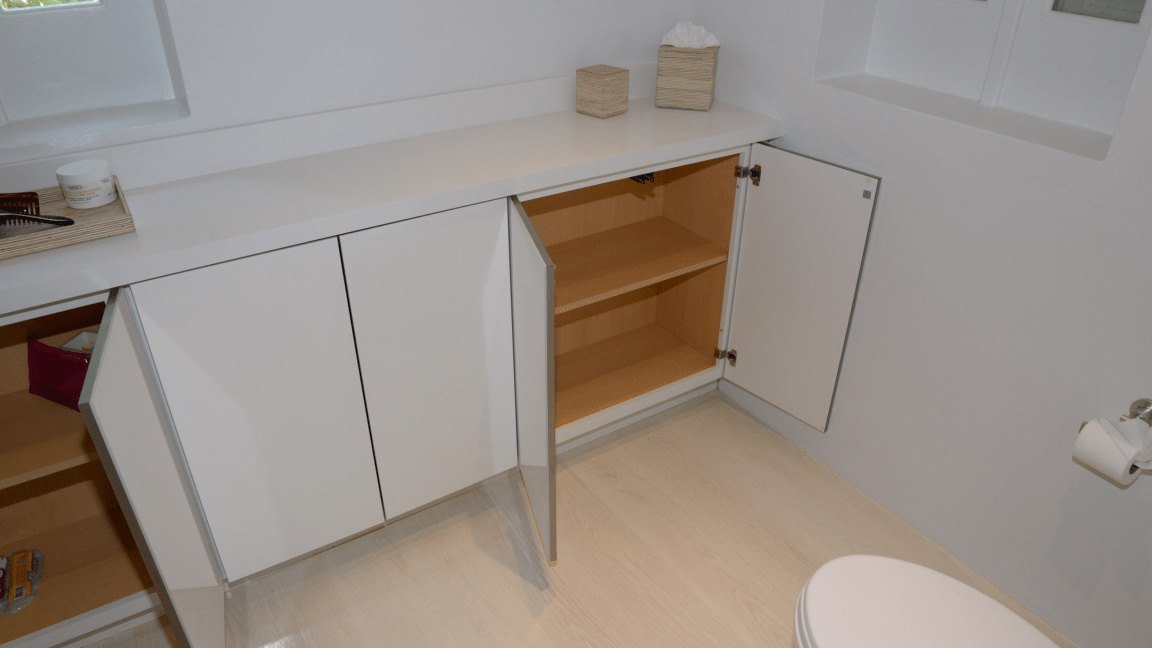
The vanity is the most-used piece of joinery in a home. It is opened several times a day, it lives in the wettest room in the property, and in Dubai it cycles between 45 °C outdoor humidity and hard air conditioning every time a door is left open. It is also the item most often bought on a photograph. A client sees a fluted oak vanity with a book-matched marble top, approves it on the render, and receives something that looks identical on day one and swells at the bottom rail by the second summer.
This guide covers what a luxury bathroom vanity design in Dubai actually costs in 2026, how to specify the carcass and fronts for UAE conditions, how the four worktop families really compare, the rough-in dimensions your plumber needs before the joinery goes into production, the bathroom electrical rules that govern mirrors and sockets, and when a vanity upgrade crosses the line into permitted work. If you are budgeting the whole room rather than the vanity alone, read it alongside our bathroom interior design and fit-out cost guide.
What a luxury bathroom vanity costs in Dubai in 2026
Bespoke joinery is quoted per linear metre of cabinet run, measured along the front face. A 1,200 mm vanity is 1.2 linear metres whether it has two doors or four drawers — although a drawer bank costs materially more to build than a door bank, so a good quotation prices them separately rather than averaging them.
The rate below is the cabinet only: carcass, fronts, shelves, hardware, finishing and installation. Worktop, basin, tap, waste, mirror and lighting are separate line items, and that separation is the single most useful thing you can insist on when comparing bids.
| Specification tier | Joinery, AED / linear metre | What you get | Installed 1,200 mm vanity, all-in |
|---|---|---|---|
| Rental refresh | AED 800 – 1,200 | MR MDF carcass and fronts, laminate or basic spray finish, standard hinges, 20 mm quartz top, ceramic drop-in basin | AED 3,500 – 8,500 |
| Mid-range residential | AED 1,200 – 1,800 | Plywood carcass, MR MDF sprayed or PU-lacquered fronts, soft-close hinges and runners, 20 mm quartz, undermount basin | AED 8,500 – 16,000 |
| Premium / master bathroom | AED 1,800 – 2,500 | Marine or WBP plywood carcass, real wood veneer or high-gloss acrylic fronts, European soft-close hardware, sintered stone or engineered marble top, LED mirror | AED 16,000 – 28,000 |
| Bespoke / signature | AED 2,500 and above | Book-matched natural stone, integrated solid-surface basin, fluted or curved fronts, brass or stainless detailing, imported ironmongery | AED 30,000 – 60,000+ |
Independent Dubai suppliers converge on the same mainstream band — custom cabinetry at roughly AED 800 to AED 2,500 per linear metre depending on material, made-to-measure vanities starting around AED 3,500, and full vanity upgrades running from about AED 8,500 for a powder room to AED 28,000 for a master bathroom with stone tops, LED mirrors and custom cabinetry. The top tier in the table above sits outside published rate cards because it is priced per project; treat those figures as our own observed range on signature villa work rather than a market rate.
The carcass decides how long the vanity lasts, not the door finish
Every failed vanity we have replaced in Dubai failed the same way: swelling at the bottom of a gable or at the back panel, under the basin, spreading outward from a cut edge. The door fronts were usually fine. That is not a coincidence — it is a direct consequence of which board went where.
Moisture-resistant MDF is for humid air, not for water
MR MDF is engineered to resist the swelling that ordinary MDF suffers in high ambient humidity. It is not waterproof, and the marketing language around it in the region routinely implies that it is. It performs well as a door and drawer front, because it machines to a dead-flat face that takes spray lacquer better than any plywood, and a sprayed front has no exposed edge once the finish is applied. It performs badly as a carcass base under a basin, where the first slow waste leak will find the unsealed underside.
Plywood is the correct carcass board in a UAE bathroom
Marine-grade or WBP-bonded plywood uses waterproof adhesive between veneers and holds its dimensions through wet-dry cycling far better than any fibreboard. Premium contractors in Dubai and Abu Dhabi increasingly default to plywood carcasses in kitchens, bathrooms, laundry rooms and commercial wet areas precisely because of the humidity and the constant air-conditioning cycling. The same logic that drives kitchen carcass selection in our kitchen interior design guide applies with more force in a bathroom, because a bathroom has a shower in it.
| Board | Use it for | Behaviour in a Dubai bathroom | Cost signal |
|---|---|---|---|
| Marine / WBP plywood | Carcass, gables, base, back panel | Holds dimension through wet-dry cycling; survives a slow leak long enough to be found | Highest board cost, lowest lifetime cost |
| Moisture-resistant MDF | Sprayed and lacquered fronts, shaker frames, decorative panels | Excellent painted face; swells irreversibly at any unsealed edge that gets wet | Mid |
| Standard MDF or particleboard | Nothing in a wet area | Swells in ambient humidity alone, before any leak | Cheapest, and the reason cheap vanities fail |
| Solid timber | Fluted or profiled fronts, edge detailing, legs | Moves seasonally; needs a finish schedule and a movement allowance in the design | High, and design-led rather than performance-led |
Edge sealing beats board grade
Water almost never enters a panel through its face. It enters through a machined edge — a hinge bore, a shelf-pin hole, a cut-out for a waste pipe, the underside of a base panel resting on a tiled floor. A plywood carcass with unsealed edges will outlive an MR MDF one, but both will eventually fail if the joiner treats sealing as an afterthought. The specification line that actually protects the vanity is a short one: all machined edges, bores and cut-outs sealed before assembly; base panel raised clear of the finished floor on an adjustable plinth. Insist on it and check it at the workshop inspection, not at handover.
Door and drawer fronts: five finishes Dubai actually specifies
The front is what the client sees, so it takes the design conversation. It also carries the least performance risk, because a sealed front is a sealed box. The choice is therefore mostly aesthetic, with two practical caveats: how the finish behaves under UAE light, and how easy it is to repair.
- PU or 2K spray lacquer on MR MDF. The workhorse of Dubai luxury joinery. Any colour, matt or gloss, seamless on curved and fluted profiles. Repairable on site by a sprayer. Shows fingerprints in high gloss and dark colours — specify a matt or satin sheen for a family bathroom.
- Real wood veneer. The finish that reads as genuinely expensive, particularly in walnut, oak and fumed oak. Needs a lacquer schedule appropriate to a wet room, and needs the leaves sequenced across the run so the grain continues from door to door. Veneer sequencing is a line item; if it is not in the quotation, you will get random leaves.
- High-gloss acrylic. Deeper and more scratch-resistant than a sprayed gloss, and dimensionally stable. Not repairable in situ — a damaged panel is replaced, so order a spare door with the original batch.
- High-pressure laminate and compact laminate. The value option, and genuinely tough. Modern textured HPL is convincing at arm's length. The tell is the edge: an ABS edge band will always read as an edge band next to a lacquered return.
- Anti-fingerprint matt (Fenix-type) surfaces. Increasingly specified in Dubai for exactly the reason the name suggests, and thermally repairable for light scratches. Costs more than laminate, less than veneer.
Worktops: four families compared on performance, not looks
The worktop is usually the second-largest line after the joinery, and it is where the visual identity of the vanity lives. It is also where the most expensive specification mistake gets made, because the material that photographs best is the one that performs worst.
| Material | Indicative supply & fix, AED / m² | Strengths | Watch out for |
|---|---|---|---|
| Engineered quartz | AED 700 – 1,400 | Non-porous, no sealing, huge colour range, consistent slab to slab | Resin binder can discolour under sustained direct sunlight; avoid in a window-lit vanity run |
| Sintered stone / porcelain slab | AED 900 – 2,000 | UV-stable, heat and stain proof, available in 6 mm to 20 mm, convincing marble prints | Brittle at cut-outs; needs a fabricator who works with it regularly, not a first attempt |
| Natural marble | AED 800 – 4,000+ | The look every luxury brief is actually describing; each slab unique; book-matching possible | Porous and acid-sensitive — toothpaste, perfume and limescale cleaners etch it. Needs sealing and a client who accepts patina |
| Solid surface (Corian-type) | AED 1,100 – 2,200 | Seamless integrated basin, invisible joints, sandable and repairable in place | Softer than stone; a damaged bowl means replacing the whole top |
Quartz slab rates from UAE suppliers commonly run AED 450 to AED 889 per square metre before fabrication, edging and installation, which is why the fitted figure roughly doubles. On a vanity the fabrication charge is disproportionately high relative to a kitchen, because a small top can carry a basin cut-out, a tap hole, a splashback return and a polished front edge — four operations on two square metres. If you are pricing stone across kitchen and bathroom together, our kitchen renovation cost guide covers the same slabs at kitchen quantities, where the rate per square metre falls.
Basin mounting changes the joinery, not just the look
Clients choose a basin by appearance. The joiner has to build a different cabinet for each choice, and the plumber has to rough in to a different height. Deciding the mounting late is one of the two most common causes of a vanity variation order on a Dubai fit-out.
- Undermount. Bonded below the worktop, giving a clean wipe-down from top into bowl. Needs a top thick enough to take a polished reveal — 20 mm stone, not 12 mm. It eats drawer depth: the top drawer becomes a U-shaped shallow tray around the bowl, and that has to be drawn, not assumed.
- Countertop or vessel. Sits proud of the surface. Because the rim ends up 120 mm to 150 mm above the top, the carcass is built lower — typically 750 mm to 800 mm rather than 850 mm — so the finished rim lands at a usable height. Leaves the deepest usable storage of any mounting.
- Integrated. The bowl moulded into a solid-surface top as one piece. No silicone joint anywhere, which is the easiest surface in the room to keep clean. The trade-off is repair: damage the bowl and you replace the top.
- Semi-recessed. The bowl projects forward of the cabinet face. This is the specification for a shallow vanity in a narrow bathroom — anything under about 450 mm deep — where a full undermount simply will not fit behind the front rail.
The MEP rough-in dimensions your joiner needs before production
This is the step that goes wrong most often, and it goes wrong quietly. The plumber first-fixes the waste and supplies at standard heights on a standard centreline. Six weeks later a bespoke vanity with a full-width drawer bank arrives, and the trap is exactly where the drawer box needs to be. The fix is a variation: cut the drawer, offset the trap, or rebuild the cabinet.
| Dimension | Typical figure | Why it matters to the joinery |
|---|---|---|
| Finished top height, floor-standing | 850 – 900 mm AFFL | Sets carcass height; reduce to 750 – 800 mm if a vessel basin sits on top |
| Vanity depth | 460 – 550 mm | Under 450 mm forces a semi-recessed basin; over 550 mm crowds a small bathroom door swing |
| Cabinet widths | 600 – 1,800 mm | Double basins need 1,500 mm minimum to avoid two people at one tap |
| Waste rough-in, under-counter basin | 460 – 510 mm AFFL | Must clear the drawer box; push to the rear or to one side for a drawer bank |
| Hot and cold supplies, under-counter | 510 – 560 mm AFFL, approx. 100 mm each side of the waste centreline | Isolation valves need to be reachable after installation, not sealed behind a fixed panel |
| Waste rough-in, wall-hung basin | 760 – 915 mm AFFL | Must be co-ordinated with the carrier frame and the tiling setting-out |
| Plinth / floor clearance | 80 – 150 mm, adjustable | Keeps the base panel off a wet floor and absorbs an out-of-level screed |
Treat every figure above as a working dimension, not a code requirement. The rough-in that governs is the one on the approved joinery shop drawing, issued to the plumber before first fix. Where a vanity is part of a wider fit-out, this co-ordination sits inside the general MEP co-ordination process that keeps services and joinery from occupying the same space on paper and then colliding on site.
A wall-hung vanity needs structural backing, not a bracket
Floating vanities are the dominant look in Dubai apartments, and for good reason: they make a small bathroom read larger and the floor is far easier to clean. They are also the mounting most often under-built.
A loaded vanity is heavy. A 1,500 mm cabinet with a 20 mm stone top, an undermount basin, water in the trap and a drawer of bottles can approach 150 kg, and it is cantilevered off the wall with someone occasionally leaning on it. That load needs to land on something: a steel or timber noggin built into the stud wall before boarding, or a proper resin-anchored fixing into a blockwork wall. What it must not land on is a plasterboard cavity fixing, however confident the packaging is.
This is a sequencing problem more than an engineering one. The backing has to go in before the wall is boarded and tiled, which means the vanity has to be designed and its fixing positions issued before the partition is closed. If the joinery package is still being value-engineered while the walls are being boarded, the backing will be missed — and the only remedies afterwards are opening the tiling or switching to a floor-standing unit. The same discipline governs any heavy wall-mounted element, and it is why we set joinery fixing points at the same stage we set out ceiling and bulkhead framing.
Bathroom electrics: the zone rules that govern mirrors and sockets
An LED mirror, a demister pad, a shaver point and a concealed strip under the vanity are now standard in a Dubai luxury bathroom. All four sit in a wet zone, and all four are governed by the same framework.
UAE consultants specify to Section 701 of BS 7671, the British wiring regulations, which the DEWA regulations for electrical installations follow in practice. The zones matter because they set a minimum ingress protection rating for anything installed within them:
IP67 and SELV at 12 V only. Nothing associated with a vanity belongs here.
The vanity zone. Minimum IP44 — protection against splashing from any direction. LED mirrors, vanity lighting and shaver sockets live here.
Normal fittings permitted, subject to the isolation and RCD requirements of the installation.
Three practical consequences follow. First, a mirror is compliant only if the mirror and its integrated driver are rated IP44 or better — a common failure is an IP-rated mirror with an unrated driver. Second, a standard 13 A socket is not permitted in Zone 2; the correct outlet is a shaver socket to BS EN 61558-2-5, which contains an isolating transformer. Third, DEWA practice requires double-pole switching so the circuit can be fully isolated at the point of use, which is why UAE drawings show double-pole switches on bathroom and water-heater circuits where a European drawing might not.
One detail that is not in any regulation but should be in every specification: put the mirror driver somewhere you can reach it. Drivers fail long before LEDs do, and a driver buried behind full-height tiling turns a AED 200 component into a AED 4,000 tiling repair. An accessible ceiling void, a service panel or the vanity cabinet itself all work. If the bathroom lighting scheme is being designed as a whole, our interior lighting design guide covers driver access and colour temperature selection in more detail; a vanity mirror should generally sit at 3000 K to 4000 K with a CRI above 90, because anything lower makes skin tones unusable for the one task the mirror exists for.
Ventilation is a joinery specification, not just an MEP one
A vanity fails faster in an under-ventilated bathroom than in a wet one. Where a shower's moisture has nowhere to go, it condenses on the coolest surfaces in the room — and in an air-conditioned Dubai bathroom those are often the underside of a stone top and the inside face of a cabinet gable.
Two things fix it. The extract fan must actually run long enough to clear the room, which means an over-run timer rather than a fan wired to the light switch, and it must discharge to outside rather than into a ceiling void. And the cabinet itself needs to breathe: a ventilation gap at the back of the carcass, or perforated plinth ventilation, lets air move through the cabinet instead of leaving still, humid air sitting against sealed board. It costs nothing at the drawing stage and cannot be added later. Where a fit-out changes the extract arrangement, the wider implications are covered in our HVAC modification guide.
When a vanity upgrade triggers a Dubai Municipality permit
This is where a straightforward joinery job becomes a regulated one, and the boundary is clearer than most homeowners expect.
| Scope of work | Permit position | What you still need |
|---|---|---|
| Replace vanity in place, existing waste and supply points unchanged | Like-for-like fitting change — no DM permit triggered by the vanity itself | Building management or owners-association approval and a contractor with valid access documents |
| Move the basin, add a second basin, or relocate the waste | Change to plumbing inside a wet area — DM fit-out or renovation permit required | Landlord NOC, approved drawings, a DM-registered contractor |
| New water supply point, new drainage run, or a change to the bathroom layout | Permitted work | Full submission; Trakhees instead of DM in Trakhees-administered communities |
| Any of the above in a leased apartment | As above, plus the lease | Landlord NOC before anything else — it gates the permit application |
Enforcement of wet-area work has tightened materially. Unpermitted plumbing alterations can attract a stop-work order and a requirement to reinstate at the owner's cost, and an unresolved violation can complicate a later sale. None of that is a reason to avoid moving a basin — it is a reason to settle the permit position before the joinery is ordered, because a six-week bespoke lead time does not pause while an application is processed. The submission route itself is set out in our guides to the Dubai Municipality fit-out permit via the BPS portal and the wider DM, DCD and Trakhees approval landscape, and the landlord NOC process that precedes both.
Hardware and lead times: where the programme actually slips
Hardware is a small fraction of the cost and a large fraction of the daily experience. A soft-close drawer runner from a European manufacturer will still close properly after a decade of twice-daily use; a generic one develops a rattle within two years, and replacing it means removing the drawer box. Specify the brand and the runner series, not “soft-close runners”.
In a bathroom, the finish on the hardware matters as much as the mechanism. Concealed hinges and runners sit inside a humid cabinet for their whole life, so nickel-plated or stainless components are worth the uplift over bare steel. Exposed handles in brushed brass or PVD finishes should be specified as PVD rather than lacquered brass, because lacquer fails around wet hands and the underlying brass then tarnishes unevenly.
On programme, a realistic Dubai schedule for a bespoke vanity runs six to ten weeks from approved shop drawing to installation: one to two weeks for drawing approval and material selection, three to five weeks in the workshop, one to two weeks for the stone template and fabrication — which can only begin after the cabinet is installed and measured — and a few days for installation and sealing. Imported stone, specialist ironmongery or a book-matched slab selection adds two to four weeks. That sequence is the reason the stone is templated last, and the reason a vanity cannot be compressed into the final fortnight of a project however much the programme wants it to. Our renovation project management guide sets out where joinery sits in the wider programme.
What the vanity market gets wrong
Four claims come up repeatedly in Dubai showrooms and on supplier websites, and each one costs clients money.
- “Waterproof MDF.” There is no such board. Moisture-resistant MDF resists humid air; it is not rated for water contact and it will swell at a wet edge. Ask for the board's designation, not an adjective.
- “Marine plywood” as a loose description. The term is used in the region for anything from genuine BS 1088 marine ply to ordinary commercial ply with a waterproof glue line. The performance difference is real. Ask which standard the board is certified to and expect a document, not a reassurance.
- “IP65 rated” on a mirror where only the light is rated. A rating applies to a defined product assembly. A mirror whose LED module is rated but whose driver is not has an unrated component in a wet zone. Ask for the rating of the complete assembly including the driver.
- “Quartz is heatproof and scratchproof.” Engineered quartz is resin-bound, which makes it non-porous but also makes it vulnerable to sustained heat and, in some formulations, to UV discolouration behind a sunlit window. Sintered stone is the material that genuinely does not care about either.
None of these are conspiracies. They are shorthand that has hardened into claims. The defence is the same in every case: put the performance requirement in the specification, and ask for the certificate rather than the adjective.
A specification that produces comparable quotations
If you take one thing from this guide into a supplier meeting, take this list. A vanity quotation that answers all ten points can be compared against another that does the same. One that answers three cannot be compared with anything.
- Carcass board and standard — plywood grade or MR MDF, named.
- Front board and finish system — spray lacquer sheen level, veneer species and sequencing, or laminate reference.
- Edge sealing — confirmation that all machined edges, bores and cut-outs are sealed before assembly.
- Worktop material, brand, slab thickness and edge profile.
- Basin mounting type and model, with the tap hole configuration.
- Hardware brand and series for hinges, runners and handles, with the finish.
- Mounting method — floor-standing with adjustable plinth, or wall-hung with the required backing specified.
- Rough-in dimensions issued to the plumber, referenced to the approved shop drawing.
- Electrical items with their IP rating stated for the complete assembly, driver included.
- Lead time, split between drawing approval, workshop, stone template and installation.
Ten lines. They convert an unfalsifiable AED 12,000 into something you can hold a supplier to, and they are the same ten lines that let a project manager reject a substitution before it reaches site rather than after. For the wider room, our bathroom renovation cost guide covers tiling, waterproofing and sanitaryware at the same level of detail, and villa-scale schemes are budgeted in our villa interior design cost guide and penthouse fit-out guide.
Specify the vanity before you price it
V Square writes the joinery specification, sets the board and hardware schedule, issues the rough-in dimensions to the plumber before first fix, and co-ordinates the stone template against the installed cabinet — so the vanity you approved on the drawing is the vanity that arrives on site.
See V Square in action →Frequently Asked Questions
How much does a custom bathroom vanity cost in Dubai in 2026?
Bespoke vanity joinery in Dubai is priced per linear metre of cabinet run, and the mainstream 2026 band is AED 800 to AED 2,500 per linear metre depending on carcass board, front finish and hardware. That rate covers the cabinet only. A complete 1,200 mm vanity delivered and installed, including the worktop, basin, tap and waste, typically lands between AED 8,500 for a simple powder-room unit and AED 28,000 for a master-bathroom vanity with a stone top, an LED mirror and soft-close European hardware. Book-matched natural stone, integrated solid-surface basins and custom metalwork push past AED 30,000 and are quoted per project rather than per metre.
Is marine plywood or moisture-resistant MDF better for a Dubai bathroom vanity?
For the carcass, marine or WBP-bonded plywood is the better specification in a UAE bathroom, and it is what most premium Dubai contractors use. Moisture-resistant MDF is engineered for humid air, not for water contact, so it performs acceptably in a well-ventilated powder room and poorly under a leaking waste or against a wet skirting. MR MDF remains the right board for sprayed and lacquered door fronts, because it machines to a flawless painted face that plywood cannot match. The strongest specification is therefore mixed: plywood carcass and gables, MR MDF fronts, and every cut edge sealed before assembly. Edge sealing matters more than the board grade, because water almost always enters through an unsealed machined edge rather than through the face.
What are the standard bathroom vanity dimensions and rough-in heights?
A floor-standing vanity is normally built to a finished top height of 850 to 900 mm, at 460 to 550 mm deep, in widths from 600 mm to 1,800 mm. For an under-counter basin, the waste is roughed in at roughly 460 to 510 mm above finished floor level with the hot and cold supplies at 510 to 560 mm, offset about 100 mm either side of the waste centreline so the P-trap has room. A wall-hung basin moves the waste up to roughly 760 to 915 mm with the supplies just below it. These are working dimensions, not a code: the rough-in must be set from the approved joinery shop drawing, because a bespoke vanity with a drawer bank needs the trap pushed to the back or to one side and the standard centre position will collide with it.
Do I need a Dubai Municipality permit to replace a bathroom vanity?
Replacing a vanity in the same position, on the existing waste and supply points, is treated as a like-for-like fitting change and does not by itself require a Dubai Municipality permit. Moving the basin, adding a second basin, relocating drainage or adding a new water supply point is a change to the plumbing installation inside a wet area, and that does trigger a DM fit-out or renovation permit, or a Trakhees permit in a Trakhees-administered community. Building management will also require a landlord or owners-association NOC before any contractor is allowed to work. Enforcement has tightened, and unpermitted wet-area work can attract a stop-work order and a requirement to reinstate at the owner's cost, so the permit position should be settled before the joinery is ordered rather than after.
Which worktop material is best for a luxury bathroom vanity in Dubai?
Engineered quartz is the default for good reason: it is non-porous, needs no sealing, and slab rates from UAE suppliers commonly run AED 450 to AED 889 per square metre before fabrication and fitting. Sintered stone or full-body porcelain is the better choice where the top runs into a window or a strong downlight, because it does not discolour under UV the way some resin-bound quartz can. Natural marble gives the look that most luxury schemes are actually asking for, but it is porous, it etches on contact with acidic cleaners and toothpaste, and in a family bathroom it will show that within a year. Solid surface is the material to choose when you want a seamless integrated basin with no joint to clean.
Should the basin be undermount, countertop or integrated?
Each mounting changes the joinery, not only the appearance. An undermount basin needs a stone top thick enough to take a polished reveal and reduces usable drawer depth by the bowl height. A countertop or vessel basin sits above the surface, so the vanity carcass is built lower to keep the rim at a usable height, and it leaves the fullest storage underneath. An integrated basin moulded into a solid-surface top removes the silicone joint entirely and is the easiest to clean, but the whole top must be replaced if the bowl is damaged. A semi-recessed basin is the specification for a shallow vanity, typically under 450 mm deep, where a full undermount would not fit. Decide the mounting before the joinery drawing is approved, because it sets the carcass height and the trap position.
What IP rating do LED mirrors and sockets above a vanity need?
The zone framework that UAE consultants specify to is Section 701 of BS 7671, which the DEWA electrical installation regulations follow in practice. The area above and around a vanity basin normally falls in Zone 2, where the minimum protection is IP44, meaning protected against splashing water from any direction. An LED or backlit mirror is compliant when the mirror and its integrated driver are rated IP44 or better. A shaver socket to BS EN 61558-2-5, which contains an isolating transformer, is permitted in Zone 2, and a standard 13 A socket outlet is not. DEWA practice also requires double-pole switching for isolation at the point of use. The driver for a mirror should sit in an accessible ceiling void or cabinet, not buried behind tiling, because it will fail before the LEDs do.