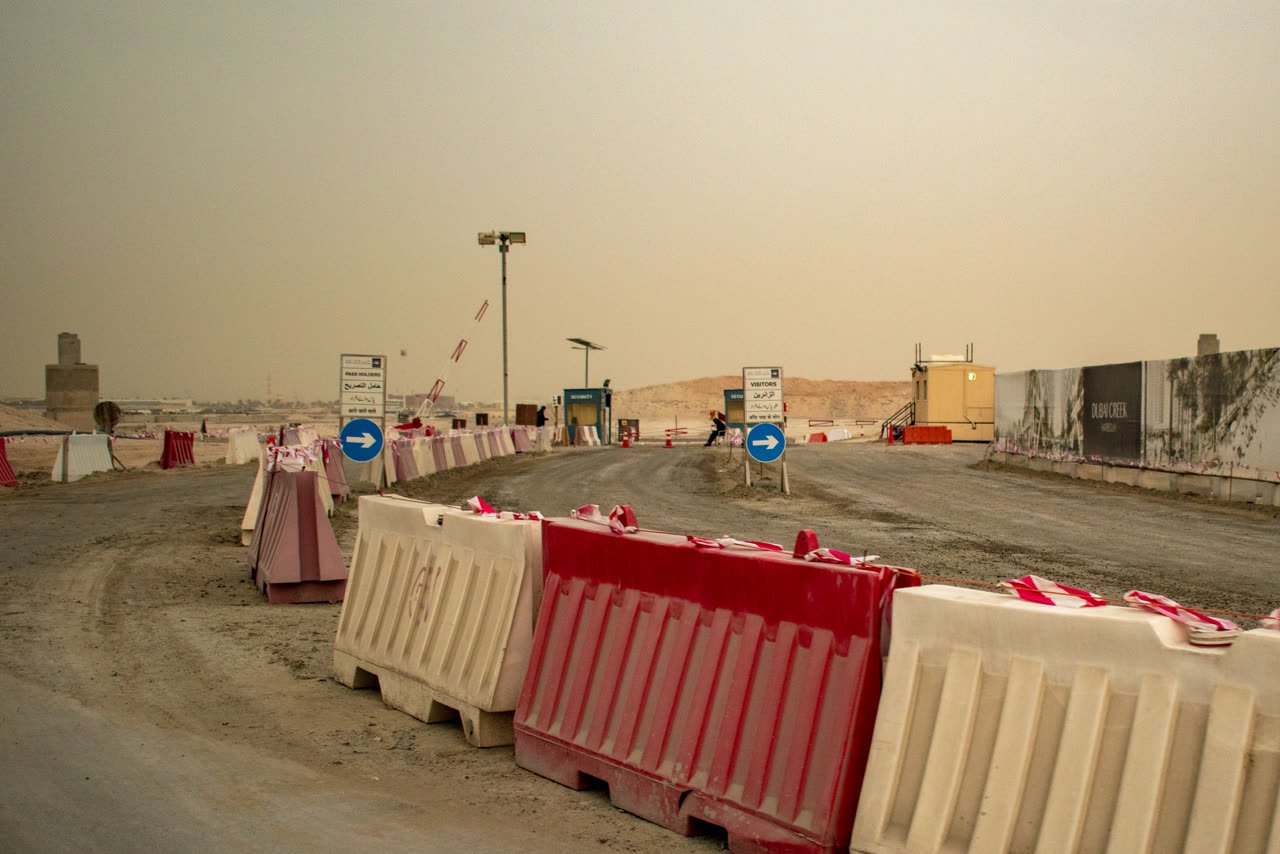
A Dubai site entrance is a useful mental model for prequalification: the gate decides who is allowed to work before anyone discusses rate. Since January 2026 that gate has a statutory component. Photo: ZarlokX, Wikimedia Commons, CC BY-SA 4.0.
Prequalification stopped being a private client exercise in January 2026
For most of the last decade, prequalifying a fit-out contractor in Dubai was a discretionary exercise. A tenant, a landlord's project manager or a facilities team would ask for a company profile, three reference projects, a trade licence copy and an insurance certificate, form a view, and move on to pricing. Nothing in that process was compelled. A tenant who skipped it and appointed on a recommendation was taking a commercial risk, not a legal one.
That changed with Law No. (7) of 2025 regulating contracting activities in the Emirate of Dubai. The law establishes a unified, integrated electronic Contractor Register administered by Dubai Municipality and surfaced through the Invest in Dubai digital platform. Every company performing contracting work in the emirate is required to be registered and to operate strictly within the classification and capacity it has been granted. The law was issued in July 2025 and comes into force six months after publication in the Official Gazette, placing the commencement in January 2026, with a one-year window for existing contractors to regularise their status. That window may be extended by a further year by the Contracting Activities Regulation and Development Committee, the body created to oversee implementation and chaired by a Dubai Municipality representative.
The scope is deliberately wide. It reaches contractors operating in mainland Dubai, in the special development zones and free zones, and in the Dubai International Financial Centre. Contracting activities related to airports and their associated infrastructure are excluded, along with anything else exempted by decision at Executive Council level. Interior fit-out, MEP and joinery contracting all sit inside the scope. There is no small-works carve-out that lets a modest office refurbishment ignore the framework.
What the penalties mean for a tenant, not just a contractor
The published penalty range for a violation is AED 1,000 to AED 100,000, with repeat violations inside the same year doubled to a ceiling of AED 200,000. Beyond fines, the competent authority may suspend contracting activity, downgrade a contractor's classification, strike the company from the register entirely, revoke its licence, or deregister individual technical staff.
Those consequences land on the contractor. The reason they matter to a tenant is sequencing. A fit-out is a chain of authority interactions - the Dubai Municipality permit, the landlord NOC, Civil Defence review, DEWA energisation, then completion certificates and handover. Each of those steps is transacted by the contractor in the contractor's own name. A firm that is suspended, downgraded below your project's threshold, or removed from the register mid-project cannot pull the next permit or close the next inspection. The tenant is then holding a stripped shell, a rent clock that has not stopped, and a contract with a counterparty who has lost the legal standing to finish the work. Recovering from that costs far more than the two days of due diligence that would have prevented it.
Contractors are also now required to keep original contracts, records and project documentation for at least ten years after completion or termination. That obligation is worth noting at prequalification because it tells you something about the administrative maturity you should expect. A contractor with no document control system is a contractor who will struggle to produce the as-built and warranty pack you need at handover.
Six registrations to verify before you look at a single rate
Prequalification is often run as a scoring exercise across financial strength, experience and resourcing. Those matter, but they are second-order. The first-order question is binary: is this company legally permitted to perform this specific scope, in this specific building, in 2026? Six checks answer it.
1. The trade licence, read for activity rather than existence
Almost every prequalification asks for a trade licence copy. Very few actually read it. The licence lists permitted activities, and "interior decoration works", "building contracting", "electromechanical equipment installation and maintenance" and "false ceiling and light partitions installation" are distinct entries. A company licensed only for interior decoration is not licensed to self-perform your electrical or HVAC scope, which means either an undisclosed subcontractor or an unlicensed one. Check that the activity list covers the scope you are tendering, and check the expiry date against your programme, not against today.
2. Dubai Municipality registration and the company practice certificate
The trade licence and the Municipality registration are different documents issued by different bodies for different purposes. The licence, from Dubai Economy and Tourism or a free zone authority, says what the company may commercially sell. The Dubai Municipality practice certificate says the company is technically recognised to practise construction work in the emirate. Dubai Healthcare City Authority's published engineering fit-out guidelines make the distinction explicit: a contractor registering in that zone must supply both a valid Dubai trade licence with approved fit-out or contracting activity and a valid Dubai Municipality practice certificate for the company.
Under Law No. (7) of 2025 the Municipality is also responsible for classifying contractors engaged in construction, building and demolition activities and for issuing professional competency certificates. Ask for the registration record and the classification, not a screenshot of a portal landing page.
3. The jurisdiction register for your specific building
This is the check most often missed, and the one that most often stops a project in week one. Dubai's fit-out approvals are not centralised by building type; they are decided by the plot the building sits on. A contractor perfectly registered for mainland Dubai Municipality work may have no standing at all in Dubai Internet City, Dubai Healthcare City or a Trakhees-governed area of Jebel Ali or Palm Jumeirah. Our guide to fit-out approvals across DM, DCD and Trakhees sets out the jurisdictional map in detail.
Two of these authorities publish their contractor registration fee openly, which makes them easy to verify and useful as a benchmark for the rest.
| Authority / zone | Published contractor registration fee | Validity and renewal | What it gates |
|---|---|---|---|
| Dubai Development Authority (TECOM clusters: Internet City, Media City, d3, Knowledge Park, Studio City and others) | AED 250 new, AED 250 renewal, plus AED 10 Knowledge Dirham and AED 10 Innovation Dirham per transaction | 1 year; 2 working day service level | Unregistered firms cannot submit anything. The fit-out permit is issued to the contractor, not the tenant |
| Dubai Healthcare City Authority (DHCC) | AED 500 per annum (fee code F7, published service schedule) | 1 year; annual renewal mandatory | Registration through the Masaar online system is required before any works start or any permit application is submitted |
| Dubai Municipality (mainland) | Not published as a single open figure | Per the unified Contractor Register under Law No. (7) of 2025 | Registration and classification; professional competency certificates for technical staff |
| Trakhees (Ports, Customs and Free Zone Corporation areas) | Not published as a single open figure | Confirm current position directly | Contractor and consultant registration for buildings inside its jurisdiction |
| Other free zone authorities (DMCC, DAFZA, JAFZA and similar) | Varies; generally not published openly | Typically annual | Zone-level contractor registration in addition to the emirate-level register |
The practical instruction is simple. Establish which authority governs your plot before you issue the tender, then require every bidder to evidence registration with that authority as a condition of bidding. A contractor who tells you they will "register once awarded" is asking you to carry a two-to-six week programme risk that belongs to them, and the DDA position is instructive here: unregistered firms cannot submit applications at all, so the registration is not a formality that runs in parallel with mobilisation. Our DDA fit-out approval guide covers the permit sequence in those clusters.
4. Dubai Civil Defence registration for fire and life safety scope
Fire alarm, fire fighting, suppression, fire-rated construction and smoke management works must be executed by a contractor registered with Dubai Civil Defence. This is not a preference expressed by consultants; it is how the approval and inspection regime is built. A main fit-out contractor who is not DCD-registered will subcontract this package, which is normal and acceptable - but you should prequalify that subcontractor with the same rigour, because their registration status is what your Civil Defence inspection depends on.
Two 2026 changes are worth building into the prequalification questionnaire. First, an Annual Maintenance Contract with a DCD-registered maintenance company is now expected to be in place and submitted before inspection rather than produced afterwards, which moves an item most tenants treat as a post-handover FM matter into the critical path. Second, wet chemical suppression systems serving commercial cooking equipment are required to be UL 300 certified, which is a material specification point for any restaurant or cloud kitchen fit-out. Ask bidders to confirm both in writing at tender stage. Related fire scope such as certified fire-rated doors carries its own certification chain.
5. DEWA enrolment for electrical works
DEWA maintains its own enrolment regime for electrical consultants and contractors, including lists specific to electricity fit-out work, applied for through DEWA e-services. If your scope includes a new distribution board, a supply modification or anything that ends in an energisation request, the firm doing that work has to be enrolled and appropriately classified with DEWA. This becomes acute where the fit-out involves a load upgrade, because the application itself is submitted by the enrolled contractor. A contractor without DEWA enrolment cannot lodge it, and the tenant discovers this at the point the programme depends on it.
6. Competency certificates for the people, not just the company
Law No. (7) of 2025 pushes competency down to the individual. Technical personnel are required to hold a professional competency certificate issued by Dubai Municipality, and contractors carry responsibility for ensuring their staff meet the requirement, with penalties reaching both the company and the uncertified worker. Deregistration of staff is one of the administrative sanctions available to the authority.
For a tenant, this converts a familiar prequalification weakness into a checkable fact. Contractors routinely present their most senior project manager at tender and deploy someone else on site. Naming the project manager, the site engineer and the MEP coordinator in the tender return - and asking for their competency certificates - makes the bait-and-switch visible before award rather than after. The quality of that named team is the single largest predictor of how MEP coordination will go.
What a classification grade actually restricts, and the matrix nobody publishes
Classification under the new framework is assessed on financial, technical and administrative criteria - broadly, capital and fiscal health, equipment and technical capacity, and workforce qualifications. New entrants without a UAE project portfolio start in the base tier, with promotion available only on proven capability. Dubai Municipality has also signalled an update to its Contractor and Engineering Consultancy Rating System, adding performance-based evaluation across financial discipline, compliance history and technical capacity.
Two restrictions follow directly from the law and both are worth writing into your tender conditions:
- A contractor may not exceed the technical or financial limits of its classification. Awarding a contract above a firm's classified capacity is not a grey area the parties can agree to ignore.
- A contractor may not subcontract without prior approval. This matters enormously in fit-out, where a main contractor commonly subcontracts joinery, MEP, fire systems and specialist finishes. Ask for the intended subcontractor list at tender, not after award.
Here is the part that most published guidance gets wrong. There is no openly published Dubai Municipality matrix mapping each classification grade to a maximum contract value, building height or floor area. Articles that confidently present "Grade 1 up to AED X, Grade 2 up to AED Y" tables are presenting estimates, or figures from an older or different regime, as current official fact. Commentary that does describe tiering states only that new entrants are placed in the lowest categories and can be promoted on merit; the detailed criteria sit with the Municipality's own regulations rather than in a public table.
The correct response to an unpublished matrix is not to guess at it. It is to ask each bidder for a copy of its actual classification certificate and to confirm, in writing, that the project value and scope you are tendering fall inside it. That is a single document request that converts an unanswerable general question into a specific, evidenced answer about your project.
The insurance file: five policies and what each one is actually for
Insurance is where prequalification most often becomes theatre. A certificate is emailed, someone confirms "insurance received", and nobody reads the schedule. The five policies below do different jobs, and a fit-out with the wrong combination leaves a real gap.
| Policy | What it responds to | Who needs it on a fit-out | What to check on the certificate |
|---|---|---|---|
| Contractors All Risk (CAR) | Physical loss or damage to the works, materials and plant on site during construction | The main contractor, always | Sum insured at least the contract value; your project address named; period covers the full programme plus the maintenance period |
| Third Party / Public Liability | Injury to people and damage to property belonging to others - the landlord's base build, the neighbouring tenant, a passer-by | The main contractor, always | Limit proportionate to the building, not the fit-out; often bundled inside the CAR policy - confirm which |
| Workmen's Compensation / employer's liability | Injury to the contractor's own workforce | The main contractor and every subcontractor with labour on site | Headcount basis matches the labour histogram they submitted; subcontractor labour is covered by someone |
| Professional Indemnity (PI) | Financial loss caused by defective design or professional advice | Anyone carrying design responsibility - a design-and-build contractor, or the appointed consultant | Claims-made basis means cover must be live when the claim is made, not only when the work was done; run-off after completion |
| Decennial Liability | Collapse or defects threatening structural stability or safety in the ten years after delivery | Where the scope touches structure - slab penetrations, structural openings, mezzanines | Whether it exists at all; ten-year period aligned to the statutory liability rather than the contract period |
On cost, published market commentary places general UAE contractor insurance in the region of AED 2,000 to AED 25,000 per year depending on business size, project scope and risk profile, and the Society of Engineers is generally understood to expect professional indemnity of at least AED 5 million from engineering and architectural consultancies. Treat both as orientation rather than a benchmark to hold a bidder to - the correct limits are driven by the specific project, the building and the lease.
Three checks catch most of the real problems. Confirm the named insured is the legal entity you are contracting with and not a parent or affiliate. Confirm the project address appears, because a policy written for a different site does not respond to yours. Confirm the period of insurance extends past practical completion into the defects liability period, since a policy that lapses at handover leaves the DLP uninsured precisely when latent defects surface.
Decennial liability moved from Article 880 to Article 821 on 1 June 2026
This is the single most commonly out-of-date statement in UAE construction content, and it is worth correcting carefully because a great deal of published material - including material dated 2026 - still cites the old article number.
Federal Decree-Law No. 25 of 2025, the new UAE Civil Code, entered into force on 1 June 2026 and replaced Federal Law No. 5 of 1985 in its entirety. The decennial liability provisions that sat at Articles 880 to 883 of the 1985 code now sit at Articles 821 to 824. Citing Article 880 as the current basis of decennial liability is now a citation to a repealed instrument.
The substance is largely carried across. The regime imposes strict liability on the contractor and the supervising architect or engineer, jointly, to the employer, for total or partial collapse or for a defect that threatens the stability or safety of the structure, arising within ten years of delivery. Liability is strict, so it does not depend on proving negligence. The anti-exclusion rule is preserved: any agreement seeking to exempt or limit that liability is void. Claims must be brought within three years of the collapse or of discovery of the defect.
One change matters for how you prequalify. The new code expressly excludes the decennial liability rules from the contractor-subcontractor relationship, confining them to the employer's relationship with the main contractor and the engineer. In practical terms, a main contractor's ability to pass decennial exposure straight down to the specialist who actually built the element is narrower than it was. That strengthens the case for prequalifying the main contractor on balance-sheet durability rather than on price alone, because the entity that carries the ten-year exposure needs to still exist in year eight.
For most interior fit-outs the decennial question is genuinely marginal, because partitions, ceilings, finishes and loose furniture do not engage structural stability. It becomes live the moment the scope touches the frame - a new mezzanine floor, a core-drilled slab, a structural opening for a feature stair, or heavy plant added to a roof. Where any of those appear in the scope, decennial cover moves from optional to a question you should put in the prequalification questionnaire.
A prequalification scorecard you can run in a week
The framework below assumes you are shortlisting from a longer list down to the four to six firms who will actually receive the tender. Compliance items are pass or fail - a firm that cannot evidence them does not proceed to scoring, regardless of how attractive the rest of the submission looks.
| Stage | Item | Weight | Evidence required |
|---|---|---|---|
| Gate (pass/fail) | Trade licence with the correct fit-out or contracting activity, valid past the programme | Pass/fail | Licence copy, activity list read line by line |
| Gate (pass/fail) | Dubai Municipality contractor registration and company practice certificate | Pass/fail | Registration record and practice certificate |
| Gate (pass/fail) | Registration with the authority governing your specific plot | Pass/fail | Registration confirmation from DM, DDA, DHCA, Trakhees or the free zone |
| Gate (pass/fail) | Classification covers the project value and scope | Pass/fail | Classification certificate plus written confirmation against your project |
| Gate (pass/fail) | Insurance set complete and correctly named | Pass/fail | CAR, TPL, workmen's compensation certificates; PI where design is carried |
| Scored | Comparable completed projects - same building type, similar value, last 36 months | 25% | Three references with client contact, value, duration, photographs |
| Scored | Named site team with competency certificates and CVs | 25% | Project manager, site engineer, MEP coordinator, QA/QC and HSE officer named |
| Scored | Self-perform versus subcontract split, with the intended subcontractor list | 15% | Package-by-package declaration |
| Scored | Financial standing - audited accounts, bank reference, bonding capacity | 15% | Two years of audited financials; bank facility letter |
| Scored | Authority approvals track record in your jurisdiction specifically | 10% | Two completed permits in the same authority area, with dates |
| Scored | HSE record, method statements and document control maturity | 10% | HSE policy, incident record, sample method statement and as-built pack |
Weightings are a starting point rather than doctrine. On a healthcare fit-out the authority track record deserves more than ten percent, because a contractor who has never taken a project through the relevant health regulator will learn on your programme. On a straightforward Category B office fit-out in a building the contractor already works in, comparable experience carries proportionally more.
Seven signals that should end a prequalification early
- "We will register once we are awarded." Registration is a prerequisite for submitting applications in at least one major jurisdiction, and it converts the contractor's administrative delay into your programme delay.
- A trade licence whose activities do not cover the scope being tendered. Either there is an undisclosed subcontractor or there is unlicensed work.
- An insurance certificate naming a different entity, a different site, or expiring before practical completion. All three are common and all three mean the cover does not respond to your project.
- A refusal to name the site team, or CVs supplied without competency certificates. Under the 2026 framework the certificates exist as a checkable document.
- References that are all more than three years old, or all from a single repeat client, or that decline a site visit.
- A price materially below the rest of the field with no explanation of the difference. Cross-read this against the BOQ and exclusion list - the gap is usually scope that has been left out rather than efficiency.
- No documented subcontractor list. Given the prior-approval requirement on subcontracting, an undeclared supply chain is now a compliance exposure and not merely a coordination concern.
What good prequalification does to the rest of the project
The measurable benefit of prequalification is not that it finds a cheaper contractor. It is that it makes the tender comparable and the programme believable. A shortlist of four to six firms who are all registered in the right jurisdiction, all classified for the project value, and all insured on the right basis will return bids that differ because of scope and rate rather than because one of them has quietly assumed someone else will handle Civil Defence. That is the precondition for the normalisation exercise described in our guide to comparing fit-out quotations.
It also protects the programme. Most fit-out overruns in Dubai are approval overruns rather than construction overruns, and a large share of approval overruns trace back to a contractor who was not registered, not classified, or not enrolled with the utility for the work they were appointed to do. Our office fit-out timeline guide sets out where those weeks are usually lost, and the project management stages guide covers where prequalification sits in the wider sequence. Where the fit-out is being funded through a landlord contribution, the landlord will frequently impose prequalification criteria of their own, and aligning the two lists early avoids re-tendering.
Two days spent reading five documents per bidder is the cheapest risk transfer available on a fit-out project. It is considerably cheaper than discovering in week six that the company holding your site cannot lodge the next application.
Prequalifying contractors for a Dubai fit-out?
V Square runs contractor prequalification, tender management and bid evaluation for commercial, healthcare and industrial fit-outs across Dubai, Sharjah and Abu Dhabi - including registration and classification verification against the authority that governs your building.
Request a consultation →Frequently Asked Questions
Is contractor registration with Dubai Municipality mandatory for fit-out work in 2026?
Yes. Dubai Law No. (7) of 2025 regulating contracting activities creates a unified Contractor Register administered by Dubai Municipality through the Invest in Dubai platform, and it applies to contractors across mainland Dubai, the free zones and the DIFC, with contracting activities relating to airports and their associated infrastructure excluded. The law took effect six months after publication in the Official Gazette, in January 2026, and existing contractors were given one year to regularise their status - a window the Contracting Activities Regulation and Development Committee may extend by a further year. Fit-out and interior contracting sit inside the scope, so a tenant appointing an unregistered firm is appointing one that cannot lawfully perform the work.
What are the fines for using an unregistered contractor in Dubai?
Under Law No. (7) of 2025 the published penalty range for a first violation is AED 1,000 to AED 100,000. Repeat violations within one year are doubled up to a maximum of AED 200,000. The competent authority may also suspend contracting activity, downgrade a contractor's classification, remove the company from the register, revoke the licence, or deregister technical staff. The fines fall on the contractor rather than the tenant, but the consequential risk to the tenant is real: a suspended or deregistered contractor cannot pull a permit or close out an inspection, so the project stops mid-fit-out with the site already stripped.
What is a Dubai Municipality practice certificate and how is it different from a trade licence?
A trade licence is issued by the licensing authority - Dubai Economy and Tourism on the mainland, or the relevant free zone authority - and states which commercial activities the company may sell. A Dubai Municipality practice certificate is a separate technical registration confirming the company is recognised by the Municipality to practise construction or contracting work in the emirate. Dubai Healthcare City Authority's published fit-out guidelines require both a valid Dubai trade licence with approved fit-out or contracting activity and a valid Dubai Municipality practice certificate for the company before a contractor can register in its zone. Law No. (7) of 2025 additionally requires professional competency certificates for individual technical personnel.
How much does fit-out contractor registration cost in Dubai free zones?
Two authorities publish an exact figure. Dubai Development Authority charges AED 250 for consultant or contractor registration, the same AED 250 to renew, valid one year, with a two working day service level, plus AED 10 Knowledge Dirham and AED 10 Innovation Dirham on every transaction. Dubai Healthcare City Authority lists fit-out contractor registration at AED 500 per annum in its published service fee schedule, with annual renewal mandatory. These are registration fees only. They are separate from the fit-out permit fee, from Civil Defence and DEWA charges, and from the contractor's own insurance costs.
Which insurance policies should a Dubai fit-out contractor produce at prequalification?
Ask for five: Contractors All Risk covering the works and materials on site, Third Party or Public Liability covering injury and property damage to others, Workmen's Compensation or employer's liability covering the contractor's own labour, Professional Indemnity where the contractor carries design responsibility, and Decennial Liability cover where the scope touches structure. Published market commentary puts general UAE contractor insurance in the region of AED 2,000 to AED 25,000 a year depending on size and risk, and the Society of Engineers is generally understood to expect professional indemnity of at least AED 5 million from engineering and architectural consultancies. Check the certificate names your project address and that the period runs past practical completion into the defects liability period.
Did the article number for decennial liability in the UAE change?
Yes. Federal Decree-Law No. 25 of 2025, the new Civil Code, entered into force on 1 June 2026 and replaced Federal Law No. 5 of 1985 in full. The decennial liability provisions that sat at Articles 880 to 883 of the old code now sit at Articles 821 to 824. The substance is largely preserved: strict joint liability of the contractor and the supervising architect or engineer to the employer for total or partial collapse or a defect threatening the stability or safety of the structure within ten years of delivery, an anti-exclusion rule that voids any agreement limiting that liability, and a three-year window to bring a claim from collapse or discovery of the defect. One meaningful change is that the new code expressly excludes the decennial rules from the contractor-subcontractor relationship.
Does classification stop a small contractor from doing my office fit-out?
It can. Under Law No. (7) of 2025 contractors must operate strictly within their approved classification and are prohibited from exceeding their technical or financial limits, or from subcontracting without prior approval. Classification is assessed on financial, technical and administrative criteria, and new entrants without a UAE project history start in the lowest tier with promotion only on proven capability. Dubai Municipality has not published an open matrix mapping each grade to a contract value ceiling, so any blog quoting exact AED thresholds per grade is presenting an estimate as fact. The practical check is to ask the contractor for the classification certificate itself and confirm your project value and scope sit inside it before you award.
Note on sources. The description of Law No. (7) of 2025 - the unified Contractor Register at Dubai Municipality, the Invest in Dubai platform, the classification and subcontracting restrictions, the ten-year record retention duty, the scope covering free zones and the DIFC with airports excluded, and the AED 1,000–100,000 and AED 200,000 penalty figures - is drawn from the Dubai Media Office announcement and from published law-firm commentary. Sources differ on the exact commencement day: the law takes effect six months after publication in the Official Gazette, and commentators place that in January 2026, with individual analyses citing 8 January and 15 January. Confirm the operative dates against the Gazette text before relying on them. The DDA registration fee, validity and service level are read from dda.gov.ae; the DHCA AED 500 per annum contractor registration fee, the Masaar registration document list and the annual renewal requirement are read from Dubai Healthcare City Authority's published engineering fit-out guidelines. Dubai Municipality has not published an open matrix of classification grades against contract values; any such table found online should be treated as an estimate. Insurance premium ranges and the AED 5 million professional indemnity expectation reflect published market commentary rather than a statutory tariff, and correct limits are project-specific. The decennial liability position reflects Federal Decree-Law No. 25 of 2025, in force 1 June 2026, under which Articles 880–883 of the 1985 Civil Code were replaced by Articles 821–824. Authority fees and requirements change without a public changelog. Confirm current requirements with Dubai Municipality, Dubai Development Authority, Dubai Civil Defence, Trakhees and DEWA, and take legal advice before relying on any statement here about statutory or contractual liability.