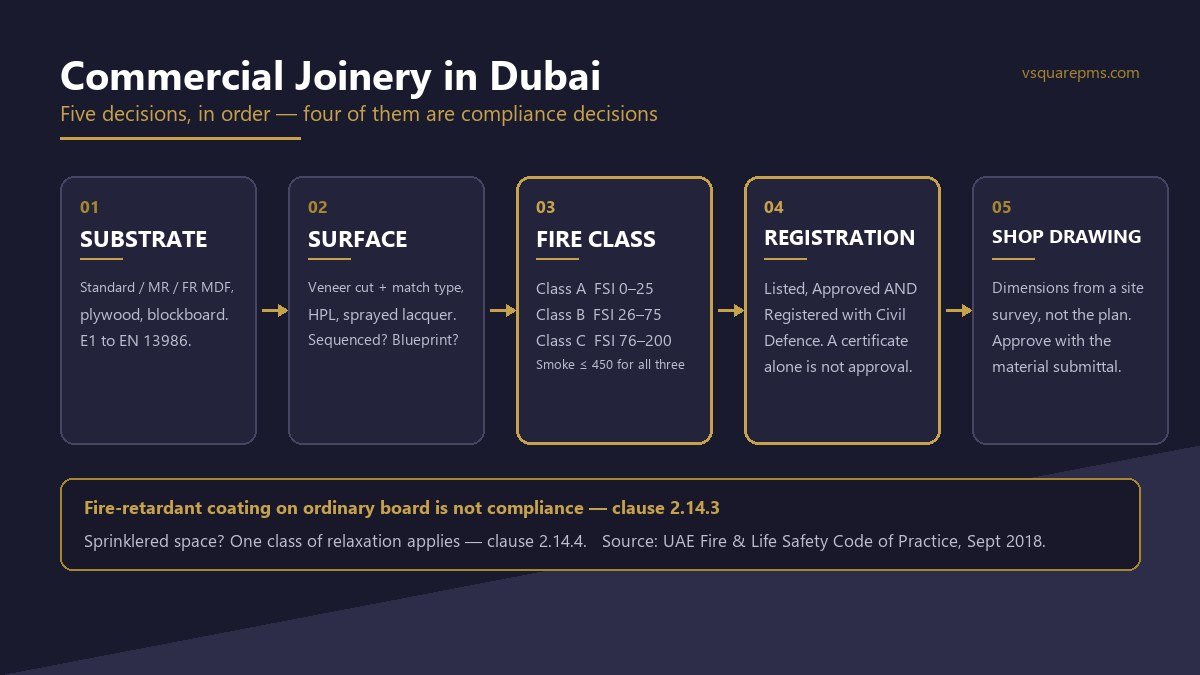
A commercial joinery package is the part of a fit-out that clients feel and inspectors fail. It is the reception desk, the boardroom credenza, the veneered lift-lobby panelling, the retail cash wrap, the restaurant back-bar, the clinic reception counter. It is usually 8–15% of an office fit-out budget and can reach 20% of a hospitality or luxury retail one, and it is nearly always the last package to be approved and the first to delay handover.
Most guidance on the subject is written by joinery factories, and it stops at species and finishes. That is the easy half. The half that costs money on a Dubai project is that a veneered panel screwed to a corridor wall is regulated by Civil Defence in exactly the same way as the wall behind it, and a beautiful sample board with no test certificate behind it is a package that will be rejected at material submittal.
This guide covers what commercial joinery actually costs in Dubai in 2026, how to read a millwork quotation so two bids can be compared, the veneer cuts and matching methods that move the price before the species does, the substrate and grade language a specification needs, and — in detail, with the clause numbers — what the UAE Fire and Life Safety Code of Practice requires of joinery that is fixed to a wall or a ceiling.
What commercial joinery costs in Dubai in 2026
Joinery is priced per linear metre of finished run, measured along the front face, at a stated height and depth. The rate is not a species rate. It is a construction rate: substrate, surface, edge treatment, hardware, finishing, delivery and installation. Change the substrate and the rate moves more than changing oak for walnut does.
| Specification tier | 2026 rate (AED / linear metre) | What it typically means |
|---|---|---|
| Basic laminate casework | 500 – 900 | Particleboard or standard MDF carcass, HPL or melamine faces, PVC edge banding, budget hinges and runners. Storage units, back-of-house, utility rooms. |
| Standard commercial millwork | 900 – 1,600 | MR MDF or plywood carcass, HPL or veneer faces, ABS or lipped edges, branded soft-close hardware. Most office storage walls, tea points, workstation returns. |
| Veneered and lacquered joinery | 1,600 – 2,500 | Sequenced veneer or multi-coat sprayed lacquer, mitred or shadow-gap edges, concealed fixings, adjustable levelling. Boardrooms, reception areas, executive offices. |
| Premium / feature joinery | 2,500 – 3,500+ | Handleless push-to-open or J-profile, book-matched flitch, curved or CNC-formed fronts, integrated lighting, solid-surface or stone tops, metal inlay. |
| Bespoke feature elements | Priced per item | Reception desks, back-bars, retail cash wraps, display joinery with integrated MEP. Linear-metre rates do not apply. |
These are market bands for Dubai and the Northern Emirates in 2026, drawn from live tenders rather than a published tariff — there is no official rate card for joinery in the UAE, and any figure presented as one should be treated with suspicion. Our office interior design cost breakdown carries the same band inside a full AED-per-square-foot budget, and the UAE office fit-out cost guide shows where it sits against MEP, ceilings and flooring.
Where the rate goes in a commercial fit-out budget
As a share of construction value, joinery lands roughly where the interior earns its money. In a Category B office it is commonly 8–12%. In a showroom or a restaurant it is routinely 15–20%, because the joinery is the design. If your joinery package is coming back at 25% of the build cost, the design is carrying more bespoke work than the budget was written for, and that is a design conversation, not a procurement one.
The linear-metre rate hides four things, and every one of them is a variation
A quotation that reads “joinery — 42 lm @ AED 1,450 = AED 60,900” is not a quotation. It is a number. Four items sit outside almost every per-metre rate in the UAE market, and each one arrives later as a variation if it was not asked about first.
- Worktops and counters. Solid surface, quartz, sintered stone and timber tops are separate. So is the templating visit, which cannot happen until the carcass is installed — a sequencing fact that catches out more programmes than any other.
- Integrated MEP. Power and data grommets, cable management, under-counter sockets, LED strips and their drivers, sinks and wastes in a tea point. The joiner cuts the aperture; someone else must be contracted to terminate it. Our MEP co-ordination guide covers where that hand-off usually fails.
- Site preparation and backing. Wall-hung units, tall panelling and cantilevered reception counters need structural backing built into the partition before it is closed. If the gypsum partition is already boarded and skimmed, adding backing is demolition.
- Fire test certification and material registration. Covered in detail below. A supplier who has never been asked for a certificate does not have one, and obtaining it for a board already in the workshop is not always possible.
Insist that a bid separates carcass, fronts, tops, hardware, finishing and site works. Two bids that are separated the same way can be compared. Two lump sums cannot — a point we make at more length in the fit-out quotation and BOQ comparison guide.
Reception desks are priced as a project, not per metre
A reception desk is the one piece of joinery that almost never obeys the linear-metre rate, because almost nothing about it is linear. It usually combines a curved or faceted front, a solid-surface or stone transaction top at a different height from the working top, a lower accessible section, integrated lighting, a data and power spine, a lockable back-of-house return, and a brand element in a second material.
| Reception desk type | Indicative 2026 cost (AED) | What drives it |
|---|---|---|
| Straight laminate desk, 2.4 m | 9,000 – 16,000 | HPL faces, standard top, simple cable tray. |
| Veneered desk with solid-surface top, 3 m | 18,000 – 35,000 | Sequenced veneer, thermoformed top, integrated LED, levelling plinth. |
| Curved or faceted feature desk, 4 m+ | 40,000 – 120,000+ | CNC-formed substrate, seamless solid surface, metal or stone inlay, back-lit brand panel, structural steel sub-frame. |
Two things reliably blow this budget. The first is a curve: any radius forces a formed substrate and a thermoformed or seamed top, and the labour is several times a flat equivalent. The second is a fully accessible section — a lowered counter run with knee clearance is not a cosmetic change, it changes the structure of the desk. Decide both at concept stage. Our corporate lobby and reception design guide covers the space around the desk; this is about the desk itself.
Your wall panelling is not furniture — the UAE Fire Code calls it interior finish
This is the single most consequential thing a client, a designer or a joinery factory can get wrong on a Dubai commercial project, and it is almost never mentioned in joinery marketing.
The UAE Fire and Life Safety Code of Practice (September 2018 edition, reference CDGH-OP-25, published by the Directorate General of Civil Defence) draws a line between interior finish, which is regulated, and decorations and furnishings, which are regulated differently. Chapter 1 puts fixed joinery firmly on the regulated side. In the code’s own words, fixed or movable walls and partitions, panelling, and wall pads applied structurally or for decoration, acoustical correction or surface insulation “shall be considered interior finish and shall not be considered decorations or furnishings.”
The practical consequence: a veneered feature wall in a lift lobby, an acoustic slat panel in a meeting room, a timber-lined corridor and a full-height joinery storage wall are all interior finish. They must carry a surface-burning classification appropriate to where they are installed. A free-standing credenza that is not fixed to the building is not caught by the same clause. The moment it is screwed to the wall, it is.
Class A, B and C: the actual numbers, and where each is allowed
The code classifies interior wall and ceiling finish by flame spread index and smoke developed index, measured to ASTM E 84 or UL 723. The definitions are exact and worth memorising, because suppliers quote them loosely.
| Classification | Flame spread index | Smoke developed index |
|---|---|---|
| Class A | 0 – 25 | 0 – 450 |
| Class B | 26 – 75 | 0 – 450 |
| Class C | 76 – 200 | 0 – 450 |
Note that the smoke limit is the same for all three. A material can fail on smoke alone while passing on flame spread, and untreated timber veneers on a combustible substrate frequently do. When a supplier says “it is Class A”, the correct reply is “send me the flame spread index, the smoke developed index, the test standard and the laboratory”.
The code also recognises the British and European classification families, and a Dubai project will see all three in one submittal folder:
- BS 476 Part 7 Class 1 — surface spread of flame, the best of four levels in that standard. Class 0 is a Class 1 product that additionally achieves a fire propagation index of not more than 12 and a sub-index of not more than 6 to BS 476 Part 6.
- EN 13501-1 Class B-s1,d0 or B-s2,d0 (or DIN 4102 B1) — materials that are difficult to ignite and self-extinguish when the source is removed. The code explicitly names fire-retardant-treated wood in this group.
- EN 13501-1 Class A2-s2,d0 (or DIN 4102 A2) — non-combustible with combustible organic components; gypsum boards and mineral wool sit here.
Which class you need is set by Table 1.12 of Chapter 1, which is indexed by occupancy and by location. The columns are exits, corridors, other spaces, ceilings and flooring, and the occupancies are grouped: assembly, education, healthcare, residential, hotel and day care in one group; business, detention and mercantile in another; private and commercial villa in a third; industrial and storage in a fourth.
The pattern that matters for joinery is consistent across every group: escape routes are the tightest. Panelling in an exit or an exit-access corridor is held to a higher class than the same panelling in an office you can walk out of. Ceilings are held tighter than walls. That is why the corridor veneer is the item that gets rejected while the identical veneer inside the boardroom passes — and why a designer who specifies one panel product for the whole floor plate has to specify it to the corridor requirement, not the average one.
Sprinklers change the class you are allowed to use
There is a concession most joinery suppliers do not know exists, and it can materially widen the palette on a project. Clause 2.14.4 provides that where an approved automatic sprinkler system is provided, Class C interior wall and ceiling finish is permitted in any location where Class B is required, and Class B is permitted in any location where Class A is required.
In plain terms: a sprinklered Dubai office floor can very often accept a veneered panel that would be refused in an unsprinklered one. This is a real and legitimate relaxation written into the code, and it is worth confirming the sprinkler status of the demise before you conclude a finish is unbuildable. It is also worth confirming it in writing, because a fit-out that removes or defers sprinkler coverage removes the concession with it.
Fire-retardant lacquer will not get your veneer past Civil Defence
This is the most common and most expensive misconception in the Dubai joinery market, and the code addresses it directly.
Clause 2.14.3 states that external fire-retardant coatings applied to achieve the Table 1.12 ratings are not acceptable unless the building is an existing one, and that materials have to achieve the required ratings through the tests listed in Section 7 of the chapter. The 2011 edition was blunter still: fire-retardant coatings “shall not be used to obtain compliance with the interior finish requirements of this Code.”
What that kills, in practice, is the workshop habit of building panelling from ordinary MDF and then spraying an intumescent or FR topcoat over it to satisfy an inspector. The rating has to be a property of the tested assembly — the board, the adhesive, the veneer or laminate and the finish, tested together in the configuration in which it will be installed — not a coating added at the end.
The compliant route is fire-rated board: FR-grade MDF or FR plywood, typically supplied with the retardant impregnated through the panel, faced and finished by a factory that holds test evidence for that build-up. It costs more per sheet than standard MDF. It costs far less than stripping out an installed corridor.
Where the assembly is tested, not the ingredient
Section 7.1.4 of Chapter 1 lists the test standards Civil Defence accepts for interior wall and ceiling finish materials, and it is a long list: ASTM E 119, UL 723, FM 4880, NFPA 286, UL 1715, EN 13823, EN-ISO 11925-2, EN-ISO 1182, EN-ISO 1716, EN 13501-1, EN 1364-2 and BS 476 Parts 6 and 7. Two points follow from it. First, a European certificate is as acceptable as an American one — you do not need to re-test to ASTM if you hold a valid EN 13501-1 classification. Second, the code notes deliberately that no edition year is given against any standard, because the intent is that the latest edition applies as and when it is revised. A certificate issued against a superseded version of a test standard is a problem waiting at submittal.
The material must be registered, not merely certified
A test certificate on its own is not approval. Clause 7.1.1 of Chapter 1 requires that all materials, components, systems, assemblies, equipment, products and accessories referred to in the chapter “shall be Listed, Approved and Registered by the Civil Defence Material Approval Department.” The 2011 wording added the point explicitly: this applies to products with or without international listing, registration or approval.
So a panel product carrying a UL or EN certificate from its manufacturer is still not compliant in the UAE until it is registered here. On a live project, this is the question to ask a joinery supplier at tender: not “is your board fire rated?” but “is the board registered with Civil Defence, and can you send me the registration reference alongside the test report?”
The same chapter also defines the contractor who is allowed to do this work. A fit-out contractor — the code calls it a “décor company” — is an organisation registered by the individual emirate’s Civil Defence, authorised and responsible to design and execute fit-out work under formal approval and permit from the municipality and Civil Defence. It is a licensing category, not a job title. If your joinery is being installed under a fit-out permit, the entity holding that permit needs the registration.
For how that fits into the wider approval sequence, see our guides to the DM, DCD and Trakhees fit-out permit routes, the DDA fit-out approval process for TECOM districts, and the Civil Defence inspection checklist, which lists the failures that most often send a fit-out back for a second visit.
Substrate: what the joinery is actually made of
Everything above the substrate is visible and everything below it is structural. In a Dubai commercial interior, cycling between ambient humidity and hard air conditioning, the substrate decision is also a durability decision.
| Substrate | Typical commercial use | Behaviour and limits |
|---|---|---|
| Standard MDF | Painted and lacquered fronts, dry decorative panelling | Machines to a flawless face; the best board for spray finishes. Swells irreversibly on water contact and holds screws poorly at edges. |
| Moisture-resistant (MR) MDF | Tea points, washroom vanities, humid zones | Resists humid air, not standing water. Frequently mis-sold as “waterproof MDF”, which does not exist. |
| Fire-rated (FR) MDF / FR plywood | Panelling in corridors, lobbies, escape routes | The compliant route to a Class A or Class B assembly. Specify by tested build-up, not by board alone. |
| Plywood (BB/WBP, marine) | Carcasses, structural gables, wall-hung units | Best screw holding and dimensional stability; the correct board where the unit carries load or hangs off a wall. |
| Blockboard | Long shelves, door cores, wide spans | Light and stiff for its depth, resists sag better than MDF. Edge treatment is critical — the core shows. |
| Particleboard / melamine faced | Back-of-house storage, budget casework | Cheapest option and the least tolerant of moisture or repeated re-fixing. Acceptable where nothing is seen and nothing is loaded. |
Two specification lines belong in every commercial joinery scope alongside the board name. The first is formaldehyde emission class: E1 to EN 13986 is the standard interior requirement and covers most commercial carcass, shelving and panelling work, with E0 available where a green-building rating or a client wellbeing standard asks for it. The second is edge sealing — confirmation that all machined edges, bores and cut-outs are sealed before assembly. Water and humidity enter a panel through an unsealed machined edge far more often than through the face, which is the same failure mode we set out in the bathroom vanity joinery guide.
Veneer cuts change the price before the species does
Clients choose a species. Specifications choose a cut. The cut determines how much of a log yields usable leaves, and that is what moves the rate.
| Cut | Appearance | Cost and practical note |
|---|---|---|
| Rotary cut | Wide, variegated, unrepeating grain | Cheapest. Peels the log continuously, so it yields very wide leaves — useful for large single-piece faces, difficult to match panel to panel. |
| Plain / crown cut | The classic cathedral or flame arch | The commercial default. Consecutive leaves match well and it is the most widely stocked. |
| Quarter cut | Straight, even, linear grain | Growth rings run perpendicular to the blade; leaves are narrower, so more joints per panel. Premium look, higher rate. |
| Rift cut | Tight straight grain with minimal ray fleck | Specified mainly for oak, where quarter cutting exposes medullary ray figure some schemes do not want. The most wasteful cut, and priced accordingly. |
Two commercial habits are worth adopting. Order the whole package from one flitch — a single log — where the panels will be seen together, because two flitches of the same species will not match. And order the flitch early: veneer lead time sits in front of the joinery programme, not inside it.
Matching is where the money actually goes
Matching is how adjacent leaves are joined, and it is a bigger cost driver than the species on most feature walls.
- Book match. Every second leaf is turned over, like opening a book, producing a mirror image at each joint. The most common commercial match. Because alternate leaves present their opposite face, the two can take stain slightly differently — the “barber pole” effect that shows under raking light.
- Slip match. Leaves are laid in sequence without turning any over. The grain repeats across the panel and no mirror line appears. Preferred for quarter and rift cuts, and it avoids barber poling entirely.
- Random match. Leaves deliberately mixed for a plank-like, non-repeating look. Cheaper on material, harder to control aesthetically.
- Sequence matching across panels. Panels numbered and installed in flitch order along a wall, so grain runs continuously through the run. This is what makes a boardroom wall read as one surface, and it is the line clients most often assume is included when it is not.
- Blueprint matching. Every panel manufactured to its exact installed dimension, so the sequence survives door openings, switch plates and returns. The most expensive option, and the only one that genuinely guarantees the finished wall.
Veneer, HPL, lacquer or foil — choose on the wear cycle
| Surface | Best for | Weakness |
|---|---|---|
| Natural veneer | Reception, boardroom, executive — anywhere the material is the point | Every panel is different; needs sequencing, and repairs rarely match. UV will shift the colour of a lobby wall in a year. |
| High-pressure laminate (HPL) | High-traffic public areas, retail, education, healthcare | Repeatable, tough and easy to replace, but visible dark edges unless post-formed or edged in a matching lipping. |
| Sprayed lacquer / PU | Handleless fronts, curves, brand-colour work | The most flawless flat face available and the least tolerant of impact. Site damage means re-spraying a panel, not touching it in. |
| Melamine / foil | Back-of-house, internal carcass faces | Cheapest and thinnest; edges chip and it cannot be refinished. |
| Fenix, acrylic and solid surface faces | Fingerprint-critical or seamless work | Higher rate, longer lead time, and each has a specific cleaning regime that has to reach the facilities team. |
The decision is made on the wear cycle, not the render. A veneered lift-lobby panel in a building with a trolley route past it will look worse in eighteen months than an HPL panel chosen for the same location and specified in a convincing woodgrain. Match the material to the abuse it will take.
Grade: what “Custom” and “Premium” actually commit a supplier to
The grading language that Gulf consultants most commonly write into joinery specifications comes from the Architectural Woodwork Standards, which set three levels — Economy, Custom and Premium. They are not marketing words. Each grade fixes permitted materials, appearance, joinery detailing, finish quality and, importantly, fabrication and installation tolerances.
- Economy is the lowest level: the minimum expectation is work suitable to be sanded and painted unless the architect specifies otherwise.
- Custom is the default grade and covers most good commercial architectural woodwork — above Economy in materials and appearance, below Premium.
- Premium is specified where the highest level of materials, workmanship and installation is required, and is normally reserved for the areas that carry the scheme.
These are American standards and they are not UAE law. What they give a Dubai project is a shared, defined vocabulary, so that “Premium grade to AWS, Custom grade elsewhere” means something specific and testable rather than being an adjective. Write the grade against each area of the joinery schedule. It costs nothing at specification stage and it is the only workable basis for rejecting substandard work later.
Edges and hardware: the two lines that separate a real quote from a cheap one
Edge treatment is the most reliable tell of joinery quality and the easiest thing to value-engineer out silently. A 0.4 mm PVC edge and a 2 mm ABS edge look similar in a photograph and behave completely differently under a vacuum cleaner. Laser-edged and glue-line-free edges cost more again and remove the visible dark line entirely. Mitred and shadow-gap details are joinery, not edging, and are priced as such.
On hardware, the specification needs a brand, a series and a finish — not “soft-close hinges”. Ask for the cycle rating on drawer runners in any location that is opened dozens of times a day: a reception drawer, a clinic reception counter, a retail cash wrap. Concealed hinges, push-to-open catches and undermount runners are where a low per-metre rate is quietly recovered.
Shop drawings are the contract
The joinery shop drawing is the document the piece is actually built from. It supersedes the design drawing, and once it is signed, changes are variations. Reviewing it properly is the highest-leverage hour anyone spends on a joinery package.
- Dimensions taken from a site survey, not from the architectural plan. Dubai partitions are rarely square; a joinery run built to plan dimensions arrives with a 15 mm gap at one end.
- Scribes and filler pieces shown explicitly, at every junction with a wall, column, ceiling or floor.
- Board schedule per element — substrate, thickness, face material, edge treatment, and fire class where the element is interior finish.
- Fixing details — what the unit is fixed to, and confirmation that the backing exists in the partition build-up.
- Service cut-outs co-ordinated against the MEP drawings, with grommet positions and cable routes shown.
- Setting-out for finished floor level, so plinth heights work with the flooring build-up that is actually being installed.
Approve the shop drawing and the material submittal together. Approving a drawing while the board specification is still open is how a compliant design becomes a non-compliant installation.
Lead times, and the sequencing mistake that costs three weeks
| Stage | Typical duration | Note |
|---|---|---|
| Survey and shop drawings | 1 – 2 weeks | Cannot start until partitions are set out on site. |
| Drawing and sample approval | 1 – 2 weeks | The stage clients most often underestimate. Two review cycles is normal. |
| Material procurement | 1 – 4 weeks | Stock HPL is days. A specific veneer flitch or an imported hardware series is weeks. |
| Workshop production | 2 – 4 weeks | Longer for sprayed lacquer, which needs coat and cure cycles. |
| Installation | 3 days – 2 weeks | Depends on access, lift bookings and how many other trades are on the floor. |
| Stone / solid-surface top templating and fit | +1 – 2 weeks after carcass install | Sequential. It cannot be compressed by ordering earlier. |
The sequencing mistake is templating. Worktops are templated from the installed carcass, not from the drawing, so the top always lands one to two weeks after the joinery. Programmes that show joinery and worktops finishing in the same week are wrong on the day they are issued, and the fix is to pull the joinery install forward, not to promise the templating team a shorter turnaround. Our UAE office fit-out timeline guide shows where that sits against the rest of the programme, and the fit-out project management guide covers the stage gates around it.
What a compliant commercial joinery submittal contains
If you take one checklist from this guide into a tender, take this one. A joinery package that answers all ten points can be approved and compared. One that answers four cannot.
- Substrate named per element, with thickness — and fire-rated grade stated wherever the element is fixed panelling.
- Surface material with manufacturer reference: veneer species and cut, HPL decor code, or lacquer colour and sheen.
- Veneer match type, whether it is sequenced across the run, and whether panels are blueprint matched.
- Fire test certificate for the assembly, naming the test standard, the laboratory and the measured flame spread and smoke indices.
- Civil Defence material registration reference for that product.
- Formaldehyde emission class to EN 13986 — E1 as the baseline.
- Edge treatment type and thickness, with confirmation that machined edges are sealed before assembly.
- Hardware brand, series, finish and cycle rating.
- Grade per area against a named standard, with tolerances.
- Programme split into survey, approval, procurement, production, installation and top templating.
Every line on that list is a question a supplier can answer in a sentence, and every one of them is a variation or a rejection if it is left open. The compliance lines — four, five and six — are the ones that cannot be resolved retrospectively. They also sit alongside the other certificated element most fit-outs get wrong, covered in our fire-rated door installation guide.
What the joinery market gets wrong
- “Waterproof MDF.” It does not exist. MR MDF resists humid air, not water contact.
- “We will spray it with fire-retardant paint.” Clause 2.14.3 rules this out for new work. The rating belongs to the tested assembly.
- “It has a UL certificate, so it is approved.” Certification and UAE registration are two different things, and the code says so explicitly.
- “Joinery is furniture, so the fire code does not apply.” Fixed panelling is interior finish under Chapter 1. Loose furniture is not.
- “Book-matched” meaning a continuous wall. It does not, unless sequencing is specified as well.
- A single rate for the whole package. Reception desks, curved work and integrated MEP are not linear-metre items.
None of this is exotic. It is the difference between a joinery package specified by someone who has watched one fail a municipality inspection and one specified from a mood board. If you are still selecting the team that will write the specification, our guide to choosing an interior designer in Dubai covers what to ask for.
Specify the joinery before you price it
V Square writes the joinery specification, sets the substrate and fire-class schedule against the space it is going into, checks material registration before the submittal is made, reviews shop drawings against a site survey, and sequences worktop templating into the programme — so the package you approved on paper is the package that passes inspection.
See V Square in action →Frequently Asked Questions
How much does commercial joinery cost per linear metre in Dubai in 2026?
Commercial joinery in Dubai is quoted per linear metre of finished run, and the 2026 market bands are roughly AED 500 to AED 900 per linear metre for basic laminate casework, AED 900 to AED 1,600 for standard commercial millwork, AED 1,600 to AED 2,500 for veneered or lacquered joinery, and AED 2,500 to AED 3,500 and above for premium handleless, curved or book-matched work. Those rates cover the cabinet only. Worktops, integrated power and data, site backing and fire test certification sit outside almost every per-metre rate in the UAE market and should be priced as separate lines. Feature items such as reception desks, back-bars and retail cash wraps are quoted per item rather than per metre, because almost nothing about them is linear.
Does wall panelling need a fire rating in Dubai?
Yes, when it is fixed to the building. The UAE Fire and Life Safety Code of Practice states that fixed or movable walls and partitions, panelling and wall pads applied structurally or for decoration, acoustical correction or surface insulation shall be considered interior finish and shall not be considered decorations or furnishings. That places veneered feature walls, acoustic slat panels, timber-lined corridors and full-height joinery storage walls in the same regulatory category as the wall behind them, so each must carry a surface-burning classification appropriate to its location. Loose furniture that is not fixed to the building fabric is treated differently. The practical test is whether the item is fixed to the building and covers a wall or ceiling surface.
What are the Class A, B and C fire ratings for interior finishes in the UAE?
The UAE Fire and Life Safety Code of Practice classifies interior wall and ceiling finish by flame spread index and smoke developed index measured to ASTM E 84 or UL 723. Class A is a flame spread of 0 to 25 with smoke development of 0 to 450. Class B is a flame spread of 26 to 75 with the same smoke limit of 0 to 450. Class C is a flame spread of 76 to 200, again with smoke development of 0 to 450. Because the smoke limit is identical across all three classes, a material can pass on flame spread and still fail on smoke, which untreated timber veneers on combustible substrates frequently do. The code also recognises BS 476 Part 7 Class 1 and Class 0, and the EN 13501-1 classifications B-s1,d0, B-s2,d0 and A2-s2,d0.
Can fire-retardant paint be used to make joinery compliant in Dubai?
No, not for new work. Clause 2.14.3 of Chapter 1 of the September 2018 UAE Fire and Life Safety Code of Practice states that external fire-retardant coatings applied to achieve the Table 1.12 ratings are not acceptable unless the building is an existing one, and that materials have to achieve those ratings through the tests listed in Section 7 of the chapter. The 2011 edition put it even more plainly: fire-retardant coatings shall not be used to obtain compliance with the interior finish requirements of the code. The compliant route is fire-rated board — FR-grade MDF or FR plywood with the retardant through the panel — faced and finished by a factory that holds test evidence for that complete build-up, because the rating belongs to the tested assembly rather than to a coating added at the end.
Do sprinklers change the fire class of finishes I can use?
Yes. Clause 2.14.4 of the UAE Fire and Life Safety Code of Practice provides that where an approved automatic sprinkler system is provided, Class C interior wall and ceiling finish materials are permitted in any location where Class B is required, and Class B materials are permitted in any location where Class A is required. For a joinery package this is a genuine and often overlooked relaxation: a sprinklered Dubai office floor can frequently accept a veneered panel that would be refused in an unsprinklered demise. It is worth confirming the sprinkler status of the space in writing before concluding that a finish is unbuildable, and worth remembering that a fit-out which removes or defers sprinkler coverage also removes the concession that came with it.
Is a UL or EN fire certificate enough for joinery materials in the UAE?
A certificate alone is not approval. Clause 7.1.1 requires that all materials, components, systems, assemblies, equipment, products and accessories referred to in the chapter shall be Listed, Approved and Registered by the Civil Defence Material Approval Department, and the 2011 edition made explicit that this applies to products with or without international listing, registration or approval. So a board carrying a valid UL or EN 13501-1 certificate from its manufacturer still has to be registered in the UAE before it is compliant here. The question to put to a joinery supplier at tender is not whether the board is fire rated but whether it is registered with Civil Defence, and whether they can produce the registration reference alongside the test report. The code also notes that no edition year is given against any test standard, because the latest edition is intended to apply.
What is the difference between book matching and slip matching veneer?
Book matching turns over every second leaf, like opening the pages of a book, so the grain mirrors at each joint. It is the most common commercial match, and because alternate leaves present their opposite face they can take stain slightly differently, producing the light and dark banding known as barber poling under raking light. Slip matching lays leaves in sequence without turning any of them over, so the grain figure repeats across the panel with no mirror line and no barber poling — it is generally preferred for quarter and rift cuts. Neither term on its own commits a supplier to a continuous wall. For that you also need sequence matching across panels, or blueprint matching, where every panel is made to its exact installed dimension.
Which board should a commercial joinery carcass be made from in Dubai?
It depends on what the unit does. Plywood in a WBP or marine grade is the correct carcass board where the unit carries load or hangs off a wall, because it holds screws best and is the most dimensionally stable. Standard MDF is the right board for sprayed and lacquered fronts, since it machines to a face plywood cannot match, but it swells irreversibly on water contact. Moisture-resistant MDF suits tea points and humid zones, though it resists humid air rather than standing water and is routinely mis-sold as waterproof MDF, which does not exist. Fire-rated MDF or plywood is required wherever the element is fixed panelling regulated as interior finish. Whichever board is chosen, specify the formaldehyde emission class — E1 to EN 13986 is the normal commercial baseline — and require that all machined edges are sealed before assembly.